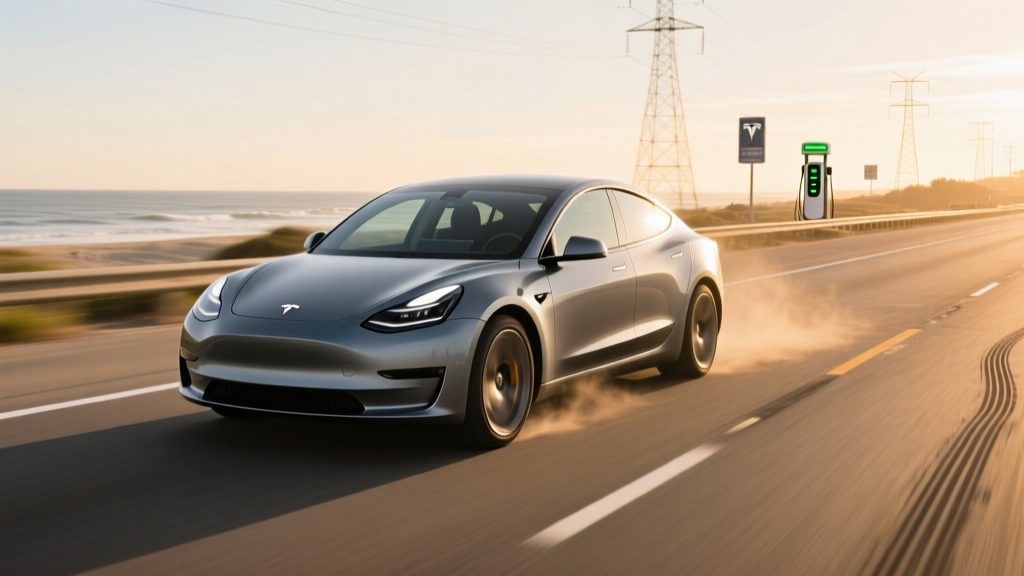
The Tesla Model 3 Rear-Wheel Drive remains the entry point into Tesla's lineup and one of the most affordable premium electric sedans on the market. For buyers researching the Model 3 RWD 0-60 time, charging speeds, and whether the base trim delivers enough range for daily life, this review breaks down every number that matters — from the LFP battery chemistry to real-world highway efficiency.
Updated for the current-generation "Highland" refresh, the Model 3 RWD trades the older 2170 NMC cells for a lithium iron phosphate (LFP) pack, gains a quieter cabin, and keeps Tesla's software ecosystem intact. It's a compelling package — but not without trade-offs that spec-sheet shoppers should understand before signing.
Quick Verdict: Who the Model 3 RWD Is For
The Model 3 RWD is best suited for daily commuters and urban/suburban drivers who have access to home Level 2 charging and want a tech-forward sedan with strong efficiency. It's not a road-trip champion compared to the Long Range AWD variant, and the single-motor layout means no snow-belt traction advantage. If your commute is under 80 miles round-trip and you value low running costs over all-weather capability, the RWD trim is the value pick.
Tesla Model 3 RWD Specs at a Glance
| Spec | Value |
|---|---|
| EPA Range | 272 miles |
| Battery (usable) | ~57.5 kWh, LFP chemistry |
| Drivetrain | Single motor, Rear-Wheel Drive |
| Horsepower | 271 hp |
| 0-60 mph | 5.8 seconds |
| Top Speed | 125 mph |
| MPGe (combined) | 132 MPGe |
| Efficiency | 25 kWh / 100 mi |
| Max DC Fast Charge | 170 kW peak |
| 10-80% DCFC Time | ~25 minutes |
| Level 2 Charge Rate | 11.5 kW (~44 mi/hr) |
| Cargo Volume | 23 cu ft (trunk + frunk combined) |
| Base MSRP | $38,990 (before destination) |
| Battery Warranty | 8 years / 100,000 miles |
Sources: EPA / fueleconomy.gov, Tesla Model 3 specs.
Range & Efficiency: EPA vs. Real World
The Model 3 RWD achieves its 132 MPGe combined rating through a combination of low curb weight (~3,862 lbs), excellent aerodynamics (0.219 Cd), and Tesla's heat pump, which dramatically reduces cabin-heating energy draw compared to resistive heaters. Efficiency of 25 kWh per 100 miles puts it among the most efficient EVs in its class — meaning you spend less per mile at any charger.
For a 40-mile round-trip commute, the RWD requires roughly 10 kWh of energy per day — easily replenished overnight on a Level 2 home charger. Drivers with longer commutes or frequent highway trips should consider the Long Range AWD (363 miles EPA) for the additional buffer.
Charging Speed: DC Fast & Home Level 2
| Charging Level | Power | Miles Added per Hour | Notes |
|---|---|---|---|
| Level 1 (120V outlet) | ~1.4 kW | ~5-6 mi/hr | Emergency/top-up only |
| Level 2 (240V, 48A) | 11.5 kW | ~44 mi/hr | Full charge in ~6 hours |
| DC Fast Charge | 170 kW peak | ~175 mi in 15 min | 10-80% in ~25 min |
The Model 3 RWD's LFP battery charges at a peak of 170 kW on DC fast chargers — slower than the Long Range's 250 kW peak. However, LFP chemistry offers a practical advantage: Tesla recommends charging to 100% regularly, unlike NMC batteries where daily 80% limits are suggested for longevity. This means your usable daily range on the RWD is effectively the full 272 miles, not a derated 80% figure.
The charging curve on the RWD holds strong through 50% SoC before tapering. From 10-80%, expect roughly 25 minutes at a V3 Supercharger (250 kW capable) or comparable CCS station with a NACS adapter. Above 80%, the curve slows significantly — plan to unplug at 80% on road trips for optimal time efficiency.
At home on a 48-amp Level 2 circuit (such as the Tesla Wall Connector), the RWD adds about 44 miles of range per hour. A full 0-100% charge takes approximately 6 hours, meaning overnight charging easily covers any daily driving needs.
Performance: Model 3 RWD 0-60 and Driving Dynamics
The Model 3 RWD 0-60 mph time of 5.8 seconds places it in warm-territory — quicker than most gas-powered compact sedans but noticeably behind the Long Range AWD (4.2 seconds) and the Performance variant (2.9 seconds). The single rear motor produces 271 horsepower and delivers instant torque from a stop, making it feel punchy in city driving and highway merging.
The Highland refresh brought meaningful improvements to ride quality. Tesla retuned the suspension, added acoustic glass, and improved isolation, making the cabin noticeably quieter than the pre-2024 Model 3. Steering remains quick and precise, though the lack of a physical instrument cluster and stalk-mounted turn signals (now on the steering wheel) continues to divide owners.
Rear-wheel drive means the RWD is less capable in snow and ice than AWD competitors. Winter tire upgrades are strongly recommended for cold-climate buyers. The low center of gravity from the floor-mounted battery pack provides confident cornering regardless of drivetrain.
Pricing, Trims & Federal Tax Credit Eligibility
| Trim | MSRP (incl. destination) | Est. After §30D Credit |
|---|---|---|
| RWD | $39,990 | ~$32,490* |
| Long Range AWD | $47,990 | ~$40,490* |
| Long Range RWD | $44,990 | ~$37,490* |
| Performance | $54,990 | ~$47,490* |
*Assumes full $7,500 §30D credit eligibility. Actual credit depends on buyer income, battery sourcing, and point-of-sale transfer rules. See IRS.gov §30D guidelines.
The Model 3 RWD's MSRP of $39,990 (including $1,000 destination) sits well below the $55,000 sedan cap for the federal EV tax credit. However, eligibility for the full $7,500 depends on three factors:
- Buyer income caps: Modified AGI must not exceed $150,000 (single), $225,000 (head of household), or $300,000 (joint).
- Battery sourcing: Critical minerals and battery components must meet phased-in thresholds from US or FTA-partner supply chains.
- Point-of-sale transfer: Since 2024, buyers can transfer the credit to the dealer for an immediate price reduction at purchase.
Tesla's battery sourcing has evolved significantly. The RWD's CATL-supplied LFP cells are manufactured in China, which has faced scrutiny under the Foreign Entity of Concern (FEOC) rules. Buyers should verify current credit eligibility on Tesla's website or with a tax professional before relying on the full $7,500 reduction — partial credits ($3,750) may apply depending on model year and production batch.
Interior, Tech & Daily Usability
The Model 3 cabin is minimalist by design — a 15.4-inch center touchscreen handles all vehicle controls, navigation, media, and climate. The Highland refresh added ventilated front seats, ambient lighting, rear-seat ventilation controls via an 8-inch screen, and power-folding mirrors.
Passenger space remains adequate for four adults: 42.2 inches of front legroom and 35.3 inches rear. The rear seat is tight for taller passengers on longer trips. Cargo space totals 23 cubic feet across the trunk (22 cu ft) and front trunk/frunk (1 cu ft), sufficient for a week's groceries or two carry-on bags.
Driver assistance: Basic Autopilot (Traffic-Aware Cruise Control and Autosteer) is standard. Enhanced Autopilot ($6,000) and Full Self-Driving (Supervised) ($8,000) are optional. Note: FSD remains an SAE Level 2 system requiring active driver supervision — it is not autonomous driving.
Pros & Cons
Pros
- Best-in-class efficiency (25 kWh/100 mi)
- LFP battery allows daily 100% charging
- Supercharger network access (NACS native)
- Strong resale value and OTA updates
- Quieter, more refined Highland cabin
- Low starting price for a premium EV
Cons
- 170 kW peak DC charging is slower than rivals
- RWD only — limited snow/ice traction
- 272-mile range tight for long road trips
- Turn signals on steering wheel (no stalks)
- No Apple CarPlay / Android Auto
- FSD tax-credit eligibility uncertain (LFP sourcing)
Warranty & Long-Term Ownership
Tesla covers the Model 3 RWD's battery and drive unit for 8 years or 100,000 miles, whichever comes first, with a minimum 70% capacity retention guarantee. The vehicle limited warranty runs 4 years / 50,000 miles.
LFP chemistry offers a longevity advantage: LFP cells typically endure 3,000+ full charge cycles with minimal degradation, compared to ~1,000-2,000 for NMC. In practical terms, the RWD's battery is likely to outlast the car's ownership life under normal use. Real-world data from high-mileage Teslas shows 10-15% degradation at 100,000 miles for LFP packs — well within warranty thresholds.
Insurance costs for the Model 3 tend to run 15-25% higher than comparable gas sedans due to repair costs and parts pricing. Buyers should obtain insurance quotes before purchasing to factor into total cost of ownership.
Model 3 RWD vs. Key Competitors
Against the Hyundai Ioniq 6 SE (360-mile range, 800V charging at 350 kW), the Model 3 RWD gives up range and charging speed but wins on Supercharger network access, software polish, and efficiency. The BMW i4 eDrive35 starts higher (~$52,000) and offers a more traditional luxury interior but less range (307 miles). The Polestar 2 single-motor (276 miles EPA) is a close rival but charges slower and lacks Tesla's charging infrastructure.
The Model 3 RWD's strongest competitive advantage remains the Tesla Supercharger network — over 20,000 stalls in North America with unmatched reliability. While NACS adapters now give rival EVs access, native NACS integration means no adapter hassle and optimal charge preconditioning.
Frequently Asked Questions
What is the real-world range of the Tesla Model 3 RWD?
Expect 230-250 miles on the highway in moderate temperatures, and 280+ miles in city driving with regen braking. In freezing weather, plan for 190-210 miles. The EPA rates it at 272 miles.
How fast does the Model 3 RWD charge at home and on DC fast chargers?
At home on a 48A Level 2 charger, it adds ~44 miles per hour (full charge in ~6 hours). On DC fast chargers, it peaks at 170 kW, reaching 10-80% in about 25 minutes.
Does the Tesla Model 3 RWD qualify for the $7,500 federal tax credit?
It can, but eligibility depends on buyer income (AGI caps), battery critical-mineral sourcing rules, and FEOC compliance. The LFP cells are CATL-sourced, which may limit the credit to $3,750 in some production batches. Verify on IRS.gov and Tesla's site before purchase.
Is the Model 3 RWD worth buying over the Long Range?
If your daily driving is under 80 miles round-trip and you have home charging, the RWD saves $8,000 and delivers excellent efficiency. For frequent road trippers, cold-climate drivers, or those who want AWD traction, the Long Range AWD is worth the premium.
How does the Model 3 RWD 0-60 compare to competitors?
At 5.8 seconds, the Model 3 RWD is quicker than the Hyundai Ioniq 6 SE (6.3s) and BMW i4 eDrive35 (5.5s is comparable). It trails AWD competitors like the Polestar 2 dual-motor (4.1s) but delivers the instant torque feel expected from an EV.