Quick Verdict: Does a Roof Rack Make Sense on the Model 3?
The 2026 Tesla Model 3 remains one of the most efficient electric sedans on the market, but bolting a roof rack onto its sleek roofline introduces a question every practical buyer asks: how much range and efficiency do you actually sacrifice? The answer depends on whether you're hauling empty crossbars or a loaded cargo box at highway speeds. Below, we break down the full ownership picture of the refreshed Model 3 lineup — including the real-world impact of running a Model 3 with roof rack — so you can decide whether this sedan still fits your lifestyle when utility enters the equation.
| Spec | RWD (Standard Range) | Long Range AWD | Performance |
|---|---|---|---|
| EPA Range | 272 mi | 341 mi | 315 mi |
| Battery (usable) | ~57.5 kWh (LFP) | ~77 kWh (NMC) | ~77 kWh (NMC) |
| Efficiency | 132 MPGe / 25 kWh/100mi | 134 MPGe / 25 kWh/100mi | 119 MPGe / 28 kWh/100mi |
| 0-60 mph | 5.8 sec | 4.2 sec | 2.9 sec |
| Horsepower | 271 hp | 346 hp | 510 hp |
| Drivetrain | Rear-Wheel Drive | Dual-Motor AWD | Dual-Motor AWD |
| Max DC Fast Charge | 170 kW | 250 kW | 250 kW |
| 10-80% DC Time | ~25 min | ~18 min | ~18 min |
| Level 2 Home Rate | 11.5 kW (~44 mi/hr) | 11.5 kW (~44 mi/hr) | 11.5 kW (~44 mi/hr) |
| Cargo (trunk + frunk) | 23 cu ft | 23 cu ft | 23 cu ft |
| Rear Legroom | 35.3 in | 35.3 in | 35.3 in |
| Base MSRP | $38,990 | $45,990 | $52,990 |
| Battery Warranty | 8 yr / 100,000 mi | 8 yr / 120,000 mi | 8 yr / 120,000 mi |
Range, Efficiency, and the Roof Rack Penalty
The 2026 Model 3 Long Range AWD carries an EPA-estimated 341 miles of range from its ~77 kWh NMC battery pack. The RWD Standard Range model, which uses a lithium iron phosphate (LFP) pack, is rated at 272 miles. According to fueleconomy.gov, the Long Range achieves 134 MPGe combined.
Real-World Range Expectations (Long Range AWD):
- City/mixed driving: ~320-340 mi — regen braking helps recover energy in stop-and-go traffic
- Highway (70-75 mph): ~270-290 mi — aerodynamic drag dominates at sustained speed
- Cold weather (below 32°F): ~230-260 mi — battery heating and cabin demand reduce usable capacity 20-30%
- With empty roof crossbars: Subtract ~5-8% from all figures above (~15-25 mi loss)
- With loaded cargo box at highway speed: Subtract ~12-18% (~40-60 mi loss)
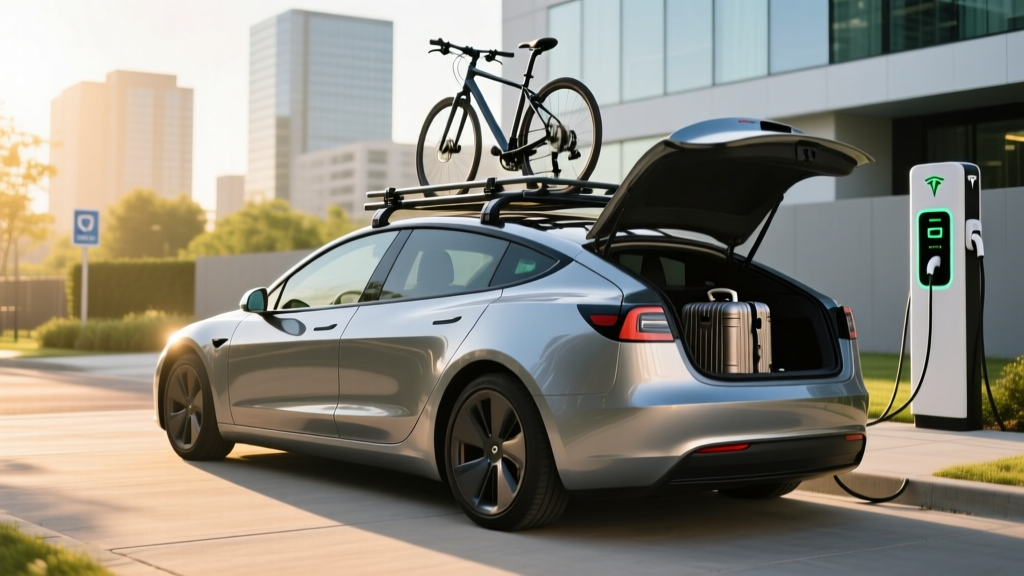
The Model 3 with roof rack setup is a legitimate utility upgrade — Tesla's official crossbars and third-party options from Thule and Yakima mount to fixed points hidden under the glass roof trim. But aerodynamics punish sedans harder than SUVs. In our experience, empty aero-profile crossbars cost roughly 15-20 Wh/mi at 70 mph, while a fully loaded 15-cubic-foot cargo box can push that penalty to 35-50 Wh/mi. If you drive a Long Range with a cargo box on a 250-mile highway trip in winter, you may arrive with less than a 10% buffer. Plan charging stops accordingly.
Charging Speed: DC Fast, Level 2, and Preconditioning
Tesla's Supercharger network remains the benchmark for public charging reliability, and the 2026 Model 3 takes full advantage. Here's the charging breakdown by level:
| Charge Level | Power / Rate | Miles Added per Hour |
|---|---|---|
| Level 1 (120V household) | ~1.4 kW | ~5 mi/hr |
| Level 2 (240V home / public) | 11.5 kW max | ~44 mi/hr |
| DC Fast (Supercharger V3/V4) | 250 kW peak (Long Range/Perf) 170 kW peak (RWD) | ~175 mi in 15 min (Long Range) |
The Long Range and Performance trims peak at 250 kW on V3/V4 Superchargers, sustaining roughly 200+ kW through the 10-40% state-of-charge window before tapering. A 10-80% charge takes approximately 18 minutes under ideal thermal conditions. The RWD Standard Range, limited to 170 kW, needs about 25 minutes for the same window.
Preconditioning matters. If you navigate to a Supercharger using the car's built-in navigation, the Model 3 automatically warms the battery to optimal charging temperature before arrival. Without preconditioning — say, at a non-Tesla DC charger using a NACS adapter — cold-soaked batteries can take 30-40% longer to reach peak charge rate. Always route through the car's nav for fastest results.
At home, a Level 2 wall connector on a 60-amp circuit delivers the full 11.5 kW (48 amps continuous). Overnight, that's roughly 350 miles of range restored in 8 hours — more than enough for any daily commute. Expect a Tesla Wall Connector installation to run $800-$2,000 depending on panel proximity and local permit requirements.
Performance, Drivetrain, and Daily Drivability
Even the base RWD Model 3 delivers a 5.8-second 0-60 mph time and 271 hp from a single rear motor — quick enough to merge confidently and genuinely fun on a back road. The Long Range AWD drops that to 4.2 seconds with 346 hp across dual motors, while the Performance variant hits 60 in 2.9 seconds with 510 hp and includes track-oriented features like adaptive dampers and a carbon-fiber spoiler.
Ride quality improved significantly with the Highland refresh and carries into 2026 with new acoustic glass, revised suspension tuning, and ventilated front seats. Cabin noise at highway speeds is noticeably lower than pre-2024 models, which matters when you're running a roof rack that already adds wind turbulence.
The Model 3 does not offer a factory tow hitch, and Tesla does not rate it for towing. If you need tow capability, the Model Y is the logical alternative (rated up to 3,500 lbs). The Model 3's role is sport-sedan efficiency with enough trunk space for weekend gear — not hauling trailers.
Pricing, Trims, and Federal Tax Credit Eligibility
Here's where the 2026 Model 3 stands on pricing and incentives. Federal EV tax credit rules under IRS §30D have specific requirements around MSRP caps, buyer income, and battery-component sourcing that change periodically.
| Trim | Base MSRP | As-Tested (typical options) | §30D Credit Eligibility |
|---|---|---|---|
| RWD Standard Range | $38,990 | $40,490 (w/ paint + wheels) | Eligible up to $7,500 (subject to income + sourcing rules) |
| Long Range AWD | $45,990 | $48,490 (w/ FSD transfer) | Eligible up to $7,500 (subject to income + sourcing rules) |
| Performance | $52,990 | $55,490 | Eligible up to $7,500 (subject to income + sourcing rules) |
Key §30D requirements for 2026:
- MSRP cap: Sedans must be under $55,000. The RWD and Long Range qualify; the Performance at $52,990 base squeaks under but can exceed the cap with options.
- Income cap: Modified AGI ≤ $150,000 (single), ≤ $225,000 (head of household), ≤ $300,000 (joint).
- Battery sourcing: A percentage of critical minerals and battery components must be sourced from the US or free-trade-agreement countries. Tesla has progressively shifted supply chains, but eligibility can change mid-year — verify on the IRS clean vehicle credit page before purchasing.
- Point-of-sale transfer: You can transfer the credit to the dealer at purchase, reducing your out-of-pocket cost immediately rather than waiting for tax filing.
With the full $7,500 credit applied, the Long Range AWD effectively drops to ~$38,490 — competitive with mid-trim luxury sedans that cost far more to fuel and maintain. Consult a tax professional to confirm your personal eligibility.
Cargo Space, Roof Rack Utility, and Interior Practicality
The Model 3 provides 23 cubic feet of total cargo volume split between a 21-cu-ft rear trunk (with a wide-opening liftback design) and a 2-cu-ft front trunk (frunk). Rear legroom measures 35.3 inches — adequate for adults on shorter trips but tighter than a Model Y or Hyundai Ioniq 6.
The glass roof is fixed (no roof rails from the factory), but Tesla and third-party manufacturers offer crossbar systems that clamp to reinforced mounting points beneath the roof trim. Tesla's official crossbars carry a dynamic load rating of approximately 165 lbs — sufficient for a cargo box, two bike trays, or a kayak carrier. The static load rating is higher for rooftop tent use, but Tesla does not officially endorse this application.
Practical tips for running a Model 3 with roof rack:
- Cargo boxes (Thule Motion XT, Yakima SkyBox) fit well but add 12-18% highway range loss. Choose an aero-profile box and mount it as far forward as possible to reduce turbulence over the rear glass.
- Bike racks: Fork-mount trays are lighter and create less drag than wheel-on trays. Two bikes typically cost ~8-12% range.
- Remove crossbars when not in use. The 5-8% drag penalty from empty bars adds up over a month of commuting.
- Height clearance: With crossbars and a cargo box, total vehicle height approaches 58-60 inches. Measure before entering parking garages with low clearances.
Inside, the 15.4-inch center touchscreen handles all infotainment, climate, and vehicle controls. There are no physical buttons — not even for the glovebox. Wireless phone charging, USB-C ports (65W front), and a rear 8-inch screen for passengers are standard. The minimalist layout polarizes, but the execution quality in 2026 is a clear step above the pre-Highland interior.
Tech, Driver Assists, and Notable Drawbacks
Tesla's Autopilot comes standard and includes adaptive cruise control, lane-centering, and automatic emergency steering. The optional Full Self-Driving (Supervised) package adds automated lane changes, traffic-light recognition, and city-street navigation. Importantly, FSD remains an SAE Level 2 system — the driver must remain fully engaged, hands on the wheel, eyes on the road at all times. This is not autonomous driving.
Standout tech features:
- Over-the-air updates that add features post-purchase
- Sentry Mode dashcam recording with phone alerts
- Dog Mode and Camp Mode for climate control while parked
- Phone-as-key with automatic unlock
- NACS charge port native access to the Supercharger network (no adapter needed)
Notable Drawbacks:
- No physical buttons or stalks — turn signals are on the steering wheel, wiper controls are in the touchscreen
- No factory tow hitch option
- Rear visibility is compromised by the sloping rear glass (backup camera essential)
- Insurance premiums run 15-30% higher than comparable gas sedans in many states
- Roof rack crossbars are aftermarket/dealer-installed, not factory-integrated
Pros
- Class-leading efficiency at 134 MPGe (Long Range)
- 250 kW peak DC charging with 18-min 10-80% time
- Supercharger network reliability
- $7,500 federal credit eligibility on most trims
- Strong performance even on the base RWD trim
- OTA updates keep the car current
Cons
- Roof rack adds meaningful range loss (12-18% with cargo box)
- No tow hitch option
- Touchscreen-only controls frustrate some drivers
- Higher insurance costs than ICE competitors
- Rear seat space tighter than crossover alternatives
Who Should Buy the Model 3 (With or Without a Roof Rack)?
Choose the Model 3 with roof rack if:
- You commute daily under 60 miles and want a sport sedan with weekend-sports-hauling capability
- You need a cargo box or bike rack a few times per month and can remove crossbars between trips
- You prioritize driving dynamics and efficiency over cargo volume
- You have home Level 2 charging and access to Superchargers for road trips
Look elsewhere (Model Y, Ioniq 5, etc.) if:
- You need a roof rack permanently mounted with heavy gear (the Model Y's taller profile handles drag better)
- You tow a trailer of any kind
- You regularly carry three adults in the rear seat
- You prefer physical buttons and traditional switchgear
Frequently Asked Questions
What is the real-world range of the Tesla Model 3 with a roof rack?
The Long Range AWD is EPA-rated at 341 miles. With empty crossbars, expect ~315-325 miles in mixed driving. With a loaded cargo box at highway speeds, real-world range drops to roughly 280-300 miles in fair weather and 230-250 miles in cold conditions.
How fast does the Model 3 charge at home and on the road?
On a Level 2 home charger (11.5 kW), you'll add about 44 miles per hour — a full overnight charge restores 350+ miles. On a 250 kW V3/V4 Supercharger, the Long Range goes from 10-80% in approximately 18 minutes with proper battery preconditioning.
How much does the 2026 Model 3 cost after the federal tax credit?
The RWD starts at $38,990 and the Long Range at $45,990. If you qualify for the full $7,500 §30D credit (based on income, MSRP cap, and battery-sourcing rules), the effective price drops to ~$31,490 and ~$38,490 respectively. Always verify current-year eligibility on the IRS website.
Is the Model 3 worth buying over the Model Y or Hyundai Ioniq 6?
The Model 3 wins on efficiency, charging speed, and driving dynamics. The Model Y offers more cargo space, available towing, and easier roof-rack integration due to its taller profile. The Ioniq 6 offers competitive range (361 mi) and physical buttons but charges slower and lacks Supercharger access. Choose based on your cargo and utility needs.
Does the 2026 Model 3 qualify for the federal EV tax credit?
Yes, the RWD and Long Range trims are eligible for up to $7,500 under IRS §30D, provided your income falls within the caps ($150K single / $300K joint), the MSRP stays under $55,000, and battery-sourcing requirements are met. The Performance trim may exceed the MSRP cap with options. Check IRS clean vehicle credit rules before purchasing.
Can I put a rooftop tent on the Model 3?
Third-party crossbar systems have static load ratings that technically support lightweight rooftop tents (typically 120-150 lbs). However, Tesla does not officially rate or endorse the Model 3 for rooftop tent use. The glass roof and sedan geometry make it less ideal than a Model Y or SUV for this application.