The Tesla Model 3 Highland refresh brought a quieter cabin, sharper styling, and updated suspension — but one design element has carried forward and continues to dominate buyer curiosity: the full glass roof. Search forums, Reddit threads, or owner groups and you'll find endless debate about the Tesla Model 3 roof — its panoramic openness, solar heat gain, structural contribution, and whether it meaningfully impacts range or cabin comfort.
As an EV analyst who has driven multiple Model 3 variants across seasons, I can tell you the glass roof is more than an aesthetic choice. It's a structural and thermal engineering decision that intersects with efficiency, HVAC load, and daily livability. This review covers the 2026 Tesla Model 3 lineup in full — range, charging, pricing, tax credits, and how that signature glass roof factors into real-world ownership.
The Tesla Model 3 Glass Roof: Engineering and Real-World Impact
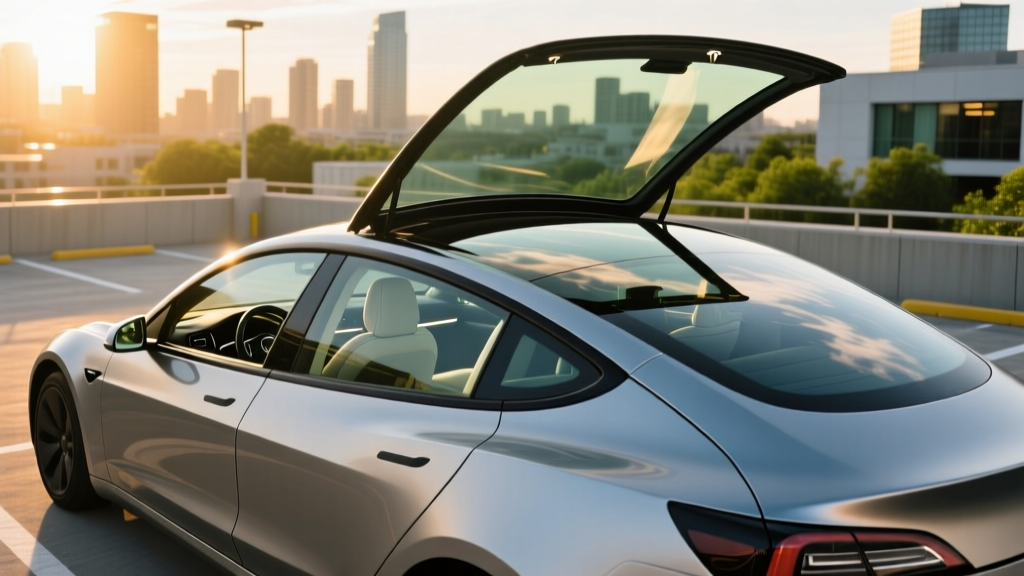
The Model 3's roof is a single, continuous piece of tinted glass spanning from the top of the windshield to the rear window edge. Unlike a traditional sunroof, it does not open, tilt, or retract. Tesla uses this design for several reasons:
- Structural rigidity: The bonded glass panel contributes to the Model 3's impressive torsional stiffness, which aids handling precision and crash safety. The NHTSA has consistently awarded the Model 3 its 5-star overall safety rating, and the rigid roof structure plays a role in rollover protection.
- Weight savings: A glass panel with a bonded frame is lighter than a steel roof with a mechanical sunroof assembly (motor, tracks, seals), helping preserve efficiency.
- Cabin experience: The uninterrupted glass creates an airy, spacious feel in a compact sedan that might otherwise feel enclosed, especially for rear-seat passengers.
The tradeoff is thermal. Glass, even tinted and UV-treated glass, transmits more infrared heat than insulated steel. In summer months, cabin temperatures rise faster in direct sunlight, placing additional load on the heat pump and climate system. Tesla mitigates this with a heavily tinted, IR-reflective glass coating, but owners in hot climates (Arizona, Texas, Southern California) consistently report that the roof radiates noticeable warmth overhead.
2026 Tesla Model 3: Range, Battery, and Efficiency
The 2026 Model 3 is offered in three primary configurations, each with distinct battery chemistry and range profiles:
| Spec | RWD (Base) | Long Range AWD | Performance AWD |
|---|---|---|---|
| EPA Range | 272 mi | 341 mi | 315 mi |
| Battery (usable) | ~57.5 kWh (LFP) | ~75 kWh (NMC) | ~75 kWh (NMC) |
| Drivetrain | RWD, single motor | AWD, dual motor | AWD, dual motor |
| Horsepower | 271 hp | 346 hp | ~460 hp |
| 0–60 mph | 5.8 sec | 4.2 sec | 2.9 sec |
| Efficiency (MPGe) | 132 MPGe combined | 134 MPGe combined | 122 MPGe combined |
| Efficiency (kWh/100 mi) | 25 kWh | 25 kWh | 27 kWh |
LFP vs. NMC: What the Roof Doesn't Change but the Battery Does
The base RWD Model 3 uses a lithium iron phosphate (LFP) battery, while the Long Range and Performance trims use nickel-manganese-cobalt (NMC) chemistry. Here's why that matters for daily ownership:
| Factor | LFP (RWD) | NMC (Long Range / Performance) |
|---|---|---|
| Charge to 100% daily? | Yes — Tesla recommends 100% at least weekly | No — 80% daily, 100% for trips only |
| Cold-weather performance | More range loss in freezing temps | Better cold resilience |
| Energy density | Lower — smaller kWh, lighter pack | Higher — more range per kg |
| Cycle life / longevity | Excellent — 3,000+ cycles typical | Good — 1,500–2,000 cycles typical |
The glass roof has no direct bearing on battery chemistry, but together they define the Model 3's thermal story: the roof lets in radiant heat (increasing summer cooling load), while the battery's chemistry determines how efficiently the car stores and deploys energy under those conditions.
Charging Speed: DC Fast, Level 2, and the Supercharger Advantage
Charging remains one of Tesla's strongest ownership advantages, thanks to the Supercharger network's reliability and the Model 3's capable charge acceptance.
| Charging Level | RWD (LFP) | Long Range / Performance (NMC) |
|---|---|---|
| Max DC Fast Charge | ~170 kW peak | ~250 kW peak |
| 10–80% DC Fast Time | ~25 min | ~18 min (V3 Supercharger) |
| Level 2 Home (11.5 kW) | ~30 mi/hr added | ~44 mi/hr added |
| Level 1 (120V) Emergency | ~3 mi/hr | ~3 mi/hr |
| Connector | NACS (native) | NACS (native) |
A critical note on the charging curve: peak kW is not sustained kW. The Long Range Model 3 may hit 250 kW at a low state of charge (10–15%), but that rate tapers progressively — dropping to ~100 kW by 60% SoC and ~40 kW above 85%. This is normal lithium-ion behavior and applies to all EVs. The 10–80% time of ~18 minutes reflects the integrated area under that curve, not a sustained peak. For road trips, plan stops around the 15–20 minute mark and avoid charging past 80% unless necessary — the time-per-mile-added worsens dramatically above that threshold.
At home on a Level 2 Tesla Wall Connector (up to 11.5 kW / 48A on a 60A circuit), any Model 3 variant will fully recharge overnight. Installation typically costs $500–$1,500 depending on panel proximity and whether a subpanel upgrade is needed. Per the IRS §30D guidelines, home charger equipment may also qualify for a separate residential energy credit (up to $1,000, 30% of cost).
Pricing, Trims, and Federal Tax Credit Eligibility
The 2026 Model 3 lineup starts at a competitive price point for the premium electric sedan segment. Here's the current trim breakdown:
| Trim | Base MSRP | Est. After §30D Credit* |
|---|---|---|
| RWD | $38,990 | ~$31,490 |
| Long Range AWD | $45,740 | ~$38,240 |
| Performance AWD | $52,990 | ~$45,490 |
*Tax credit estimates assume full eligibility. Actual credit depends on individual tax liability, battery sourcing compliance, and income thresholds.
Federal Tax Credit Eligibility (§30D) — Key Requirements
- MSRP Cap: Sedans must be priced at or below $55,000. The RWD and Long Range trims qualify; the Performance trim at $52,990 also clears the cap, but adding options (Full Self-Driving, premium paint, larger wheels) can push the as-tested price above the threshold — verify before ordering.
- Income Caps: Modified adjusted gross income (MAGI) must not exceed $150,000 (single), $225,000 (head of household), or $300,000 (joint filers).
- Battery Sourcing: A percentage of critical minerals and battery components must be sourced from the U.S. or free-trade-agreement partners. Tesla's supply chain has been adapting to these requirements, but compliance percentages shift annually. Verify current-year eligibility on fueleconomy.gov before purchasing.
- Point-of-Sale Transfer: As of 2024, qualifying buyers can transfer the credit to the dealer at purchase, effectively reducing the out-of-pocket price rather than waiting for a tax refund.
Interior, Cargo, and the Glass Roof Cabin Experience
The Highland-generation Model 3 interior is a study in minimalism. There are no physical buttons, no instrument cluster, and no traditional stalks (turn signals are now steering-wheel-mounted buttons). Everything routes through the 15.4-inch center touchscreen.
The glass roof is central to the cabin atmosphere. Rear-seat headroom measures 37.8 inches — adequate for adults under 6 feet, and the open glass above creates a perception of space that competitors with conventional steel roofs and small windows cannot match. Front headroom is 40.3 inches.
Cargo capacity stands at 23 cubic feet (trunk + frunk combined). The trunk offers 21 cu ft of usable space with a wide opening, while the front trunk (frunk) adds roughly 2 cu ft — enough for a charging cable kit and small bag. This is competitive with the Hyundai Ioniq 6 (12.3 cu ft trunk only) and significantly more usable than the BMW i4's 16.6 cu ft.
Notable Drawbacks
- Phantom braking: Tesla's vision-only Autopilot system still exhibits occasional phantom braking events on highways, where the car decelerates unexpectedly for perceived obstacles. This remains a known issue acknowledged in NHTSA investigations.
- Turn signal buttons: The steering-wheel-mounted capacitive turn signals are a genuine ergonomic regression from the traditional stalk, particularly during roundabouts and multi-lane maneuvers.
- No Apple CarPlay / Android Auto: Tesla's proprietary infotainment remains closed. If you rely on phone projection, this is a dealbreaker.
- Rear visibility: The sloping rear glass and thick C-pillars create a significant blind spot. The cabin camera-based rearview mirror (optional in some markets) partially addresses this.
Driver Assistance: Autopilot and FSD (Supervised)
Tesla Autopilot and Full Self-Driving (Supervised) are SAE Level 2 driver-assistance systems. The driver must remain fully engaged, hands on or near the wheel, and eyes on the road at all times. These systems do NOT make the Model 3 a self-driving vehicle. Only Level 4 services like Waymo operate without a human driver in defined areas.
Standard Autopilot includes Traffic-Aware Cruise Control and Autosteer (lane centering). The optional FSD (Supervised) package ($8,000 one-time or $99/month) adds automatic lane changes, traffic light and stop sign recognition, and Navigate on Autopilot. As of 2026, FSD remains a supervised beta-quality system — impressive in many scenarios but requiring constant driver oversight. Tesla's camera-only approach (no LiDAR or radar) means performance can degrade in heavy rain, construction zones, or poorly marked roads.
Who Should Buy the 2026 Tesla Model 3?
Choose the Model 3 If:
- You want access to the Supercharger network — still the most reliable DC fast-charging ecosystem in North America
- You prioritize efficiency and driving dynamics over interior luxury
- You have home Level 2 charging access and commute under 60 miles daily
- You value over-the-air updates that meaningfully improve the car over time
- You want the best resale value retention in the EV sedan segment
Look Elsewhere If:
- You need physical buttons, a traditional instrument cluster, or CarPlay
- You live in a region with limited Supercharger density and need CCS compatibility (though NACS adoption is expanding rapidly)
- You want a quieter, more luxurious ride — the BMW i4 or Genesis Electrified G80 offer more refinement
- You frequently carry tall rear-seat passengers who may find the low roofline restrictive
Warranty and Long-Term Ownership
Tesla's warranty coverage for the 2026 Model 3:
- Basic Vehicle: 4 years / 50,000 miles
- Battery & Drive Unit: 8 years / 100,000 miles (RWD) or 8 years / 120,000 miles (Long Range / Performance), with a minimum 70% capacity retention guarantee
- Corrosion: 12 years, unlimited miles
The 70% retention threshold is standard for the industry. Based on aggregated fleet data from sources like Tesla North and independent analyses, most Model 3 batteries retain 88–92% capacity at 100,000 miles, with LFP packs showing particularly strong longevity due to their inherent cycle-life advantage. A full battery replacement outside warranty currently costs between $12,000 and $16,000 depending on the pack — rare, but a figure worth knowing for long-term planning.
Frequently Asked Questions
Does the Tesla Model 3 glass roof make the cabin hot?
In direct summer sunlight, the glass roof does transmit more infrared heat than a steel roof. Tesla's IR-reflective tint helps, but owners in hot climates frequently report noticeable overhead warmth. An aftermarket or Tesla-branded interior sunshade reduces this substantially and is a $30–$80 investment most Southern owners consider essential.
Does the glass roof affect the Model 3's range?
Indirectly, yes — increased cabin heat from the glass roof can raise HVAC energy consumption in hot weather, potentially reducing range by 2–5% in extreme conditions. However, this is a minor factor compared to driving speed, ambient temperature, and terrain. The roof's contribution to overall efficiency is negligible compared to aerodynamics and battery chemistry.
Can you get a Model 3 without the glass roof?
No. The all-glass panoramic roof is standard across every Model 3 trim. There is no steel-roof or solid-roof option. If a glass roof is a dealbreaker, competitors like the BMW i4 and Hyundai Ioniq 6 offer conventional roof configurations.
Is the Model 3 glass roof safe in a crash?
Yes. The bonded glass contributes to structural rigidity, and the Model 3 has earned a 5-star overall rating from NHTSA, including strong rollover resistance scores. The glass is laminated and designed to remain bonded to the frame in collision scenarios.
How does the Model 3 compare to the Hyundai Ioniq 6 or BMW i4?
The Ioniq 6 offers comparable range (up to 361 mi EPA on SEL) at a lower starting price but lacks Supercharger access and has slower DC charging. The BMW i4 offers superior interior refinement and CarPlay but starts ~$10,000 higher and has less range. The Model 3's combination of Supercharger access, efficiency, and tech remains difficult to beat for the price.
Does the 2026 Model 3 qualify for the full $7,500 federal tax credit?
Eligibility depends on your income, the specific vehicle's battery sourcing compliance, and MSRP. The RWD and Long Range trims fall under the $55,000 sedan cap. Verify your personal eligibility using the IRS clean vehicle credit tool and confirm current-year battery compliance on fueleconomy.gov before ordering, as sourcing requirements tighten annually.