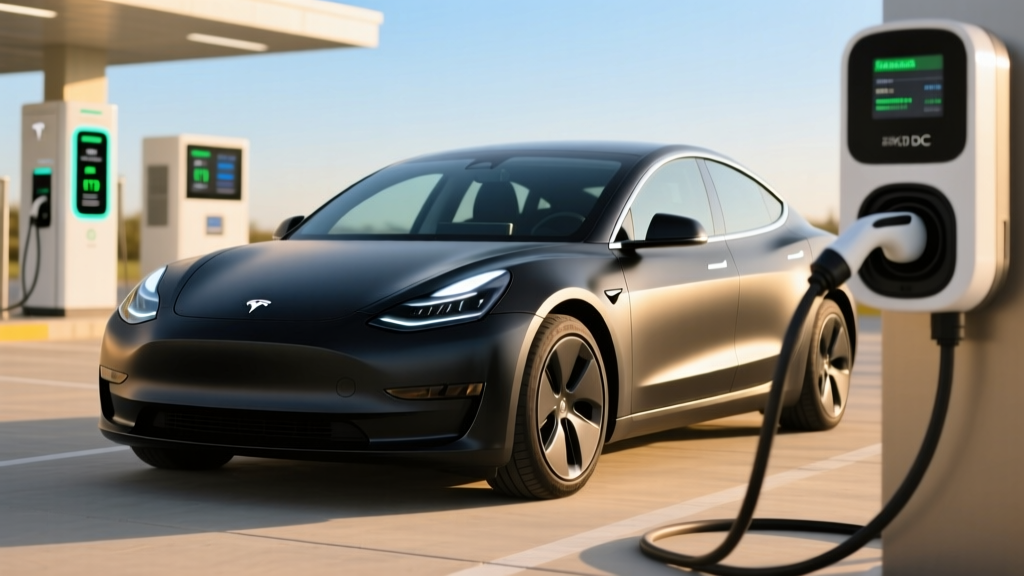
The Tesla Model 3 remains the benchmark compact electric sedan in 2026, offering class-leading efficiency, access to the most reliable DC fast-charging network in North America, and a starting price that undercuts most rivals. But a recent headline — a Tesla $200,000 fine in Nevada — has shoppers asking whether regulatory friction is changing the ownership equation. This review covers the 2026 Model 3's real-world range, charging speed, pricing after federal tax credits, and what that Nevada enforcement action actually means for you.
What the Tesla $200,000 Nevada Fine Actually Means
In 2024, Nevada's Department of Motor Vehicles levied a $200,000 fine against Tesla for operating its showrooms as de facto dealerships without a state-issued dealer license. Nevada, like several U.S. states, has franchise-dealer protection laws that prohibit automakers from selling directly to consumers through company-owned stores. Tesla has historically navigated this by operating "galleries" where visitors can look at cars but cannot complete a purchase on-site — orders must be placed online and delivered out-of-state or through a third-party entity.
What this means for buyers: If you live in Nevada (or states with similar direct-sales bans like Texas and Connecticut), the purchase process is more convoluted. You still order online at Tesla.com, but delivery and registration may require additional steps, and local service-center availability may be more limited than in direct-sales states. The fine itself does not affect vehicle quality, warranty coverage, or federal tax-credit eligibility — but it does highlight the friction Tesla faces in expanding its physical retail footprint in certain markets.
For Nevada residents specifically: expect to coordinate delivery through Tesla's out-of-state logistics, potentially incurring transport fees of $500–$1,500. Registration and titling remain straightforward through the Nevada DMV once you have your purchase documentation.
2026 Tesla Model 3: Full Specifications
| Specification | Long Range RWD | Long Range AWD | Performance |
|---|---|---|---|
| EPA Range | 363 mi | 341 mi | 315 mi |
| Battery (usable) | ~75 kWh (NMC) | ~75 kWh (NMC) | ~75 kWh (NMC) |
| Max DC Fast Charge | 250 kW | 250 kW | 250 kW |
| 10–80% DC Time | ~25 min | ~25 min | ~25 min |
| Level 2 Home Charge | 11.5 kW (~44 mi/hr) | 11.5 kW (~44 mi/hr) | 11.5 kW (~44 mi/hr) |
| 0–60 mph | 5.8 sec | 4.2 sec | 2.9 sec |
| Horsepower | 271 hp | 346 hp | 510 hp |
| Drivetrain | RWD (single motor) | AWD (dual motor) | AWD (dual motor) |
| Efficiency (MPGe) | 132 MPGe combined | 121 MPGe combined | 113 MPGe combined |
| Base MSRP | $42,380 | $47,380 | $54,380 |
Source: fueleconomy.gov and Tesla.com (2026 model year). Prices exclude $1,390 destination fee.
Real-World Range: What the EPA Sticker Doesn't Tell You
EPA Estimated: 341 miles (Long Range AWD)
Real-World Expectation:
- City/commute driving (mild weather): 320–340 mi — regenerative braking recovers energy in stop-and-go traffic.
- Highway (70–80 mph, mild weather): 270–300 mi — aerodynamic drag dominates at sustained speed.
- Cold weather (below 32°F, mixed driving): 220–260 mi — NMC chemistry loses 20–30% capacity in freezing temps; the heat pump helps but cannot eliminate the loss.
The Model 3's heat pump (standard since 2021) is one of the best in the industry at preserving range in cold climates, scavenging waste heat from the battery and drivetrain. Preconditioning the battery while plugged in — which the Tesla app handles automatically when you set a departure time — can recover 15–20 miles of range in winter compared to a cold start.
For context, on a 300-mile highway trip from Reno to Los Angeles in January (ambient temps 25–45°F), plan for one 15–20-minute Supercharger stop. In July on the same route, you could make it with 30–40 miles to spare.
Charging Speed: Supercharger Network Advantage
The Model 3's peak DC fast-charge rate of 250 kW is not class-leading on paper — the Hyundai Ioniq 5 peaks at 350 kW, and the Lucid Air at 300 kW — but Tesla's Supercharger network delivers that speed more consistently than any public network in North America. Electrify America and EVgo chargers frequently deliver below their rated peak due to thermal throttling, shared cabinets, or maintenance issues.
| Charging Level | Power | Speed (mi/hr added) | Typical Use Case |
|---|---|---|---|
| Level 1 (120V) | ~1.4 kW | ~4 mi/hr | Emergency/overnight trickle |
| Level 2 (240V, 48A) | 11.5 kW | ~44 mi/hr | Home daily charging |
| DC Fast (Supercharger V3) | Up to 250 kW | ~1,000 mi/hr (peak) | Road trips; 10–80% in ~25 min |
| DC Fast (Supercharger V4) | Up to 250 kW (cable-limited) | ~1,000 mi/hr (peak) | Newer stations, same speed for Model 3 |
Charge curve reality: The 250 kW peak sustains from roughly 10% to 40% SoC. Above 60%, the rate tapers to ~100 kW; above 80%, it drops to ~40 kW. This is why Tesla (and every EV maker) quotes 10–80% times rather than 0–100%. Charging to 100% at a Supercharger adds 25–30 extra minutes for the final 20% — plan accordingly on road trips and charge to 80% when possible.
Home charging: A Wall Connector on a 60A circuit delivers the full 11.5 kW (48A continuous). Expect installation costs of $800–$2,200 depending on panel proximity and local permitting. A full charge from 10% to 100% takes approximately 7.5 hours — easily overnight.
Pricing, Trims, and Federal Tax Credit Eligibility
The 2026 Model 3 lineup starts at $42,380 for the Long Range RWD (which replaced the base Standard Range in 2025). The mid-tier Long Range AWD adds $5,000, and the Performance variant tops out at $54,380 before options.
| Trim | MSRP | Est. §30D Credit | Effective Price |
|---|---|---|---|
| Long Range RWD | $42,380 | Up to $7,500 | ~$34,880 |
| Long Range AWD | $47,380 | Up to $7,500 | ~$39,880 |
| Performance | $54,380 | Up to $7,500 | ~$46,880 |
§30D Federal Tax Credit — eligibility requirements (2026 rules per IRS.gov):
- MSRP cap: Sedars must be ≤ $55,000. All Model 3 trims qualify.
- Buyer income cap: AGI ≤ $150,000 (single), $225,000 (head of household), $300,000 (joint). Exceed these and the credit phases out to zero.
- Battery sourcing: Increasing percentages of critical minerals and battery components must be sourced from the U.S. or FTA partners. Tesla has progressively met these thresholds for Model 3 — but the exact credit amount ($3,750 vs $7,500) depends on the production month and battery-cell sourcing. Verify current eligibility on Tesla.com at the time of order.
- Point-of-sale transfer: As of 2024, you can transfer the credit to the dealer (Tesla) at purchase, reducing your out-of-pocket cost immediately rather than waiting for a tax refund.
Important: Tesla's direct-sales model means the "dealer" for point-of-sale transfer is Tesla itself. The process is handled in the online checkout flow. Always confirm eligibility with a tax professional — rules change annually.
Interior, Cargo, and Technology
The Model 3 "Highland" refresh (introduced for 2024, carried into 2026) significantly improved interior materials, added ventilated front seats, ambient lighting, rear-seat ventilation, and a rear touchscreen for climate and entertainment. Build quality — historically a Tesla weak point — is now competitive with BMW and Audi in fit and finish.
Dimensions:
- Cargo (trunk): 23 cu ft
- Frunk: 3.1 cu ft
- Rear legroom: 35.3 in
- Front headroom: 40.3 in
The trunk is deep and wide but lacks a hatchback opening (unlike the Model Y or Polestar 2), which limits bulk-item loading. The frunk is small — useful for charging cables and a bag of groceries, not luggage.
Tech highlights:
- 15.4-inch center touchscreen with Tesla OS (no Apple CarPlay or Android Auto — a dealbreaker for some buyers)
- Over-the-air updates add features quarterly (recent additions: adaptive high beams, improved Sentry Mode, trip planner refinements)
- Standard Autopilot (SAE Level 2): adaptive cruise + lane centering — driver must remain engaged at all times
- Optional Full Self-Driving (Supervised) at $8,000 or $99/month — adds automated lane changes, traffic-light recognition, and Navigate on Autopilot. Still Level 2: you are the driver.
ADAS Limitation Warning: Tesla Autopilot and FSD (Supervised) are SAE Level 2 driver-assistance systems. They do not make the car self-driving. You must keep your hands on the wheel (or demonstrate attention via the cabin camera) and be prepared to take over instantly. FSD does not handle all road types, construction zones, or adverse weather reliably. Only Level 4 robotaxi services (Waymo, Zoox in limited geofenced areas) operate without a human driver.
Warranty, Longevity, and Ownership Costs
Tesla's warranty coverage is average for the EV segment:
- Basic vehicle: 4 years / 50,000 miles
- Battery & drive unit: 8 years / 120,000 miles (Long Range AWD & Performance); 8 years / 100,000 miles (Long Range RWD)
- Battery retention threshold: Tesla warrants that the battery will retain at least 70% of its original capacity during the warranty period. Below 70%, they will repair or replace it at no cost.
Real-world degradation data: Tesla's own impact reports (and independent fleet data from Recurrent Auto) show Model 3 NMC batteries retaining approximately 88–92% capacity at 100,000 miles. The degradation curve is steepest in the first 20,000 miles (~3–5% loss), then flattens significantly. Daily charging to 80% (as Tesla recommends for NMC chemistry) and avoiding repeated Supercharging to 100% will maximize longevity.
Insurance: Model 3 insurance premiums are 15–30% higher than comparable gas sedans (Camry, Accord) due to repair costs, aluminum body panels, and sensor recalibration after collisions. Expect $1,800–$2,800/year depending on your state, age, and driving record. Tesla Insurance (available in select states) uses real-time driving data and can be 10–20% cheaper for clean-record drivers.
Pros and Cons: The Honest Summary
Pros
- Best-in-class efficiency (132 MPGe RWD) translates to lowest cost-per-mile in the segment
- Supercharger network: 6,000+ U.S. stations, consistently operational, no adapter needed
- Over-the-air updates continuously improve the car post-purchase
- Strong resale value relative to most EVs (though depreciation has accelerated since 2023 price cuts)
- Sub-$35,000 effective price after tax credit for Long Range RWD
- Excellent safety ratings: IIHS Top Safety Pick+, NHTSA 5-star overall
Cons
- No Apple CarPlay or Android Auto — Tesla's OS only
- No hatchback — trunk-only cargo limits utility vs. Model Y or Ioniq 5
- Rear seat is tighter than competitors (Hyundai Ioniq 6, BMW i4)
- FSD ($8,000) remains Level 2 despite the name — questionable value
- Direct-sales restrictions complicate purchase in NV, TX, CT, and other states
- Panel gaps and paint quality, while improved, still trail German rivals at this price
Model 3 vs. Key Competitors: Is It Still the Best Buy?
The compact EV sedan segment has matured significantly. Here's how the Model 3 Long Range AWD stacks up against its primary rivals:
- vs. Hyundai Ioniq 6 SE (AWD): Ioniq 6 offers 316 mi EPA, 350 kW peak charging, and Apple CarPlay — but its public-charging reliability lags. Model 3 wins on Supercharger access and efficiency.
- vs. BMW i4 eDrive40: i4 starts at $57,000 (before credit), offers a more luxurious interior and CarPlay, but delivers only 307 mi EPA and charges at 205 kW. Model 3 wins on value and range.
- vs. Polestar 2 Long Range Dual Motor: Polestar 2 offers 276 mi EPA, 205 kW charging, and a hatchback. More practical cargo, but significantly less range and slower charging. Model 3 wins on efficiency.
Choose the Model 3 if: You prioritize lowest cost-per-mile, reliable road-trip charging via Superchargers, and a tech-forward ownership experience — and you don't need CarPlay or hatchback cargo.
Choose a competitor if: You need Apple CarPlay (Ioniq 6, i4), hatchback utility (Polestar 2, Ioniq 5), or a traditional dealership purchase experience in a direct-sales-restricted state.
Frequently Asked Questions
What is the real-world range of the 2026 Tesla Model 3?
EPA-estimated 341 miles for the Long Range AWD. In real-world highway driving at 75 mph, expect 270–300 miles. In freezing weather, plan for 220–260 miles. The Long Range RWD achieves up to 363 miles EPA and slightly better real-world figures.
How fast does the Model 3 charge at home and on the road?
On a Level 2 home charger (11.5 kW), it adds ~44 miles per hour — a full overnight charge. On a V3 Supercharger, it peaks at 250 kW and charges 10–80% in approximately 25 minutes. Above 80%, expect significant taper — don't plan to charge past 80% on road trips unless necessary.
How much does the Model 3 cost after the federal tax credit?
The Long Range RWD starts at $42,380 and can drop to ~$34,880 with the full $7,500 §30D credit, subject to income caps ($150K single / $300K joint) and battery-sourcing requirements. Verify current credit eligibility on Tesla.com and with your tax professional.
Does the Tesla $200,000 Nevada fine affect my purchase?
The fine was levied against Tesla for operating unlicensed showrooms. It does not affect vehicle warranty, quality, or tax-credit eligibility. However, Nevada residents may face a more complex delivery process (out-of-state logistics, possible transport fees) and should confirm service-center proximity before ordering.
Is the Model 3 worth buying vs. the Hyundai Ioniq 6 or BMW i4?
For most buyers, yes — the Model 3's combination of range, Supercharger access, efficiency, and post-credit price is unmatched. If you require Apple CarPlay, a hatchback, or a traditional dealership experience, the Ioniq 6 or i4 are strong alternatives at a higher price point.
What battery chemistry does the 2026 Model 3 use?
All 2026 Model 3 Long Range and Performance variants use NMC (nickel manganese cobalt) chemistry. Tesla recommends daily charging to 80% for NMC batteries, with 100% reserved for trips. The base Standard Range (available in some markets) uses LFP chemistry, which can be charged to 100% daily without degradation concerns — but it is not currently offered in the U.S. for 2026.
Sources: fueleconomy.gov — 2026 Tesla Model 3, IRS.gov — Clean Vehicle Credits, IIHS — Tesla Model 3 Safety Ratings.