Why Tesla Model 3 Replacement Tires Deserve Extra Attention
If you've put 30,000 to 40,000 miles on your Tesla Model 3, you've probably noticed the tread is wearing thin — and you're not alone. EV sedans chew through rubber faster than their gas-powered counterparts, thanks to instant torque, heavier curb weights (the Long Range AWD tips the scales around 4,034 lbs), and aggressive regenerative braking that loads the tires differently under deceleration. When it's time for Tesla Model 3 replacement tires, the wrong choice can cost you 15–20 miles of EPA-estimated range, increase cabin noise noticeably, and compromise wet-weather grip.
This guide walks through the exact tire sizes your 2024–2026 Model 3 requires, how different compounds and constructions affect efficiency, what you'll actually pay, and which brands deliver the best balance of range, comfort, and longevity. We'll also recap the Model 3's core specs so you can match tire selection to how you actually drive.
2026 Tesla Model 3: Spec Snapshot for Tire Buyers
Before shopping for rubber, confirm your trim and wheel size. The current-generation Model 3 (the "Highland" refresh that debuted for model year 2024 and continues into 2026) comes in three trims with two factory wheel diameters.
| Spec | RWD (Base) | Long Range AWD | Performance |
|---|---|---|---|
| Stock Tire Size | 235/45R18 | 235/45R18 (19" option: 235/40R19) | 235/40R19 |
| EPA Range | 341 mi | 341 mi (19" wheels: 318 mi) | 296 mi |
| Battery (usable) | ~57.5 kWh LFP | ~75 kWh NMC | ~75 kWh NMC |
| Drivetrain | RWD, single motor | Dual-motor AWD | Dual-motor AWD |
| 0-60 mph | 5.8 sec | 4.2 sec | 2.9 sec |
| Horsepower | ~271 hp | ~384 hp | ~510 hp |
| Efficiency (MPGe) | 132 MPGe combined | 125 MPGe combined | 113 MPGe combined |
| Curb Weight | ~3,862 lbs | ~4,034 lbs | ~4,065 lbs |
| Base MSRP | $38,990 | $45,990 | $52,990 |
Sources: fueleconomy.gov, Tesla.com (2026 model year specs). Efficiency figures are EPA combined.
OEM Tire Sizes and What They Mean for Range
The most consequential decision when buying Tesla Model 3 replacement tires is whether to stick with the factory size or switch. Here's what you need to know:
- 18-inch Aero wheels (235/45R18): The efficiency champion. The narrower sidewall and lower rolling resistance deliver the maximum EPA range on Long Range (341 miles). Most owners replacing these should prioritize low-rolling-resistance (LRR) touring tires.
- 19-inch Sport wheels (235/40R19): Better lateral grip and steering response, but you'll lose roughly 20–25 miles of range versus 18s on the Long Range trim. Replacement costs run $30–$60 higher per tire.
- Staggered setups: The Performance trim sometimes ships with a wider rear tire. Always replace in matched pairs (or all four) to avoid upsetting the AWD torque split.
Best Tesla Model 3 Replacement Tires by Use Case
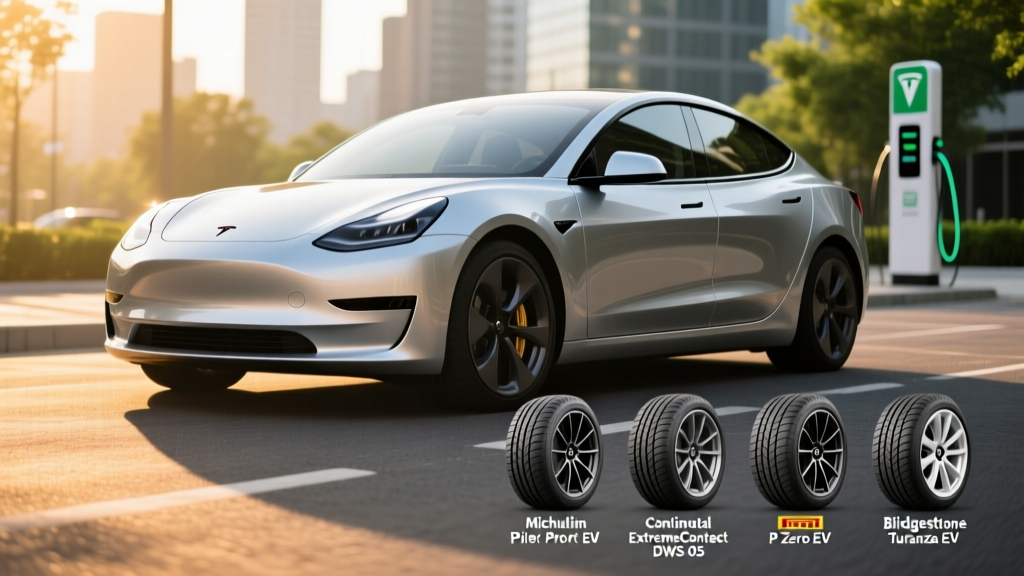
Based on rolling-resistance data, owner-reported mileage, and independent testing, here are the top picks organized by how you drive.
Best for Maximum Range & Efficiency: Michelin e.Primacy
Michelin's EV-specific touring tire posts some of the lowest rolling-resistance numbers in its class (roughly 6.5 kg/t vs. ~8.5 kg/t for a standard grand-touring tire). Owners report regaining 10–15 miles of range versus worn OEM rubber. Treadlife warranty: 40,000 miles. Expect to pay $220–$260 per tire for 235/45R18.
Best All-Around: Continental EcoContact 6 Q
Tesla's OEM supplier for many Highland Model 3s. The "Q" variant is tuned for EV weight and torque with a foam noise-damping layer that cuts cabin resonance by roughly 3–5 dB. Strong wet grip (EU label A-rated). Warranty: 40,000 miles. Price: $200–$245 per tire.
Best for Performance Trims: Michelin Pilot Sport 5
If you own a Performance Model 3 and actually use its 2.9-second 0-60 capability, the Pilot Sport 5 delivers exceptional dry and wet grip while remaining a competent all-season tire in climates that don't see hard freezes. Rolling resistance is higher — budget 8–10% range loss versus LRR rubber. Price: $280–$330 per tire (235/40R19).
Best Value: Hankook iON evo
Hankook's purpose-built EV tire line offers 85–90% of the Michelin e.Primacy's efficiency at roughly 70% of the price ($170–$200 per tire). Sound-absorbing foam included. Treadwear warranty: 40,000 miles. A strong pick for RWD owners who commute mostly in fair weather.
Best for Winter / Snow: Nokian Hakkapeliitta R5 EV
Studless winter tire with low rolling resistance for a snow tire and EV-specific construction. Expect a 10–15% range hit versus all-seasons, but dramatically better braking and cornering on ice. Swap back to all-seasons in spring to preserve range. Price: $240–$280 per tire.
Tesla Model 3 Replacement Tire Costs: What You'll Actually Pay
| Item | Budget Tier | Mid-Range | Premium / OEM |
|---|---|---|---|
| Tire price (per tire) | $150–$180 | $200–$260 | $270–$340 |
| Mounting & balancing (×4) | $80–$120 | $80–$120 | $80–$120 |
| Alignment | $80–$120 | $80–$120 | $80–$120 |
| Disposal / shop fees | $20–$40 | $20–$40 | $20–$40 |
| Total (set of 4) | $900–$1,100 | $1,180–$1,500 | $1,460–$1,940 |
Pro tip: Tesla Service Centers will mount and balance tires, but independent EV-savvy shops and chains like Discount Tire or Costco often beat them on price by $200–$400 per set. Make sure any shop uses a touchless tire machine and knows how to handle the foam-lined tires without damaging the acoustic layer. Also, request a hunter road-force balance — the Model 3's quiet cabin amplifies any vibration that a gas car's engine noise would mask.
How Tire Choice Affects Your Model 3's Efficiency and Noise
Three physical factors dominate the EV-tire equation:
- Rolling resistance coefficient (RRC): A 1 kg/t reduction in RRC translates to roughly 1.5–2% more range on the EPA cycle. Over a 75 kWh battery, that's 5–8 miles recovered.
- Weight: Heavier tires increase rotational inertia. A 3-lb per-tire increase can cost 2–4 miles of range and slightly degrade 0-60 times.
- Acoustic foam: Tires marked "PNCS" (Pirelli), "ContiSilent" (Continental), "Acoustic" (Michelin), or "Sound Absorber" (Hankook) include a polyurethane foam liner bonded to the inner tread. This dampens cavity resonance in the 180–220 Hz range — the exact frequency band that annoys Model 3 occupants at highway speed.
If you regularly drive over 70 mph on the freeway, prioritize foam-lined tires. The Model 3's lack of engine noise means tire roar becomes the dominant sound source above 50 mph, and non-foamed tires can raise perceived cabin noise by a noticeable 3–6 dB.
Model 3 Ownership Context: Warranty, Tax Credit, and Running Costs
When you're budgeting for replacement tires, it helps to see them in the full ownership picture.
| Category | Details |
|---|---|
| Basic Warranty | 4 years / 50,000 miles |
| Battery & Drive Unit | 8 years / 100,000 miles (RWD); 8 years / 120,000 miles (Long Range & Performance), minimum 70% retention |
| Federal Tax Credit (§30D) | Up to $7,500 — subject to MSRP cap ($55,000 for sedans), buyer income cap ($150k single / $300k joint), and critical-mineral/battery-component sourcing rules. Point-of-sale transfer available. Verify at irs.gov. |
| Estimated 5-Year Fuel (electricity) | ~$3,200 at $0.15/kWh national avg (vs. ~$8,500 for a comparable gas sedan) |
| Tire Replacement Interval | Every 25,000–40,000 miles depending on tire, driving style, and alignment |
| Cargo Volume | 23 cu ft trunk + rear seats fold; ~3.1 cu ft frunk |
| Rear Legroom | 35.3 inches |
Tesla's Basic and Battery warranties do not cover tire wear. Budget for one tire replacement per 30,000–35,000 miles if you drive aggressively or live in a hot climate (heat accelerates rubber degradation).
- Widely available tire sizes — 235/45R18 is a common passenger-car dimension, not an exotic EV-only size
- Multiple OEM-equivalent and EV-specific tire options from major brands
- Strong Supercharger network reduces the range penalty of choosing grippier tires
- Low overall running costs offset premium tire prices
- EV weight and torque wear tires 20–30% faster than equivalent gas sedans
- Performance trim's 19-inch tires cost significantly more and reduce range
- Aftermarket foam-lined tires add $20–$40 per tire vs. non-foamed equivalents
- Alignment sensitivity — even slight toe-out accelerates inner-edge wear dramatically
Frequently Asked Questions About Tesla Model 3 Replacement Tires
How often do Tesla Model 3 tires need to be replaced?
Most owners replace tires between 25,000 and 40,000 miles. RWD models with lighter curb weight and less torque tend toward the upper end; Performance models driven hard may need new rubber at 20,000 miles. Rotate every 6,250 miles (Tesla's recommended interval) to maximize life.
Can I use regular (non-EV) tires on my Model 3?
Yes, but you'll likely sacrifice 5–15 miles of range and hear more road noise. Standard touring tires also may not carry the XL (extra load) rating that the Model 3's weight demands. Always match or exceed the OEM load index (94 or higher for 235/45R18).
Does Tesla sell replacement tires directly?
Tesla Service Centers can order and mount OEM-spec tires, but pricing is typically $30–$60 per tire higher than independent retailers. Tesla's mobile service can sometimes come to your home or office for tire replacement — convenient but not always the cheapest option.
Will switching tires void my Tesla warranty?
No. Under the Magnuson-Moss Warranty Act, Tesla cannot void your battery or drivetrain warranty simply because you installed aftermarket tires. However, if a tire-related failure damages a component (e.g., an incorrect size causes a half-shaft issue), that specific claim could be denied.
Are foam-lined tires worth the extra cost?
For most Model 3 owners, yes. The acoustic foam reduces cabin noise by 3–6 dB at highway speed — a meaningful difference in a car with no engine masking sound. The premium is typically $20–$40 per tire and doesn't affect range, grip, or treadlife.
What tire pressure should I run?
Tesla recommends 42 PSI cold for most Model 3 trims (check your driver's door jamb sticker). Running 2–3 PSI above the recommendation can recover 3–5 miles of range at the cost of a firmer ride and slightly accelerated center-tread wear. Never drop below the placard pressure — underinflation increases rolling resistance and generates excess heat.