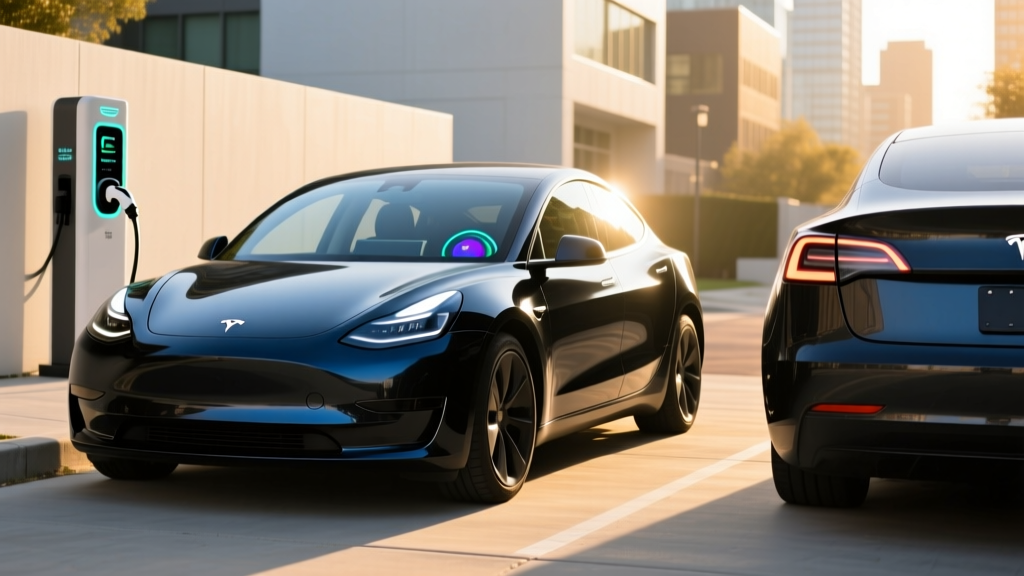
The 2026 Tesla Model 3 Long Range AWD remains the default benchmark in the midsize electric sedan segment. With a revised 82 kWh battery, improved thermal management, and Tesla's relentless over-the-air (OTA) software upgrades continuously reshaping the ownership experience, the Model 3 is a vehicle that genuinely evolves after you buy it. But does continuous iteration justify the price, and what do those software updates actually deliver in 2026? This review breaks down every critical spec with real-world ownership context.
2026 Tesla Model 3: Core Specifications at a Glance
| Specification | Long Range AWD | Performance AWD | Rear-Wheel Drive |
|---|---|---|---|
| EPA Range | 363 mi | 325 mi | 272 mi |
| Battery (usable) | ~79 kWh (82 kWh gross) | ~79 kWh (82 kWh gross) | ~57.5 kWh (60 kWh gross) |
| Chemistry | NMC (Nickel Manganese Cobalt) | NMC | LFP (Lithium Iron Phosphate) |
| Drivetrain | Dual-Motor AWD | Dual-Motor AWD | Single-Motor RWD |
| Horsepower | ~346 hp | ~510 hp | ~271 hp |
| 0–60 mph | 4.2 sec | 2.9 sec | 5.8 sec |
| MPGe (combined) | 130 MPGe | 115 MPGe | 132 MPGe |
| Efficiency | 25 kWh/100 mi | 29 kWh/100 mi | 24 kWh/100 mi |
| Max DC Fast Charge | 250 kW | 250 kW | 170 kW |
| 10–80% DC Time | ~25 min | ~25 min | ~30 min |
| Level 2 Home Charging | 11.5 kW (~44 mi/hr) | 11.5 kW (~44 mi/hr) | 11.5 kW (~44 mi/hr) |
| Cargo Volume | 23 cu ft (trunk + frunk) | 23 cu ft | 23 cu ft |
| Base MSRP | $47,740 | $54,740 | $38,990 |
Source: fueleconomy.gov, Tesla official specifications. Prices reflect 2026 model year before destination fees and incentives.
Range Reality: EPA Sticker vs. What You'll Actually Drive
Real-World Expectation: ~290–320 mi highway at 70 mph; ~250–280 mi in freezing weather (below 30°F); ~340+ mi mixed city driving with regen.
The Long Range AWD's 363-mile EPA figure is among the highest in the segment, but EPA tests favor low-speed, city-biased driving cycles. On sustained highway trips at 70–75 mph, expect to use approximately 280–310 miles of a full charge before needing to stop. In sub-freezing temperatures, the battery's thermal management system will consume energy to keep the NMC pack within its optimal operating window, reducing effective range by 15–25% depending on cabin heat usage. The Model 3's standard heat pump helps mitigate this loss compared to resistive heating systems in older EVs, but cold-weather reduction is a physical reality no EV fully escapes.
The RWD variant's LFP chemistry offers an advantage here: LFP cells tolerate regular 100% charging without significant degradation concerns, meaning you can actually use the full 272-mile EPA figure daily. NMC variants (Long Range and Performance) perform best when charged to 80% for daily use, effectively giving you ~290 usable miles on the Long Range — still more than adequate for nearly all commutes and most single-day road trips.
Charging Speed and the Tesla Software Upgrade Advantage
Tesla's 250 kW peak DC fast-charging capability on the Long Range and Performance trims remains competitive in 2026, though rivals like the Hyundai Ioniq 6 (350 kW capable) have closed the gap on paper. The critical distinction is charging-curve management — an area where Tesla's software engineering delivers measurable advantages through continuous over-the-air (OTA) updates.
| Charging Level | Power | Speed (Long Range) | Notes |
|---|---|---|---|
| Level 1 (120V) | ~1.4 kW | ~4–5 mi/hr | Emergency/trickle only |
| Level 2 (240V, 48A) | 11.5 kW | ~44 mi/hr | Full charge in ~8 hr |
| DC Fast (Supercharger V3) | 250 kW peak | 10–80% in ~25 min | Tapers above 80%; preconditioning critical |
| DC Fast (Supercharger V4) | Up to 325 kW (future) | Model 3 hardware-limited to 250 kW | V4 stalls rolling out through 2026 |
Why the Tesla software upgrade matters for charging: Tesla's OTA updates periodically refine the battery preconditioning algorithm — the process of warming the pack to optimal temperature before a fast-charging stop. Recent 2026 firmware revisions have improved cold-weather preconditioning accuracy, reducing the "charging speed ramp-up" delay that previously added 3–5 minutes to the first portion of a winter fast-charge session. Additionally, Tesla's navigation system automatically initiates preconditioning when you route to a Supercharger, a seamless integration that most competitors still can't match.
The charge curve itself is well-managed: the Model 3 Long Range sustains above 200 kW from approximately 10–35% State of Charge (SoC), then gradually tapers through 150 kW by 55% and drops below 100 kW past 70%. This is why the 10–80% time of ~25 minutes is the meaningful metric — charging past 80% slows dramatically and should be reserved for destination charging unless you specifically need the last 20%.
What Tesla Software Upgrades Actually Deliver in 2026
The phrase "Tesla software upgrade" encompasses far more than infotainment tweaks. Tesla's OTA update architecture modifies vehicle dynamics, battery management, driver-assistance capabilities, and user interface elements — often without a service center visit. Here's what 2026 owners are seeing:
- Full Self-Driving (Supervised) improvements: FSD v13.x delivers smoother lane changes, improved unprotected left turns, and better construction-zone handling. This remains SAE Level 2 — the driver must remain fully attentive at all times.
- Battery management refinements: OTA updates have optimized regen braking profiles and thermal preconditioning logic, extracting marginally more range from the same hardware.
- UI and entertainment: Theater mode improvements, new gaming capabilities on the 15.4-inch center display, and enhanced Spotify/Apple Music integration.
- Sentry Mode and security: Improved camera-based recording, dashcam clipping features, and phone-key reliability patches.
- Trip planning: Supercharger routing now factors in real-time stall availability, elevation changes, and ambient temperature more accurately than previous versions.
Performance, Handling, and Daily Drivability
The Long Range AWD's 4.2-second 0–60 mph time is brisk by any measure and effortless for highway merging. Dual-motor torque vectoring provides confident all-weather traction without the mechanical complexity of a traditional AWD system. The Performance trim's 2.9-second sprint is supercar territory, though the stiffer adaptive suspension trades some ride comfort for cornering capability.
Ride quality on the refreshed Model 3 (introduced for 2024, carried into 2026) is noticeably improved over the pre-refresh generation. Acoustic glass, revised suspension bushings, and additional sound deadening have reduced cabin noise substantially. The 15.4-inch touchscreen remains the single control interface — there are no physical buttons for climate, mirrors, or glovebox, which some buyers love and others find frustrating. Turn signals are now on a stalk (Tesla reversed the controversial yoke-mounted buttons from the 2024 refresh), addressing one of the most common complaints.
Interior dimensions: Front legroom measures 42.7 inches; rear legroom is 35.2 inches — adequate for adults on shorter trips but tight for taller passengers on long hauls. The 23 cu ft of combined cargo space (trunk + front trunk/frunk) is generous for the class, with a wide trunk opening and flat load floor. The 60/40 split-folding rear seats expand utility for longer items.
Pricing, Trims, and Federal Tax Credit Eligibility
| Trim | Base MSRP | Destination | Est. Total Before Credit | §30D Credit Eligibility |
|---|---|---|---|---|
| RWD | $38,990 | $1,390 | $40,380 | Up to $7,500 (if sourcing rules met) |
| Long Range AWD | $47,740 | $1,390 | $49,130 | Up to $7,500 (if sourcing rules met) |
| Performance AWD | $54,740 | $1,390 | $56,130 | Up to $7,500 (if sourcing rules met) |
Does the 2026 Tesla Model 3 qualify for the federal EV tax credit? Under IRS §30D rules, the Model 3 qualifies for up to $7,500, provided the buyer meets all current requirements. As of 2026, this means:
- MSRP cap: Sedans must be under $55,000 MSRP. The RWD and Long Range qualify; the Performance trim at $54,740 is under the cap.
- Buyer income limits: AGI must not exceed $150,000 (single), $225,000 (head of household), or $300,000 (joint filers).
- Battery sourcing: A percentage of critical minerals and battery components must be sourced from the U.S. or free-trade-agreement countries. Tesla has worked to qualify the maximum $7,500 (split between critical minerals and battery component requirements), but sourcing rules tighten annually. Verify current eligibility on the IRS qualified vehicles list at point of purchase.
- Point-of-sale transfer: As of 2024, buyers can transfer the credit to the dealer at purchase, reducing the out-of-pocket price immediately rather than waiting for tax filing.
Note: Tax credit rules are subject to legislative and regulatory change. Consult a tax professional and check irs.gov for the most current guidance before purchasing.
Warranty, Reliability, and Long-Term Ownership
Tesla provides a 4-year/50,000-mile limited vehicle warranty and an 8-year/120,000-mile battery and drive unit warranty for the Long Range AWD (8-year/100,000-mile for the RWD). The battery warranty guarantees retention of at least 70% of original capacity during the coverage period. Real-world data from high-mileage Tesla owners suggests NMC packs in the Model 3 typically retain 85–90% capacity at 100,000 miles when following recommended charging practices (daily charge to 80%, avoid prolonged storage at 100% or below 10%).
The LFP battery in the RWD variant has a different degradation profile: LFP chemistry degrades more slowly and can be routinely charged to 100%, making it an attractive option for high-mileage commuters who don't need the Long Range's extra capacity. Tesla recommends a full 100% charge at least once per week for LFP packs to maintain battery management system calibration.
Pros, Cons, and Who Should Buy the Model 3
Pros
- Class-leading efficiency (130–132 MPGe)
- Supercharger network reliability — the most robust DC fast-charging ecosystem in North America
- Continuous OTA software upgrades add features and refine performance post-purchase
- Strong real-world range (290+ mi highway on Long Range)
- Point-of-sale tax credit transfer reduces upfront cost
- Excellent cargo space (23 cu ft) for a sedan
Cons
- No physical buttons — all controls routed through touchscreen
- Rear seat space is tighter than Hyundai Ioniq 6 or BMW i4
- FSD (Supervised) requires $8,000 add-on and remains Level 2 only
- Insurance premiums are higher than segment average
- NMC battery requires 80% daily charge limit for longevity
- Build quality improved but still inconsistent vs. legacy luxury brands
Who the 2026 Tesla Model 3 Suits Best
Choose the Model 3 Long Range AWD if: You want maximum range for road trips, need AWD for winter climates, value Supercharger network access for travel, and appreciate continuous software-driven feature updates.
Choose the Model 3 RWD if: You're a high-mileage commuter who can charge at home nightly, want the lowest entry price with LFP battery durability, and don't need 363 miles of range.
Look at the Hyundai Ioniq 6 or BMW i4 instead if: You prefer physical controls, want a more traditional luxury interior, or need more rear-seat room for family use.
Frequently Asked Questions
What is the real-world range of the 2026 Tesla Model 3?
The Long Range AWD achieves 363 miles EPA, but expect approximately 290–320 miles on sustained highway drives at 70 mph, and 250–280 miles in sub-freezing temperatures. The RWD delivers its full 272 EPA miles more consistently since LFP chemistry allows routine 100% charging.
How fast does the Tesla Model 3 charge at home and on the road?
On a Level 2 home charger (240V, 48A), the Model 3 charges at 11.5 kW, adding roughly 44 miles of range per hour — a full overnight charge. On a V3 Supercharger, the Long Range peaks at 250 kW and charges from 10–80% in approximately 25 minutes with proper battery preconditioning.
How much does the 2026 Model 3 cost after the federal tax credit?
The Long Range AWD starts at $49,130 including destination. If you qualify for the full $7,500 §30D credit (meeting income, MSRP, and battery sourcing requirements), the effective price drops to approximately $41,630. The RWD can reach as low as ~$32,880 after credit.
Is the Tesla Model 3 worth buying vs. the Hyundai Ioniq 6 or BMW i4?
The Model 3 wins on charging infrastructure (Supercharger access), software updates, and efficiency. The Ioniq 6 offers faster peak charging (350 kW capable) and more rear-seat room. The BMW i4 delivers superior interior materials and physical controls. Your priority — network access vs. interior comfort vs. charging speed — should drive the decision.
Do Tesla software upgrades cost money?
Most OTA software upgrades are free and included with the vehicle — these cover UI improvements, battery management refinements, navigation updates, and entertainment features. Full Self-Driving (Supervised) capability is a separate $8,000 purchase (or $99/month subscription) and receives its own ongoing updates.
Does the Model 3 qualify for the $7,500 federal EV tax credit in 2026?
All three Model 3 trims fall under the $55,000 sedan MSRP cap. Eligibility for the full $7,500 depends on your AGI (income limits apply), and Tesla's battery must meet the current year's critical-mineral and component sourcing thresholds under §30D. The credit can be transferred at point of sale. Verify current eligibility on the IRS qualified vehicles list before purchase.