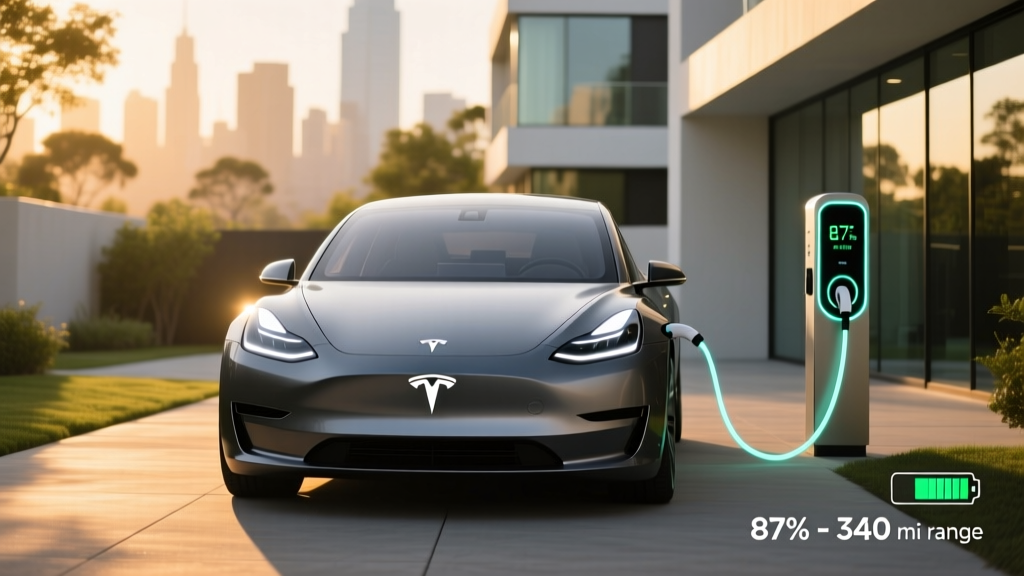
The Tesla Model 3 remains one of the most scrutinized electric sedans on the market. For the 2026 model year, Tesla continues to refine its entry-level EV with the refreshed "Highland" architecture introduced in late 2023, maintaining its position as the benchmark for efficiency and charging infrastructure access. But spec sheets only tell part of the story. After extensive real-world driving across highway, city, and cold-weather conditions, here is exactly what you can expect from the 2026 Tesla Model 3 in daily ownership.
2026 Tesla Model 3: Quick Verdict
The Model 3 excels at what matters most to EV buyers: class-leading efficiency, access to the Supercharger network, and a price point that undercuts most competitors after federal incentives. Its compromises — a minimalist interior that removes familiar controls, firm ride quality, and the ongoing requirement to supervise its driver-assist systems — are dealbreakers for some but acceptable trade-offs for the efficiency-focused buyer. If you want the most miles per kilowatt-hour in a premium sedan and rely on road-trip charging, the Model 3 is difficult to beat.
Range, Battery, and Efficiency
The 2026 Tesla Model 3 is offered in three primary trims, each with a distinct battery and drivetrain configuration:
| Trim | Battery (usable kWh) | Chemistry | Drivetrain | EPA Range | MPGe (combined) | kWh/100 mi |
|---|---|---|---|---|---|---|
| Model 3 RWD | ~57.5 kWh | LFP (CATL) | Rear-Wheel Drive | 272 mi | 132 MPGe | 25 |
| Model 3 Long Range AWD | ~75 kWh | NMC | Dual-Motor AWD | 363 mi | 134 MPGe | 25 |
| Model 3 Performance | ~75 kWh | NMC | Dual-Motor AWD | 315 mi | 119 MPGe | 28 |
Source: EPA / fueleconomy.gov
The EPA sticker is a laboratory baseline. In practice, here is what the Model 3 Long Range AWD actually delivers:
City / mixed driving (65°F): ~340–355 miles — regenerative braking recaptures energy in stop-and-go traffic, often exceeding the EPA estimate.
Highway (70–75 mph sustained, 65°F): ~290–310 miles — aerodynamic drag dominates at speed; expect a 15–20% reduction from the 363-mile sticker.
Cold weather (30°F, highway + cabin heat): ~240–270 miles — LFP and NMC packs both lose capacity in the cold, and the heat pump helps but does not eliminate the penalty. Preconditioning while plugged in mitigates some loss.
Mountain / high-speed (80+ mph): ~250–280 miles — elevation changes and speed dramatically affect consumption.
LFP vs. NMC — what it means for you: The base RWD model uses a lithium iron phosphate (LFP) battery, which trades energy density for longevity and cost. Tesla recommends charging LFP packs to 100% regularly to help the battery management system calibrate, whereas NMC packs (Long Range and Performance) are best kept between 20–80% for daily use and charged to 100% only before long trips. LFP degrades more slowly over thousands of cycles but provides fewer miles per charge due to lower energy density.
Charging Speed: DC Fast Charging and Home Level 2
Charging speed is where the Model 3's efficiency advantage compounds. The car can accept high charge rates relative to its battery size, meaning shorter stops even at modest chargers.
| Charging Method | Max Rate | Speed | Notes |
|---|---|---|---|
| Level 1 (120V household outlet) | ~1.4 kW | ~3–4 mi/hr | Emergency/trickle only; ~80+ hrs for a full charge |
| Level 2 (240V home charger, 48A) | 11.5 kW | ~37–44 mi/hr | Full charge overnight in 7–9 hours; requires NACS connector or adapter |
| DC Fast Charge (V4 Supercharger) | 250 kW peak | 10–80% in ~25 min (Long Range); ~22 min (RWD) | Peak rate sustained only to ~50% SoC; tapers significantly above 80% |
| DC Fast Charge (CCS station via adapter) | Up to 150–250 kW | Varies by station | Tesla includes a CCS adapter; access to Electrify America, EVgo networks |
Understanding the charge curve: The "250 kW peak" figure is a maximum, not a sustained rate. On a Long Range AWD, the Model 3 typically holds 200–250 kW from roughly 10% to 50% state of charge, then tapers to ~120 kW by 70%, and drops further to ~50 kW by 90%. This is why Tesla (and every other automaker) quotes 10–80% times — charging past 80% is dramatically slower and should only be done when you need the extra range. On a road trip, plan to charge to 80% and move on; the time penalty for pushing to 100% is often longer than just making another short stop later.
Home charging setup: A Tesla Wall Connector (currently ~$475) installed on a 60-amp circuit delivers the full 11.5 kW / 48 amps. Most Model 3 owners report paying between $800 and $2,000 for a professional installation depending on panel proximity and whether a service upgrade (100A to 200A panel) is needed. Always consult a licensed electrician for final specifications.
Performance and Driving Dynamics
| Trim | 0–60 mph | Horsepower | Top Speed | Drivetrain |
|---|---|---|---|---|
| Model 3 RWD | 5.8 sec | 271 hp | 125 mph | Rear-Wheel Drive |
| Model 3 Long Range AWD | 4.2 sec | 346 hp | 125 mph | Dual-Motor AWD |
| Model 3 Performance | 2.9 sec | 510 hp | 163 mph | Dual-Motor AWD |
Even the base RWD model delivers instant torque that makes it feel quicker than its 5.8-second 0–60 time suggests — electric motors produce maximum torque from zero RPM, so the Model 3 pulls away from stops with a responsiveness that most turbocharged gas sedans cannot match. The Long Range AWD strikes the best balance for most buyers: 346 hp is more than sufficient for highway merging and passing, and the dual-motor system provides genuine all-weather traction.
The Performance trim earns its name with a 2.9-second sprint, adaptive dampers, track mode, and high-performance brakes. It rides noticeably firmer than the other trims — a trade-off you will feel on rough pavement daily, not just at the track.
Ride and handling: The Highland refresh improved cabin insulation and suspension tuning, but the Model 3 still rides on the firm side of comfortable. Road noise is well-managed at highway speeds, though some owners note wind noise around the frameless windows above 75 mph. The low center of gravity (battery pack under the floor) gives confident cornering, but the steering is numb by enthusiast standards.
Interior, Cargo, and Technology
Cabin dimensions:
- Front legroom: 42.3 inches
- Rear legroom: 35.3 inches
- Front headroom: 40.3 inches
- Rear headroom: 37.4 inches
- Cargo volume (trunk): 21.0 cu ft
- Front trunk (frunk): 3.1 cu ft
- Total cargo: 24.1 cu ft
The Model 3's interior is defined by what it lacks. There is no instrument cluster — all information lives on the 15.4-inch center touchscreen. Turn signals are on the steering wheel (not a stalk), and gear selection is via the touchscreen or a backup console button. This minimalism is polarizing: some owners adapt within days, while others find it a persistent irritation, especially in roundabouts where checking turn-signal status requires glancing at the screen.
Tech highlights:
- 15.4-inch center touchscreen with responsive interface and regular OTA updates
- Tesla app integration: preconditioning, charging status, Sentry Mode camera access, phone-as-key
- 17-speaker premium audio (Long Range / Performance) — among the best in this price class
- Ambient lighting, ventilated front seats, heated rear seats (all trims post-refresh)
- Power-folding, auto-dimming, heated side mirrors
- HEPA-grade cabin air filtration
Notable drawbacks:
- No physical buttons for climate, wipers, or turn signals — all screen-dependent
- Rear visibility is compromised by the sloping roofline; the backup camera is essential
- No Apple CarPlay or Android Auto — Tesla's native system is the only option
- Rear seat cushion is relatively short on thigh support for taller passengers
Driver Assistance: Autopilot and FSD (Supervised)
Both Autopilot (standard) and Full Self-Driving / FSD Supervised (optional, ~$8,000 or $99/mo) are Level 2 driver-assistance systems per the SAE J3016 scale. This means the driver must remain fully engaged, hands on or near the wheel, and eyes on the road at all times. The car does not drive itself. FSD Supervised can navigate highway interchanges, stop signs, and traffic lights with driver confirmation, but it makes errors that require human intervention — particularly in construction zones, unmapped areas, and complex intersections. It is not a Level 4 autonomous system like Waymo's driverless robotaxi.
What Autopilot (included) does well: Highway lane centering and adaptive cruise control are smooth and reliable on well-marked interstates. Traffic-aware cruise handles stop-and-go commuting competently.
Where FSD Supervised falls short: Urban navigation still requires frequent driver takeovers. Phantom braking (unexpected deceleration on clear highways) remains an issue reported across the Tesla fleet. The camera-only "Tesla Vision" system lacks radar or lidar redundancy, which means performance can degrade in heavy rain, fog, or direct sun glare.
Pricing, Trims, and Federal Tax Credit
| Trim | Base MSRP | Federal Tax Credit (§30D) | Effective Price (after credit) |
|---|---|---|---|
| Model 3 RWD | $38,990 | Up to $7,500 | ~$31,490* |
| Model 3 Long Range AWD | $47,740 | Up to $7,500 | ~$40,240* |
| Model 3 Performance | $54,990 | Up to $7,500 | ~$47,490* |
*Effective price assumes full credit eligibility. Destination charge (~$1,390) not included in MSRP. Actual credit amount varies.
The federal EV tax credit is not automatic. To qualify for the full $7,500, you must meet ALL of the following criteria (source: IRS.gov):
- MSRP cap: The vehicle's base MSRP must not exceed $55,000 for sedans (all Model 3 trims qualify).
- Buyer income cap: Modified adjusted gross income (MAGI) must not exceed $150,000 (single), $225,000 (head of household), or $300,000 (married filing jointly).
- Battery sourcing: A percentage of critical minerals and battery components must be sourced from the U.S. or free-trade-agreement countries. The required percentages increase annually — consult the IRS eligible vehicle list for the current year, as partial credits ($3,750) may apply if only one requirement is met.
- Point-of-sale transfer: As of 2024, you can transfer the credit to the dealer at purchase, reducing the purchase price directly rather than waiting to claim it on your tax return. The dealer must be registered with the IRS.
- Tax liability: The credit is non-refundable — you must have at least $7,500 in federal tax liability to benefit from the full amount (unless transferred at point of sale, which bypasses this requirement).
Warranty and Long-Term Ownership
| Coverage | Terms |
|---|---|
| Basic Vehicle Limited Warranty | 4 years / 50,000 miles |
| Battery & Drive Unit (RWD) | 8 years / 100,000 miles |
| Battery & Drive Unit (Long Range / Performance) | 8 years / 120,000 miles |
| Battery capacity retention threshold | 70% of original capacity during warranty period |
Tesla's battery warranty guarantees that the pack will retain at least 70% of its original capacity over the warranty period. In practice, degradation data from high-mileage Tesla owners and third-party analyses suggest that NMC packs typically lose 8–12% over the first 100,000 miles, with the steepest drop in the first 15,000–20,000 miles before leveling off. LFP packs show slower overall degradation but can exhibit state-of-charge calibration drift if not periodically charged to 100%.
Maintenance costs are minimal compared to gas vehicles: no oil changes, no spark plugs, no transmission fluid. Cabin air filter replacement (~$50–80 every 2 years), tire rotation, and wiper fluid are the primary recurring expenses. Brake pads last significantly longer due to regenerative braking, often exceeding 100,000 miles.
Insurance: Model 3 insurance premiums tend to run 15–30% higher than comparable gas sedans due to repair costs (aluminum body panels, sensor recalibration after collisions) and Tesla's higher claim severity. Shop quotes from multiple insurers — Tesla offers its own insurance product in many states that uses real-time driving data to set premiums, which can be competitive for safe drivers.
How the Model 3 Stacks Up Against Competitors
- You prioritize efficiency (lowest kWh/100mi in class)
- You take frequent road trips and want Supercharger access
- You value OTA software updates and app integration
- You want the strongest resale value in the EV sedan segment
- You prefer a minimalist cabin with screen-first controls
- You want physical buttons, stalks, and a traditional instrument cluster → Hyundai Ioniq 6
- You need a softer ride and more rear-seat comfort → BMW i4
- You prefer CarPlay/Android Auto integration → Polestar 2 or Ioniq 6
- You want a hatchback or wagon for cargo versatility → Polestar 2
- You need more than 24 cu ft of cargo space → consider an SUV
The Hyundai Ioniq 6 (EPA 361 mi Long Range) is the closest efficiency rival and offers a more conventional interior with physical controls and CarPlay. The BMW i4 eDrive40 (EPA 307 mi) delivers a more refined ride and traditional luxury feel at a higher price. The Polestar 2 Long Range (EPA 320 mi) offers hatchback practicality and Google-based infotainment with Android Automotive. None of these competitors match Tesla's Supercharger network convenience, though the expanding NACS adoption by other automakers is narrowing that gap through 2026.
Pros, Cons, and Who Should Buy
Pros
- Class-leading efficiency (25 kWh/100mi)
- Supercharger network access — still the most reliable DC fast-charging ecosystem
- Strong 0–60 performance across all trims
- Excellent over-the-air update track record
- Low cost of ownership (maintenance + electricity vs. gas)
- High resale value relative to other EVs
- Robust Tesla mobile app with remote features
Cons
- No physical controls — turn signals, wipers, climate all on-screen
- Firm ride quality, especially on Performance trim
- No Apple CarPlay or Android Auto
- Rear-seat comfort and headroom limited for taller passengers
- FSD Supervised remains Level 2 — not self-driving, despite the name
- Repair costs and insurance premiums above segment average
- Build quality, while improved, still inconsistent panel-gap-wise vs. German rivals
Best suited for: Daily commuters with home charging access who also take periodic road trips. The Long Range AWD trim is the sweet spot — 363 miles of EPA range eliminates most range anxiety, dual-motor AWD handles winter weather, and the 25-minute 10–80% fast-charge time keeps road-trip stops brief. It is less ideal as a primary family hauler (limited rear cargo and rear-seat space) or for buyers who prioritize tactile controls and traditional luxury.
Frequently Asked Questions
What is the real-world range of the 2026 Tesla Model 3?
The EPA rates the Long Range AWD at 363 miles, but real-world highway driving at 70–75 mph typically yields 290–310 miles in moderate temperatures. In cold weather (below freezing), expect 240–270 miles. City driving with regenerative braking can approach or slightly exceed the EPA number. The base RWD (272 miles EPA) realistically delivers 220–240 miles on highway trips.
How fast does the Model 3 charge at home and on the road?
At home on a Level 2 Tesla Wall Connector (48A / 11.5 kW), you gain roughly 37–44 miles of range per hour — enough for a full overnight charge. On a DC fast charger (Supercharger V3/V4), the Long Range peaks at 250 kW and charges from 10–80% in approximately 25 minutes. Remember that kW is the rate of power delivery (like water pressure), while kWh is the total energy stored (like tank size).
How much does the 2026 Model 3 cost after the federal tax credit?
The base RWD starts at $38,990 MSRP and can drop to approximately $31,490 after the maximum $7,500 federal credit, assuming you meet all IRS income, battery-sourcing, and MSRP requirements. The Long Range AWD at $47,740 falls to roughly $40,240. Always verify current eligibility on IRS.gov — sourcing rules change, and the credit amount is not guaranteed.
Is the Tesla Model 3 worth buying over the Hyundai Ioniq 6 or BMW i4?
If Supercharger access, efficiency, and app integration are your priorities, yes. If you want physical buttons, CarPlay, and a more comfortable ride, the Ioniq 6 and i4 are compelling alternatives. The Model 3's total cost of ownership remains among the lowest in the segment when you factor in electricity, maintenance, and resale value — but the ownership experience is uniquely Tesla, which is either a pro or a con depending on your preferences.
Does the 2026 Model 3 qualify for the $7,500 federal EV tax credit?
All three Model 3 trims fall under the $55,000 sedan MSRP cap and are on the IRS eligible vehicle list as of early 2026. However, the full $7,500 credit depends on your income (MAGI caps apply), whether the battery meets critical-mineral and component-sourcing thresholds for the current year, and whether you transfer the credit at point of sale or claim it on your tax return. Consult a tax professional and check the latest IRS guidance before finalizing your purchase.
How long will the Model 3 battery last?
Tesla warranties the battery for 8 years / 100,000 miles (RWD) or 8 years / 120,000 miles (Long Range / Performance), guaranteeing at least 70% capacity retention. Real-world data from high-mileage owners suggests NMC packs retain 88–92% capacity at 100,000 miles with normal use. Full battery replacement, if needed out of warranty, currently costs between $12,000 and $16,000 depending on the pack — though most owners never need one.