Quick Verdict: Why Tesla Drivers Still Pick the Model 3
The Tesla Model 3 remains the default entry point into the Tesla ecosystem and one of the most data-rich EVs on the market. For 2026, Tesla drivers choosing the refreshed "Highland" Model 3 get a sedan that balances strong EPA range (up to 363 miles on the Long Range AWD trim), access to the most reliable DC fast-charging network in North America, and a minimalist cabin that polarizes some but satisfies most owners after a week of ownership. The real question isn't whether it's a competent EV — it's whether its value proposition holds against increasingly strong rivals like the Hyundai Ioniq 6, BMW i4, and Chevrolet Equinox EV.
This review breaks down what Tesla drivers actually experience: real-world range versus the EPA sticker, charging curves at Superchargers, the LFP versus NMC battery trade-off, and the exact math on federal tax credit eligibility under current IRS §30D rules.
| Spec | RWD (Standard Range) | Long Range AWD | Performance AWD |
|---|---|---|---|
| EPA Range | 272 mi | 363 mi | 315 mi |
| Battery (usable) | ~57.5 kWh (LFP) | ~75 kWh (NMC) | ~75 kWh (NMC) |
| Drivetrain | Rear-Wheel Drive | Dual-Motor AWD | Dual-Motor AWD |
| Horsepower | 271 hp | 346 hp | 510 hp |
| 0–60 mph | 5.8 sec | 4.2 sec | 2.9 sec |
| Peak DC Fast Charge | 170 kW | 250 kW | 250 kW |
| 10–80% DC Time | ~25 min | ~25 min | ~25 min |
| Level 2 Home Charge | 11.5 kW (~44 mi/hr) | 11.5 kW (~44 mi/hr) | 11.5 kW (~44 mi/hr) |
| EPA Efficiency | 132 MPGe (25 kWh/100mi) | 132 MPGe (25 kWh/100mi) | 121 MPGe (28 kWh/100mi) |
| Base MSRP | $38,990 | $47,740 | $54,990 |
| Battery Warranty | 8 yr / 100,000 mi | 8 yr / 120,000 mi | 8 yr / 120,000 mi |
Real-World Range: What Tesla Drivers See Beyond the EPA Sticker
EPA Estimated Range: 272 mi (RWD) / 363 mi (Long Range AWD) / 315 mi (Performance)
Real-World Expectation: Tesla drivers on mixed highway commutes at 70–75 mph should budget 230–250 mi (RWD), 300–320 mi (Long Range), and 260–280 mi (Performance). In cold weather (below 35°F), expect a 15–30% reduction depending on cabin heating usage and whether you precondition the battery.
The Model 3's efficiency is genuinely class-leading, and Tesla drivers who drive primarily in city and suburban conditions often meet or slightly exceed EPA numbers thanks to aggressive regenerative braking. However, the EPA test cycle is weighted toward lower speeds. At sustained 75 mph highway cruising, aerodynamic drag and Tesla's relatively low ride height mean efficiency drops to roughly 27–30 kWh/100mi on the Long Range trim — translating to about 300–320 usable miles on a full charge in mild weather.
Cold-weather performance is where the LFP battery in the RWD trim shows its limitation. LFP chemistry has higher internal resistance at low temperatures, meaning Tesla drivers in northern climates will see more pronounced range loss (up to 30%) and slower initial charging speeds unless they consistently precondition via scheduled departure or navigation to a Supercharger. The NMC packs in the Long Range and Performance trims handle cold better, and Tesla's heat pump (standard on all trims) mitigates cabin-heating energy draw significantly compared to resistive heaters.
Charging Speed and the Supercharger Advantage
| Charging Level | Power / Connector | Miles Added per Hour | Notes |
|---|---|---|---|
| Level 1 (120V) | ~1.4 kW / NACS | ~5 mi/hr | Emergency/trickle only |
| Level 2 (240V, 48A) | 11.5 kW / NACS or J1772 w/ adapter | ~44 mi/hr | Full charge overnight in 7–9 hrs |
| DC Fast (V3 Supercharger) | 250 kW peak / NACS | ~175 mi in 15 min | 10–80% in ~25 min; tapers above 80% |
| DC Fast (V4 Supercharger) | Up to 325 kW / NACS | Similar to V3 for Model 3 | Model 3 onboard limits to ~250 kW |
Tesla drivers have a distinct charging advantage: the Supercharger network, which now boasts over 6,000 stalls in North America with industry-leading uptime (above 99%). While the Model 3's peak DC charge rate of 250 kW isn't the fastest among 2026 EVs — the Hyundai Ioniq 5 peaks at 350 kW on 800V architecture — Tesla's charge curve management is well-tuned. The Long Range Model 3 sustains approximately 180–220 kW from 10–50% state of charge before tapering, meaning the 10–80% time of roughly 25 minutes is genuinely achievable at a V3 Supercharger in moderate temperatures.
One critical note for Tesla drivers: the RWD trim's LFP battery charges slower on DC fast charging, peaking at 170 kW, and the charge curve is flatter but lower overall. Expect 10–80% in roughly 25–28 minutes, but with fewer miles added per minute compared to the Long Range. Tesla recommends LFP owners charge to 100% regularly (unlike NMC, which benefits from an 80–90% daily limit) to maintain battery calibration and longevity.
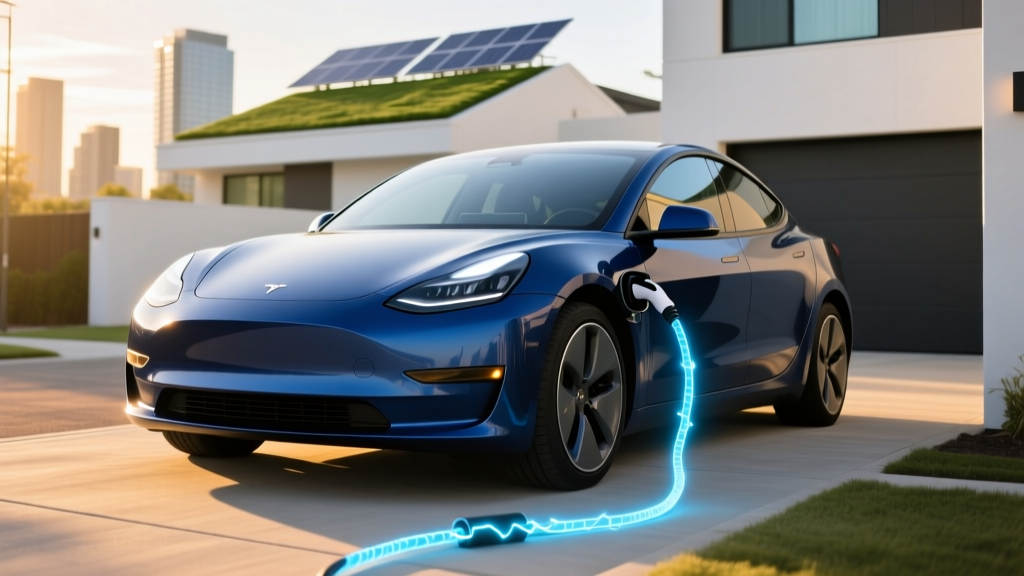
For home Level 2 charging, Tesla drivers using the Wall Connector on a 60A circuit get the full 11.5 kW (48A), adding roughly 44 miles of range per hour. A full charge from 10% takes about 7–8 hours — easily overnight. Tesla includes a NACS connector natively, and the car comes with a J1772 adapter for non-Tesla Level 2 stations. With Tesla opening Superchargers to other brands via a built-in CCS-to-NACS adapter (sold separately for older vehicles, included with the Model 3 for third-party DC networks), Tesla drivers can also use Electrify America and EVgo stalls, though at speeds limited by the Model 3's onboard charge acceptance.
Battery Chemistry: LFP vs NMC and What It Means for Tesla Drivers
The 2026 Model 3 lineup splits battery chemistry by trim, and this is one of the most consequential choices Tesla drivers make — even if many buyers don't realize it at purchase.
| Factor | LFP (RWD Trim) | NMC (Long Range / Performance) |
|---|---|---|
| Energy Density | Lower (smaller pack, less range) | Higher (more range per kg) |
| Cycle Life | 3,000+ cycles (excellent longevity) | 1,500–2,000 cycles |
| Daily Charge Recommendation | 100% OK (and recommended weekly) | 80–90% daily, 100% for trips |
| Cold Weather Performance | Weaker (more range loss, slower charge) | Better thermal resilience |
| Cobalt/Nickel Content | None (lower supply-chain risk) | Contains nickel & cobalt |
| Cost to Replace (out of warranty) | ~$12,000–$14,000 | ~$14,000–$18,000 |
For Tesla drivers in mild climates who charge primarily at home and want maximum battery longevity, the LFP-equipped RWD trim is arguably the smartest long-term play. LFP chemistry degrades more slowly, meaning you're likely to retain 90%+ of original capacity after 150,000 miles. For Tesla drivers who need maximum range for road trips, live in cold climates, or want AWD traction, the NMC Long Range is the clear pick.
All Model 3 trims carry Tesla's battery warranty: 8 years/100,000 miles for RWD and 8 years/120,000 miles for Long Range and Performance, with a guaranteed minimum 70% capacity retention over the warranty period. According to Tesla's Impact Report, the average Model 3 battery retains approximately 85% capacity at 150,000 miles — a strong data point for second-owner confidence.
Performance, Handling, and Daily Drivability
The Model 3's performance envelope is well-documented, but numbers only tell part of the story. The RWD trim's 5.8-second 0–60 mph time is quick by any commuter-sedan standard, and the instant torque delivery makes it feel even faster in stoplight-to-stoplight driving. The Long Range AWD at 4.2 seconds provides confident highway merging and passing, while the Performance trim's 2.9-second sprint enters sports-car territory.
The Highland refresh (introduced for the 2024 model year and carried forward into 2026) substantially improved ride quality. Tesla drivers who tested pre-refresh models will notice a quieter cabin (acoustic glass all around), retuned dampers that absorb sharp impacts without sacrificing body control, and a new steering rack that offers better on-center feel. The Model 3's low center of gravity (battery pack under the floor) keeps body roll minimal, though the ride is firm by luxury-sedan standards — this is a sporty compact, not a cruiser.
Regenerative braking remains strong and essentially enables one-pedal driving in most conditions. Tesla removed the driver-selectable regen mode in recent software updates, meaning Tesla drivers get a single, aggressive regen profile. Most owners adapt within a day, but if you're transitioning from an EV with adjustable regen (like a Hyundai or BMW), expect a brief adjustment period.
Interior, Tech, and Cargo: The Minimalist Trade-Off
The Model 3's cabin is the most debated aspect of the car. The 15.4-inch center touchscreen handles virtually every function — climate, mirrors, glovebox, navigation, media — with no physical buttons or instrument cluster. A secondary 8-inch rear touchscreen for back-seat passengers was added in the Highland refresh. Tesla drivers who embrace the interface find it responsive and logically organized; traditionalists find the lack of physical HVAC controls frustrating, especially while driving.
Cargo and Passenger Dimensions:
- Front headroom: 40.3 in | Front legroom: 42.7 in
- Rear headroom: 37.8 in | Rear legroom: 35.2 in
- Trunk (rear): 21.0 cu ft (including under-floor storage)
- Front trunk (frunk): 3.1 cu ft
- Total cargo: 24.1 cu ft
Compared to the Hyundai Ioniq 6 (12.3 cu ft trunk) or the BMW i4 (16.6 cu ft), the Model 3's cargo space is generous for a compact sedan. The 60/40 split-folding rear seats expand utility for longer items, though the trunk opening is relatively narrow.
Standout Tech Features:
- Autopilot (standard): SAE Level 2 driver assist with adaptive cruise, lane centering, and automatic emergency braking. Competent on highways but requires constant driver supervision.
- Full Self-Driving Supervised ($8,000 option): Adds automatic lane changes, navigate-on-Autopilot, traffic light/stop sign recognition, and the FSD (Supervised) city-street capability. Still SAE Level 2 — the driver must remain fully engaged at all times.
- Sentry Mode: 360° camera-based security recording when parked.
- Over-the-air updates: Regular feature additions and performance improvements.
- Dashcam and built-in recording: No aftermarket hardware needed.
Important — SAE Automation Level: Tesla Autopilot and FSD (Supervised) are SAE Level 2 driver-assistance systems. The driver must keep hands on or near the wheel, monitor the road, and be prepared to take over instantly. These are not self-driving systems. Only SAE Level 4 services like Waymo operate without a driver, and only in geofenced areas.
Notable Drawbacks:
- No physical buttons for climate, mirrors, or wipers — all screen-controlled
- No Apple CarPlay or Android Auto (Tesla's native ecosystem only)
- Rear visibility is limited; rely on the backup camera
- Turn-signal stalks removed in Highland refresh — signals are now on the steering wheel (controversial among Tesla drivers)
- Insurance costs tend to run 15–25% higher than comparable non-Tesla sedans
Pricing, Trims, and Federal Tax Credit Eligibility
| Trim | Base MSRP | As-Tested (typical config) | Est. Federal Credit (§30D) | Effective Price |
|---|---|---|---|---|
| RWD (Standard Range) | $38,990 | $39,990 (w/ paint + wheels) | Up to $7,500* | ~$32,490* |
| Long Range AWD | $47,740 | $50,740 (w/ FSD, paint) | Up to $7,500* | ~$43,240* |
| Performance AWD | $54,990 | $57,490 (w/ paint, wheels) | Up to $7,500* | ~$49,990* |
*Federal tax credit eligibility depends on buyer income, battery component sourcing, and critical mineral requirements under IRS §30D. Credit may be $0, $3,750, or $7,500 depending on sourcing compliance. Point-of-sale transfer available at participating dealers. Verify current rules at IRS.gov.
§30D Federal EV Tax Credit Requirements (2026):
- MSRP Cap: Sedan MSRP must not exceed $55,000 (all Model 3 trims qualify at base; Performance with options may exceed — verify before purchase)
- Buyer Income Cap: Modified AGI ≤ $150,000 (single) / $225,000 (head of household) / $300,000 (joint)
- Battery Sourcing: $3,750 requires critical minerals from US/FTA partners; additional $3,750 requires battery components manufactured in North America. Sourcing percentages change annually — Tesla's LFP cells (CATL, China) may not qualify for the full $7,500 on the RWD trim.
- Point-of-Sale Transfer: Buyers can transfer the credit to the dealer at purchase for an immediate price reduction, rather than waiting to claim on their tax return.
- Foreign Entity of Concern (FEOC): Battery components from FEOC entities disqualify the credit. This rule tightens annually.
The tax credit situation for Tesla drivers is nuanced. The Long Range AWD, with its NMC battery assembled at Tesla's Nevada and Texas Gigafactories, has historically qualified for the full $7,500. The RWD trim's LFP battery, sourced from CATL in China, faces increasing scrutiny under FEOC and critical-mineral rules — Tesla drivers targeting the RWD trim should verify current eligibility on fueleconomy.gov before purchasing, as the credit amount may be $3,750 or $0 depending on the model year's sourcing percentages.
Tesla Model 3 vs. Key Competitors: Is It Still the Default?
| Spec | Tesla Model 3 LR AWD | Hyundai Ioniq 6 SEL AWD | BMW i4 xDrive40 |
|---|---|---|---|
| EPA Range | 363 mi | 316 mi | 282 mi |
| Battery | ~75 kWh NMC | 77.4 kWh NMC | 81.5 kWh NMC |
| Peak DC Charge | 250 kW | 350 kW (800V) | 205 kW |
| 10–80% DC Time | ~25 min | ~18 min | ~31 min |
| 0–60 mph | 4.2 sec | 5.1 sec | 4.7 sec |
| MPGe (combined) | 132 MPGe | 111 MPGe | 98 MPGe |
| Base MSRP | $47,740 | $46,500 | $57,900 |
| Charging Network | Supercharger (native) | CCS → NACS adapter | CCS → NACS adapter |
The Model 3 Long Range still leads its segment in efficiency (MPGe) and real-world range per dollar. The Ioniq 6 charges significantly faster thanks to its 800V architecture — a meaningful advantage on road trips where 18-minute vs. 25-minute stops add up. The BMW i4 offers a more traditional luxury interior with physical controls and Apple CarPlay, but at a $10,000+ premium with less range.
Choose the Tesla Model 3 if: You prioritize maximum range per dollar, Supercharger network reliability, over-the-air updates, and best-in-class efficiency. You're comfortable with a screen-centric interface and don't need CarPlay.
Choose the Hyundai Ioniq 6 if: You want the fastest DC charging in the segment, prefer physical buttons alongside a touchscreen, and value Hyundai's 10-year/100,000-mile powertrain warranty.
Choose the BMW i4 if: You want a traditional luxury-brand experience, premium interior materials, Apple CarPlay, and don't mind paying more for less range.
Pros, Cons, and Who This EV Suits Best
Pros
- Class-leading EPA range and efficiency (132 MPGe)
- Supercharger network access — best uptime in North America
- Strong performance across all trims (2.9–5.8 sec 0–60)
- Regular OTA updates add features post-purchase
- LFP battery option offers exceptional cycle life for RWD buyers
- Competitive pricing, especially after potential $7,500 credit
- Spacious trunk (21 cu ft) for a compact sedan
Cons
- Screen-only controls (no physical buttons or stalks for signals)
- No Apple CarPlay or Android Auto
- Insurance costs 15–25% above segment average
- LFP RWD battery struggles in cold weather
- FSD (Supervised) remains Level 2 despite the name and $8,000 price
- Build quality improved but still inconsistent vs. legacy luxury brands
- Turn-signal buttons on steering wheel are unintuitive for many Tesla drivers
Who the Model 3 suits best:
- Commuters: The RWD trim at ~$32,500 (after credit) is one of the cheapest ways into a 270+ mile EV with low running costs.
- Road-trip families: Long Range AWD with 363 miles EPA and Supercharger access makes 400-mile days comfortable with one 25-minute stop.
- Tech-forward buyers: OTA updates, Sentry Mode, and the Tesla app ecosystem are unmatched for connected-car features.
- Not ideal for: Buyers who need physical controls, CarPlay, or a luxury-badge experience. Also not the best choice for extreme cold-climate buyers who should consider the Long Range NMC over the LFP RWD.
Frequently Asked Questions
What is the real-world range of the 2026 Tesla Model 3?
EPA estimates are 272 mi (RWD), 363 mi (Long Range AWD), and 315 mi (Performance). In real-world highway driving at 70–75 mph, Tesla drivers typically see 230–250 mi (RWD), 300–320 mi (Long Range), and 260–280 mi (Performance). Cold weather below 35°F reduces these figures by 15–30%, with LFP batteries hit hardest.
How fast does the Model 3 charge at home and on the road?
At home on a Level 2 (240V, 48A) Wall Connector, the Model 3 charges at 11.5 kW, adding about 44 miles of range per hour — a full overnight charge in 7–9 hours. On DC fast charging, the Long Range and Performance trims peak at 250 kW at a V3 Supercharger, achieving 10–80% in approximately 25 minutes. The RWD trim peaks at 170 kW with a similar 10–80% time but adds fewer total miles due to its smaller battery.
How much does the Model 3 cost after federal tax credits?
The RWD starts at $38,990, the Long Range at $47,740, and the Performance at $54,990. If you qualify for the full $7,500 federal tax credit under IRS §30D (income caps, MSRP caps, and battery-sourcing requirements all apply), effective prices drop to roughly $32,490 / $43,240 / $49,990. However, the RWD's LFP battery sourcing may limit its credit to $3,750 or $0 under current FEOC rules — always verify on fueleconomy.gov and consult a tax professional.
Does the Tesla Model 3 qualify for the federal EV tax credit?
It depends on the trim, your income, and current battery-sourcing rules. The Long Range AWD has historically qualified for the full $7,500 due to North American battery component manufacturing. The RWD's LFP cells from CATL face increasing FEOC restrictions. Buyer income must not exceed $150K (single) / $300K (joint), and the vehicle MSRP must stay under $55,000 for sedans. Point-of-sale transfer is available, letting you apply the credit at purchase rather than on your tax return.
Is the Tesla Model 3 worth buying vs. competitors in 2026?
For Tesla drivers who value range efficiency, Supercharger reliability, and connected tech, the Model 3 Long Range remains the segment benchmark. If fast DC charging is your priority, the Hyundai Ioniq 6's 18-minute 10–80% time on 350 kW chargers is meaningfully quicker. If you want luxury materials and physical controls, the BMW i4 is worth its premium. The Model 3 wins on total cost of ownership for most buyers, especially when the $7,500 credit applies.
Is Tesla Autopilot or FSD self-driving?
No. Both Autopilot and Full Self-Driving (Supervised) are SAE Level 2 driver-assistance systems. The driver must remain fully engaged, monitor the road, and be ready to take over at any moment. FSD (Supervised) can handle city streets, intersections, and lane changes, but it makes errors and requires constant supervision. Only SAE Level 4 robotaxi services like Waymo operate without a human driver, and only in specific geofenced cities.
How long will the Model 3 battery last?
Tesla warranties the battery for 8 years / 100,000 miles (RWD) or 8 years / 120,000 miles (Long Range / Performance) with a minimum 70% capacity retention guarantee. Tesla's fleet data shows average retention of approximately 85% at 150,000 miles. LFP batteries in the RWD trim are expected to last even longer (3,000+ charge cycles), potentially exceeding 200,000 miles before hitting the 70% threshold. Out-of-warranty replacement costs range from $12,000–$18,000 depending on the pack.