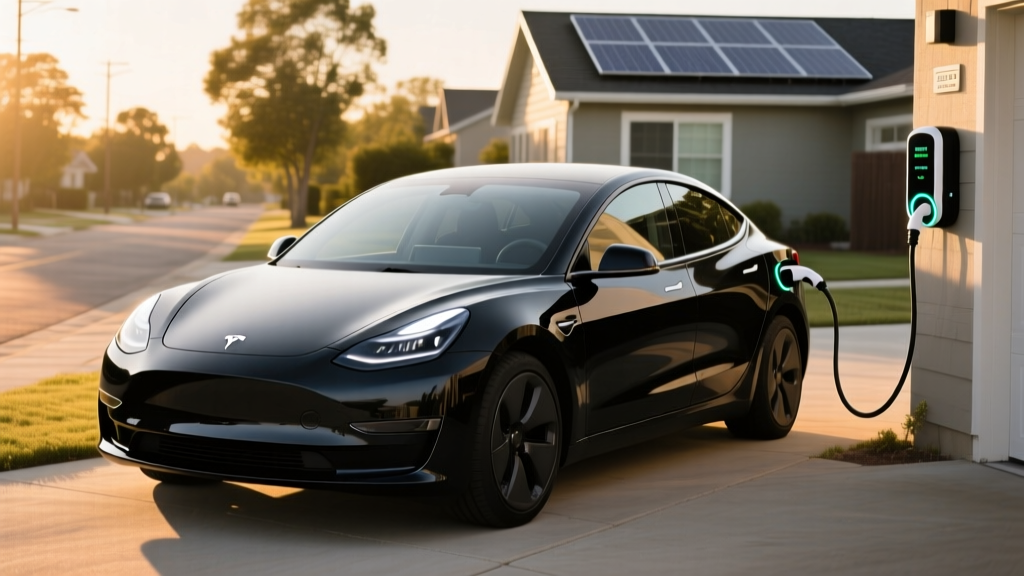
The Tesla Model 3 remains the default entry point into premium electric-vehicle ownership in 2026, but the landscape around it has shifted. Hyundai, BMW, and Polestar now challenge Tesla on range, interior quality, and charging speed. For buyers Googling tesla fast pass ev maintenance — essentially, "how do I keep a Tesla running cheaply and skip the dealership headaches?" — the Model 3's story is one of minimal scheduled maintenance, over-the-air updates, and a Supercharger network that still sets the reliability bar. But does the math still work in 2026?
2026 Tesla Model 3 At a Glance: Core Specs
| Spec | Value |
|---|---|
| EPA Range | 341 miles |
| Battery (usable) | ~75 kWh, NMC (2170 cells) |
| Peak DC Fast Charge | 250 kW |
| 10–80% DC Time | ~25 minutes |
| Level 2 Home Charge | 11.5 kW (~44 mi/hr) |
| 0–60 mph | 4.2 seconds |
| Horsepower | 346 hp (dual motor) |
| Drivetrain | Dual-motor AWD |
| Efficiency | 132 MPGe / 25 kWh/100 mi |
| Cargo (trunk + frunk) | 23 cu ft trunk + 3.1 cu ft frunk |
| Rear Legroom | 35.3 inches |
| Battery Warranty | 8 years / 120,000 miles (min 70% retention) |
| Base MSRP | $47,740 (Long Range AWD) |
Source: fueleconomy.gov and Tesla spec sheets.
Real-World Range vs. the EPA Sticker
Tesla's efficiency is among the best in the segment — 25 kWh/100 mi beats the Hyundai Ioniq 6 (27 kWh/100 mi) and the BMW i4 eDrive40 (28 kWh/100 mi). The heat pump, standard on the refreshed Model 3, reduces cold-weather range loss compared to earlier generations. Still, physics is physics: any EV loses 20–30% of range at 20°F, and the Model 3 is no exception. Buyers in northern climates should plan for a realistic 250-mile winter highway buffer.
Charging Speed: Supercharger Network vs. Home Level 2
| Level | Power (kW) | Miles Added per Hour | Typical Use Case |
|---|---|---|---|
| Level 1 (120V) | ~1.4 kW | ~5 mi/hr | Emergency / trickle |
| Level 2 (240V, 48A) | 11.5 kW | ~44 mi/hr | Overnight home charging |
| DC Fast (Supercharger V3) | Peak 250 kW | ~1,000 mi/hr (peak) | Road trips; 10–80% in ~25 min |
The Model 3's 250-kW peak charge rate is no longer class-leading — the Hyundai Ioniq 5 and Porsche Taycan pull 350 kW on compatible chargers. The Model 3's charge curve tapers hard above 80% SoC, so plan DC stops around the 10–80% window. Preconditioning via the built-in navigation (set Supercharger as destination) is essential; without it, peak rates drop by 30–50% in cool weather.
Access to the Tesla Supercharger network — over 6,000 U.S. stalls as of 2026 — remains a meaningful advantage. Reliability surveys consistently rank Superchargers above Electrify America and EVgo. With Tesla opening Superchargers to NACS-equipped non-Teslas, the exclusivity moat has shrunk, but the integrated navigation-routing experience still works best in a Tesla.
Performance, Ride, and Daily Drivability
The Long Range AWD's 4.2-second 0–60 mph time is brisk by any sedan standard, and the dual-motor torque vectoring delivers confident all-weather traction. The Performance trim ($54,740 MSRP) drops 0–60 to 2.9 seconds and adds Track Mode, adaptive dampers, and stickier rubber — a legitimate sports-sedan rival to the BMW i4 M50 at a lower price.
Ride quality improved noticeably with the "Highland" refresh: new bushings, revised damper tuning, and acoustic glass cut cabin noise by several dB. Rear-seat comfort is acceptable for adults on short trips but tight for long hauls — 35.3 inches of legroom trails the Hyundai Ioniq 6 (37.0 in).
Interior, Tech, and Driver Assistance
The minimalist cabin centers on a 15.4-inch touchscreen that handles everything from climate to glovebox release. The 2026 Model 3 retains physical turn-signal stalks (restored after the controversial wheel-button experiment in some markets). Ventilated front seats, a rear touchscreen for passengers, and ambient lighting are now standard on Long Range.
Autopilot (basic lane-keep + adaptive cruise) is standard. FSD (Supervised) remains a $8,000 option or $99/month subscription. Real-world FSD capability has improved on highways, but urban edge cases — construction zones, unprotected left turns — still require frequent takeovers. Competitors like GM's Super Cruise and Ford's BlueCruise offer comparable hands-off highway driving on mapped routes, often bundled at no extra cost.
Pricing, Trims, and Federal Tax Credit Eligibility
| Trim | MSRP | Est. §30D Credit | Effective Price |
|---|---|---|---|
| RWD (LFP) | $38,990 | Up to $7,500 | ~$31,490* |
| Long Range AWD | $47,740 | Up to $7,500 | ~$40,240* |
| Performance | $54,740 | Up to $7,500 | ~$47,240* |
*Credit eligibility depends on IRS §30D rules: buyer AGI caps ($150k single / $300k joint), vehicle MSRP cap ($55k for sedans), and battery critical-mineral + North American assembly sourcing requirements. The Model 3 qualifies for the full credit as of early 2026 for most buyers, but sourcing rules tighten annually. Confirm on IRS.gov or with a tax professional. Point-of-sale transfer is available at delivery.
Maintenance Costs: The "Fast Pass" Ownership Story
This is where the Model 3 still shines versus ICE and even some EV rivals. Tesla has no scheduled maintenance intervals — no oil, no spark plugs, no transmission fluid. The owner's manual recommends only:
- Cabin air filter: every 2 years (HEPA every 3 years)
- Tire rotation: every 6,250 miles
- Brake fluid check: every 3 years (regen braking extends pad life dramatically)
- A/C desiccant bag: every 6 years
Tesla's 2025 published estimated 5-year maintenance cost for the Model 3 is approximately $1,300, versus $3,500–$4,500 for a comparable BMW 3 Series or Audi A4. The "fast pass" pitch — minimal dealer visits, OTA software updates, mobile service for many repairs — holds up. The trade-off: Tesla service centers remain sparse in some regions, and body-shop wait times after collisions can stretch weeks. Insurance premiums average 15–25% higher than equivalent ICE sedans due to repair cost data; get a quote before signing.
Warranty and Battery Longevity
Tesla's battery and drive-unit warranty is 8 years / 120,000 miles (Long Range/Performance), with a guaranteed 70% capacity retention threshold. Real-world data from Tesla's impact reports shows average degradation of roughly 12% at 150,000 miles across the fleet — better than the warranty floor. The base RWD uses an LFP (lithium iron phosphate) pack: slightly lower energy density, but longer cycle life, and Tesla recommends regular 100% charges for LFP — a reversal of typical NMC care.
Pros and Cons
Pros
- Best-in-class Supercharger access and integrated routing
- Lowest scheduled-maintenance burden in the segment
- Class-leading efficiency (25 kWh/100 mi)
- Strong OTA updates add features post-purchase
- Full $7,500 §30D credit eligibility for most buyers
Cons
- 250-kW peak charge rate trails 350-kW rivals
- Rear seat legroom tight vs. Ioniq 6, BMW i4
- FSD (Supervised) expensive and still Level 2
- Insurance premiums above segment average
- No physical buttons; touchscreen-only controls
Who Should Buy the 2026 Model 3?
The Model 3 fits commuters and tech-forward buyers who prioritize charging-network reliability, low running costs, and software-driven features. Families needing max rear-seat space should test the Model Y or Ioniq 5. Road-trippers will appreciate Supercharger density. Budget buyers should look at the RWD trim with the LFP battery — ~$31,490 after credit is hard to beat for a 272-mile EV.
Frequently Asked Questions
What is the real-world range of the 2026 Tesla Model 3?
EPA-rated 341 miles for Long Range AWD. Real-world highway driving yields 290–310 miles; cold weather drops that to 240–270 miles. City driving with regen can exceed 330 miles.
How fast does the Model 3 charge at home and on DC?
Peak 250 kW DC (10–80% in ~25 minutes) on V3 Superchargers. Home Level 2 at 11.5 kW adds ~44 miles per hour, fully replenishing overnight.
Does the 2026 Model 3 qualify for the federal EV tax credit?
Yes, up to $7,500 under §30D for eligible buyers (AGI under $150k single / $300k joint; sedan MSRP cap $55k). Battery sourcing rules apply — verify at irs.gov before purchase.
Is the Model 3 worth buying over the Ioniq 6 or BMW i4?
Choose the Model 3 for Supercharger access, low maintenance, and software. Choose the Ioniq 6 for 350-kW charging and rear space, or the i4 for traditional luxury build and physical controls.
What are typical annual maintenance costs?
Roughly $250–$300/year on average over 5 years (~$1,300 total), mostly tires and cabin filters. No oil, coolant, or scheduled dealer service intervals.