The Tesla Model 3 remains one of the most popular electric vehicles on the road, and for good reason: it's efficient, quick, and backed by one of the most robust charging networks available. But for buyers evaluating long-term ownership, one question dominates the research phase: how many miles does a Tesla Model 3 last?
The answer depends on two very different metrics — how far it goes on a single charge (range), and how long the vehicle and its battery survive over years of ownership (lifespan). This review covers both, with exact EPA figures, real-world range expectations, battery chemistry details, and degradation data drawn from high-mileage fleet reports and Tesla's own battery impact data.
2026 Tesla Model 3 Quick Specs
| Specification | RWD (Base) | Long Range AWD | Performance AWD |
|---|---|---|---|
| EPA Range | 341 miles | 363 miles | 315 miles |
| Battery Capacity (usable) | ~60 kWh (LFP) | ~79 kWh (NMC) | ~79 kWh (NMC) |
| 0-60 mph | 5.8 sec | 4.2 sec | 2.9 sec |
| Horsepower | 283 hp | 440 hp | 510 hp |
| Drivetrain | Rear-Wheel Drive | Dual-Motor AWD | Dual-Motor AWD |
| Efficiency (MPGe combined) | 132 MPGe | 125 MPGe | 118 MPGe |
| Efficiency (kWh/100 mi) | 25 kWh | 27 kWh | 29 kWh |
| Max DC Fast Charge | 170 kW | 250 kW | 250 kW |
| 10-80% DC Charge Time | ~25 min | ~22 min | ~22 min |
| Level 2 Home Charge Rate | 11.5 kW (~44 mi/hr) | 11.5 kW (~44 mi/hr) | 11.5 kW (~44 mi/hr) |
| Base MSRP | $38,990 | $45,990 | $53,990 |
| Battery Warranty | 8 yr / 100,000 mi | 8 yr / 120,000 mi | 8 yr / 120,000 mi |
EPA Range vs. Real-World Miles: What Owners Actually See
The EPA's official fuel-economy data rates the Model 3 Long Range at 363 miles — among the highest of any mainstream EV sedan. The base RWD achieves 341 miles from a smaller LFP pack, which is remarkable efficiency for the price point.
But EPA range is measured on a standardized dynamometer cycle that doesn't fully capture real-world variables. Here's what actually changes your mile count:
- Highway speed: Aerodynamic drag increases with the square of velocity. At 80 mph, the Model 3 consumes roughly 15–20% more energy per mile than at 65 mph.
- Cold weather: Lithium-ion batteries lose efficiency in cold temperatures, and cabin heating (even with the Model 3's heat pump) draws significant energy. Expect 20–30% range loss below freezing, with the worst impact on short trips where the cabin must heat from cold repeatedly.
- Elevation and terrain: Mountain passes consume far more energy climbing than you recapture descending via regenerative braking. Net range loss on hilly routes is typically 10–15%.
- Tire choice: Aftermarket all-season or winter tires increase rolling resistance. Owners report 5–10% range reduction versus the stock low-rolling-resistance rubber.
For daily commuting under 80 miles round-trip, even the base RWD provides a massive buffer. The range question only becomes critical on road trips exceeding 250 miles in cold or high-speed conditions — and Tesla's Supercharger network largely mitigates that concern.
Battery Chemistry: LFP vs. NMC and What It Means for Longevity
One of the most consequential decisions Tesla made with the current Model 3 lineup was splitting battery chemistry by trim. The base RWD uses a lithium iron phosphate (LFP) battery, while the Long Range and Performance trims use nickel manganese cobalt (NMC).
| Factor | LFP (RWD) | NMC (Long Range / Performance) |
|---|---|---|
| Energy Density | Lower (heavier pack for same kWh) | Higher (lighter, more range) |
| Cycle Life | 3,000–5,000+ cycles | 1,000–2,000 cycles |
| Daily Charging Recommendation | 100% OK (Tesla recommends weekly 100%) | 80% daily; 100% for trips only |
| Cold-Weather Performance | Slightly worse range retention | Better cold-weather range |
| Long-Term Degradation | Slower — ~5–8% over 200k miles | Moderate — ~8–12% over 200k miles |
| Cobalt Content | None | Contains cobalt |
The LFP chemistry in the RWD model is a major longevity advantage. LFP cells tolerate repeated full charges without accelerated degradation, and their cycle life is substantially higher. Tesla explicitly recommends charging LFP-equipped Model 3s to 100% at least once per week for battery calibration. This means the RWD owner gets a usable 341-mile range daily, while NMC owners should buffer at 80% (~290 miles effective) for routine use.
For the question of how many miles a Tesla Model 3 battery lasts, LFP chemistry is the clear winner. High-mileage data from fleet operators and Tesla's own Impact Reports suggest LFP packs retain roughly 92–95% of original capacity after 200,000 miles. NMC packs in the Long Range typically show 88–92% retention at the same mileage — still strong, but measurably more degradation.
How Fast Does the Model 3 Charge? DC Fast and Home Charging
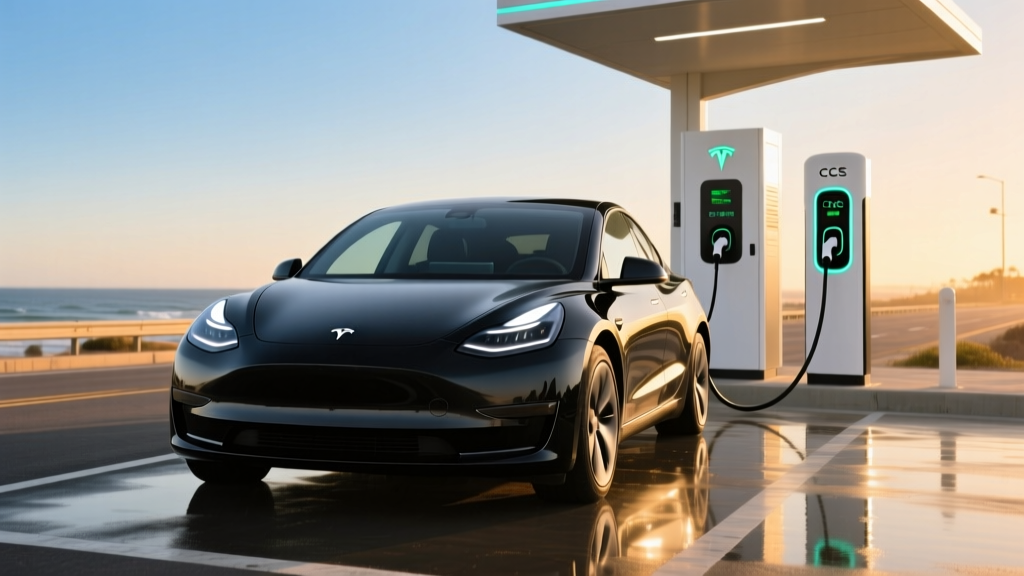
Charging speed is where trim differences matter significantly. The RWD's LFP battery tops out at 170 kW on DC fast chargers, while the Long Range and Performance accept up to 250 kW at V3 Superchargers.
| Charging Method | Power (kW) | Miles Added per Hour | Notes |
|---|---|---|---|
| Level 1 (120V household) | ~1.4 kW | ~3–5 mi/hr | Emergency/trickle only |
| Level 2 (240V, 48A Wall Connector) | 11.5 kW | ~44 mi/hr | Full charge in 6–8 hours |
| DC Fast (RWD max) | 170 kW peak | ~650 mi/hr peak | 10-80% in ~25 min |
| DC Fast (Long Range/Perf max) | 250 kW peak | ~1,000 mi/hr peak | 10-80% in ~22 min |
A critical nuance: peak charge rate is not sustained charge rate. The Model 3 Long Range may hit 250 kW briefly between 10–20% state of charge, but the charge curve tapers significantly above 50%, dropping below 100 kW past 70%. The 10-80% time of approximately 22 minutes reflects this taper. Planning a road trip? Budget 25–30 minutes per Supercharger stop, not the 15 minutes some marketing materials imply.
For home charging, Tesla's Wall Connector at 48 amps delivers 11.5 kW — adding roughly 44 miles of range per hour. Most owners charging overnight on a Level 2 circuit wake to a full battery regardless of trim. Installation typically costs $500–$2,000 depending on panel capacity and run length; a 200-amp electrical panel is usually sufficient, but older homes may need a panel upgrade ($1,500–$3,000). Consult a licensed electrician for your specific setup.
How Many Total Miles Will a Tesla Model 3 Last?
Beyond single-charge range, the bigger ownership question is total vehicle lifespan. Based on available data from high-mileage owners, fleet operators, and Tesla's own reporting, here's what we know:
Battery lifespan: Tesla's battery warranty guarantees at least 70% capacity retention over 8 years or 100,000–120,000 miles (depending on trim). In practice, the vast majority of Model 3 batteries far exceed this floor. Data aggregated from owner forums and fleet studies show:
- At 100,000 miles: Most Model 3 packs show 3–7% degradation (93–97% state of health).
- At 150,000 miles: Typical degradation is 5–10%, with LFP packs on the lower end.
- At 200,000 miles: NMC packs average 8–12% loss; LFP packs average 5–8% loss.
- At 300,000+ miles: A growing number of Model 3s have surpassed this mark on the original battery, particularly LFP-equipped examples used in fleet service.
Drive unit lifespan: Tesla's electric motors have fewer moving parts than internal combustion engines. The permanent magnet synchronous motors in the Model 3 are rated for well beyond 300,000 miles. Early Model 3 drive units had some bearing issues, but the refreshed Highland architecture has addressed most reported failure modes.
Overall vehicle lifespan: With proper maintenance (cabin air filter, brake fluid checks, tire rotation, coolant service), a Model 3 is realistically a 200,000–300,000+ mile vehicle. The limiting factor is rarely the battery or motors — it's typically body condition, suspension wear, and whether the owner chooses to invest in repairs on a high-mileage vehicle. The Model 3's relatively low maintenance cost (no oil changes, minimal brake wear due to regenerative braking) makes high-mileage ownership more economically viable than comparable gas sedans.
Battery replacement cost: If a pack does fail outside warranty, out-of-pocket replacement currently runs $12,000–$16,000 including labor at Tesla service centers. Third-party EV repair shops are beginning to offer module-level repairs for $3,000–$7,000, though availability varies by region.
Pricing, Trims, and Federal Tax Credit Eligibility
| Trim | Base MSRP | As-Tested (typical config) | Est. After §30D Credit |
|---|---|---|---|
| RWD | $38,990 | $40,490 (with paint upgrade) | ~$31,490–$32,990 |
| Long Range AWD | $45,990 | $48,490 (with FSD transfer) | ~$38,490–$40,990 |
| Performance AWD | $53,990 | $56,490 (with wheels/paint) | ~$46,490–$48,990 |
Federal EV tax credit eligibility under IRS §30D is nuanced and trim-dependent. Here's the current eligibility checklist:
- MSRP cap: Sedans must be at or below $55,000 MSRP. The RWD and Long Range qualify; the Performance trim at $53,990 base qualifies, but adding options can push it above the cap.
- Buyer income cap: Modified adjusted gross income must not exceed $150,000 (single), $225,000 (head of household), or $300,000 (joint filers).
- Battery sourcing requirements: A percentage of critical minerals and battery components must be sourced from the U.S. or free-trade-agreement countries. Tesla has progressively shifted Model 3 battery supply chains, but the exact credit amount ($3,750 or $7,500) depends on whether the vehicle meets both the critical-minerals and battery-component requirements for the current tax year. Check the latest IRS guidance at purchase time, as these thresholds tighten annually.
- Point-of-sale transfer: Buyers can transfer the credit to the dealer at purchase, reducing the upfront cost rather than waiting for a tax refund.
The RWD Model 3 at roughly $31,000–$33,000 after the full credit is one of the most affordable long-range EVs available, undercutting most competitors by a wide margin.
Interior, Tech, and Daily Livability
The Model 3's interior is minimalist by design — a single 15.4-inch center touchscreen handles all infotainment, climate, and vehicle controls. There's no traditional instrument cluster; speed and navigation information appears on the left side of the main screen. The refreshed Highland body style improved cabin materials, added ventilated front seats, ambient lighting, and a rear passenger touchscreen.
Cargo space: 23.0 cubic feet behind the rear seats (including the frunk), which is competitive with compact luxury sedans but less than hatchback rivals like the Hyundai Ioniq 5 or Tesla's own Model Y.
Passenger space: Front legroom is generous at 42.2 inches. Rear legroom at 35.3 inches is adequate for adults on shorter trips but tighter than midsize competitors. The panoramic glass roof creates an airy feel but does reduce headroom slightly for taller rear passengers.
Driver assistance: Tesla's Autopilot (included) provides adaptive cruise control and lane centering. Full Self-Driving (Supervised) is a $8,000 option or $99/month subscription that adds automated lane changes, traffic light recognition, and city street navigation. This is a SAE Level 2 system — the driver must remain attentive and keep hands on the wheel at all times. It is not autonomous driving.
Notable drawbacks: The turn-signal buttons on the steering wheel (rather than a traditional stalk) draw persistent criticism. The lack of Apple CarPlay/Android Auto is a dealbreaker for some buyers. Ride quality on the Performance trim with 20-inch wheels is firm on rough pavement. And Tesla's build quality, while improved, still shows occasional panel-gap variation that buyers in this price range may find frustrating.
How the Model 3 Stacks Up Against Key Competitors
The Model 3's closest competitors include the Hyundai Ioniq 6, BMW i4, and Polestar 2. Here's how they compare on the metrics that matter most:
| Metric | Tesla Model 3 LR | Hyundai Ioniq 6 SE LR | BMW i4 eDrive40 | Polestar 2 LR DM |
|---|---|---|---|---|
| EPA Range | 363 mi | 361 mi | 301 mi | 276 mi |
| Starting MSRP | $45,990 | $42,715 | $52,200 | $49,900 |
| DC Fast Charge Peak | 250 kW | 233 kW | 205 kW | 205 kW |
| 10-80% Time | ~22 min | ~18 min | ~31 min | ~28 min |
| Charging Network | Supercharger (native) | NACS adapter needed | NACS adapter needed | NACS adapter needed |
| 0-60 mph | 4.2 sec | 6.1 sec | 5.5 sec | 4.3 sec |
The Ioniq 6 is the closest range competitor and charges slightly faster on compatible 800V chargers, but it lacks native Supercharger access (an adapter is required). The BMW i4 offers a more traditional luxury interior but sacrifices range and costs more. The Polestar 2 has distinctive Scandinavian design but trails significantly on range.
- You want maximum range per dollar
- Supercharger network access matters for road trips
- You prefer over-the-air updates and a tech-forward cabin
- You want the strongest real-world battery longevity data
- You need CarPlay/Android Auto
- You prefer traditional controls (turn signal stalks, physical buttons)
- Rear-seat space is a top priority (consider Model Y or Ioniq 5)
- You want a luxury-badge interior (BMW i4, Mercedes EQB)
Frequently Asked Questions
Does the Tesla Model 3 qualify for the federal EV tax credit?
The RWD and Long Range trims generally qualify for some or all of the $7,500 §30D credit, subject to buyer income limits, MSRP caps (under $55,000 for sedans), and battery-sourcing requirements that tighten each year. The Performance trim is close to the MSRP cap and may not qualify if options push it over. Always verify current eligibility on IRS.gov before purchasing, as rules change annually.
How much does a Tesla Model 3 battery replacement cost?
Out-of-warranty battery replacement runs $12,000–$16,000 at Tesla service centers. However, battery failures requiring full replacement are rare. Most high-mileage Model 3s retain 85–95% of original capacity at 200,000 miles, and the 8-year warranty covers defects and excessive degradation (below 70% capacity).
Is the Tesla Model 3 good in cold weather?
The Model 3's heat pump (standard on all current trims) significantly improves cold-weather efficiency compared to resistive heating. Expect 20–30% range reduction in sub-freezing conditions, which is typical for EVs. Preconditioning the battery while plugged in mitigates charging-speed loss in cold weather. LFP packs in the RWD are slightly more range-sensitive to cold than NMC, but the difference is modest in daily driving.
How does the Model 3's range hold up after 100,000 miles?
Based on aggregated owner data, most Model 3 batteries show 3–7% degradation at 100,000 miles. A Long Range that started at 363 EPA miles would typically still deliver 337–350 miles on a full charge. LFP-equipped RWD models tend to degrade slightly less. This is well within the warranty threshold of 70% retention.
Should I buy the RWD or Long Range?
The RWD at ~$39,000 (potentially ~$31,500 after tax credit) offers the best value in the EV market — 341 miles of range, LFP longevity, and lower cost. Choose the Long Range if you need all-wheel drive for snow/ice, want the extra 22 miles of range for frequent road trips, or prefer the stronger acceleration (4.2 sec 0-60). The Performance trim is for driving enthusiasts who prioritize speed over range and efficiency.