Search "how much money is a Tesla" and you'll find a tangle of outdated prices, expired incentives, and trim reshuffles. Tesla adjusts pricing more frequently than legacy automakers, and federal tax credit rules under IRS §30D have tightened around battery sourcing and income caps. This guide cuts through the noise with 2026 Model 3 pricing, real-world range data, charging speeds, and exactly what you'll pay after credits.
The 2026 Tesla Model 3 starts at $38,990 for the Rear-Wheel Drive (RWD) trim and climbs to $52,990 for the Performance all-wheel-drive variant. But the sticker price is only half the story — federal tax credits, state incentives, and charging costs reshape the true cost of ownership.
2026 Tesla Model 3 Pricing by Trim
Tesla's pricing has stabilized after years of volatility. Here's where each trim lands for the 2026 model year, before destination fees ($1,390) and any incentives:
| Trim | Base MSRP | Drivetrain | EPA Range | 0-60 mph |
|---|---|---|---|---|
| Model 3 RWD | $38,990 | Rear-Wheel Drive | 272 mi | 5.8 sec |
| Model 3 Long Range AWD | $44,990 | Dual Motor AWD | 341 mi | 4.2 sec |
| Model 3 Performance | $52,990 | Dual Motor AWD | 315 mi | 2.9 sec |
All trims include Tesla's basic Autopilot (lane centering + adaptive cruise). Full Self-Driving (Supervised) remains a $8,000 add-on — and yes, it's still SAE Level 2, meaning you must stay engaged at all times.
Federal Tax Credit: Does the Model 3 Qualify?
The 2026 Model 3 RWD and Long Range AWD currently qualify for up to $7,500 under IRS §30D, but eligibility hinges on three moving targets:
- MSRP cap: Sedans must be under $55,000. All Model 3 trims clear this bar.
- Buyer income cap: Modified AGI cannot exceed $150,000 (single), $225,000 (head of household), or $300,000 (joint). Exceed these and the credit phases out.
- Battery sourcing: Critical minerals and battery components must meet escalating domestic-content thresholds. Tesla's shift to LFP cells from CATL (China) for the RWD trim has complicated eligibility — verify current sourcing status on the fueleconomy.gov credit lookup before purchasing.
| Trim | MSRP | Est. Federal Credit | Effective Price |
|---|---|---|---|
| Model 3 RWD | $38,990 | $7,500* | $31,490 |
| Model 3 Long Range AWD | $44,990 | $7,500* | $37,490 |
| Model 3 Performance | $52,990 | $7,500* | $45,490 |
*Credit eligibility varies by buyer income, battery sourcing compliance, and point-of-sale transfer rules. Confirm with your tax professional and the IRS §30D guidance before purchase.
The credit can now be transferred to the dealer at point of sale, reducing your upfront cost rather than waiting for a tax refund. This is a significant cash-flow advantage if you qualify.
Real-World Range vs. EPA Estimates
EPA Estimate: 272 mi (RWD) / 341 mi (Long Range) / 315 mi (Performance)
Real-World Expectation: Plan for 230-250 mi on the RWD trim in mixed highway driving, and roughly 280-310 mi on the Long Range. Cold weather (below 32°F) can shave 20-30% off these figures due to cabin heating demand and reduced battery efficiency. In summer city driving with regen braking, you may match or slightly exceed EPA numbers.
The RWD trim uses a ~60 kWh LFP (lithium iron phosphate) battery pack. LFP chemistry trades energy density for longevity — it tolerates daily 100% charging better than NMC and shows slower long-term degradation, but you'll feel the range gap versus the Long Range's ~79 kWh NMC pack.
Efficiency-wise, the RWD achieves 132 MPGe combined (25 kWh/100 mi), while the Long Range AWD lands at 130 MPGe combined (26 kWh/100 mi) per EPA data. These are among the most efficient EVs on the market — Tesla's heat pump and thermal management system deserve credit here.
Charging Speed: DC Fast Charge and Home Level 2
Charging speed is where Tesla's Supercharger network advantage shows — but the Model 3's onboard architecture also matters. Here's what to expect:
| Charging Method | Max Power | Speed / Time |
|---|---|---|
| DC Fast Charge (Supercharger V3/V4) | 170 kW (RWD) / 250 kW (LR/Perf) | 10-80% in ~25 min (RWD) / ~18 min (LR) |
| Level 2 Home (240V, 48A) | 11.5 kW | ~44 miles of range per hour |
| Level 1 (120V standard outlet) | ~1.4 kW | ~4-5 miles per hour (emergency use only) |
A critical nuance: the RWD trim's LFP battery charges slower at peak (170 kW vs 250 kW) and sustains that peak for a shorter window. The charge curve tapers sharply above 80% State of Charge — this is normal battery management to protect cell health, but it means a "10-90%" session will take significantly longer than the 10-80% figure suggests.
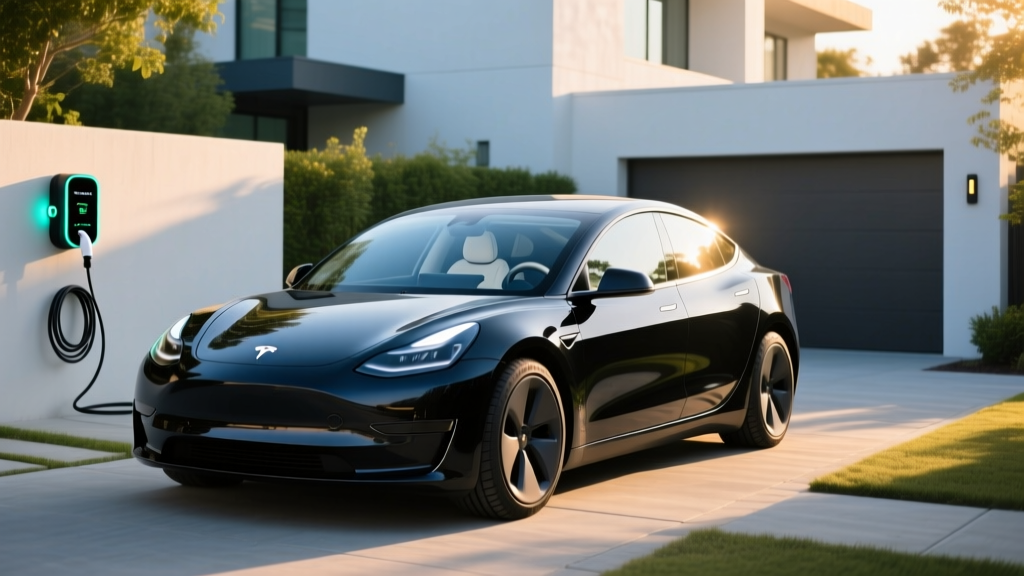
For home charging, Tesla's Wall Connector ($475) delivers up to 11.5 kW on a 60A circuit (48A continuous). A typical electrician installation runs $800-$2,000 depending on panel proximity and whether your home needs a service upgrade from 100A to 200A. Most Model 3 owners charge overnight and start each day at 80-100% SoC — eliminating routine public charging entirely.
Performance, Interior Space, and Tech
The Model 3 "Highland" refresh (introduced for 2024, carried into 2026) brought meaningful improvements: ventilated front seats, ambient lighting, rear touchscreen for passengers, acoustic glass for a quieter cabin, and a slightly retuned suspension that softens the ride without losing composure.
Performance figures:
- RWD: 283 hp, 5.8 sec 0-60 — adequate for commuting, unremarkable for a Tesla
- Long Range AWD: 384 hp, 4.2 sec 0-60 — the sweet spot for performance and efficiency
- Performance: 510 hp, 2.9 sec 0-60 — sports-car territory, with adaptive dampers and track mode
Cargo and passenger space:
- Cargo volume: 23 cu ft (trunk) + 3.1 cu ft (frunk) = 26.1 cu ft total
- Rear legroom: 35.3 inches — adequate for adults on shorter trips, tight for tall passengers on long hauls
- Front headroom: 40.3 inches
The 15.4-inch center touchscreen handles nearly all vehicle functions — there are no physical buttons for climate, mirrors, or glovebox. This minimalism divides buyers. The infotainment system is fast, includes Netflix/YouTube while parked, and supports Bluetooth audio (but no Apple CarPlay or Android Auto).
Driver assistance: Basic Autopilot is standard and competent for highway lane-keeping. FSD (Supervised) adds city-street navigation, traffic light recognition, and automatic turns — but it remains a Level 2 system requiring constant driver supervision. IIHS awarded the 2026 Model 3 Top Safety Pick+ with acceptable headlight ratings across all trims.
Pros
- Class-leading efficiency (25-26 kWh/100 mi)
- Supercharger network reliability — still the gold standard for road trips
- LFP battery on RWD trim allows routine 100% charging without degradation anxiety
- Over-the-air updates continuously add features
- Strong resale value relative to other EVs
Cons
- No Apple CarPlay / Android Auto — Tesla's ecosystem only
- Rear seat space is tight for adults over 6'0"
- RWD trim's 170 kW peak charge rate lags competitors at 200-350 kW chargers
- Panel gaps and paint quality still draw complaints, though improved post-Highland
- FSD (Supervised) is expensive ($8,000) and not truly autonomous
Warranty Coverage and Long-Term Costs
Tesla's warranty structure is straightforward:
- Basic vehicle: 4 years / 50,000 miles
- Battery and drive unit: 8 years / 100,000 miles (RWD) or 8 years / 120,000 miles (Long Range & Performance), with a minimum 70% capacity retention threshold
The 70% retention floor is standard across the industry — if your battery degrades below 70% of original capacity within the warranty period, Tesla will repair or replace it. Real-world data from high-mileage Teslas suggests most packs retain 85-90% capacity at 100,000 miles, though LFP packs on the RWD trim have less long-term field data.
Insurance costs remain a pain point. Model 3 premiums average 15-25% higher than comparable gas sedans due to repair costs (aluminum body panels, sensor recalibration after collisions). Get quotes before purchasing — the savings on fuel can evaporate if insurance runs $250+/month.
Model 3 vs. Key Competitors: Is It Worth Buying?
At $31,490 (after federal credit), the Model 3 RWD undercuts the Hyundai Ioniq 6 SE ($37,500 before credit) and BMW i4 eDrive35 ($52,200) while offering comparable or better efficiency. The Supercharger network remains a decisive advantage for road-trippers — though Tesla has opened the network to other brands via NACS adapters, reducing this moat.
If you prioritize rear-seat space, the Hyundai Ioniq 6 offers more legroom and physical buttons. If you want a premium badge and build quality, the BMW i4 is a step up (at nearly double the price). For pure value-per-mile of range, the Model 3 Long Range at $37,490 (after credit) is difficult to beat: 341 EPA miles, dual-motor AWD, and 250 kW peak charging.
Choose the Model 3 RWD if: You commute under 60 miles daily, charge at home, want the lowest entry price, and value LFP battery longevity over maximum range.
Choose the Model 3 Long Range AWD if: You take regular road trips, live in a cold climate (AWD + larger battery buffer), or simply want the best range-per-dollar ratio in the lineup.
Choose the Model 3 Performance if: You want sports-car acceleration and adaptive suspension, and are willing to sacrifice ~26 miles of range for it.
Look elsewhere if: You need CarPlay, regularly carry tall rear-seat passengers, or want physical climate controls.
Frequently Asked Questions
How much money is a Tesla Model 3 after all incentives?
The 2026 Model 3 RWD starts at $38,990. After the $7,500 federal tax credit (if you qualify based on income and battery sourcing), the effective price drops to ~$31,490 before destination fees. Some states offer additional rebates (California's CVRP, Colorado's $5,000 credit), but these vary by jurisdiction and income — check your state energy office for current programs.
What is the real-world range of the Model 3 Long Range?
The EPA rates it at 341 miles. In mixed highway driving at 70-75 mph, expect 290-310 miles. In cold weather (teens to low 30s°F), plan for 240-270 miles due to cabin heating and reduced battery efficiency. City driving with regenerative braking can match or slightly exceed the EPA figure.
How fast does the Model 3 charge at home?
On a Level 2 Tesla Wall Connector (240V, 48A), the Model 3 charges at up to 11.5 kW, adding roughly 44 miles of range per hour. A full overnight charge (8 hours) restores approximately 350 miles — more than enough for any trim's battery. Installation costs $800-$2,000 depending on electrical panel proximity.
Does the Model 3 qualify for the federal EV tax credit in 2026?
Yes, the RWD and Long Range trims currently qualify for up to $7,500 under IRS §30D, provided the buyer meets income caps ($150K single / $300K joint) and the battery meets critical-mineral sourcing thresholds. The credit can be applied at point of sale. Always verify current eligibility on fueleconomy.gov and with a tax professional, as sourcing rules can shift mid-year.
Is the Model 3 cheaper to own than a gas car?
Over 5 years, a Model 3 RWD charged mostly at home (national average $0.16/kWh) costs roughly $4,500 in electricity vs. $9,000+ in gasoline for a comparable 30 MPG sedan. Add in zero oil changes, fewer brake replacements (regen braking saves pads), and lower maintenance — but offset this with higher insurance premiums and potentially higher tire wear (EVs are heavier and deliver instant torque). Net savings typically run $3,000-$6,000 over 5 years depending on your local electricity and gas prices.
Should I buy FSD (Supervised)?
For most buyers, no — not yet. At $8,000, FSD (Supervised) is a Level 2 driver-assist system, not autonomous driving. Basic Autopilot (included) handles highway cruising well. FSD adds city-street capability but still requires constant supervision and makes occasional errors. Unless you commute in heavy stop-and-go traffic daily and value the convenience, wait for the technology to mature or for Tesla to offer a monthly subscription ($99/month) to trial it first.