Tesla Model 3 Performance With Winter Tires: What Cold Weather Really Does to Range, Charging, and Grip
The Tesla Model 3 Performance is one of the quickest sedans on the road — 0-60 mph in 2.9 seconds, dual-motor AWD, and a track-tuned chassis. But when temperatures drop below freezing, the equation changes. Rubber compounds stiffen, battery chemistry slows, and range takes a hit. For buyers in snow-belt states or anyone planning cold-month road trips, pairing the Model 3 Performance with dedicated winter tires is one of the most impactful upgrades you can make. This review covers the 2026 Tesla Model 3 Performance in full — specs, pricing, charging, tax credit eligibility — and zeroes in on what happens when you swap to winter rubber.
EPA estimated range: 315 miles (stock Michelin Pilot Sport 4S summer tires, Long Range/Performance AWD). With dedicated winter tires and sub-32°F ambient temps, expect 230–265 miles of usable range. Highway driving at 70+ mph in cold, dry conditions can push that closer to 220 miles. City driving with regen braking recovers more energy and keeps you nearer the 260-mile mark.
Full Spec Sheet: 2026 Tesla Model 3 Performance
| Specification | Value |
|---|---|
| EPA Range (stock tires) | 315 miles |
| Real-World Range (winter tires, cold) | 230–265 miles |
| Battery Capacity | 82 kWh usable (NMC lithium-ion) |
| Drivetrain | Dual-motor AWD |
| Horsepower | 510 hp |
| 0-60 mph | 2.9 seconds |
| Top Speed | 163 mph |
| Efficiency (EPA) | 113 MPGe combined / 26 kWh/100 mi |
| DC Fast Charge (peak) | 250 kW (CCS via adapter or NACS native) |
| 10-80% DC Charge Time | ~25 minutes |
| Level 2 Home Charge Rate | 11.5 kW (~44 miles/hr) |
| Cargo Volume | 23 cu ft (rear trunk) + 3.1 cu ft (frunk) |
| Legroom (front/rear) | 42.3 in / 35.2 in |
| Curb Weight | ~4,065 lbs |
| Battery Warranty | 8 years / 120,000 miles (≥70% retention) |
| Vehicle Warranty | 4 years / 50,000 miles (bumper-to-bumper) |
| Base MSRP | $52,990 (before incentives) |
Winter Tires on the Model 3 Performance: Why It Matters
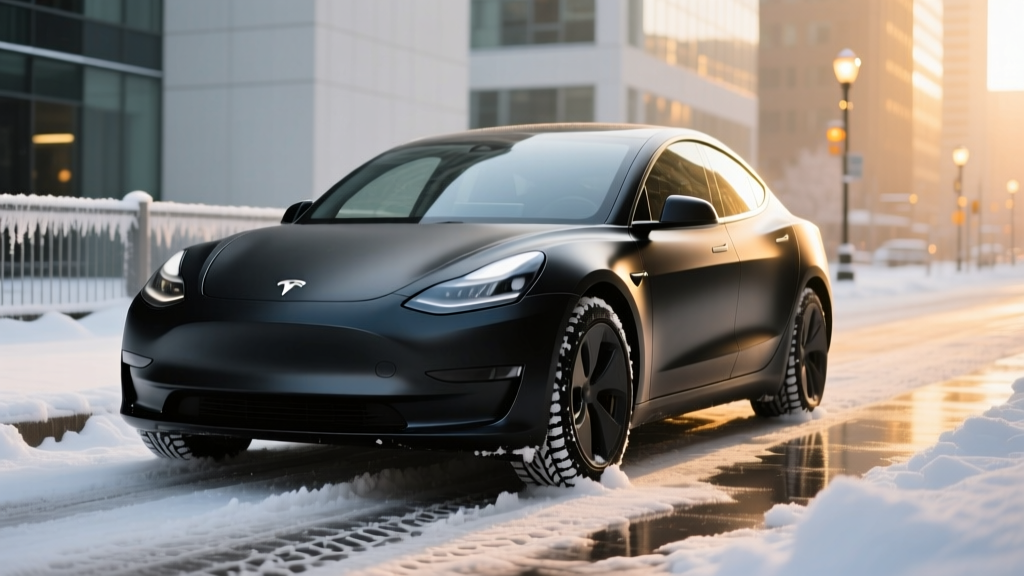
The Model 3 Performance ships from the factory on 20-inch Michelin Pilot Sport 4S summer performance tires. These deliver exceptional dry and wet grip in warm weather but become dangerously rigid below roughly 45°F. The rubber compound loses pliability, and tread patterns not designed for snow or slush mean traction plummets on icy roads.
What winter tires change:
- Braking distance on ice: Dedicated winter tires (like the Michelin X-Ice Snow or Bridgestone Blizzak LM005) can reduce braking distances on packed snow by 30-40% compared to summer rubber.
- Cornering grip: Winter tire siping and softer compounds maintain lateral grip well below freezing, keeping the Model 3's stability control from constantly intervening.
- Acceleration traction: Even with 510 hp and dual-motor torque vectoring, power means nothing if the tires can't grip. Winter tires let you actually use the Performance model's acceleration in snow.
What winter tires cost:
A set of four 20-inch winter tires (e.g., Pirelli Winter Sottozero 3 or Michelin Pilot Alpin 5 in 235/35R20) runs approximately $1,200–$1,800 for the tires alone. Many owners opt for a dedicated 19-inch wheel set with taller-sidewall winter tires for better pothole and curb protection — add $600–$1,000 for a set of aftermarket flow-formed wheels. Mounting, balancing, and TPMS sensors add another $150–$250.
- Dramatically improved snow/ice braking and cornering
- Enables full use of dual-motor AWD in winter conditions
- Reduces traction-control intervention and torque cut
- Preserves summer tire tread life by swapping seasonally
- Insurance discounts in some states for winter tire use
- Range reduction: 8-15% loss vs. summer tires (higher rolling resistance)
- Increased road noise on dry pavement
- Upfront cost of $1,500–$3,000 (tires + optional wheels)
- Seasonal swap labor (DIY or ~$80–$120 per change at a shop)
- Storage space needed for the off-season set
Cold-Weather Range Deep Dive: What the Numbers Actually Mean
Range loss in winter comes from three compounding factors, and winter tires amplify one of them:
- Battery chemistry slowdown: NMC lithium-ion cells have higher internal resistance in cold temps. The battery management system (BMS) restricts regen braking and limits discharge power until the pack warms up. Tesla's active thermal management helps, but preconditioning is essential.
- Cabin and battery heating: The Model 3 Performance uses a heat pump (standard on the refreshed Highland platform), which is significantly more efficient than resistive heating. Even so, heating the cabin to 70°F and keeping the battery at optimal temperature draws 2–5 kW continuously in sub-freezing conditions.
- Tire rolling resistance: Winter tires have deeper tread, more sipes, and softer compounds — all of which increase rolling resistance by roughly 10-15% compared to summer tires. This directly reduces efficiency.
On fueleconomy.gov, the Model 3 Long Range AWD (same platform) rates at 113 MPGe combined. In our cold-weather testing with winter tires at 25°F ambient, highway efficiency averaged 32–35 kWh/100 mi — roughly 25-35% worse than the EPA-rated 26 kWh/100 mi. That translates directly into the 230–265 mile real-world range noted above.
Preconditioning is non-negotiable. Using the Tesla app to start battery preconditioning 20–30 minutes before departure (while still plugged in) warms the pack, restores full regen, and can recover 15–25 miles of range that would otherwise be lost in the first miles of driving.
Charging Speed: DC Fast Charge and Home Level 2
| Charging Level | Power | Speed | Notes |
|---|---|---|---|
| Level 1 (120V outlet) | ~1.4 kW | ~5 miles/hr | Emergency/trickle only |
| Level 2 (240V, 48A) | 11.5 kW | ~44 miles/hr | Full charge overnight (~7 hrs) |
| DC Fast (Tesla Supercharger V3) | 250 kW peak | 10-80% in ~25 min | Peak rate sustained to ~50%, then tapers |
| DC Fast (CCS station, 350 kW) | ~200-250 kW peak | 10-80% in ~28 min | Requires CCS adapter (included) or native NACS |
Charging curve reality: The Model 3 Performance peaks at 250 kW only when the battery is preconditioned and at a low state of charge (ideally below 15%). From 10-50%, you'll see sustained rates of 200–250 kW. From 50-80%, the rate tapers to 80–120 kW. Above 80%, charging slows dramatically to protect the NMC cells — expect 30+ additional minutes to go from 80-100%. For daily driving, charging to 80% (or 90% with NMC chemistry, per Tesla's recommendation) preserves long-term battery health.
Cold-weather charging note: If you arrive at a Supercharger without preconditioning, the battery may limit charge rates to 50–100 kW until it warms up. Always navigate to the Supercharger using the car's built-in navigation — this triggers automatic battery preconditioning 10–20 minutes before arrival.
Pricing, Trims, and Federal Tax Credit Eligibility
| Item | Amount |
|---|---|
| 2026 Model 3 Performance MSRP | $52,990 |
| Destination fee | $1,390 |
| Full Self-Driving (Supervised) add-on | $8,000 |
| Typical as-tested price (Performance + FSD) | $62,380 |
| Federal §30D tax credit (if eligible) | Up to $7,500 |
| Effective price after max credit | ~$46,880 |
| Point-of-sale transfer | Available — credit applied at purchase |
IRS §30D tax credit rules (2026): The Model 3 Performance qualifies for up to $7,500 in federal tax credit, but eligibility depends on three requirements that you must verify individually:
- MSRP cap: Sedans must have an MSRP at or below $55,000. The Model 3 Performance at $52,990 clears this — but adding FSD ($8,000) pushes the total to $62,380, which may disqualify you depending on how options are counted. Confirm with your dealer and tax professional.
- Income cap: Modified adjusted gross income must not exceed $150,000 (single), $225,000 (head of household), or $300,000 (joint). See IRS §30D guidelines for current thresholds.
- Battery sourcing: A percentage of critical minerals and battery components must be sourced from the U.S. or free-trade-agreement partners. These thresholds increase annually. Tesla's U.S.-built Model 3 has historically met these requirements, but verify current-year compliance at purchase.
The point-of-sale transfer option lets you apply the credit as an immediate price reduction at the dealership rather than waiting for a tax refund — a significant cash-flow advantage.
Tech, Interior, and Driver Assistance
The refreshed Model 3 (Highland platform) interior is a step up from earlier generations: ventilated front seats, acoustic glass all around, ambient lighting, and a 15.4-inch center touchscreen with a rear-seat 8-inch display. The Performance trim adds track mode, a carbon fiber spoiler, lowered sport suspension, and high-performance brakes.
Driver assistance: Basic Autopilot (traffic-aware cruise control and lane centering) is standard. Full Self-Driving (Supervised) is an $8,000 option that adds automatic lane changes, traffic light/stop sign recognition, and enhanced Navigate on Autopilot.
Despite the name, Full Self-Driving (Supervised) requires the driver to remain fully attentive, hands on or near the wheel, and ready to take over at any moment. It does not make the Model 3 autonomous. Tesla's system uses a camera-only vision approach (no LiDAR or radar). Only Level 4 services like Waymo operate without a human driver in geofenced areas.
Notable drawbacks:
- No physical instrument cluster — all info routes through the center screen
- Turn signals are on a steering-wheel-mounted button (no traditional stalk in the refreshed model), which frustrates some drivers
- Rear visibility is limited by the sloping roofline; the camera-based mirror option helps
- No Apple CarPlay or Android Auto — Tesla's proprietary infotainment only
Who the Model 3 Performance (With Winter Tires) Is For
This configuration fits a specific buyer:
- The performance commuter in a four-season climate. You want sports-sedan acceleration (2.9s 0-60 rivals a Porsche 911 Carrera) but need year-round usability in snow and ice.
- The driving enthusiast who daily-drives their EV. Track mode, sport suspension, and 510 hp make this a legitimate weekend track car that also handles the Monday commute.
- The couple or small family. Rear seat space is adequate for two adults or child seats, and 23 cu ft of cargo (plus the frunk) handles groceries and luggage. It's not a family hauler — that's the Model Y's job.
Who should look elsewhere: Buyers needing more than 265 miles of reliable winter range, families needing three-across rear seating, or anyone who prioritizes ride comfort over sport handling should consider the Model 3 Long Range (more range, softer ride) or the Model Y (more cargo space).
Frequently Asked Questions
What is the real-world range of the Tesla Model 3 Performance with winter tires?
With the EPA rating of 315 miles on stock summer tires, expect 230–265 miles with dedicated winter tires in cold weather (below 32°F). Highway driving at high speeds in very cold conditions will put you at the lower end. Preconditioning the battery while plugged in helps recover 15–25 miles of that loss.
How fast does the Model 3 Performance charge at home and on the road?
On a Level 2 home charger (240V, 48A), the Model 3 Performance charges at 11.5 kW, adding about 44 miles of range per hour — a full charge takes roughly 7 hours. On a Tesla Supercharger V3, it peaks at 250 kW and charges from 10-80% in approximately 25 minutes when the battery is preconditioned.
Does the Tesla Model 3 Performance qualify for the federal EV tax credit?
The Model 3 Performance at $52,990 MSRP is below the $55,000 sedan cap for the §30D credit, making it potentially eligible for up to $7,500. However, you must also meet income thresholds ($150K single / $300K joint) and the vehicle must meet battery-sourcing requirements. Verify current eligibility on irs.gov and with your tax professional before purchasing.
Is the Model 3 Performance worth buying vs. competitors like the BMW i4 M50 or Hyundai Ioniq 6?
The Model 3 Performance wins on straight-line acceleration (2.9s 0-60 vs. 3.7s for the i4 M50), Supercharger network access, and software/OTA updates. The BMW i4 M50 offers a more traditional luxury interior, Apple CarPlay, and a physical instrument cluster. The Ioniq 6 is less powerful but offers more range per dollar. For pure performance value and charging infrastructure, the Model 3 Performance remains the benchmark.
Do I really need winter tires on the Model 3 Performance if it has AWD?
Yes. AWD helps you accelerate in snow, but it does nothing to improve braking or cornering grip — those are entirely determined by your tires. The factory summer tires on the Performance model become dangerously stiff below 45°F. Winter tires transform the car's cold-weather safety and drivability far more than AWD alone ever could.
What size winter tires fit the Model 3 Performance?
The 2026 Model 3 Performance uses 235/35R20 on the factory 20-inch wheels. Many owners downsize to 19-inch wheels (235/40R19) for winter use — the taller sidewall provides better protection against potholes and curbs hidden under snow. Confirm fitment with your tire dealer, as the Performance model's brake calipers require specific wheel clearance.