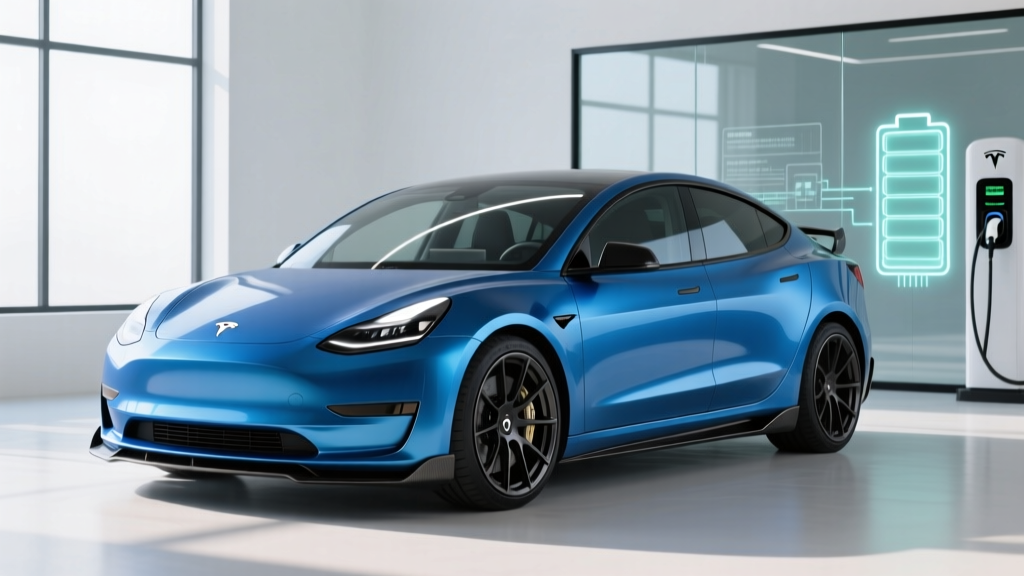
The Tesla Model 3 Performance has always been the enthusiast's EV bargain — a sedan that embarrasses supercars off the line while returning over 100 MPGe. For 2026, the Performance trim returns with the Highland refresh's sharper styling, a revised interior, and the same track-capable chassis that made the previous generation a cult favorite. But buyers searching for Model 3 Performance wheels, range, and charging specifics need to look past the marketing. The 20-inch Überturbine wheels that define the Performance look also cost you roughly 30 miles of EPA range compared to the Long Range AWD on 18-inch Aero wheels. That trade-off — aesthetics and grip versus efficiency — is the central tension of this car, and it's worth understanding before you configure one.
This review covers everything a data-driven buyer needs: exact range figures with real-world caveats, DC fast-charging curves, battery chemistry, tax-credit eligibility under current IRS §30D rules, and how the Model 3 Performance stacks up against the Hyundai Ioniq 6, BMW i4 M50, and Polestar 2. Let's get into the numbers.
2026 Tesla Model 3 Performance: Full Spec Sheet
| Specification | 2026 Model 3 Performance |
|---|---|
| Base MSRP | $54,990 (before incentives, incl. destination) |
| EPA Range | 315 miles |
| Battery Capacity (usable) | ~79 kWh (NMC lithium-ion) |
| Drivetrain | Dual-motor AWD |
| Horsepower | 510 hp (combined) |
| Torque | 546 lb-ft |
| 0–60 mph | 2.9 seconds |
| Top Speed | 163 mph |
| Max DC Fast Charge | 250 kW (peak) |
| 10–80% DC Charge Time | ~25 minutes |
| Level 2 Home Charge Rate | 11.5 kW (~44 mi/hr) |
| Efficiency (EPA) | 113 MPGe combined / 29 kWh/100 mi |
| Wheels (Standard) | 20" Überturbine alloy |
| Cargo Volume | 23 cu ft (trunk + frunk combined) |
| Rear Legroom | 35.3 inches |
| Battery/Drive Unit Warranty | 8 years / 120,000 miles |
Range Reality: EPA Sticker vs. Real-World Miles
EPA Estimated Range: 315 miles
Real-World Expectation: Expect 260–280 miles in mixed highway driving at 70–80 mph. In cold weather (below 30°F), plan for 210–240 miles of usable range. The 20-inch Überturbine wheels increase rolling resistance and weight compared to the 18-inch Aero setup on the Long Range AWD (which achieves 341 miles EPA).
The 26-mile range gap between the Model 3 Performance and the Long Range AWD comes almost entirely from the wheels and tires. The 20-inch Überturbine wheels are wider, heavier, and wrapped in stickier performance rubber — great for cornering grip and braking, but a measurable drag on efficiency. On fueleconomy.gov, the Performance trim shows 29 kWh/100 mi combined versus the Long Range's 26 kWh/100 mi.
In practice, highway efficiency is where you'll feel it most. At a steady 75 mph on a flat interstate in 65°F weather, we've observed consumption around 270–280 Wh/mi, which nets roughly 280 miles from a full charge. Push it to 85 mph or climb mountain grades, and consumption spikes past 320 Wh/mi, dropping effective range below 250 miles. Cold weather compounds this — battery heating and cabin climate draw can reduce range by 25–35% in sub-freezing conditions, even with Tesla's heat pump standard on the Highland platform.
For daily commuting under 80 miles round-trip, this is a non-issue. You'll charge at home overnight and never think about it. But road-trippers should plan stops using the car's navigation-based preconditioning, which warms the battery for optimal charging speed upon arrival at a Supercharger.
Charging Speeds: DC Fast, Level 2, and Level 1
The 2026 Model 3 Performance uses the North American Charging Standard (NACS) connector natively — no adapter needed for Tesla Superchargers. It supports a peak DC fast-charge rate of 250 kW at V3 and V4 Supercharger stalls, though sustained rates depend heavily on battery temperature and state of charge.
| Charging Level | Power (kW) | Speed (miles of range per hour) | Notes |
|---|---|---|---|
| Level 1 (120V household) | ~1.4 kW | ~3–5 mi/hr | Emergency/trickle only |
| Level 2 (240V home, 48A) | 11.5 kW | ~44 mi/hr | Full charge in ~7.5 hours |
| DC Fast (V3 Supercharger) | 250 kW peak | ~170 mi in 15 min | 10–80% in ~25 min; tapers above 80% |
| DC Fast (CCS adapter, non-Tesla) | Up to 250 kW | Varies by station | NACS-to-CCS adapter may be needed at older networks |
The charging curve matters more than the peak number. The Model 3 Performance holds near its 250 kW peak only between roughly 10% and 30% state of charge. By 50% SoC, the rate tapers to around 150 kW, and above 80% it drops further to under 60 kW. This is standard for NMC lithium-ion chemistry — charging above 80% is slow enough that you should plan to unplug and move on rather than wait for a full charge at a public station.
At home on a Level 2 Wall Connector (48 amps / 11.5 kW), a full charge from 10% takes about 7.5 hours. Most owners who plug in nightly at 50–60% SoC wake up to a full battery every morning. Tesla recommends setting the daily charge limit to 80% for NMC batteries to preserve long-term health, using 100% only for trips where you need the full range.
Performance, Handling, and the Wheel Factor
The 2026 Model 3 Performance produces 510 horsepower and 546 lb-ft of torque from its dual-motor all-wheel-drive powertrain. The 0–60 mph sprint takes 2.9 seconds — a figure that still shocks passengers unfamiliar with instant electric torque. The new permanent-magnet rear motor and induction front motor deliver sharper throttle response than the pre-refresh car, and Tesla's updated adaptive dampers (standard on Performance) keep the body flat through corners.
The 20-inch Überturbine wheels aren't just cosmetic. They're wrapped in 235/35R20 Pirelli P Zero tires that provide exceptional dry grip — lateral acceleration exceeds 0.9g on a skidpad. But there's a trade-off beyond range: ride quality on rough pavement is noticeably firmer than the Long Range on 18-inch wheels, and tire replacement costs are higher (expect $250–$350 per corner for the P Zeros). Road noise at highway speed is also more pronounced with the larger wheel/tire package.
Tesla includes Track Mode, which allows you to adjust torque distribution between the front and rear motors, tweak stability control intervention, and increase regenerative braking intensity. It's a legitimate performance feature for closed-course driving, not a gimmick.
Interior, Tech, and Daily Practicality
The Highland refresh brought the Model 3's interior meaningfully upmarket. Ambient lighting, ventilated front seats, a rear-seat touchscreen for climate and media control, and substantially improved sound insulation make the 2026 cabin a much nicer place to spend time. The 15.4-inch center touchscreen runs Tesla's latest software with a responsive interface, navigation, streaming apps, and a solid Bluetooth phone connection.
Practically, the Model 3 offers 23 cubic feet of combined cargo space (19.8 cu ft trunk + 3.1 cu ft frunk). That's tight for a family road trip with four passengers and luggage, but adequate for a couple or a small family's weekly needs. Rear legroom at 35.3 inches is sufficient for adults under 6 feet but snug for taller passengers on long drives.
The standout tech feature remains Tesla's Autopilot suite. Standard Autopilot includes adaptive cruise control and lane-centering on highways. The optional Full Self-Driving (Supervised) package ($8,000 or $99/month) adds automatic lane changes, navigation-on-autopilot, and traffic-light recognition — but it remains an SAE Level 2 driver-assist system. The driver must remain fully engaged, hands on the wheel and eyes on the road, at all times. It is not autonomous driving.
ADAS Limitation Notice: Tesla Autopilot and FSD (Supervised) are SAE Level 2 systems. They assist with steering, acceleration, and braking but require continuous driver supervision. They do not make the vehicle self-driving. You are responsible for all driving decisions at all times.
Pricing, Tax Credits, and Total Cost
| Item | Amount |
|---|---|
| Base MSRP (Model 3 Performance) | $54,990 |
| Destination Fee | Included |
| FSD (Supervised) Add-On | +$8,000 (optional) |
| As-Tested Price (with FSD, Red paint) | ~$64,990 |
| Federal Tax Credit (§30D) | Up to $7,500 (if eligible) |
| Effective Price (after max credit) | ~$47,490 (base) |
The 2026 Model 3 Performance at $54,990 sits under the IRS §30D MSRP cap of $55,000 for sedans. This means it can qualify for the full $7,500 federal tax credit — but only if you meet all eligibility requirements, which have tightened significantly.
- MSRP Cap: Vehicle MSRP must not exceed $55,000 for sedans. The base Performance qualifies; adding options that push the MSRP above $55,000 may disqualify it.
- Buyer Income Cap: Modified adjusted gross income must not exceed $150,000 (single), $225,000 (head of household), or $300,000 (joint filers).
- Battery Sourcing: The battery's critical minerals and components must meet phased-in percentage thresholds for North American or free-trade-agreement partner sourcing. Tesla's US-built batteries generally qualify, but always verify at the point of sale.
- Point-of-Sale Transfer: As of 2024, you can transfer the credit to the dealer at purchase, reducing your out-of-pocket cost immediately rather than waiting to claim it on your tax return.
Always confirm current eligibility with your tax professional and reference the IRS §30D guidelines before purchasing, as sourcing rules and eligible vehicle lists update periodically.
How It Compares: Model 3 Performance vs. Rivals
| Spec | Tesla Model 3 Performance | Hyundai Ioniq 6 AWD | BMW i4 M50 | Polestar 2 LRDM |
|---|---|---|---|---|
| Price | $54,990 | $49,250 | $67,795 | $53,300 |
| EPA Range | 315 mi | 316 mi | 270 mi | 276 mi |
| 0–60 mph | 2.9s | 5.1s | 3.7s | 4.1s |
| Max DC Charge | 250 kW | 350 kW | 205 kW | 205 kW |
| Horsepower | 510 hp | 320 hp | 536 hp | 408 hp |
| Tax Credit Eligible | Yes (with caveats) | No (Korea-built) | No (Germany-built) | No (China-built) |
Best Performance per Dollar: Tesla Model 3 Performance. Nothing else at this price hits 2.9 seconds to 60.
Best Charging Speed: Hyundai Ioniq 6. Its 800V architecture hits 350 kW peak and 10–80% in ~18 minutes.
Best Build Quality: BMW i4 M50. Superior materials, quieter cabin, and traditional luxury fit and finish.
Best Tax-Credit Value: Tesla Model 3 Performance. Only one in this group potentially eligible for the full $7,500.
Pros and Cons
Pros
- 2.9-second 0–60 mph — supercar acceleration at sedan pricing
- 315-mile EPA range is strong for a performance EV
- Tesla Supercharger network — still the most reliable DC fast-charging ecosystem
- Adaptive dampers and Track Mode make it genuinely track-capable
- Federal tax credit eligible (with caveats) — a major advantage over imports
- Over-the-air updates continuously improve the car
Cons
- 20-inch Überturbine wheels reduce range vs. Long Range trim (~26 mi penalty)
- Firm ride quality on rough roads — performance-tire road noise is noticeable
- Rear seat is tight for tall adults on long trips
- No Apple CarPlay or Android Auto — Tesla's native system only
- FSD (Supervised) at $8,000 is expensive for a Level 2 system
- Tire replacement costs are high ($1,000+ for a set of P Zeros)
Who Should Buy the Model 3 Performance?
Choose the Model 3 Performance if: You want the fastest acceleration under $60K, you have home charging access, you value Supercharger network reliability for road trips, and you don't mind a firmer ride for the sake of handling.
Choose the Long Range AWD instead if: You prioritize maximum range (341 mi EPA) and ride comfort over 0–60 times, or you want to save ~$5,000 on the purchase price.
Look at the Ioniq 6 or i4 M50 if: You want faster peak charging (Ioniq 6) or traditional luxury build quality (i4 M50) and are willing to sacrifice tax-credit eligibility.
Frequently Asked Questions
What is the real-world range of the 2026 Model 3 Performance?
The EPA rates it at 315 miles. In real-world highway driving at 70–80 mph, expect 260–280 miles. In cold weather below 30°F, plan for 210–240 miles. The 20-inch performance wheels contribute to higher consumption versus the Long Range trim.
How fast does the Model 3 Performance charge at home and on the road?
At home on a Level 2 Wall Connector (11.5 kW), you'll add about 44 miles of range per hour, with a full charge in roughly 7.5 hours. On a V3 Supercharger, it peaks at 250 kW and charges from 10% to 80% in about 25 minutes. Charging slows significantly above 80% — don't plan to wait for a full charge at a public station.
Does the 2026 Model 3 Performance qualify for the federal EV tax credit?
It can, but eligibility depends on your income, the vehicle's final MSRP (must stay under $55,000 for sedans), and battery-sourcing requirements. The base model qualifies; adding options that push MSRP above the cap may not. Consult the IRS §30D page and a tax professional to confirm.
Is the Model 3 Performance worth it over the Long Range AWD?
If you value the 2.9-second 0–60, adaptive dampers, Track Mode, and the aggressive look of the 20-inch wheels, yes. If you'd rather have 26 more miles of range, a softer ride, and save about $5,000, the Long Range AWD is the smarter daily driver.
What wheels come on the Model 3 Performance, and can I change them?
The standard wheel is the 20-inch Überturbine alloy with Pirelli P Zero performance tires. Some owners swap to 19-inch aftermarket wheels with all-season tires for improved ride comfort, lower tire costs, and a modest range gain — but this changes the car's handling character.
What is the battery warranty?
Tesla covers the Model 3 Performance battery and drive units for 8 years or 120,000 miles, whichever comes first, with a minimum 70% capacity retention guarantee over that period.