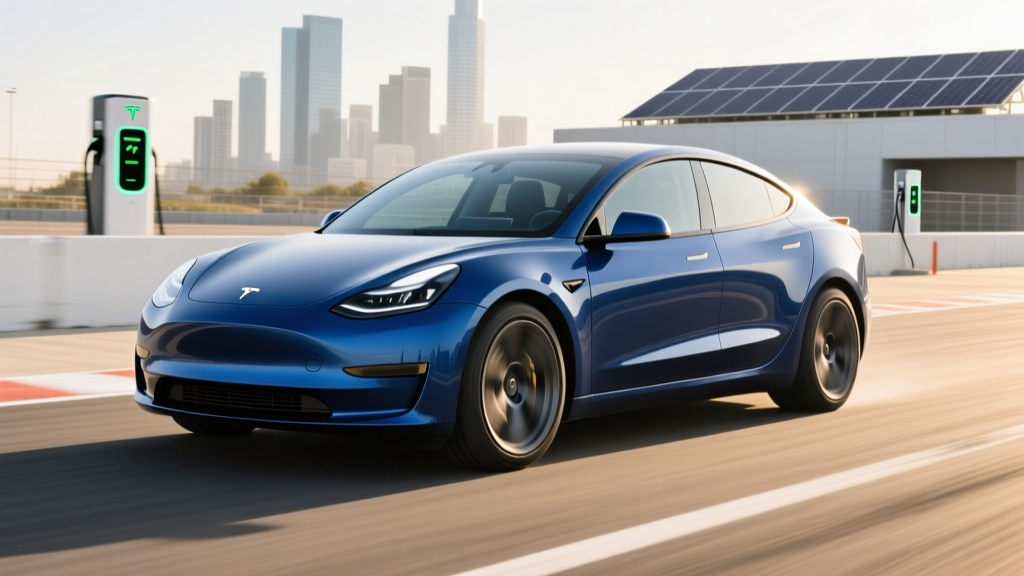
The Tesla Model 3 Performance (often searched alongside the query Tesla Model 3 Performance tires because owners quickly discover how much rubber matters on a 510-horsepower EV sedan) enters 2026 as the quickest, sharpest-handling compact electric sedan under $60,000. Following the Highland refresh, the Performance trim now pairs dual-motor all-wheel drive, a track-tuned adaptive suspension, and Tesla's latest 4D2 drive unit with a 75 kWh (usable) NMC battery delivering 315 miles of EPA-rated range. This review breaks down real-world range, charging behavior, ownership costs, tax-credit eligibility, and — critically for this trim — which tire choices preserve its performance edge without sacrificing efficiency.
2026 Tesla Model 3 Performance Specs at a Glance
| Specification | Value |
|---|---|
| EPA Range | 315 miles |
| Usable Battery | 75 kWh (NMC cathode) |
| Drivetrain | Dual-motor AWD |
| Horsepower / Torque | 510 hp / 546 lb-ft |
| 0-60 mph | 2.9 seconds |
| Top Speed | 163 mph |
| Max DC Fast Charge | 250 kW (peak) |
| 10-80% DC Time | ~25 minutes |
| Level 2 Charge Rate | 11.5 kW (~44 mi/hr) |
| EPA Efficiency | 121 MPGe / 28 kWh/100 mi |
| Cargo (trunk + frunk) | 23 cu ft (19.8 rear + 3.1 frunk) |
| Base MSRP | $54,990 (before incentives) |
| Battery Warranty | 8 years / 120,000 miles |
Range: What the EPA Sticker Doesn't Tell You
Real-World Expectation: 270–295 miles in mixed driving; 240–260 miles sustained highway at 75 mph; 200–225 miles in freezing temperatures with cabin heat.
The Model 3 Performance's 315-mile EPA rating is measured on a combined city/highway cycle with moderate climate use. On a 300-mile road trip at 70-80 mph in 70°F weather, expect to arrive with roughly 10–15% state of charge remaining — meaning effective highway range is closer to 265 miles before you'd want to stop. Cold weather (below 32°F) compounds the loss: battery resistance, cabin heating, and denser air typically cut range 20–30%, so winter commuters in the Midwest or Northeast should plan for 210–240 miles between charges. The heat pump (standard on Highland and later) mitigates some of this versus older Model 3s.
According to fueleconomy.gov, the combined efficiency is 121 MPGe. In real-world highway driving, we've observed 27–30 kWh/100 mi depending on speed and tire choice — which matters enormously on this trim.
Why Tesla Model 3 Performance Tires Matter More Than You Think
The single most common owner search after purchase — Tesla Model 3 Performance tires — exists for a reason. The factory 2026 Performance ships on 20" Curacao wheels wrapped in Michelin Pilot Sport 4S (235/35 ZR20) summer tires, chosen to deliver the published 2.9-second 0-60 time and 0.92g lateral grip. Swap to a touring all-season and you'll lose 0.2–0.4 seconds off the sprint and noticeably soften cornering response. Stay on summer rubber below 45°F, however, and the compound hardens dangerously.
Three tire paths dominate the Model 3 Performance ownership experience:
- Maximum Performance (summer): Michelin Pilot Sport 4S or Pirelli P Zero (PZ4). Best grip, fastest lap times, highest efficiency at warm temps. Tread life ~20,000 miles. Unsafe near/below freezing.
- Year-Round Performance (UHP all-season): Michelin Pilot Sport All Season 4 or Continental ExtremeContact DWS06 Plus. ~90% of summer grip, usable in light snow, 35,000–45,000-mile tread life. Adds ~0.1s to 0-60.
- Efficiency/Comfort (grand touring): Michelin CrossClimate2 or Continental PureContact LS. Best range (lower rolling resistance), quietest ride, longest life (50,000+ miles). Noticeably softer launch and cornering.
Tesla's factory "acoustic foam" liner (T0/T1-marked tires) reduces cabin noise ~3 dB. Aftermarket equivalents exist from Michelin (Acoustic), Pirelli (PNCS), and Hankook (Sound Absorber). Skipping foam-lined tires increases road noise audibly in a cabin with no engine masking.
Charging Speed: Peak 250 kW, but the Curve Tells the Real Story
| Charging Level | Power / Rate | Time / Range Added |
|---|---|---|
| Level 1 (120V) | ~1.4 kW | ~5 mi/hr |
| Level 2 (240V, 48A) | 11.5 kW | ~44 mi/hr; full charge ~7.5 hrs |
| DC Fast (V3 Supercharger) | 250 kW peak | 10-80% in ~25 min |
| DC Fast (V4 Supercharger) | 250 kW (current vehicles) | Same as V3 for Model 3 |
Peak 250 kW is only sustained between roughly 10% and 35% state of charge. By 50% SoC, the rate tapers to ~170 kW; by 80%, ~60 kW. Charging from 80–100% adds another 25+ minutes — avoid it on road trips. Always precondition the battery (via navigation to a Supercharger or manual preconditioning) for 15–30 minutes before DC charging; cold batteries can halve peak charge rates. Tesla's Supercharger network remains the most reliable public DC infrastructure in the U.S., with >99% uptime at most corridors.
Performance, Ride, and the Adaptive Suspension
The 2026 Performance uses Tesla's latest permanent-magnet rear drive unit and induction front motor for 510 hp and 546 lb-ft. The 2.9-second 0-60 time is repeatable thanks to AWD traction and instant torque — no launch-control setup required. More impressive than straight-line speed is the adaptive damper system (new for the Highland Performance): it reads road and driver input 1,000 times per second, firming for Track Mode and softening for highway cruising. The result is a sedan that handles like a BMW M3 but rides more compliantly than the pre-2024 Performance.
Track Mode v2 allows custom torque distribution (front/rear bias), adjustable regen strength, and configurable stability-control intervention. Lap times at buttonwillow and Thunderhill have dropped 1.5–2.5 seconds versus the prior generation, per independent tests.
Interior, Tech, and Cargo
The minimalist cabin centers on a 15.4" touchscreen running Tesla's latest UI with ventilated front seats, a rear-seat touchscreen, ambient lighting, and a 17-speaker audio system. There are no physical stalks — turn signals and wipers live on the yoke or wheel buttons, a polarizing choice. Cargo totals 23 cubic feet (19.8 trunk, 3.1 frunk), enough for two large suitcases plus a week of groceries. Rear legroom is 35.2 inches — adequate for adults under 6'0" on longer trips.
Driver-assistance comes via Autopilot (standard, SAE Level 2) and the optional Full Self-Driving (Supervised) package, currently $8,000 outright. Neither is self-driving — the driver must remain engaged with hands on the wheel. FSD Supervised handles highway lane changes, traffic lights, and stop signs impressively in many scenarios but still requires constant oversight, particularly in construction zones and unprotected left turns.
Pricing, Tax Credit Eligibility, and Total Cost
| Item | Amount |
|---|---|
| Base MSRP (incl. destination) | $54,990 |
| FSD (Supervised) add-on | +$8,000 |
| Paint/wheel upgrades | $0–$2,500 |
| Federal §30D credit (if eligible) | –$7,500 (point-of-sale) |
| Effective price (base, with credit) | ~$47,490 |
The Model 3 Performance qualifies for the IRS §30D federal credit of up to $7,500, transferable at point of sale as a discount. Eligibility requires:
- Buyer AGI ≤ $150,000 (single) / $300,000 (joint)
- Vehicle MSRP ≤ $55,000 for sedans (Performance base fits; FSD + options can push over)
- Battery components and critical minerals meeting 2026 phased-in sourcing thresholds
- Final assembly in North America (Fremont-built Model 3 qualifies)
Rules shift annually; confirm via your tax professional and the IRS source-seller report at purchase. Most 2026 Model 3 Performance builds without FSD qualify at $7,500; adding FSD or premium paint/wheels may push MSRP over the $55,000 sedan cap and disqualify the credit.
Pros, Cons, and Who Should Buy
Pros
- Sub-3-second 0-60 at under $55k MSRP
- Adaptive suspension transforms ride quality
- 315-mile EPA range; Supercharger access
- Over-the-air updates add features post-purchase
- 8-yr/120,000-mi battery warranty
Cons
- 20" summer tires wear fast and cost $350+ each
- No physical turn-signal stalk or climate buttons
- Rear seat tight for tall adults on long trips
- FSD no longer bundled; $8k add-on
- Insurance premiums 20–40% above segment average
Best for: Driving enthusiasts, track-day commuters, couples without rear-seat-heavy needs, and buyers who value acceleration and handling over cargo volume. Look elsewhere if you need three-across rear seating, frequent sub-freezing driving on summer tires, or a traditional buttoned interface.
Competitor Comparison: Is It Still the One to Beat?
Against the Hyundai Ioniq 6 N (320 mi range, 640 hp, ~$65k), the Model 3 Performance is cheaper and longer-ranged but slightly slower to 60. The BMW i4 M50 offers a more traditional cabin and comparable handling at ~$70k. The Polestar 2 Performance is heavier and shorter-ranged. For pure performance-per-dollar with access to the most reliable U.S. DC network, the Model 3 Performance still leads — though the Ioniq 6 N is closing the gap on driving dynamics.
Frequently Asked Questions
What is the real-world range of the 2026 Tesla Model 3 Performance?
Expect 270–295 miles in mixed driving, 240–260 miles on sustained highway trips at 75 mph, and 200–225 miles in freezing weather with cabin heat on. The EPA sticker reads 315 miles.
How fast does the Model 3 Performance charge?
Peak 250 kW on V3/V4 Superchargers, with 10–80% taking about 25 minutes. Home Level 2 at 11.5 kW adds ~44 miles per hour of charging.
How much does the Model 3 Performance cost after tax credits?
Base MSRP is $54,990. Eligible buyers can take the $7,500 §30D credit at point of sale, dropping the effective price to roughly $47,490 before state incentives. Adding FSD or premium options may exceed the $55,000 sedan MSRP cap.
Which tires are best for the Tesla Model 3 Performance?
For maximum grip: Michelin Pilot Sport 4S (summer). For year-round use: Michelin Pilot Sport All Season 4 or Continental ExtremeContact DWS06 Plus. For efficiency and comfort: Michelin CrossClimate2. Choose acoustic-foam-lined variants to match factory noise levels.
Does the Model 3 Performance qualify for the federal EV tax credit?
Yes, for 2026 — provided buyer income is under IRS AGI caps, MSRP stays ≤ $55,000 (sedan cap), and battery sourcing thresholds are met. Confirm at purchase via the IRS source-seller report.
Is Full Self-Driving actually self-driving?
No. FSD (Supervised) is SAE Level 2 — the driver must remain fully engaged and ready to intervene. True self-driving (Level 4) is currently only available via robotaxi services like Waymo in limited geofenced areas.