Tesla Model 3 Performance: When a Sedan Races Supercars and Commutes Daily
The 2025 Tesla Model 3 Performance (internally dubbed "Highland" refresh) isn't just the fastest sedan under $60,000 — it's a legitimate track weapon disguised as a tech-forward commuter. With dual-motor all-wheel drive, 510 horsepower, and a Tesla-claimed 1/4 mile time in the low 12-second range, this is the EV that made the automotive press rethink what a four-door family sedan could do. But beyond the drag-strip numbers, how does it fare as a daily driver? We break down every spec that matters to real buyers: range, charging speed, ownership costs, and whether it still qualifies for federal tax incentives.
| Spec | Value |
|---|---|
| EPA Range | 346 miles |
| Battery (usable) | ~79 kWh, NMC chemistry |
| Drivetrain | Dual-motor AWD |
| Horsepower | 510 hp (346 kW) |
| Torque | 546 lb-ft |
| 0-60 mph | 2.9 seconds |
| 1/4 Mile (est.) | ~11.8 sec @ ~125 mph |
| Top Speed | 163 mph |
| Max DC Fast Charge | 250 kW (Supercharger V3/V4) |
| 10-80% DC Charge | ~25 minutes |
| Level 2 Home Charge | 11.5 kW (~44 mi/hr) |
| Efficiency | 119 MPGe combined / 28 kWh/100mi |
| Cargo Volume | 21.0 cu ft (trunk) + 3.1 cu ft (frunk) |
| Base MSRP | $52,990 (before destination) |
| Battery Warranty | 8 years / 120,000 miles |
Quarter-Mile and Track Performance: The Numbers Behind the Hype
Search "Tesla Model 3 Performance 1/4 mile" and you'll find owner-recorded times clustering between 11.6 and 12.1 seconds at trap speeds around 118-126 mph. The variance comes down to surface prep, tire temperature, battery state of charge, and ambient temperature. Tesla officially claims a 1/4 mile in the low-12-second range, and independent testing by outlets like Motor Trend and Car and Driver has corroborated mid-to-low 12-second passes on prepped surfaces with warm tires.
What makes these numbers remarkable is context: a 2025 Porsche 911 Carrera (base, ~$120,000) runs roughly 11.9 seconds in the quarter mile. The Model 3 Performance delivers comparable acceleration for less than half the price, while seating five and offering over 300 miles of range.
Tesla's new Track Mode V3 allows drivers to customize torque distribution between front and rear motors, adjust regenerative braking intensity, and manage thermal limits for sustained track use. The adaptive dampers (a first for Model 3) are tuned specifically for the Performance variant and offer noticeably better body control than the Long Range AWD model during aggressive cornering.
On the street, the 2.9-second 0-60 mph time is more relevant than the quarter mile. Instant electric torque means no waiting for turbo spool or transmission kickdown — you press the pedal, and the car launches with a ferocity that still startles passengers unfamiliar with EVs. The all-wheel-drive system provides exceptional grip off the line, even on wet pavement.
Real-World Range: What the EPA Sticker Doesn't Tell You
Real-world expectations vary significantly by driving condition:
- City/suburban mixed driving (55-65 mph): ~320-340 miles achievable
- Highway cruising (75-80 mph): ~260-290 miles
- Cold weather (below 32°F): ~240-280 miles (20-30% reduction)
- Track/aggressive driving: Range drops dramatically — expect 100-150 miles
The Model 3 Performance's 19-inch Gemini wheels (with optional P Zero tires) carry a slight range penalty versus the Long Range's aero wheels. Tesla's heat pump helps mitigate cold-weather losses, but physics still wins in sub-zero conditions.
According to fueleconomy.gov, the Model 3 Performance achieves 119 MPGe combined (28 kWh per 100 miles). This is excellent efficiency for a 510-hp performance sedan — for comparison, the BMW i4 M50 achieves 97 MPGe combined with similar power output.
On a 300-mile highway road trip at 75 mph with climate control running, expect to arrive with roughly 10-15% state of charge remaining, or plan one 15-20 minute Supercharger stop to top up comfortably. The onboard navigation's trip planner is generally accurate, factoring in elevation, wind, and temperature.
Charging Speed: Supercharger Network Advantage
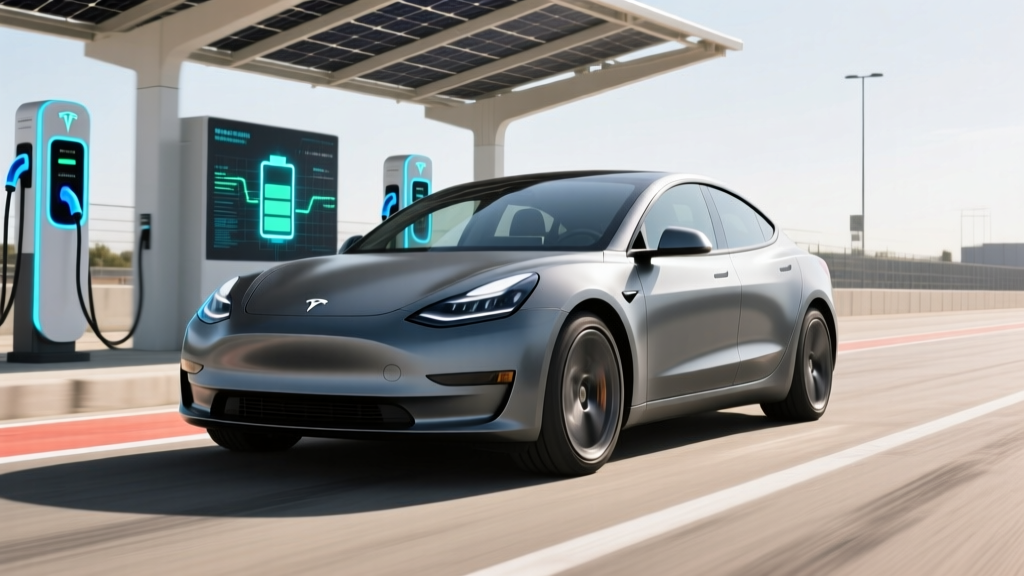
The Model 3 Performance supports up to 250 kW peak DC fast charging on Tesla's V3 and V4 Supercharger stalls. In practice, the charging curve matters more than peak numbers:
| Charging Method | Power / Rate | Time / Range Added |
|---|---|---|
| DC Fast (Supercharger V3/V4) | Peak 250 kW | 10-80% in ~25 min; ~175 mi in 15 min |
| DC Fast (third-party CCS via adapter) | Up to 150-175 kW typical | 10-80% in ~35-40 min |
| Level 2 Home (Wall Connector, 48A) | 11.5 kW | ~44 miles per hour; full charge in ~8 hours |
| Level 2 Home (32A mobile connector) | 7.7 kW | ~30 miles per hour; full charge in ~11 hours |
| Level 1 (120V standard outlet) | ~1.4 kW | ~5 miles per hour; emergency use only |
The charge curve tapers significantly above 80% state of charge. That 10-80% sprint of roughly 25 minutes can stretch to 45+ minutes if you charge to 100% at a Supercharger. Tesla recommends charging to 80% for daily use and reserving 100% charges for road trips.
One often-overlooked advantage: the Model 3 Performance supports battery preconditioning. When you navigate to a Supercharger, the car warms or cools the battery to optimal charging temperature before arrival. This means you hit peak charge rates faster, especially in cold weather. Third-party CCS chargers (via Tesla's included Magic Dock adapter or aftermarket CCS adapters) don't always trigger preconditioning, which is why real-world charging speeds on Electrify America or EVgo stalls often lag behind Supercharger performance.
For home charging, the Tesla Wall Connector at 48 amps on a 60-amp dedicated circuit delivers the best overnight experience. Installation costs typically range from $800-$2,500 depending on panel proximity and whether a 200-amp service upgrade is needed. Most owners report waking up to a full battery every morning, making public charging a road-trip-only concern.
Pricing, Trims, and Federal Tax Credit Eligibility
The 2025 Tesla Model 3 Performance starts at $52,990 (plus $1,390 destination fee, totaling $54,380). This is a single-trim offering — Tesla doesn't fragment the Performance into sub-variants. Standard equipment includes:
- Dual-motor AWD with Track Mode V3
- Adaptive dampers
- 19-inch Gemini wheels with performance tires (20-inch Nova wheels optional)
- Full glass roof
- 15.4-inch center touchscreen with all vehicle controls
- Heated and ventilated front seats, heated rear seats
- 17-speaker premium audio
- Basic Autopilot (lane centering + adaptive cruise)
Optional upgrades include Enhanced Autopilot ($6,000), Full Self-Driving Supervised ($8,000), premium interior colors ($1,000-$2,000), and 20-inch Nova wheels ($1,500). A fully loaded Model 3 Performance can approach $65,000.
| Item | Amount |
|---|---|
| Base MSRP + Destination | $54,380 |
| Federal §30D Tax Credit (if eligible) | Up to $7,500 (point-of-sale transfer available) |
| Effective Price (with full credit) | ~$46,880 |
| Estimated State Incentives (varies) | $0-$5,000+ |
Federal tax credit eligibility is complex and subject to change. Under current IRS §30D rules, the Model 3 Performance qualifies for up to $7,500, but buyers must meet all of the following criteria:
- MSRP cap: Sedan price must be ≤$55,000 (Model 3 Performance at $52,990 qualifies before options push it over — verify your configuration)
- Buyer income cap: Modified AGI ≤$150,000 (single) or ≤$300,000 (joint filers)
- Battery sourcing: Critical minerals and battery components must meet phased-in domestic/free-trade sourcing thresholds (Tesla's battery supply chain has been evolving; confirm current-year compliance at purchase)
- Assembly: Final assembly must be in North America (Model 3 is built in Fremont, CA and Austin, TX — qualifies)
The credit can now be transferred to the dealer at point of sale as a price reduction, rather than waiting for a tax refund. Consult a tax professional and verify current eligibility on the IRS website before purchasing, as sourcing requirements tighten annually.
Interior, Cargo, and Daily Usability
The "Highland" refresh brought meaningful interior improvements over the pre-2024 Model 3. Ventilated front seats, ambient lighting, acoustic glass (front and rear), and a rear-seat touchscreen for climate/media control elevate the cabin to near-luxury territory. Build quality on recent Fremont and Austin cars is noticeably improved, with tighter panel gaps and better material choices.
However, the minimalist interior remains polarizing. There is no instrument cluster — all information lives on the 15.4-inch center screen. Turn signals are now on the steering wheel (replacing the stalks), and gear selection is via the touchscreen or a capacitive strip on the overhead console. Some drivers adapt within days; others find it persistently frustrating.
Cargo space totals 24.1 cubic feet (21.0 cu ft trunk + 3.1 cu ft frunk). The trunk opening is wide and the 60/40 split-folding rear seats allow longer items. Rear legroom measures 35.3 inches — adequate for adults on shorter trips but tight for six-footers on longer journeys. Headroom is generous front and rear thanks to the glass roof's thin profile.
For families, the Model 3 Performance fits two rear-facing child seats in the outboard positions, but the center seat is narrow. The frunk is useful for charging cables and small bags but isn't large enough for a carry-on suitcase.
Driver Assistance and Technology
Tesla's Basic Autopilot (standard), Enhanced Autopilot, and Full Self-Driving (Supervised) are all SAE Level 2 driver-assistance systems. The driver must remain engaged, hands on or near the wheel, and eyes on the road at all times. These systems do NOT make the car self-driving. Tesla's "FSD Supervised" name has drawn criticism for implying more capability than the system delivers. True driverless operation (Level 4) exists only in geofenced robotaxi services like Waymo.
That said, Tesla's Autopilot remains one of the most capable Level 2 systems on the market for highway driving. Lane centering is smooth, adaptive cruise handles cut-ins well, and the automatic lane-change feature (with Enhanced Autopilot or FSD) reduces driver workload on long trips. City-street FSD performance has improved through over-the-air updates but still requires frequent driver intervention at complex intersections, construction zones, and unprotected left turns.
The infotainment system is Tesla's proprietary software — no Apple CarPlay or Android Auto. Instead, Tesla offers built-in navigation, Spotify/Apple Music/Tidal integration, a web browser, and gaming (including Cyberpunk 2077 and Stardew Valley while parked). Over-the-air updates add features regularly, though some previously free features have moved behind paywalls.
Pros and Cons: An Honest Assessment
Pros
- Supercar-rivaling acceleration (2.9s 0-60, ~12s quarter mile) at sedan pricing
- 346-mile EPA range — longest in the performance-sedan class
- Tesla Supercharger network — still the most reliable DC fast-charging ecosystem in North America
- Excellent efficiency (119 MPGe) for the power output
- Over-the-air updates continuously improve the vehicle
- Strong resale value relative to competitors
- Track Mode V3 with adaptive dampers makes it genuinely capable on track days
- Low running costs: electricity at $0.13/kWh = ~$3.64 per 100 miles vs. $12+ for gas equivalent
Cons
- Stalkless steering wheel and screen-only controls divide opinion and frustrate some drivers
- No Apple CarPlay or Android Auto
- Rear seat space is tighter than BMW i4 or Hyundai Ioniq 6 competitors
- FSD Supervised ($8,000) remains a Level 2 system despite the name and price
- Insurance premiums run 20-40% higher than comparable gas sedans in most states
- Service center wait times can be long in some metro areas
- Ride quality, while improved with adaptive dampers, is still firm on broken pavement
- Quarter-mile times vary with conditions — don't expect consistent 11-second passes on street tires
Who Should Buy the Tesla Model 3 Performance?
Choose the Model 3 Performance if:
- You want sports-car acceleration with four-door practicality and 300+ mile range
- You have home charging access and primarily drive in areas with Supercharger coverage
- You value over-the-air updates and Tesla's software ecosystem
- You want the lowest cost-per-mile performance sedan available
- You enjoy occasional track days and want a car that can drive home afterward
Look elsewhere if:
- You need maximum rear-seat space for tall passengers or three child seats (consider the Model Y Performance or Hyundai Ioniq 5 N)
- You prefer physical buttons, a traditional instrument cluster, or Apple CarPlay
- You live in an area with limited Supercharger coverage and unreliable third-party DC charging
- You need towing capability (Model 3 is not rated for towing; consider Model Y)
- You prioritize luxury interior materials over performance (consider BMW i4 M50 or Porsche Taycan)
The Model 3 Performance is best understood as a dual-purpose vehicle: a daily commuter that can embarrass sports cars at stoplight drag races and hold its own at amateur track events. It's ideal for the enthusiast who wants one car to do everything electrically, without sacrificing range or charging convenience. It's less ideal as a primary family hauler — the rear seat and cargo space work for a young family, but those needing more room should step up to the Model Y Performance.
Frequently Asked Questions
What is the real-world range of the Tesla Model 3 Performance?
The EPA rates it at 346 miles, but real-world highway driving at 75-80 mph typically yields 260-290 miles. In cold weather (below freezing), expect 240-280 miles. City driving with regenerative braking can approach or slightly exceed the EPA figure. Range varies with driving style, temperature, elevation, and tire choice.
How fast does the Model 3 Performance charge at home and on the road?
On a Tesla Supercharger (V3 or V4), it peaks at 250 kW and charges from 10-80% in approximately 25 minutes, adding about 175 miles in 15 minutes. At home on a 48-amp Level 2 Wall Connector, it charges at 11.5 kW, adding roughly 44 miles per hour — enough to fully replenish overnight. Level 1 (120V) adds about 5 miles per hour and is suitable only for emergencies or very low-mileage drivers.
What does the Model 3 Performance cost after federal tax credits?
The base MSRP is $52,990 plus $1,390 destination, totaling $54,380. If you qualify for the full $7,500 federal §30D tax credit (income, MSRP, and battery-sourcing requirements all met), the effective price drops to approximately $46,880. Point-of-sale credit transfer is available, reducing the purchase price directly. State incentives may reduce the cost further. Always verify current eligibility on the IRS website before purchasing.
Is the Model 3 Performance worth buying over the BMW i4 M50 or Hyundai Ioniq 5 N?
It depends on your priorities. The Model 3 Performance offers the best range (346 mi vs. BMW's 244 mi), the most reliable charging network, and the lowest running costs. The BMW i4 M50 (~$70,000) delivers a more traditional luxury interior and physical controls but less range and higher price. The Hyundai Ioniq 5 N (~$67,000) offers a more engaging track experience with simulated gear shifts but significantly less range (221 mi). For daily-driving performance with range and charging convenience, the Tesla wins. For track-day engagement or luxury feel, the competitors have merit.
Does the Tesla Model 3 Performance qualify for the $7,500 federal EV tax credit?
It can, but eligibility depends on multiple factors: the buyer's modified adjusted gross income (≤$150K single / ≤$300K joint), the vehicle's final MSRP (must stay ≤$55,000 for sedans — options can push it over), battery component and critical mineral sourcing requirements (which tighten annually), and North American final assembly (which Model 3 meets). Check the current eligibility list on fueleconomy.gov and consult a tax professional before relying on the credit.
How does the Model 3 Performance compare to the Long Range AWD trim?
The Long Range AWD offers 363 miles of EPA range, 346 hp, and a 4.2-second 0-60 time for $47,740 — $5,250 less than the Performance. You sacrifice roughly 1.3 seconds to 60 mph, adaptive dampers, Track Mode, and the performance brake package. For most buyers who don't plan track days or drag races, the Long Range AWD is the better value. The Performance exists for enthusiasts who want the last word in straight-line speed and chassis capability within the Model 3 lineup.