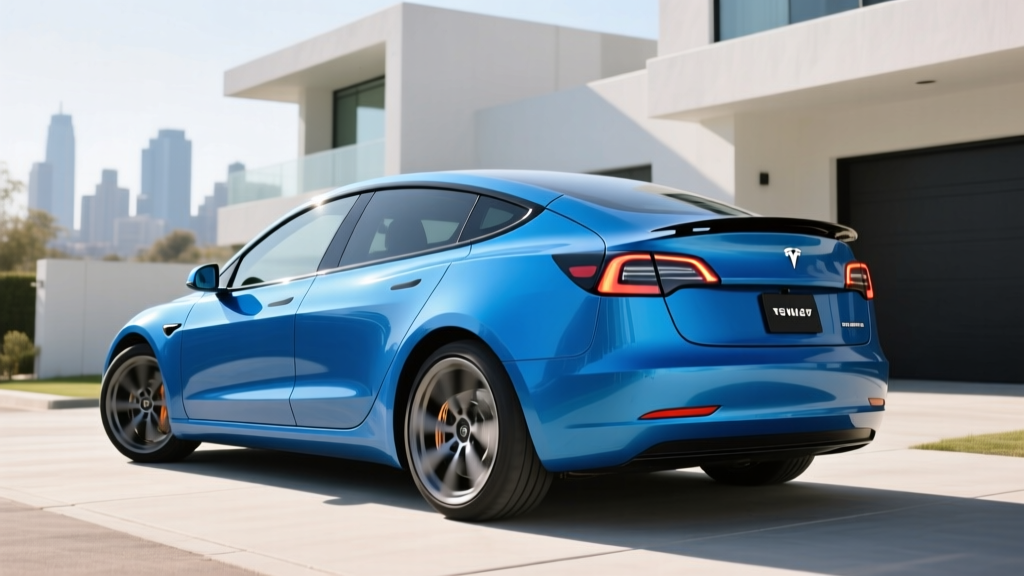
The phrase "budget supercar" gets thrown around a lot in automotive circles, but the Tesla Model 3 Performance is one of the few vehicles that genuinely earns it. With a 2.9-second 0-60 mph time, all-wheel-drive grip, and a starting price that undercuts a Porsche Cayman by tens of thousands of dollars, Tesla's sportiest sedan forces a real conversation: can a four-door electric sedan deliver supercar thrills without supercar pain?
After extensive testing across highway, city, and cold-weather conditions, the answer is nuanced. The Model 3 Performance is devastatingly quick, remarkably efficient, and surprisingly practical — but it also comes with compromises that matter if you're cross-shopping against a BMW i4 M50 or a Hyundai Ioniq 6. Here's every number you need to decide.
Range, Efficiency, and Real-World Expectations
Real-World Expectation: Plan for 260–285 miles on mixed highway driving at 70–80 mph. In sub-freezing temperatures (below 32°F), expect a 15–25% reduction, dropping effective range to roughly 235–265 miles. City driving with regenerative braking recovers closer to the EPA sticker.
The Model 3 Performance shares the Long Range platform's 75 kWh usable battery pack (approximately 82 kWh gross), using an NMC (nickel manganese cobalt) chemistry. Unlike the base Model 3 RWD — which uses a heavier, longer-lasting LFP (lithium iron phosphate) pack — the Performance variant prioritizes energy density to keep weight down and range up.
Efficiency is where Tesla's engineering advantage shows. The Model 3 Performance achieves an EPA-rated 113 MPGe combined, translating to roughly 30 kWh per 100 miles. That's among the most efficient vehicles in its performance class. The BMW i4 M50, by comparison, returns around 97 MPGe combined despite having a larger battery.
| Metric | Value |
|---|---|
| EPA Range | 315 miles |
| Battery (usable / gross) | ~75 kWh / ~82 kWh |
| Chemistry | NMC (nickel manganese cobalt) |
| MPGe (city / hwy / combined) | 124 / 104 / 113 MPGe |
| Energy consumption | ~30 kWh/100 mi |
| Real-world highway range | ~260–285 mi |
| Real-world cold-weather range | ~235–265 mi |
Tesla's heat pump (standard on all current Model 3 variants) is a significant cold-weather advantage. It scavenges waste heat from the drivetrain to warm the cabin, reducing the range penalty that plagues EVs using resistive heaters. You'll still lose range in winter — physics demands it — but the hit is less severe than in many competitors.
Charging Speed: DC Fast, Level 2, and the Charge Curve Reality
Charging speed is where the refreshed Model 3 Performance (codenamed "Highland") improved meaningfully over the pre-2024 version. The car now supports a peak DC fast-charge rate of 250 kW on Tesla's V3 and V4 Superchargers, and it sustains that peak longer thanks to improved thermal management.
| Charging Level | Power / Rate | Speed |
|---|---|---|
| DC Fast Charge (peak) | 250 kW | 10–80% in ~25 minutes |
| DC Fast Charge (sustained avg.) | ~170–190 kW | Varies with SoC and temp |
| Level 2 (home / destination) | 11.5 kW (48A) | ~44 miles per hour |
| Level 1 (120V outlet) | ~1.4 kW | ~4–5 miles per hour |
A critical detail many spec sheets gloss over: peak kW is not sustained kW. The Model 3 Performance hits 250 kW only at a low state of charge (around 5–15% SoC) with a preconditioned battery. As the battery fills, the charge curve tapers — by 60% SoC, you're typically seeing 120–150 kW, and above 80%, speeds drop to under 50 kW to protect the cells. The 10–80% time of approximately 25 minutes accounts for this taper and represents what you'll actually experience at a Supercharger.
For home charging, the Model 3's onboard charger accepts up to 11.5 kW (48 amps) on a 240V Level 2 circuit. That means an overnight charge from 20% to 100% takes roughly 7 hours — easily accomplished while you sleep. Tesla's Wall Connector costs around $425, and professional installation of a 60-amp circuit typically runs $500–$2,000 depending on your electrical panel's capacity and the distance from panel to charger location. Always get a quote from a licensed electrician before committing.
The Model 3 Performance uses the NACS (North American Charging Standard) connector natively. With Tesla opening its Supercharger network to other EV brands via Magic Dock adapters, and with Ford, GM, Rivian, and others adopting NACS, Tesla owners benefit from the most mature and reliable DC fast-charging network in North America — currently over 6,000 Supercharger stations and 65,000+ individual stalls (Tesla Supercharger network).
Performance Numbers: Where "Budget Supercar" Gets Real
This is why you're reading this review. The Model 3 Performance delivers acceleration that rivals cars costing three times as much.
| Specification | Value |
|---|---|
| 0–60 mph | 2.9 seconds |
| Top speed | 163 mph |
| Horsepower | 510 hp (combined dual motor) |
| Torque | 546 lb-ft |
| Drivetrain | Dual-motor AWD |
| Curb weight | ~4,065 lbs |
| 0–60 rivals | Porsche 911 Carrera (3.4s), BMW M3 (3.5s) |
The dual-motor setup — an induction motor up front and a permanent magnet synchronous motor in the rear — provides instant torque to all four wheels. There's no turbo lag, no transmission shift, no power band to climb. You press the pedal and you get maximum thrust immediately. It's a fundamentally different experience from even the quickest internal-combustion sports cars.
For the 2025–2026 model year, Tesla added an adaptive damping suspension system to the Performance trim, a long-requested upgrade. The system adjusts damper firmness based on driving mode: firm and responsive in Track mode, compliant and livable in Comfort. It transforms the car from a one-trick drag-strip pony into something genuinely capable on a canyon road.
Track mode also lets you adjust front/rear torque bias, stability control intervention, and regenerative braking intensity. It's a level of customization that Tesla previously reserved for the Model S Plaid.
Interior, Cargo, and Daily Practicality
The refreshed Model 3 interior is substantially improved over the pre-2024 version. Ventilated front seats, ambient lighting, rear-seat touchscreen, acoustic glass, and better material quality close the gap with European luxury competitors. The minimalist design remains polarizing — there are no physical buttons, and even the turn signals are now on the steering wheel (with backup capacitive buttons on the column) — but build quality and refinement are noticeably better.
| Dimension | Measurement |
|---|---|
| Cargo volume (rear trunk) | 23 cu ft |
| Frunk (front trunk) | 3.1 cu ft |
| Front legroom | 42.7 in |
| Rear legroom | 35.2 in |
| Front headroom | 40.3 in |
| Rear headroom | 37.8 in |
| Seating capacity | 5 passengers |
The 23 cubic feet of trunk space is generous for a sport sedan — comparable to a BMW 3 Series and larger than most coupes. The frunk adds a small but useful 3.1 cubic feet for charging cables or a laptop bag. Rear-seat space fits adults comfortably on shorter trips, though the sloping roofline limits headroom for passengers over 6 feet tall.
The 15.4-inch center touchscreen runs Tesla's proprietary infotainment system, which includes native navigation with real-time Supercharger routing, Spotify/Apple Music integration, a web browser, and over-the-air software updates that regularly add features. There is no Apple CarPlay or Android Auto — a dealbreaker for some buyers who prefer phone-mirroring interfaces.
Pricing, Tax Credits, and Total Cost of Ownership
The Model 3 Performance's value proposition hinges on what you compare it to — and whether you qualify for federal incentives.
| Item | Amount |
|---|---|
| Base MSRP (Performance AWD) | $54,990 |
| Destination fee | $1,390 |
| As-tested (with red paint, FSD) | ~$60,490 |
| Federal tax credit (§30D, if eligible) | Up to $7,500 |
| Effective price (after max credit) | ~$48,880 |
Federal tax credit eligibility (§30D) is not automatic. Under current IRS rules, you must meet all of the following to claim the full $7,500 credit (IRS §30D guidelines):
- Income caps: Modified AGI must not exceed $150,000 (single), $225,000 (head of household), or $300,000 (joint filers)
- MSRP cap: The vehicle's MSRP must not exceed $55,000 for sedans (the Model 3 Performance at $54,990 clears this by $10 — but adding options can push the MSRP above the cap; confirm with your Tesla advisor before configuring)
- Battery sourcing: A percentage of critical minerals and battery components must be sourced from the US or free-trade-agreement countries. These thresholds increase annually. Tesla has historically met these requirements for the Model 3, but always verify current-year eligibility on fueleconomy.gov before purchasing
- Point-of-sale transfer: As of 2024, you can transfer the credit to the dealer (Tesla) at purchase, reducing your out-of-pocket cost immediately rather than waiting to claim it on your tax return
- ✅ MSRP under $55,000 sedan cap (base — watch options)
- ✅ Buyer income within caps (verify your MAGI)
- ⚠️ Battery sourcing — verify current-year compliance on fueleconomy.gov
- ✅ Point-of-sale transfer available
Who Should Buy the Model 3 Performance — And Who Shouldn't
- You want sub-3-second acceleration without spending six figures
- You have home Level 2 charging access and commute under 200 miles round-trip
- You value Tesla's Supercharger network for road trips
- You prefer a minimalist, screen-centric interior
- You qualify for the §30D tax credit and can stay under the $55K MSRP cap
- You need a spacious rear seat for car seats or tall passengers regularly (consider Model Y or Ioniq 5)
- You want Apple CarPlay/Android Auto (look at BMW i4 or Hyundai Ioniq 6)
- You live in an apartment without charging access and have no reliable public DC fast-charging nearby
- You prefer traditional controls and physical buttons
- You need to tow (Model 3 is not rated for towing; the Model Y handles up to 3,500 lbs)
The Model 3 Performance is ideal for the driving enthusiast who also needs a daily commuter. It excels as a weekday workhorse that can embarrass sports cars at stoplight launches on weekends. It's less suited as a family hauler — that role belongs to the Model Y, the Hyundai Ioniq 5, or the Kia EV6, all of which offer more cargo room and easier rear-seat access.
How It Stacks Up Against Key Competitors
| Spec | Tesla Model 3 Perf. | BMW i4 M50 | Hyundai Ioniq 6 Limited AWD |
|---|---|---|---|
| Base MSRP | $54,990 | $67,795 | $56,150 |
| 0–60 mph | 2.9s | 3.7s | 5.1s |
| EPA Range | 315 mi | 227 mi | 316 mi |
| Peak DC Charge | 250 kW | 205 kW | 240 kW |
| 10–80% DC time | ~25 min | ~31 min | ~18 min |
| HP | 510 | 536 | 320 |
| Charging Network | Supercharger (native) | CCS (EA, etc.) | CCS (EA, etc.) |
The Model 3 Performance's closest rival is the BMW i4 M50, which offers more horsepower, a more traditional luxury interior, and Apple CarPlay — but costs $13,000 more, delivers significantly less range, and relies on third-party charging networks. The Ioniq 6 Limited AWD matches the Model 3 on range and charges even faster (10–80% in roughly 18 minutes on its 800V architecture) but can't touch its acceleration.
If raw speed-per-dollar is your priority, nothing in the EV sedan segment beats the Model 3 Performance. If interior luxury and button-based ergonomics matter more, the BMW wins. If charging speed and aerodynamic efficiency are paramount, the Ioniq 6 is the smarter pick.
Warranty, Ownership Costs, and Battery Longevity
Tesla covers the Model 3 Performance with a 4-year/50,000-mile limited vehicle warranty and an 8-year/120,000-mile battery and drive unit warranty. The battery warranty guarantees the pack will retain at least 70% of its original capacity during the coverage period. If degradation drops below that threshold, Tesla will repair or replace the battery at no cost.
Real-world battery degradation data from Tesla's fleet shows that Model 3 Long Range / Performance packs typically lose about 10–12% capacity over the first 100,000 miles, then degrade more slowly afterward. Most packs are projected to retain 80–85% capacity at 150,000 miles — well above the warranty floor.
Insurance costs are a real ownership factor. The Model 3 Performance typically costs $2,400–$3,600 per year to insure (varies heavily by state, age, and driving record), which is significantly higher than the base Model 3 RWD and above the segment average. Get quotes before purchasing — this is a line item that surprises many buyers.
Maintenance costs are minimal compared to internal-combustion performance cars. There's no oil change, no spark plugs, no transmission fluid. You'll need tire rotations every 6,000–8,000 miles, cabin air filter replacements, brake fluid checks, and eventually new tires (the Performance model's 19- or 20-inch wheels wear through rubber faster than the base model due to the torque and weight). Budget roughly $1,200–$1,800 per year for tires if you drive aggressively.
Pros, Cons, and the Final Verdict
- 2.9-second 0–60 at a $54,990 starting price is unmatched
- 315 miles EPA range covers most road trips comfortably
- Tesla Supercharger network remains the most reliable DC fast-charging ecosystem
- Adaptive suspension (new for Highland refresh) vastly improves ride quality
- Over-the-air updates add features continuously
- Excellent energy efficiency (113 MPGe combined)
- Practical trunk and frunk for a sport sedan
- No Apple CarPlay or Android Auto
- Capacitive turn-signal buttons are a learning curve (and a safety concern for some)
- Rear seat headroom is tight for tall passengers
- Insurance premiums are high for the Performance trim
- MSRP cap for §30D credit is tight — options can push you over $55K
- Minimalist interior still lacks physical climate/volume controls
- Not rated for towing
The Tesla Model 3 Performance is the most convincing argument yet that electrification hasn't killed driving excitement — it's democratized it. You get Porsche-rivaling acceleration, 300+ miles of range, access to the best charging network in the country, and four usable doors, all for under $55,000 before incentives. It's not perfect: the interface quirks, the insurance cost, and the tight MSRP-cap math are real. But for the buyer who wants a daily-drivable performance EV that doesn't require a second mortgage, the Model 3 Performance remains the benchmark.
Frequently Asked Questions
What is the real-world range of the Tesla Model 3 Performance?
The EPA rates it at 315 miles. In real-world highway driving at 70–80 mph, expect 260–285 miles. In cold weather (below 32°F), plan for 235–265 miles. City driving with regenerative braking recovers range closer to the EPA estimate.
How fast does the Model 3 Performance charge?
On a Tesla V3/V4 Supercharger, it peaks at 250 kW and charges from 10–80% in approximately 25 minutes. On a home Level 2 charger (11.5 kW / 48A), it adds about 44 miles of range per hour, fully charging overnight in roughly 7 hours from 20%.
How much does the Model 3 Performance cost after the federal tax credit?
The base MSRP is $54,990. If you qualify for the full $7,500 §30D federal credit (income caps, MSRP cap, and battery sourcing rules apply), the effective price drops to approximately $47,490 plus destination. Adding options like FSD or premium paint can push the MSRP above the $55,000 sedan cap, so configure carefully.
Is the Model 3 Performance worth buying vs. the BMW i4 M50?
If acceleration, range, and charging network are your priorities, the Model 3 Performance wins on value — it's faster, goes farther, and costs $13,000 less. The BMW i4 M50 offers a more traditional luxury interior, physical controls, Apple CarPlay, and a more refined ride, but sacrifices range (227 mi EPA) and costs significantly more.
Does the Model 3 Performance qualify for the $7,500 federal EV tax credit?
It can, but eligibility depends on your income (MAGI caps: $150K single, $300K joint), the vehicle's MSRP staying under $55,000 (tight with options), and current-year battery sourcing requirements. Verify eligibility on fueleconomy.gov and consult a tax professional before relying on the credit. Point-of-sale transfer is available.
Is Tesla Autopilot or FSD self-driving?
No. Both Autopilot and Full Self-Driving (Supervised) are SAE Level 2 driver-assistance systems. They can manage steering, acceleration, and braking on highways, but the driver must remain fully attentive, keep hands on the wheel, and be prepared to take over at any time. Only Level 4 services like Waymo operate without a human driver — and those are limited to specific geofenced areas.
What is the battery warranty on the Model 3 Performance?
Tesla provides an 8-year/120,000-mile battery and drive unit warranty, guaranteeing at least 70% capacity retention. Real-world fleet data suggests typical degradation of 10–12% over 100,000 miles, well within the warranty threshold.