Quick Verdict: The Performance EV Benchmark, Refined
The Tesla Model 3 Performance AWD remains the default answer for buyers who want sports-car acceleration in a practical, daily-drivable electric sedan. For the 2026 model year, Tesla continues the refreshed "Highland" architecture introduced in late 2023, pairing a dual-motor all-wheel-drive powertrain with a ~75 kWh usable NMC battery pack, adaptive dampers, and a Track Mode that genuinely transforms the car's dynamics. At a base MSRP of $52,990 (before destination), it undercuts competitors like the BMW i4 M50 and Porsche Taycan 4S by tens of thousands while delivering comparable or superior straight-line performance.
But the Model 3 Performance isn't just about 0-60 times. Its Supercharger network access, class-leading efficiency, and over-the-air update cadence make it one of the most livable high-performance EVs on the market. That said, the minimalist interior, firm ride on 20-inch wheels, and reliance on touchscreen controls won't suit every buyer. Here's the full breakdown of what you're actually getting — and what the real numbers look like once you leave the showroom.
Spec Table: 2026 Tesla Model 3 Performance AWD at a Glance
| Specification | Value |
|---|---|
| EPA Range | 315 miles |
| Battery (Usable) | ~75 kWh, NMC (Nickel Manganese Cobalt) |
| Drivetrain | Dual-Motor AWD |
| Horsepower | 510 hp (combined) |
| Torque | 546 lb-ft |
| 0-60 mph | 2.9 seconds |
| Top Speed | 163 mph |
| Max DC Fast Charge | 250 kW (peak) |
| 10-80% DC Fast Charge | ~25 minutes |
| Level 2 Home Charging | 11.5 kW (~44 mi/hr) |
| EPA Efficiency | 113 MPGe combined / 30 kWh/100 mi |
| Cargo Volume | 23 cu ft (trunk + frunk) |
| Rear Legroom | 35.2 inches |
| Battery Warranty | 8 years / 120,000 miles (70% retention) |
| Base MSRP | $52,990 (+$1,390 destination) |
Range & Efficiency: EPA Sticker vs. Real-World Driving
Real-World Expectation: 260–285 miles highway (70-80 mph); 220–250 miles in cold weather (below 32°F); 290–310 miles mixed city/suburban driving.
The 315-mile EPA figure for the 2026 Model 3 Performance AWD is achieved under the EPA's mixed-cycle test, which blends low-speed urban driving with moderate highway cruising. In practice, your mileage will vary significantly based on driving style, ambient temperature, and terrain.
On a 75°F day at highway speeds of 70-80 mph, expect to see roughly 260-285 miles before the battery hits 0%. Tesla's thermal management system and heat pump (standard on all 2026 Model 3 variants) help mitigate cold-weather losses, but lithium-ion chemistry inherently loses capacity and increases internal resistance in freezing temperatures. In sustained sub-32°F conditions with cabin heating, plan for 220-250 miles of usable range. Preconditioning the battery while plugged in — a feature accessible through the Tesla app — can recover some of that loss by warming the pack before departure.
The Model 3 Performance's efficiency of 30 kWh/100 miles (113 MPGe combined per fueleconomy.gov) is among the best in the performance-sedan segment. For comparison, the BMW i4 M50 achieves roughly 86 MPGe combined, and the Porsche Taycan 4S lands around 82 MPGe. This efficiency advantage translates directly to lower charging costs and more miles per charging stop on road trips.
Charging Speed: DC Fast Charging & Home Level 2
| Charging Method | Power / Rate | Time / Miles Added |
|---|---|---|
| DC Fast Charging (V3 Supercharger) | 250 kW peak | 10-80% in ~25 minutes |
| DC Fast Charging (CCS adapter, third-party) | Up to 250 kW (station-dependent) | Varies by station output and curve |
| Level 2 Home (Tesla Wall Connector, 48A) | 11.5 kW | ~44 miles per hour of charging |
| Level 2 Public (typical 7.2 kW) | 7.2 kW | ~28 miles per hour |
| Level 1 (120V household outlet) | ~1.2 kW | ~4-5 miles per hour |
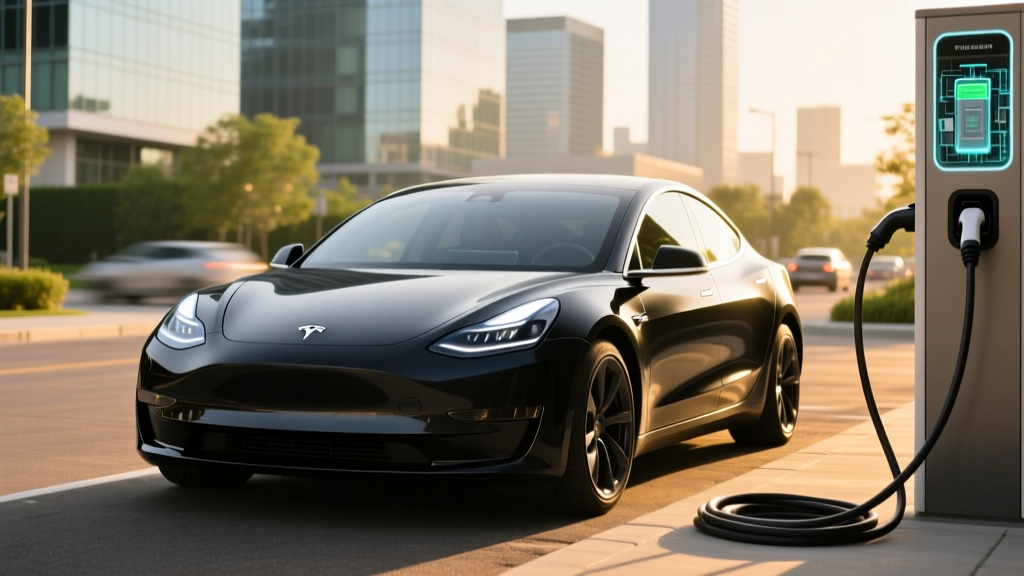
The Model 3 Performance AWD accepts a peak DC fast-charge rate of 250 kW on Tesla's V3 Superchargers and compatible CCS stations (using Tesla's included CCS adapter or the native NACS port on 2026 models). However, as with all EVs, that peak rate is not sustained across the entire charging session. The charge curve is aggressive from roughly 5-40% State of Charge (SoC), where you'll see rates above 200 kW. From 40-65%, the rate tapers to approximately 120-150 kW. Above 80%, charging slows dramatically to protect battery health — typically dropping below 50 kW.
This means the advertised 10-80% time of ~25 minutes is realistic under ideal conditions (warm battery, V3 Supercharger, low SoC start). If you arrive at a charger with a cold battery and haven't preconditioned via the car's navigation system, expect that session to stretch to 30-35 minutes. Always route through the car's built-in navigation to trigger automatic battery preconditioning — it's the single biggest factor in achieving fast charge times.
For home charging, a Tesla Wall Connector on a 60-amp circuit delivers 11.5 kW (48 amps), adding roughly 44 miles of range per hour. A full overnight charge from 20% to 80% takes about 5-6 hours, which is more than sufficient for daily use. If your home electrical panel supports only a 40-amp circuit (common in older homes), you'll see roughly 7.7 kW / ~30 mi/hr — still adequate for most commutes but worth factoring into your installation plan with a licensed electrician.
Performance & Driving Dynamics
The numbers tell the headline story: 510 horsepower, 546 lb-ft of torque, and a 2.9-second 0-60 mph time. That puts the Model 3 Performance in supercar territory for acceleration, and the instantaneous torque delivery of the dual-motor setup makes it feel even quicker in real-world roll-on situations than the spec sheet suggests.
But the Highland refresh brought meaningful chassis improvements that elevate this car beyond a straight-line drag racer. The 2026 Model 3 Performance includes:
- Adaptive dampers with configurable firmness (Comfort, Sport, Track modes)
- Revised steering rack with improved feel and feedback over pre-2024 models
- Track Mode v3 with adjustable torque distribution (front/rear bias), stability control intervention levels, and regen strength
- Performance brakes with larger front rotors and high-friction pads
- 20-inch Curvilinear wheels with Pirelli P Zero summer tires (all-season available)
Track Mode is genuinely useful for closed-course driving — you can dial up rear-bias torque distribution for controlled oversteer or lock it to a stable AWD split for maximum exit speed. The adaptive dampers in Comfort mode make the daily commute tolerable, though the firm sidewalls of the 20-inch summer tires still transmit sharp impacts into the cabin on rough pavement.
One-pedal driving via regenerative braking remains strong, though Tesla removed the driver-adjustable regen setting in 2024. The default regen level is aggressive enough for most stop-and-go traffic, but if you prefer a coasting feel, you'll need to modulate the accelerator carefully.
Pricing, Tax Credit Eligibility & Ownership Cost
| Cost Factor | Amount |
|---|---|
| Base MSRP (Performance AWD) | $52,990 |
| Destination Fee | $1,390 |
| As-Tested (with Red Multi-Coat + FSD) | ~$59,380 |
| Federal Tax Credit (§30D, if eligible) | Up to $7,500 |
| Effective Price After Max Credit | ~$46,880 |
The 2026 Tesla Model 3 Performance AWD starts at $52,990 before the $1,390 destination charge. Options are limited — Tesla offers a handful of paint colors ($1,000-$2,500), interior trims, and the Full Self-Driving (Supervised) package at $8,000 (or $99/month subscription). A well-equipped example with premium paint and FSD lands around $59,000-$62,000.
Federal tax credit eligibility requires careful attention. Under current IRS §30D rules, the Model 3 Performance may qualify for up to $7,500, but eligibility depends on multiple factors:
- MSRP cap: Sedars must be under $55,000 MSRP. The Model 3 Performance at $52,990 clears this threshold — but adding options that push the total MSRP above $55,000 could disqualify the credit. Verify the exact vehicle MSRP on the window sticker.
- Buyer income cap: Modified adjusted gross income must not exceed $150,000 (single), $225,000 (head of household), or $300,000 (joint filing).
- Battery sourcing: Critical minerals and battery components must meet phased-in domestic-content and free-trade-agreement thresholds. Tesla has historically sourced to maximize credit eligibility, but exact qualification can vary by production batch and model year. Check the VIN-specific eligibility on fueleconomy.gov before purchasing.
- Point-of-sale transfer: As of 2024, buyers can transfer the credit to the dealer at purchase, reducing the upfront cost rather than waiting for a tax refund.
Consult a tax professional to confirm your personal eligibility. State and local incentives (such as California's CVRP or Colorado's state credit) may stack on top of the federal credit — check your jurisdiction's current programs.
Interior, Tech & Driver Assistance
The 2026 Model 3 interior follows Tesla's minimalist philosophy: a single 15.4-inch center touchscreen handles virtually every vehicle function — climate, mirrors, glovebox, driving modes, and media. There is no instrument cluster; speed and navigation appear on a secondary 8-inch rear screen visible to the driver, or on the main display. The Highland refresh improved material quality with ventilated front seats, ambient lighting, acoustic glass (significantly quieter than pre-2024 models), and a rear touchscreen for passenger climate and media control.
Tech highlights:
- Wireless phone charging (dual pad)
- Premium 17-speaker audio system with immersive sound
- Over-the-air software updates adding features regularly
- Sentry Mode (dashcam/security system), Dog Mode, Camp Mode
- Tesla app integration for preconditioning, location, and remote control
Driver assistance: Basic Autopilot (adaptive cruise + lane centering) is standard. Full Self-Driving (Supervised) adds automatic lane changes, traffic light/stop sign recognition, and parking assist for $8,000. However, FSD remains an SAE Level 2 system — the driver must remain fully engaged, hands on the wheel, and eyes on the road at all times. It is not autonomous driving.
Cargo space totals 23 cubic feet (trunk plus front trunk/frunk), which is competitive with compact sport sedans. Rear legroom at 35.2 inches is adequate for adults on shorter trips but tighter than a midsize sedan like the Hyundai Ioniq 6 or the Model S.
Warranty & Long-Term Ownership
Tesla provides the following warranty coverage for the 2026 Model 3 Performance AWD:
- Basic Vehicle: 4 years / 50,000 miles
- Battery & Drive Unit: 8 years / 120,000 miles (with minimum 70% capacity retention)
The 70% retention threshold is standard for the industry, though some competitors (like Hyundai/Kia) warrant to a higher percentage. In practice, Tesla's NMC packs in the Model 3 have shown degradation curves that plateau around 5-8% loss after the first 50,000 miles, based on fleet data aggregated by third-party tracking sites. A well-maintained pack should retain 85-90% capacity at 100,000 miles.
Maintenance costs are low compared to internal-combustion performance sedans — no oil changes, no transmission fluid, no spark plugs. Expect to budget for tire replacement (high-performance summer tires wear quickly under hard acceleration, often needing replacement at 15,000-25,000 miles), cabin air filter changes, brake fluid checks, and wiper fluid. Insurance premiums tend to run higher than average for the segment due to repair costs and Tesla's direct-body-shop network limitations in some regions.
Pros, Cons & Who Should Buy
Pros
- 2.9s 0-60 mph rivals supercars at a fraction of the price
- Supercharger network access — most reliable public charging in the US
- Class-leading efficiency (113 MPGe combined)
- Adaptive dampers and Track Mode add genuine versatility
- Over-the-air updates continuously improve the vehicle
- Strong resale value relative to EV segment average
Cons
- Touchscreen-only controls frustrate some drivers (no physical buttons for climate, volume)
- Firm ride quality on 20-inch wheels, especially on rough roads
- Rear seat space is tight for tall adults on long trips
- FSD (Supervised) costs $8,000 and remains Level 2 — not autonomous
- Tax credit eligibility depends on MSRP cap and sourcing rules — verify before purchase
- No Apple CarPlay or Android Auto (Tesla's native system only)
Who This EV Suits Best
Choose the Model 3 Performance AWD if: You want supercar acceleration in a daily driver, you have access to home Level 2 charging, you take regular road trips where Supercharger infrastructure matters, and you're comfortable with a touchscreen-centric interface.
Look elsewhere if: You need a spacious rear seat for family use (consider the Model Y Performance or Hyundai Ioniq 5 N), you prefer physical buttons and traditional instrument clusters (BMW i4 M50), or you regularly drive in extreme cold where range loss will be more impactful on a 315-mile pack.
Frequently Asked Questions
What is the real-world range of the 2026 Tesla Model 3 Performance AWD?
The EPA rates it at 315 miles combined. In real-world highway driving at 70-80 mph, expect 260-285 miles. In cold weather below 32°F, plan for 220-250 miles with cabin heating. City and suburban driving at moderate speeds can approach or slightly exceed the EPA figure thanks to regenerative braking.
How fast does the Model 3 Performance charge at home and on the road?
On a Tesla V3 Supercharger (250 kW peak), it charges from 10-80% in approximately 25 minutes with a preconditioned battery. At home on a Level 2 Tesla Wall Connector (11.5 kW / 48A), it adds about 44 miles of range per hour, fully replenishing overnight.
Does the 2026 Model 3 Performance qualify for the federal EV tax credit?
It may qualify for up to $7,500 under IRS §30D, but eligibility depends on the vehicle's final MSRP staying under the $55,000 sedan cap, the buyer's income falling under statutory limits, and battery critical-mineral and component sourcing meeting current-year thresholds. Always verify VIN-specific eligibility on fueleconomy.gov and consult a tax professional before purchase.
How does the Model 3 Performance compare to the BMW i4 M50 and Hyundai Ioniq 5 N?
The Model 3 Performance is lighter, more efficient (113 vs. 86 MPGe), and has access to the Supercharger network. The BMW i4 M50 offers a more traditional luxury interior with physical controls and CarPlay but is heavier and less efficient. The Hyundai Ioniq 5 N prioritizes track engagement with simulated gear shifts and more cargo space but has lower EPA range (~221 miles) and a higher starting price. The Model 3 Performance remains the best all-around value for acceleration-per-dollar and charging infrastructure.
Is Tesla's Full Self-Driving (Supervised) worth the $8,000 cost?
FSD (Supervised) adds automatic lane changes, navigation-based highway driving, and traffic light recognition. It is an SAE Level 2 system requiring full driver attention — not autonomous. For most buyers, the standard Autopilot (included) provides adequate adaptive cruise and lane centering. Consider the $99/month subscription to test FSD before committing to the full purchase price.
What is the battery replacement cost if it fails out of warranty?
Out-of-warranty battery replacement for the Model 3 currently ranges from $12,000 to $16,000 depending on the pack and labor. However, fleet data suggests NMC packs in Tesla vehicles typically retain 85-90% capacity at 100,000 miles, and full replacement before 150,000 miles is uncommon under normal use.