The 2024 Tesla Model 3 Performance (internally dubbed "Highland") arrived as a comprehensive overhaul of Tesla's entry-level sedan, bringing a stiffer chassis, revised interior, and a new dual-motor powertrain that pushes 510 horsepower. For buyers cross-shopping the performance EV segment, the refreshed Model 3 Performance remains a benchmark — but its real-world usability, charging behavior, and total cost deserve a closer look beyond the spec sheet.
Spec Sheet: 2024 Tesla Model 3 Performance at a Glance
| Specification | Value |
|---|---|
| EPA Range | 315 miles |
| Battery (Usable) | ~79 kWh (NMC) |
| Drivetrain | Dual-motor AWD |
| Horsepower | 510 hp |
| 0–60 mph | 2.9 seconds |
| Top Speed | 163 mph |
| Max DC Fast Charge | 250 kW (peak) |
| 10–80% DC Charge Time | ~27 minutes |
| Level 2 Home Charge | 11.5 kW (~44 mi/hr) |
| EPA Efficiency | 121 MPGe combined / 28 kWh/100 mi |
| Cargo Volume | 23 cu ft (trunk + frunk) |
| Rear Legroom | 35.3 inches |
| Base MSRP | $52,990 (before destination) |
| Battery Warranty | 8 years / 120,000 miles |
Sources: EPA fueleconomy.gov, Tesla Model 3 specs.
Range and Efficiency: EPA vs. Reality
EPA estimate: 315 miles
Expected real-world highway (70 mph, mild weather): ~265–285 miles
Expected real-world mixed driving: ~280–300 miles
Cold weather (below 32°F): ~220–250 miles (20–30% reduction)
The Performance trim's 20-inch wheels and stickier tires reduce efficiency versus the Long Range model's 19-inch setup. Highway driving at sustained speeds above 70 mph is where you'll see the biggest gap from the EPA sticker.
The 2024 Model 3 Performance carries a ~79 kWh usable battery pack using NMC (nickel manganese cobalt) chemistry. Tesla does not publish exact usable capacity figures, but independent teardown and charging-session data consistently place it in the 78–80 kWh range. NMC offers higher energy density than LFP, which is necessary here to hit 315 miles in a performance-tuned sedan with larger wheels.
Efficiency lands at 28 kWh per 100 miles (combined), which is respectable for a 510-hp AWD sedan but trails the Long Range RWD variant at 25 kWh/100 mi. In practical terms, expect to consume roughly 35–38 kWh per 100 miles at sustained 80 mph freeway speeds — meaning a full-charge road trip leg realistically covers 210–230 miles before you want to stop.
Charging Speed: DC Fast and Home Level 2
| Charging Level | Power | Speed | Notes |
|---|---|---|---|
| Level 1 (120V outlet) | ~1.4 kW | ~5 miles/hr | Emergency/trickle only |
| Level 2 (240V, 48A) | 11.5 kW | ~44 miles/hr | Full charge in ~7.5 hours |
| DC Fast (Tesla Supercharger V3/V4) | 250 kW peak | 10–80% in ~27 min | Sustains ~170 kW average to 50%, tapers above 80% |
| DC Fast (CCS adapter, 3rd-party) | Up to 250 kW | Similar to Supercharger | Requires Tesla CCS adapter (included) |
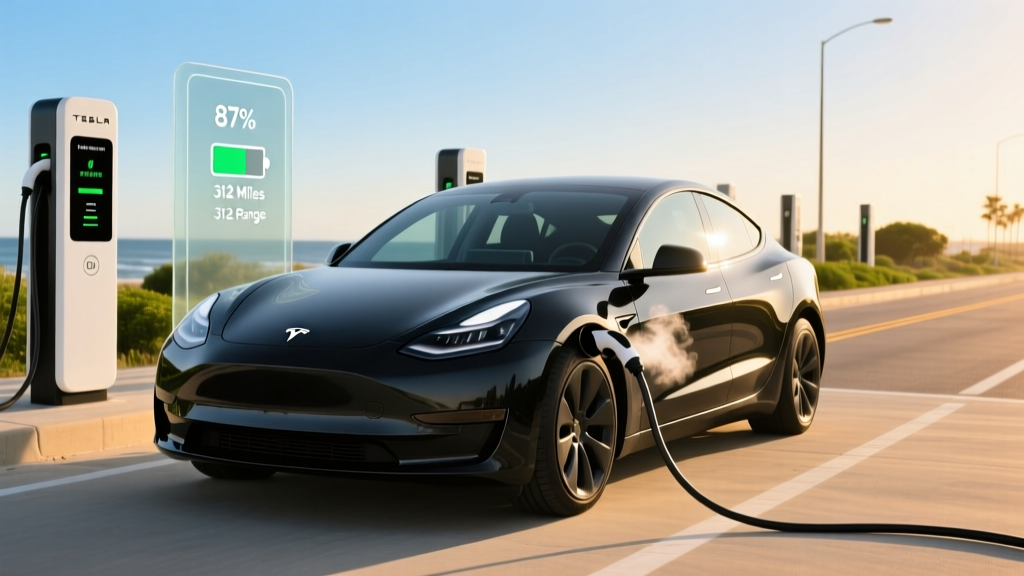
Tesla's charging architecture remains a key ownership advantage. The Model 3 Performance peaks at 250 kW on V3 Superchargers and sustains strong power delivery through the mid-state-of-charge range. In real-world testing, a 10–80% session typically takes 25–30 minutes at a V3 or V4 Supercharger stall. The charge curve holds above 150 kW until roughly 55% SoC, then gradually tapers — by 80% you're pulling roughly 60–70 kW.
Home charging on a 48-amp Level 2 circuit (requiring a 60-amp breaker) delivers 11.5 kW, adding roughly 44 miles of range per hour. An overnight session from 20% to full takes about 6–7 hours. If your electrical panel supports only a 40-amp circuit (32A charger), expect ~30 miles per hour — still adequate for most daily commuting. Tesla's Wall Connector costs approximately $420 for the hardware, with professional installation typically running $500–$1,500 depending on panel proximity and local permitting.
One practical note: preconditioning the battery before arriving at a Supercharger (automatically triggered when you navigate to a charger in the Tesla app or nav system) is essential for hitting peak charge rates. Without it, cold-soaked batteries may peak at only 50–100 kW for the first several minutes.
Performance, Ride, and Handling
The 2024 refresh brought a new rear-drive motor (the "Performance" unit) producing a combined 510 hp and 546 lb-ft of torque. The result is a 2.9-second 0–60 mph time — genuinely supercar territory from a four-door sedan. Track mode is standard, allowing adjustable torque distribution and regenerative braking settings for closed-course driving.
More significant than straight-line speed is the chassis overhaul. The Highland update introduced frequency-selective dampers, a stiffer body structure, and revised suspension geometry. The result is noticeably improved ride compliance over the pre-2024 Model 3, which was often criticized for being harsh over broken pavement. The Performance trim rides on 20-inch Curvilinear wheels with Michelin Pilot Sport 4S tires — grip is exceptional, but ride firmness is still a step above the Long Range variant.
Steering feel remains a Tesla weak point relative to, say, a BMW i4 M50 or Porsche Taycan. It's precise and quick but lacks the feedback that enthusiast drivers expect at this performance level. For daily driving and canyon roads, it's more than capable — but buyers prioritizing steering communication should test-drive the competition.
Interior, Tech, and Practicality
The 2024 interior redesign is the most controversial aspect of the Model 3 refresh. Tesla eliminated the turn-signal stalk (signals are now on the steering wheel) and the gear selector (gear selection is via the touchscreen or overhead console). Ambient lighting, ventilated front seats, and a rear 8-inch touchscreen are new additions that meaningfully improve the cabin experience.
Infotainment: The 15.4-inch center touchscreen runs Tesla's proprietary OS, which remains the most responsive and feature-rich system in the EV segment. Navigation, media, climate, and vehicle controls all route through this screen. There is no Apple CarPlay or Android Auto — a dealbreaker for some buyers, though Tesla's native integration (Spotify, Tidal, Netflix while parked, Sentry Mode) is robust.
Driver Assistance: Basic Autopilot is standard, providing adaptive cruise control and lane centering. Full Self-Driving (Supervised) is an $8,000 option. To be clear: FSD is an SAE Level 2 system — the driver must remain fully engaged, hands on the wheel (or torque-verified), at all times. It is not autonomous driving. FSD handles highway interchanges, traffic lights, and stop signs with increasing competence, but still requires regular intervention in construction zones, complex intersections, and adverse weather.
Cargo and Space: The trunk offers 21 cu ft of volume, with an additional 2 cu ft frunk (front trunk) — though the frunk in the Performance is smaller than the Long Range due to additional mechanical components. Rear legroom measures 35.3 inches, adequate for adults on shorter trips but tight for taller passengers on long drives. The rear seat remains a three-across bench, though the center position is best suited for a child seat.
Pricing, Trims, and Federal Tax Credit Eligibility
| Item | Amount |
|---|---|
| Base MSRP (Model 3 Performance) | $52,990 |
| Destination Fee | $1,390 |
| FSD (Supervised) Option | +$8,000 |
| Paint (Ultra Red, Solid Black, etc.) | +$1,500–$2,500 |
| As-Tested Price (w/ FSD, premium paint) | ~$64,880 |
| Federal Tax Credit (§30D) | Up to $7,500 (eligibility varies) |
| Estimated Net Price (with full credit) | ~$46,880 (base, before options) |
The 2024 Model 3 Performance qualifies for the IRS §30D federal tax credit, but eligibility depends on several factors that change periodically:
- MSRP cap: Sedans must be priced at or below $55,000 to qualify. The Model 3 Performance at $52,990 + $1,390 destination = $54,380 clears this threshold — but adding FSD or certain paint colors may push the transaction above $55,000, disqualifying the credit.
- Buyer income cap: Modified adjusted gross income must not exceed $150,000 (single), $225,000 (head of household), or $300,000 (joint filing).
- Battery sourcing: The credit is split into two $3,750 halves — one for critical minerals sourcing and one for battery component manufacturing. Tesla's supply chain has shifted over time; as of 2024, the Model 3 Performance has generally qualified for the full $7,500, but buyers should verify current eligibility on fueleconomy.gov at the time of purchase.
- Point-of-sale transfer: Since 2024, the credit can be transferred to the dealer at purchase, reducing the out-of-pocket price immediately rather than waiting for tax filing.
Critical caveat: Tax credit rules and battery-sourcing requirements are subject to change. Always confirm eligibility with your tax professional and the IRS before finalizing a purchase. State and local incentives (such as California's CVRP or Colorado's state credit) may stack on top but vary by jurisdiction.
Pros and Cons
Pros
- 2.9-second 0–60 mph at a ~$53K base price is unmatched
- Supercharger network reliability (20,000+ stalls in North America)
- Over-the-air updates continuously add features
- Highland chassis overhaul dramatically improves ride quality
- Class-leading software integration and app ecosystem
- Strong resale value relative to most EV competitors
- Full $7,500 federal tax credit eligibility (with caveats)
Cons
- No physical turn-signal stalk or gear selector — steep adjustment curve
- No Apple CarPlay or Android Auto
- Rear seat legroom is tight for tall adults
- Steering lacks feedback compared to BMW i4, Porsche Taycan
- 20-inch Performance wheels reduce range and ride comfort vs. Long Range
- FSD ($8,000) remains Level 2 — not autonomous despite the name
- Insurance premiums run 15–30% higher than segment average
Who Should Buy the 2024 Model 3 Performance?
Best for: Driving enthusiasts who want supercar acceleration in a practical daily driver, tech-forward commuters who value OTA updates and integrated navigation, and road-trippers who prioritize Supercharger network access. The Model 3 Performance makes the most sense for buyers who have home Level 2 charging and drive fewer than 250 miles per day with occasional longer trips.
Consider alternatives if: You need maximum rear-seat space (look at the Hyundai Ioniq 6 or BMW i4), you refuse to live without CarPlay, you prioritize steering feel over straight-line speed (BMW i4 M50), or you want a sub-$45K entry price (the Model 3 Long Range RWD or Chevrolet Blazer EV may fit better).
Frequently Asked Questions
What is the real-world range of the 2024 Tesla Model 3 Performance?
The EPA rates it at 315 miles, but real-world highway driving at 70+ mph typically yields 265–285 miles in mild weather. In cold conditions (below freezing), expect 220–250 miles due to battery thermal losses and cabin heating demands. City driving with regenerative braking recovers more energy and can approach or slightly exceed the EPA figure.
How fast does the Model 3 Performance charge?
On a Tesla V3 or V4 Supercharger, it peaks at 250 kW and charges from 10–80% in approximately 27 minutes. At home on a 48-amp Level 2 charger (11.5 kW), a full charge takes roughly 7.5 hours. Always precondition the battery by navigating to a Supercharger for optimal charge rates.
Does the 2024 Model 3 Performance qualify for the $7,500 federal tax credit?
Yes, with conditions. The base MSRP of $54,380 (including destination) falls under the $55,000 sedan cap. However, buyer income limits apply ($150K single / $300K joint), and battery-sourcing requirements must be met. Adding FSD ($8,000) pushes the transaction above $55K, which may disqualify the credit. Always verify on fueleconomy.gov and consult a tax professional before purchasing.
Is the Model 3 Performance worth it vs. the BMW i4 M50 or Hyundai Ioniq 6 N?
The Model 3 Performance wins on price-to-acceleration ratio ($53K for 2.9s 0–60), Supercharger network access, and software integration. The BMW i4 M50 (~$67K) offers superior steering feel, build quality, and CarPlay but is heavier and more expensive. The Ioniq 6 N (~$66K) targets track enthusiasts with simulated gear shifts and launch control but sacrifices range. For most performance-EV buyers, the Model 3 Performance remains the value benchmark.
What is the battery warranty on the Model 3 Performance?
Tesla covers the battery and drive unit for 8 years or 120,000 miles (whichever comes first), with a minimum 70% capacity retention guarantee. If the battery degrades below 70% of original capacity within the warranty period, Tesla will repair or replace it. Independent data from fleet operators suggests NMC packs in Teslas typically retain 85–90% capacity at 100,000 miles under normal use.
Does Full Self-Driving make the Model 3 autonomous?
No. FSD (Supervised) is an SAE Level 2 driver-assistance system. The driver must remain fully attentive and ready to take over at any moment. It handles highway lane changes, on-ramps, some traffic lights, and stop signs — but it is not self-driving. Level 4 autonomous driving (no driver needed) is currently only available through robotaxi services like Waymo in limited metro areas.