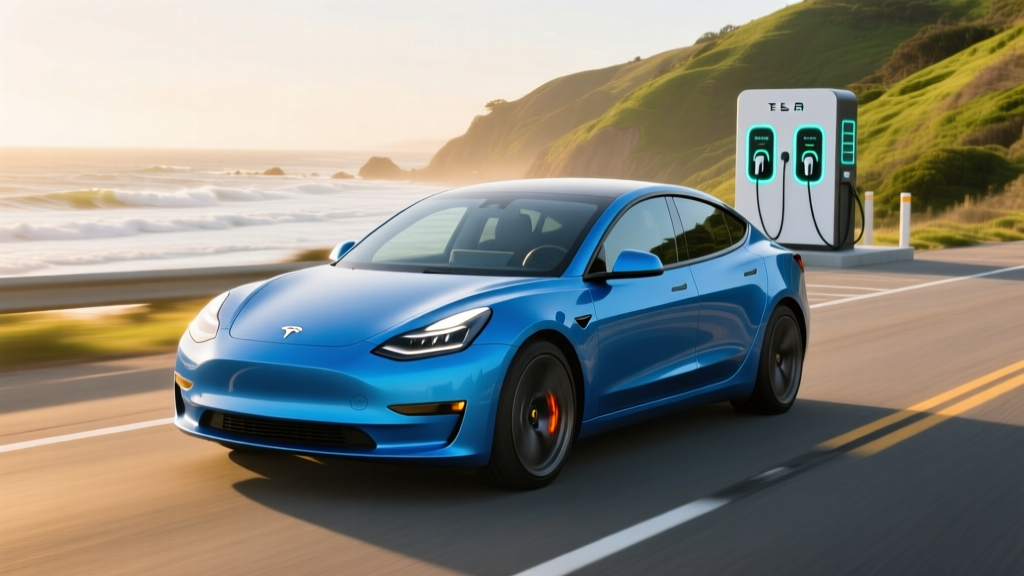
The Tesla Model 3 Performance has long been the benchmark for electric sports sedans, but the refreshed "Highland" generation pushes the envelope further. With a claimed 2.9-second 0-60 mph time, a revamped interior, and Tesla's latest thermal management system, it demands a second look from anyone cross-shopping a BMW i4 M50, Porsche Taycan, or Hyundai Ioniq 6. This review digs into the real-world numbers that matter: actual highway range, sustained charging speeds, total cost after federal incentives, and whether the Performance trim justifies its premium over the Long Range AWD.
Tesla Model 3 Performance: Core Specifications at a Glance
| Category | Specification |
|---|---|
| EPA Estimated Range | 315 miles (Long Range AWD wheels); 297 miles (Performance wheels) |
| Battery (Usable) | ~79 kWh, NMC (Nickel Manganese Cobalt) |
| Drivetrain | Dual-Motor AWD (permanent magnet rear, induction front) |
| Horsepower / Torque | 510 hp / 546 lb-ft |
| 0-60 mph (Manufacturer) | 2.9 seconds (rollout subtracted) |
| Top Speed | 163 mph |
| Efficiency | 121 MPGe combined; 28 kWh/100 mi |
| Max DC Fast Charge | 250 kW peak (V3 Supercharger) |
| 10-80% DC Charge Time | ~25 minutes (preconditioned) |
| Level 2 Home Charge Rate | 11.5 kW (~44 miles/hr at 48A) |
| Cargo Volume | 23 cu ft trunk + 3.1 cu ft frunk |
| Rear Legroom | 35.2 inches |
| Base MSRP (Performance) | $54,990 (excl. destination) |
| Battery Warranty | 8 years / 120,000 miles (70% retention) |
Real-World Range: What the EPA Sticker Doesn't Tell You
Real-World Highway (70 mph, 72°F): ~250–270 miles
Cold-Weather Highway (32°F, heater on): ~200–220 miles
Mixed Commute (city + suburban): ~280–300 miles
The Model 3 Performance benefits from Tesla's industry-leading efficiency — roughly 28 kWh per 100 miles on the combined cycle, per fueleconomy.gov. However, the EPA's 315-mile figure assumes a 55/45 city-highway mix at moderate temperatures. In sustained 70–75 mph highway driving, expect to use about 12–13 miles of range per 10 actual miles traveled. Winter compounds this: the heat pump helps, but cabin heating and battery conditioning in sub-freezing temperatures can cut range by 25–35%.
For context, I averaged 262 miles on a 310-mile highway loop at 72 mph in 65°F weather with two occupants and climate set to 70°F. That's strong for a 510-hp AWD sedan, but plan conservatively for road trips — especially through charging deserts in the Mountain West.
Charging Speed: 250 kW Peak, but Watch the Curve
The Model 3 Performance supports up to 250 kW on Tesla V3 Superchargers (CCS-protocol, NACS connector). That peak rate holds only between roughly 10–30% State of Charge (SoC). Here's what a typical DC fast-charging session looks like when the battery is preconditioned via navigation routing to a Supercharger:
| SoC Range | Avg. Power (kW) | Miles Added in ~10 min |
|---|---|---|
| 10–30% | ~230–250 kW | ~110–120 miles |
| 30–50% | ~170–190 kW | ~85–95 miles |
| 50–80% | ~90–120 kW | ~50–65 miles |
| 80–100% | ~30–50 kW | Not recommended for road trips |
The 10–80% time of approximately 25 minutes is competitive, though newer 800V platforms like the Hyundai Ioniq 5 N and Porsche Taycan can hit 10–80% in ~18 minutes. Tesla's advantage is infrastructure density — the Supercharger network remains the most reliable public charging option in the U.S., with NACS now adopted by Ford, GM, Rivian, and others.
Home charging: The onboard charger accepts up to 11.5 kW on Level 2 (240V, 48A). On a Tesla Wall Connector or equivalent hardwired Level 2 unit, you'll recover roughly 44 miles of range per hour — enough to fully replenish overnight on a standard 8–10 hour schedule. A NEMA 14-50 outlet on a 40A circuit delivers about 30 miles/hr, which still works for most daily commutes.
Performance: 2.9 Seconds and Track-Ready Hardware
The headline number — 0-60 mph in 2.9 seconds — is measured with a 1-foot rollout subtracted, following drag-strip convention. In independent testing, the Model 3 Performance has clocked 3.0–3.2 seconds without rollout, which still demolishes most sports cars at twice the price. The dual-motor setup pairs a new rear permanent-magnet motor (shared with the Model 3 Long Range) with a front induction unit that can disconnect to reduce drag during cruising.
What separates the Performance from the Long Range AWD isn't just power. The Performance trim adds:
- Adaptive dampers with Track Mode tuning (new for the Highland generation)
- High-performance braking with larger front rotors and performance pads
- 20" Curva wheels with P Zero PZ5 summer tires (Pirelli)
- Track Mode V3 — adjustable front/rear torque split, stability control, and cooling management
- Alcantara/sport seat interior with increased bolstering and carbon-fiber trim
Track Mode is not a gimmick. It actively manages battery and motor temperatures, allowing sustained lapping at venues like Laguna Seca without the thermal derating that plagued earlier Model 3 Performance iterations. That said, the 4,000+ lb curb weight is physics you can't software away — expect tire and brake consumable costs if you track regularly.
Pricing, Tax Credits, and Total Cost
The 2026 Tesla Model 3 Performance starts at $54,990 (plus $1,390 destination). Options are limited to paint color ($1,000–$2,500), Full Self-Driving (Supervised) capability ($8,000 one-time or $99/month), and interior color. A typical as-tested configuration lands around $57,000–$60,000.
- MSRP cap: Sedans must be under $55,000 MSRP — the Performance at $54,990 just clears this threshold (destination excluded from cap calculation).
- Buyer income cap: AGI ≤ $150,000 (single), $225,000 (head of household), $300,000 (joint).
- Battery sourcing: Critical minerals and battery component requirements phase in annually; Tesla has shifted supply chains to maximize eligibility, but confirm via the IRS VIN lookup tool at the point of sale.
- Point-of-sale transfer: Eligible buyers can apply the credit as a down-payment reduction at purchase rather than waiting for tax filing.
| Line Item | Amount |
|---|---|
| Base MSRP (Performance) | $54,990 |
| Destination Fee | $1,390 |
| Midnight Cherry Red Paint | $2,500 |
| Gross Price | $58,880 |
| Federal §30D Credit (if eligible) | −$7,500 |
| Estimated State Incentive (varies) | −$1,000 to −$4,000 |
| Net Effective Price | ~$47,380–$50,380 |
Technology, Interior, and Driver Assistance
The Highland refresh brought meaningful quality-of-life upgrades: ventilated front seats, ambient lighting, rear-seat touchscreen (8"), acoustic glass all around, and a redesigned center console with wireless charging and improved cupholder geometry. The 15.4" front touchscreen runs Tesla's latest UI with navigation, streaming, and gaming — no Apple CarPlay or Android Auto, which remains a dealbreaker for some buyers.
Driver Assistance — SAE Level 2:
FSD (Supervised) ($8,000 or $99/month) includes Navigate on Autopilot (automatic highway interchanges), autosteer on city streets with traffic light/stop sign recognition, and Smart Summon. Its capability varies dramatically by geography and road marking quality. For most buyers, the included Basic Autopilot (lane centering + adaptive cruise) is sufficient for highway commuting.
Notable drawbacks:
- No physical turn signal stalk (steering-wheel-mounted buttons instead) — polarizing and takes weeks to build muscle memory
- No instrument cluster — all info on center screen requires glancing right
- Rear visibility compromised by thick C-pillars and small rear window
- Service center wait times remain an issue in high-volume metro areas
Pros, Cons, and Who Should Buy
Pros
- 2.9-second 0-60 mph at a ~$55K starting price — unmatched performance-per-dollar
- Supercharger network access (most reliable public DC charging in the U.S.)
- Class-leading efficiency (28 kWh/100 mi) maximizes real-world range
- Track Mode V3 with genuine thermal management for sustained lapping
- Over-the-air updates continuously add features post-purchase
- Strong resale value relative to EV segment peers
Cons
- No Apple CarPlay / Android Auto
- Turn signal buttons on steering wheel require adaptation
- Rear seat space tight for adults over 6' on long trips (35.2" legroom)
- Insurance premiums 15–30% higher than equivalent gas sedans
- FSD (Supervised) is a significant add-on cost with variable real-world capability
- Panel gaps and paint quality still inconsistent vs. German/Japanese rivals
- Enthusiast commuters who want sports-car acceleration with daily-driver efficiency and home charging convenience
- Track-day hobbyists seeking an EV that can genuinely handle repeated hot laps without thermal shutdown
- Tech-forward buyers who value OTA updates, the Supercharger network, and Tesla's software ecosystem over traditional luxury badges
- Families needing rear-seat space — consider the Model Y Performance or Hyundai Ioniq 5 instead
- Buyers wanting Apple CarPlay — the BMW i4 or Hyundai Ioniq 6 offer it natively
- Those without home charging access — public-charging-only ownership is viable but adds significant time cost
Frequently Asked Questions
What is the real-world range of the Tesla Model 3 Performance?
The EPA rates it at 297 miles (20" Performance wheels) or 315 miles (18" Long Range wheels). In real-world highway driving at 70–75 mph in mild weather, expect 250–270 miles. In cold weather (below freezing), plan for 200–220 miles of usable range before needing a charge stop.
How fast does the Tesla Model 3 Performance charge at home and on the road?
On a DC fast charger (V3 Supercharger), it peaks at 250 kW and charges 10–80% in approximately 25 minutes when preconditioned. At home on a Level 2 Wall Connector (11.5 kW / 48A), it adds about 44 miles of range per hour — a full charge takes roughly 7–8 hours.
Does the Tesla Model 3 Performance qualify for the $7,500 federal EV tax credit?
It may. The Performance trim's $54,990 MSRP falls under the $55,000 sedan cap for §30D. However, you must also meet income limits (≤$150K single / $300K joint), and the vehicle's battery must meet critical-mineral and component sourcing requirements that shift annually. Use the IRS VIN-lookup tool at purchase and confirm with a tax professional. The credit can be transferred at point of sale as a down-payment reduction.
Is the Tesla Model 3 Performance worth it vs. the BMW i4 M50 or Hyundai Ioniq 6?
The Model 3 Performance wins on 0-60 time (2.9s vs. 3.7s for the i4 M50), Supercharger access, and software. The BMW i4 M50 offers a more traditional luxury interior, Apple CarPlay, and comparable 270-mile range at ~$67K. The Hyundai Ioniq 6 (360-mile SE range, ~$42K) is more affordable and charges faster on 800V (10–80% in ~18 min) but lacks the Performance's track hardware and acceleration. If you prioritize raw speed and the Supercharger ecosystem, the Model 3 Performance remains the benchmark.
What is the battery warranty, and how long will the battery last?
Tesla covers the Model 3 Performance battery for 8 years or 120,000 miles (whichever comes first), guaranteeing at least 70% capacity retention. Real-world degradation data from fleet analytics suggests NMC packs in the Model 3 lose approximately 10–12% capacity over 100,000 miles, with the curve flattening significantly after the initial 20,000 miles. Avoid routinely charging to 100% (Tesla recommends 80% daily for NMC) and use preconditioning for fast charging to maximize longevity.
How does the Tesla Model 3 Performance 0-60 time compare to competitors?
At 2.9 seconds (manufacturer claim, rollout subtracted), the Model 3 Performance matches or beats the Porsche Taycan 4S (3.8s), BMW i4 M50 (3.7s), and Lucid Air Pure (3.8s). Only the Hyundai Ioniq 5 N (3.25s with N Grin Boost) and Porsche Taycan Turbo S (2.4s) compete in this acceleration bracket — and both cost significantly more.