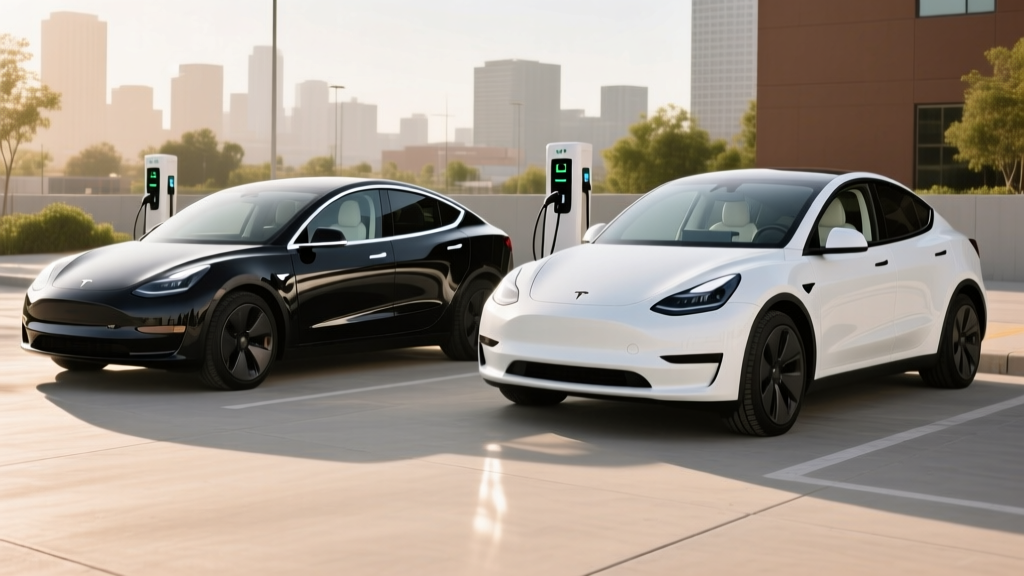
If you have narrowed your electric-vehicle search to the Tesla lineup, the decision almost always comes down to two cars: the refreshed Model 3 sedan and the crossover Model Y. Both share Tesla's software stack, Supercharger network access, and minimalist interior philosophy, but they diverge on range, cargo utility, pricing, and who they serve best. This guide dissects the 2026 Tesla Model 3 and Model Y side by side so you can pick the right one with confidence — backed by EPA data, real-world testing notes, and current IRS §30D tax-credit rules.
2026 Tesla Model 3 and Model Y at a Glance
Before we get into the weeds on charging curves and cold-weather range loss, here are the headline specifications for the most popular trims buyers actually cross-shop. All figures reflect the 2026 model year as listed on Tesla's US configurator and fueleconomy.gov.
| Spec | Model 3 Long Range AWD | Model 3 RWD | Model Y Long Range AWD | Model Y RWD |
|---|---|---|---|---|
| EPA Range | 341 mi | 272 mi | 320 mi | 260 mi |
| Battery (usable) | ~75 kWh (NMC) | ~60 kWh (LFP) | ~75 kWh (NMC) | ~60 kWh (LFP) |
| Efficiency (MPGe) | 134 MPGe | 132 MPGe | 122 MPGe | 125 MPGe |
| Efficiency (kWh/100 mi) | 25 | 25 | 28 | 27 |
| 0-60 mph | 4.2 sec | 5.8 sec | 4.8 sec | 6.6 sec |
| Horsepower | ~346 hp | ~271 hp | ~384 hp | ~295 hp |
| Drivetrain | Dual-motor AWD | RWD | Dual-motor AWD | RWD |
| Max DC Fast Charge | 250 kW | 170 kW | 250 kW | 170 kW |
| 10-80% DCFC Time | ~25 min | ~30 min | ~27 min | ~32 min |
| Base MSRP | $42,630 | $36,630 | $44,630 | $39,630 |
| Cargo Volume | 23 cu ft | 23 cu ft | 76 cu ft (rear seats folded) | 72 cu ft |
Real-World Range: What the EPA Sticker Doesn't Tell You
The EPA range figure assumes a mix of city and highway driving at moderate temperatures. In real-world conditions, expect the following adjustments:
Model 3 Long Range AWD: EPA 341 mi → Expect ~285-305 mi on sustained highway driving at 70-75 mph; ~240-260 mi in sub-30°F winter conditions.
Model 3 RWD: EPA 272 mi → Expect ~225-240 mi highway; ~190-210 mi in freezing weather.
Model Y Long Range AWD: EPA 320 mi → Expect ~265-285 mi highway; ~220-245 mi in cold weather.
Model Y RWD: EPA 260 mi → Expect ~215-230 mi highway; ~180-200 mi in freezing weather.
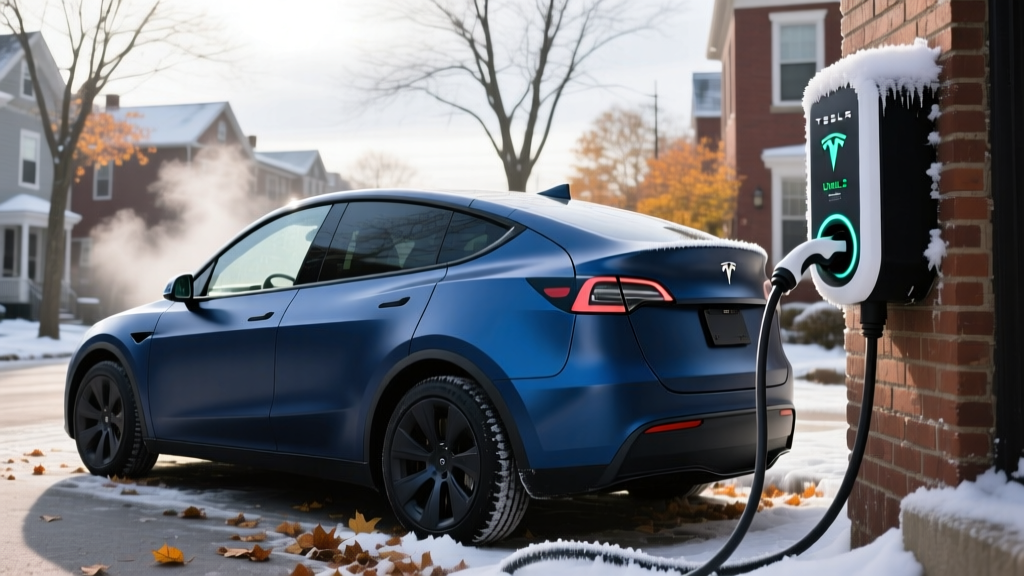
The crossover Model Y loses more range than the sedan on the highway because of its taller frontal area and increased aerodynamic drag. The Model 3's lower, sleeker profile makes it measurably more efficient at speed. Both vehicles benefit from Tesla's standard heat pump, which reduces — but does not eliminate — cold-weather range loss compared to resistive cabin heating.
If you commute mostly in stop-and-go city traffic, you will actually see range figures close to or occasionally exceeding the EPA number, because regenerative braking recaptures energy that gas cars waste at every stoplight. Highway driving is where EVs are least efficient, and winter compounds the effect as the battery spends energy warming itself and the cabin.
Charging Speed: DC Fast, Level 2, and the Charge-Curve Reality
Charging is where Tesla still holds a significant advantage over most competitors. Access to the Supercharger network — now the largest and most reliable DC fast-charging system in North America — is included with every new Model 3 and Model Y. Here is what you can expect at each charging level:
| Charging Level | Power | Model 3 LR / Model Y LR | Model 3 RWD / Model Y RWD |
|---|---|---|---|
| Level 1 (120V household) | ~1.4 kW | ~4-5 mi/hr | ~4-5 mi/hr |
| Level 2 (240V home, 48A) | 11.5 kW | ~44 mi/hr | ~44 mi/hr |
| DC Fast Charge (peak) | 250 kW (LR) / 170 kW (RWD) | 10-80% in ~25-27 min | 10-80% in ~30-32 min |
A critical point many first-time EV buyers miss: peak charge rate is not sustained charge rate. The Long Range models peak near 250 kW only when the battery is preconditioned and at a low state of charge (around 10-20%). The charge curve tapers progressively — dropping to roughly 150 kW by 50% SoC and below 80 kW by 70% SoC. This is why Tesla quotes 10-80% times rather than 0-100%: the final 20% can take as long as the first 70%. For road trips, plan to charge from roughly 10% to 80% and then drive on, rather than waiting for a full battery.
The RWD trims use LFP (lithium iron phosphate) batteries, which have a different charge-curve profile. LFP cells tolerate regular charging to 100% without the degradation concerns that apply to NMC chemistry — Tesla actually recommends periodic 100% charges on LFP vehicles to keep the battery management system calibrated. This is a genuine ownership advantage for daily commuters who want maximum range every morning.
Performance, Handling, and Drivetrain Differences
The Model 3 is the driver's car of the two. Its lower center of gravity, lighter weight (~3,862 lb for Long Range vs. ~4,198 lb for Model Y Long Range), and firmer suspension tuning make it noticeably more engaging on winding roads. The dual-motor AWD Long Range Model 3 hits 60 mph in 4.2 seconds, which is sports-car territory from just a few years ago.
The Model Y trades some of that agility for ride height, cargo space, and a slightly softer ride that families tend to prefer. Its 4.8-second 0-60 time in Long Range AWD trim is still quick by any measure, and the all-wheel-drive system provides confident traction in rain and snow.
Both vehicles feature Tesla's one-pedal driving mode, which uses aggressive regenerative braking to slow the car to a complete stop in most situations. This reduces brake wear dramatically — many Tesla owners report original brake pads lasting well past 80,000 miles.
Pricing, Tax Credits, and What You Will Actually Pay
Tesla's pricing shifts periodically, but as of the 2026 model year, here is where the lineup sits before incentives:
| Trim | Base MSRP | Est. Destination | §30D Credit Eligibility | Effective Price (if eligible) |
|---|---|---|---|---|
| Model 3 RWD | $36,630 | $1,390 | Up to $7,500 (subject to sourcing rules) | ~$30,520 |
| Model 3 Long Range AWD | $42,630 | $1,390 | Up to $7,500 (subject to sourcing rules) | ~$36,520 |
| Model Y RWD | $39,630 | $1,390 | Up to $7,500 (subject to sourcing rules) | ~$33,520 |
| Model Y Long Range AWD | $44,630 | $1,390 | Up to $7,500 (subject to sourcing rules) | ~$38,520 |
- Income caps: Modified AGI must not exceed $150,000 (single), $225,000 (head of household), or $300,000 (joint filers).
- MSRP caps: Vehicle MSRP must be ≤ $55,000 for sedans (Model 3) or ≤ $80,000 for SUVs/crossovers (Model Y). All current trims qualify.
- Battery sourcing: The credit splits into two halves — $3,750 for critical-minerals sourcing and $3,750 for battery-component manufacturing. Full $7,500 requires meeting both thresholds. Tesla has progressively shifted sourcing, but the exact credit amount can change. Always verify current eligibility at irs.gov before purchasing.
- Point-of-sale transfer: You can transfer the credit to the dealer at purchase to reduce your out-of-pocket cost immediately, rather than waiting to claim it on your tax return.
For buyers who do not qualify for the full federal credit due to income limits, several states offer additional rebates or incentives. Check your state's energy or DMV website for current programs, as these vary significantly by jurisdiction.
Interior, Cargo, and Daily Livability
The Model 3 and Model Y share the same interior architecture: a single 15.4-inch center touchscreen controls virtually everything, from climate to mirrors to glove-box release. There is no instrument cluster — speed and navigation appear on the left side of the central screen. This minimalist approach is polarizing: some owners love the clean aesthetic, while others find it distracting to reach for a touchscreen to adjust wiper speed or vent direction.
Where the two vehicles diverge sharply is cargo and passenger space:
| Dimension | Model 3 | Model Y |
|---|---|---|
| Front Headroom | 40.3 in | 41.0 in |
| Rear Headroom | 37.8 in | 39.2 in |
| Rear Legroom | 35.2 in | 37.0 in |
| Cargo (rear seats up) | 23 cu ft | 30 cu ft |
| Cargo (rear seats folded) | ~45 cu ft | 72-76 cu ft |
| Frunk (front trunk) | 3.1 cu ft | 4.1 cu ft |
| Towing Capacity | Not rated | 3,500 lb (AWD) |
If you regularly haul children, car seats, strollers, or large items, the Model Y's additional rear headroom and legroom make a meaningful difference. The crossover's hatchback design also allows you to slide in bulky objects that simply would not fit through the Model 3's traditional sedan trunk opening. The Model 3 is the better pick for singles, couples, or commuters who prioritize driving dynamics and efficiency over cargo flexibility.
Technology, Autopilot, and Driver Assistance
Tesla's Autopilot and available Full Self-Driving (Supervised) system are classified as SAE Level 2 driver-assistance systems. This means the driver must remain fully engaged, keep hands on the wheel, and monitor the road at all times. These systems are not self-driving. They can assist with steering, acceleration, and braking within their operational limits, but they do not replace the driver.
Every Model 3 and Model Y comes standard with Basic Autopilot, which includes adaptive cruise control and lane-keeping assist. Tesla's Enhanced Autopilot ($6,000 add-on) adds automatic lane changes, navigate-on-autopilot for highway interchanges, and Smart Summon for parking-lot retrieval. Full Self-Driving (Supervised), at $8,000, adds traffic-light and stop-sign recognition with automatic responses.
Beyond driver assistance, both vehicles include over-the-air software updates that can add features after purchase, a built-in dashcam and Sentry Mode surveillance system, and Tesla's mobile app for remote climate control, charging status, and vehicle location. The infotainment system supports streaming (Netflix, YouTube, Spotify) while parked and includes a surprisingly capable built-in navigation system with real-time Supercharger availability and route planning that factors in charging stops.
Warranty, Battery Longevity, and Ownership Costs
Tesla provides the following warranty coverage on both the Model 3 and Model Y:
| Component | Model 3 RWD (LFP) | Model 3 LR / Model Y (NMC) |
|---|---|---|
| Basic Vehicle | 4 years / 50,000 mi | 4 years / 50,000 mi |
| Battery & Drive Unit | 8 years / 100,000 mi | 8 years / 120,000 mi |
| Battery Retention Guarantee | ≥70% capacity | ≥70% capacity |
Real-world battery degradation data from large Tesla fleet samples shows that NMC batteries in Long Range models typically lose around 5-8% of total capacity in the first 50,000 miles, then degrade more slowly, often retaining 88-92% capacity at 150,000 miles. LFP batteries in RWD models show even slower degradation curves, with many owners reporting 95%+ capacity retention at 60,000 miles — a benefit of the chemistry's inherently longer cycle life.
Insurance costs for Teslas tend to run 15-30% higher than comparable gas-powered vehicles, largely due to higher repair costs after collisions (specialized parts, aluminum body panels, and sensor recalibration). Get quotes from at least three insurers before purchasing to set accurate expectations for your total monthly cost.
Pros and Cons: The Honest Summary
- Best-in-class DC fast-charging speed and Supercharger network reliability
- Industry-leading energy efficiency (25 kWh/100 mi on Model 3 LR)
- Over-the-air updates continuously add features post-purchase
- LFP RWD models allow daily 100% charging without degradation concern
- Minimal maintenance: no oil changes, very low brake wear
- Strong resale value relative to most EV competitors
- Minimalist interior forces nearly all controls through the touchscreen
- No physical instrument cluster or HUD; speed is on the center screen
- Insurance premiums significantly above segment average
- Ride quality is firm, especially on Model 3 with larger wheels
- No Apple CarPlay or Android Auto support
- Service center availability varies widely by region
Which One Should You Buy? A Decision Framework
- You are a commuter or couple prioritizing maximum range and efficiency
- Driving dynamics and a sportier feel matter to you
- You want the lowest purchase price and operating cost in the Tesla lineup
- You rarely need to carry large cargo or more than two rear passengers
Choose the Model Y if:
- You have a family with children and need rear-seat space for car seats
- You need hatchback cargo flexibility and up to 3,500-lb towing (AWD)
- You prefer a higher seating position and easier ingress/egress
- You regularly take road trips with bulky gear (strollers, bikes, camping equipment)
Frequently Asked Questions
What is the real-world range of the Tesla Model 3 and Model Y?
The Model 3 Long Range AWD delivers roughly 285-305 miles on highway trips in mild weather, dropping to 240-260 miles in freezing temperatures. The Model Y Long Range AWD achieves about 265-285 highway miles in mild conditions and 220-245 in cold weather. City driving with regenerative braking often yields results closer to or slightly above the EPA sticker.
How fast do the Model 3 and Model Y charge?
Long Range models peak at 250 kW on DC fast chargers, reaching 10-80% in about 25-27 minutes when preconditioned. RWD models peak at 170 kW with 10-80% in roughly 30-32 minutes. At home on a 48-amp Level 2 charger (240V), both vehicles add approximately 44 miles of range per hour of charging.
How much does a Tesla Model 3 or Y cost after the federal tax credit?
If you qualify for the full $7,500 §30D credit, the Model 3 RWD drops to approximately $30,520 including destination, and the Model Y Long Range AWD comes in around $38,520. Eligibility depends on your income, the vehicle's MSRP, and battery-sourcing requirements that change periodically. Verify current rules at irs.gov before committing.
Do the Model 3 and Model Y qualify for the federal EV tax credit?
Both models fall under the MSRP caps ($55,000 for sedans, $80,000 for SUVs). However, the actual credit amount — $3,750, $7,500, or $0 — depends on whether Tesla's battery components and critical minerals meet the current-year domestic-sourcing thresholds defined by the IRS. This changes as supply chains shift, so check the fueleconomy.gov tax credit page for the latest determination.
Is the Tesla Model 3 or Y worth buying vs. competitors?
Against the Hyundai Ioniq 6, BMW i4, and Polestar 2, the Model 3 offers superior charging infrastructure access and efficiency. Against the Ford Mustang Mach-E, Hyundai Ioniq 5, and Kia EV6, the Model Y competes on range and software but trails on interior material quality and physical controls. For buyers who prioritize the most mature charging network and lowest energy consumption, Tesla remains the benchmark. For those who want a more traditional cockpit layout or faster 800V charging architecture (Hyundai/Kia), competitors make strong cases.
What is the biggest drawback of owning a Tesla Model 3 or Y?
The most common complaint centers on the touchscreen-dependent interface — adjusting climate, mirrors, or wipers requires navigating menus rather than turning a knob. Insurance costs also surprise many first-time Tesla owners. Finally, while Tesla's Supercharger network is excellent, service-center capacity in some regions can mean longer wait times for collision or warranty repairs compared to legacy automakers with larger dealer networks.