The Real Monthly Cost of Owning a Tesla Model 3 in 2026
If you've been searching "how much a month for a Tesla," you've probably seen estimates ranging from $400 to over $1,200. The truth depends on which trim you choose, how you finance, what you pay for electricity, and whether you qualify for the federal tax credit. For the 2026 model year, the Tesla Model 3 remains one of the most efficient and best-supported electric sedans on the market — but the sticker price is only the beginning of the equation.
This guide walks through every line item: the purchase price after incentives, home and public charging costs, insurance premiums, depreciation, and maintenance. We'll use the 2026 Tesla Model 3 Long Range AWD as our primary example, with notes on the Standard Range RWD and Performance trims where costs diverge. By the end, you'll have a realistic monthly budget — not a marketing estimate.
2026 Tesla Model 3: Core Specs at a Glance
Before calculating monthly costs, here's what you're actually buying. The 2026 Model 3 lineup carries over the "Highland" refresh architecture with minor battery and software updates.
| Spec | Standard Range RWD | Long Range AWD | Performance |
|---|---|---|---|
| EPA Range | 272 miles | 341 miles | 315 miles |
| Battery (usable) | ~57 kWh (LFP) | ~75 kWh (NMC) | ~75 kWh (NMC) |
| Drivetrain | Rear-Wheel Drive | Dual-Motor AWD | Dual-Motor AWD |
| Horsepower | 271 hp | 346 hp | 510 hp |
| 0-60 mph | 5.8 sec | 4.2 sec | 2.9 sec |
| Efficiency (MPGe) | 132 MPGe combined | 132 MPGe combined | 118 MPGe combined |
| kWh/100 mi | 25 kWh | 25 kWh | 28 kWh |
| Max DC Fast Charge | 170 kW | 250 kW | 250 kW |
| 10-80% DCFC Time | ~25 min | ~25 min | ~25 min |
| Level 2 Home Charge | 11.5 kW (~44 mi/hr) | 11.5 kW (~44 mi/hr) | 11.5 kW (~44 mi/hr) |
| Base MSRP | $38,990 | $45,990 | $52,990 |
| Cargo Volume | 23 cu ft (trunk + frunk combined) | ||
| Seating | 5 passengers; 42.3" front / 35.3" rear legroom | ||
| Battery Warranty | 8 yr / 100,000 mi | 8 yr / 120,000 mi | 8 yr / 120,000 mi |
| Basic Warranty | 4 yr / 50,000 mi | ||
Sources: fueleconomy.gov, Tesla Model 3 official specs.
Real-World Range vs. EPA Sticker
EPA estimate: 341 miles (Long Range AWD).
Expect in practice: ~280–310 miles on mixed highway driving at 70 mph. In cold weather (below 32°F), plan for 220–260 miles due to battery resistance and cabin heating demands. City driving with regenerative braking often matches or slightly exceeds the EPA number. The LFP Standard Range model is more resilient in cold weather degradation but starts from a lower baseline (272 EPA, expect ~225–245 highway in winter).
Breaking Down the Monthly Payment
The largest chunk of your monthly Tesla cost is the loan or lease payment. Let's model the Long Range AWD — the most popular configuration — using realistic 2026 financing terms.
Loan Scenario: Model 3 Long Range AWD
- MSRP: $45,990 (base, before destination)
- Destination fee: $1,390
- Federal tax credit (§30D): Up to $7,500 (see eligibility below)
- Effective purchase price: ~$39,880
- State registration + taxes: ~$2,800 (varies by state)
- Amount financed: ~$42,680 (with $4,000 down payment: $38,680)
- Loan term: 72 months at 5.9% APR
- Estimated monthly payment: ~$640/month
Lease Scenario
Tesla does not traditionally offer leases on the Model 3 in most markets. Third-party lease-through arrangements exist but typically result in $500–$700/month with limited mileage allowances and no tax credit benefit to the lessee (the leasing company claims the credit). For most buyers, purchasing is the more financially sound path.
Federal Tax Credit Eligibility (§30D)
The Model 3 Long Range AWD currently qualifies for the full $7,500 federal tax credit when purchased new, provided you meet all IRS requirements. The Standard Range RWD (with its LFP battery) has faced sourcing-related credit reductions in prior years — verify current-year eligibility before purchase.
§30D Credit Requirements (2026)
- MSRP cap: Sedans must be under $55,000 — all Model 3 trims qualify
- Buyer income cap: AGI ≤ $150,000 (single) / $300,000 (joint) / $225,000 (head of household)
- Battery sourcing: Critical minerals and battery components must meet phased domestic-content thresholds — check the IRS qualified vehicles list before purchasing
- Point-of-sale transfer: You can transfer the credit to the dealer at purchase, reducing your out-of-pocket cost immediately rather than waiting for tax filing
- VIN required: Must be reported on your tax return
Monthly Charging Costs: Home vs. Public
Electricity is where EV ownership diverges most sharply from gasoline. Your monthly charging bill depends heavily on whether you charge at home, at work, or on public DC fast chargers.
Home Charging (Level 2)
The average American drives ~37 miles per day (FHWA data). For a Model 3 Long Range at 25 kWh/100 miles, that's roughly 9.25 kWh per day or 277 kWh per month.
- National average residential electricity: ~$0.16/kWh (EIA 2025 data)
- Monthly home charging cost: 277 kWh × $0.16 = ~$44/month
- With time-of-use rates (off-peak): Can drop to $0.08–$0.12/kWh → $22–$33/month
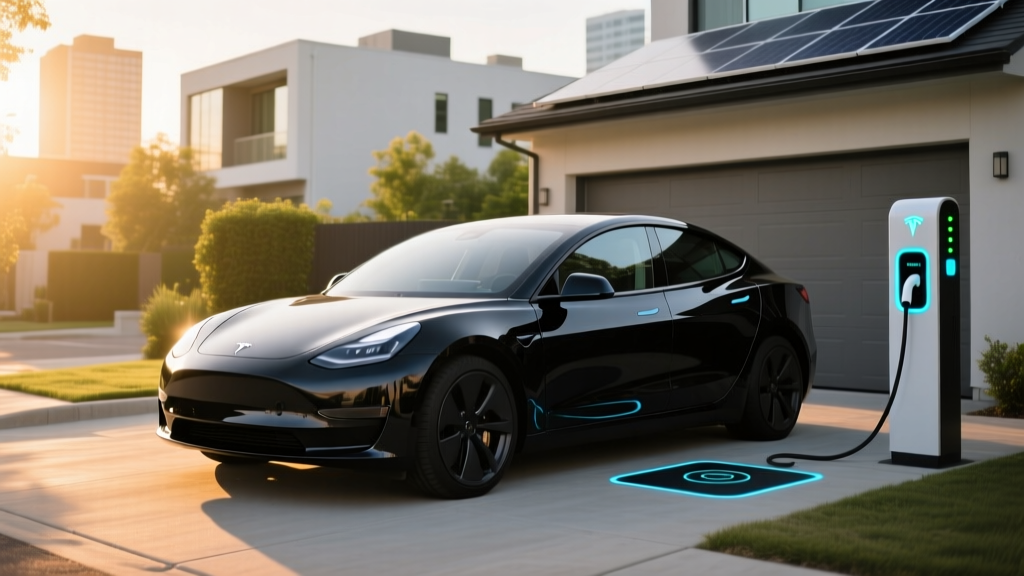
Home Level 2 charging at 11.5 kW adds roughly 44 miles of range per hour — a full overnight session (8 hours) restores the entire battery. Installation of a 240V/48A home charger (like the Tesla Wall Connector) typically costs $800–$2,000 including electrician labor and permits, depending on your panel capacity and run length.
Public DC Fast Charging
Tesla Superchargers average $0.28–$0.36/kWh depending on location and time of day. If you rely on DCFC exclusively:
- Monthly cost (exclusive Supercharging): 277 kWh × $0.32 avg = ~$89/month
- Third-party networks (Electrify America, EVgo): $0.35–$0.55/kWh → $97–$152/month
Important charging-curve note: The Model 3 Long Range peaks at 250 kW but sustains that rate only briefly (roughly 10–30% SoC). Above 50%, the curve tapers significantly — the 10–80% time of ~25 minutes reflects this taper. Plan road-trip stops around 20–25 minutes, not the "peak kW" marketing number.
Gasoline Comparison
A comparable 30 MPG gas sedan driving the same 1,110 miles/month at $3.40/gallon costs $126/month in fuel. Home-charged Model 3 owners save $80–$100/month on energy alone.
Insurance, Maintenance, and Depreciation
Insurance
Teslas carry higher-than-average insurance premiums due to repair costs (specialized aluminum body panels, sensor recalibration, and limited third-party body shop networks). Expect:
- National average for Model 3: $180–$280/month ($2,160–$3,360/year)
- Tesla Insurance (where available): Often 10–20% cheaper, using real-time driving data — typically $150–$230/month
- Factors that raise premiums: Performance trim, urban location, younger driver, no garage parking
Maintenance
This is where EVs shine. The Model 3 has no oil changes, no spark plugs, no transmission fluid, and regenerative braking extends pad life dramatically. Expected annual maintenance:
- Cabin air filter: ~$40 every 2 years
- Tire rotation: ~$50 every 6,250 miles
- Wiper blades + fluid: ~$30/year
- Brake fluid check: Every 2 years (~$60)
- Estimated monthly maintenance: $8–$15/month
Tires wear faster on EVs due to instant torque and heavier curb weight (~4,000 lbs). Budget for a set of four tires ($800–$1,200) every 30,000–40,000 miles.
Depreciation
The Model 3 has seen steeper depreciation than luxury competitors in recent years, partly due to Tesla's aggressive price cuts and market saturation. Expect roughly 40–50% value retention after 5 years/60,000 miles for a Long Range AWD, which translates to ~$350–$400/month in depreciation cost if you plan to sell.
Total Monthly Cost: The Bottom Line
Here's the combined monthly ownership cost for a 2026 Tesla Model 3 Long Range AWD, assuming home charging, a 72-month loan, and average insurance:
| Category | Monthly Cost |
|---|---|
| Loan payment (after $7,500 credit) | $640 |
| Home electricity (charging) | $44 |
| Insurance | $210 |
| Maintenance & tires | $12 |
| Depreciation (equity loss) | $375 |
| Total (cash-flow basis, excl. depreciation) | $906/month |
| Total (including depreciation) | $1,281/month |
Key takeaway: Your actual out-of-pocket monthly cost — the money leaving your bank account — is roughly $900–$950/month for the Long Range. The Standard Range RWD drops this to roughly $780–$830/month due to the lower purchase price, while the Performance trim pushes it to $1,050–$1,100/month.
Who Should Buy the Model 3 — And Who Shouldn't
Pros
- Best-in-class efficiency (132 MPGe) keeps charging costs low
- Access to Tesla Supercharger network — still the most reliable DCFC system in North America
- Over-the-air updates continuously add features
- Minimal scheduled maintenance
- Strong safety ratings (NHTSA 5-star, IIHS Top Safety Pick+)
- 250 kW peak DCFC is among the fastest in its price class
Cons
- Rear seat is tighter than rivals (35.3" legroom vs. 38"+ in Hyundai Ioniq 6)
- Insurance premiums run 15–30% higher than comparable sedans
- No physical buttons — all controls via touchscreen, including mirror adjustment and glovebox
- Phantom braking incidents reported with Autopilot (SAE Level 2 — driver must remain engaged)
- Higher depreciation than some competitors due to price volatility
- Standard Range LFP battery has lower cold-weather range and slower DCFC peak
Best For
Daily commuters who can charge at home and want the lowest cost-per-mile in the EV sedan segment. Tech-forward buyers who value software integration and OTA improvements. Road-trippers who want Supercharger network reliability.
Consider Alternatives If
You need maximum rear-seat space (look at the Hyundai Ioniq 6 or BMW i4), you want a traditional instrument cluster, or you lack home charging access (public-only charging significantly raises your monthly cost and daily inconvenience).
2026 Tesla Model 3 vs. Key Competitors
| Metric | Tesla Model 3 LR | Hyundai Ioniq 6 SEL | BMW i4 eDrive40 |
|---|---|---|---|
| Base MSRP | $45,990 | $42,750 | $57,900 |
| EPA Range | 341 mi | 342 mi | 307 mi |
| Efficiency | 132 MPGe | 140 MPGe | 109 MPGe |
| Max DCFC | 250 kW | 233 kW | 205 kW |
| §30D Credit | $7,500 | $7,500 | $7,500 |
| Est. Monthly Payment | ~$640 | ~$590 | ~$780 |
| Est. Monthly Charging | $44 | $40 | $52 |
| Rear Legroom | 35.3" | 35.1" | 34.2" |
Frequently Asked Questions
Does the 2026 Tesla Model 3 qualify for the federal EV tax credit?
Yes — the Model 3 Long Range AWD and Performance trims currently qualify for the full $7,500 §30D credit, subject to buyer income limits ($150K single / $300K joint), the $55,000 sedan MSRP cap, and battery component/critical mineral sourcing requirements. Always verify on the IRS qualified vehicles list before purchasing, as eligibility can change with supply chain updates.
How much does it cost to charge a Tesla Model 3 per month?
With average driving (1,110 miles/month) and national-average residential electricity ($0.16/kWh), home charging costs roughly $44/month. Off-peak time-of-use rates can reduce this to $22–$33. Exclusive Supercharger reliance pushes it to ~$89/month.
Is Tesla insurance really more expensive?
Generally yes — 15–30% above the segment average due to repair complexity and parts costs. Tesla's own insurance product (available in most states) uses real-time driving behavior and can be cheaper for safe drivers. Always get quotes from multiple carriers before purchasing.
How long does the Model 3 battery last?
Tesla warranties the Long Range/Performance NMC battery for 8 years or 120,000 miles against degradation below 70% capacity. Real-world data from high-mileage owners suggests 10–15% degradation at 100,000 miles with typical charging habits. The LFP Standard Range battery is warranted for 8 years/100,000 miles and tends to show slower degradation but starts from a smaller capacity.
Should I buy the Standard Range or Long Range?
If you drive under 40 miles daily, have reliable home charging, and live in a moderate climate, the Standard Range saves ~$7,000 upfront. If you road-trip frequently, live in a cold climate, or want AWD traction, the Long Range's extra 69 EPA miles and dual-motor drivetrain justify the premium. The monthly payment difference is roughly $100/month.
What's the real-world range of the Tesla Model 3?
For the Long Range AWD: expect 280–310 miles in mixed driving, 220–260 miles in freezing weather. The Standard Range RWD delivers roughly 225–245 real-world miles in mild conditions and 190–215 in cold weather. Highway driving at 75+ mph reduces range by 10–15% compared to the EPA combined figure.
How fast does the Model 3 charge at home and on road trips?
At home on a Level 2 Tesla Wall Connector (11.5 kW), you gain ~44 miles of range per hour — a full charge takes about 8 hours overnight. On DC fast chargers, the Long Range peaks at 250 kW and charges 10–80% in approximately 25 minutes. The Standard Range peaks at 170 kW and takes roughly 25 minutes for the same window despite the smaller battery, because the LFP chemistry limits charge rate.
Is the Model 3 worth buying vs. competitors in 2026?
The Model 3 remains the efficiency and charging-network benchmark. If Supercharger access and software integration are priorities, it's hard to beat. If rear-seat comfort, traditional controls, or lower insurance costs matter more, the Hyundai Ioniq 6 (better MPGe, similar range, lower price) and BMW i4 (premium interior, quieter ride) are strong alternatives. The Model 3's total monthly cost of ~$900 (cash-flow basis) is competitive with both, primarily due to its lower purchase price after the tax credit.