Tesla's Standard Lease: A New Entry Point for Model 3 and Model Y
Tesla has quietly expanded its leasing program in 2026, offering standardized lease terms on both the Model 3 and Model Y — two of the best-selling electric vehicles in the United States. Unlike traditional dealer-negotiated leases, Tesla's direct-to-consumer lease structure presents fixed monthly payments, predetermined mileage allowances, and transparent residual values. For buyers who have been sitting on the fence, this move lowers the barrier to entry significantly. But does leasing a Tesla make financial sense compared to buying, especially when the federal EV tax credit enters the equation?
This review covers the 2026 Model 3 and Model Y lineup in full — range, charging, performance, pricing, and tax credit eligibility — so you can decide whether Tesla's standard lease is the right move for your garage.
2026 Model 3 and Model Y: Side-by-Side Specifications
| Spec | Model 3 RWD | Model 3 Long Range AWD | Model Y RWD | Model Y Long Range AWD |
|---|---|---|---|---|
| EPA Range | 272 mi | 341 mi | 260 mi | 310 mi |
| Battery (usable) | ~60 kWh (LFP) | ~79 kWh (NMC) | ~60 kWh (LFP) | ~79 kWh (NMC) |
| MPGe (combined) | 132 MPGe | 125 MPGe | 123 MPGe | 117 MPGe |
| Efficiency | 25 kWh/100mi | 27 kWh/100mi | 27 kWh/100mi | 29 kWh/100mi |
| Peak DC Fast Charge | 170 kW | 250 kW | 170 kW | 250 kW |
| 10–80% DCFC Time | ~30 min | ~25 min | ~30 min | ~25 min |
| Level 2 Home Charge | 11.5 kW (~44 mi/hr) | 11.5 kW (~44 mi/hr) | 11.5 kW (~40 mi/hr) | 11.5 kW (~40 mi/hr) |
| 0–60 mph | 5.8 sec | 4.2 sec | 6.6 sec | 4.8 sec |
| Horsepower | 271 hp | 346 hp | 295 hp | 384 hp |
| Drivetrain | RWD | Dual-Motor AWD | RWD | Dual-Motor AWD |
| Cargo Volume | 23 cu ft (trunk+frunk) | 23 cu ft | 76 cu ft (rear seats folded) | 76 cu ft |
| Base MSRP | $38,990 | $45,990 | $44,990 | $48,990 |
Source: fueleconomy.gov and Tesla's official specification pages. Specs reflect the 2026 model year.
Real-World Range: What the EPA Sticker Doesn't Tell You
Model 3 RWD: EPA 272 mi — expect ~220–240 mi on sustained highway driving at 70+ mph; ~180–200 mi in freezing temperatures with cabin heat.
Model 3 Long Range AWD: EPA 341 mi — expect ~280–300 mi highway; ~230–260 mi in cold weather.
Model Y RWD: EPA 260 mi — expect ~210–230 mi highway; ~175–195 mi in cold weather.
Model Y Long Range AWD: EPA 310 mi — expect ~255–275 mi highway; ~210–240 mi in cold weather.
Tesla's EPA range estimates are among the more conservative in the industry, but real-world results depend heavily on driving style, ambient temperature, and terrain. The RWD trims use lithium iron phosphate (LFP) batteries, which tolerate repeated 100% charging better than the nickel manganese cobalt (NMC) packs in Long Range models — a meaningful advantage for daily commuters who want maximum range every morning. However, LFP chemistry loses a larger percentage of capacity in freezing weather compared to NMC, so cold-climate buyers should factor in 25–30% winter range reduction on RWD trims versus 15–20% on Long Range variants.
For highway road trips, sustained speeds above 70 mph push consumption to 30–33 kWh/100mi in the Model Y Long Range, cutting effective range below the EPA figure. Plan charging stops accordingly — the ABRP route planner is an invaluable tool for trip planning.
Charging Speed and Infrastructure: The Supercharger Advantage
| Charging Level | Power | Model 3 (RWD/LR) | Model Y (RWD/LR) | Typical Use Case |
|---|---|---|---|---|
| Level 1 (120V) | ~1.4 kW | ~3–4 mi/hr | ~3–4 mi/hr | Overnight trickle; emergency |
| Level 2 (240V, 48A) | 11.5 kW | ~44 mi/hr | ~40 mi/hr | Home daily charging |
| DC Fast Charge | 170 kW (RWD) / 250 kW (LR) | 10–80% in 25–30 min | 10–80% in 25–30 min | Road trips, public stations |
Tesla's Supercharger network remains the gold standard for public charging reliability. As of 2026, Tesla has opened portions of the network to non-Tesla EVs via the NACS connector standard, but Tesla owners still benefit from seamless plug-and-charge integration, automatic billing, and route preconditioning that warms the battery before arrival to maximize charge speed.
Charging curve reality: The Long Range models peak at 250 kW but sustain that rate only between roughly 10–30% state of charge (SoC). From 30–60%, the rate tapers to approximately 150–175 kW, and above 80%, it drops sharply to 40–60 kW to protect the battery. This means a 10–80% session takes about 25 minutes, but a 10–95% session can stretch past 45 minutes. For road trips, the optimal strategy is to charge to 80% and drive on.
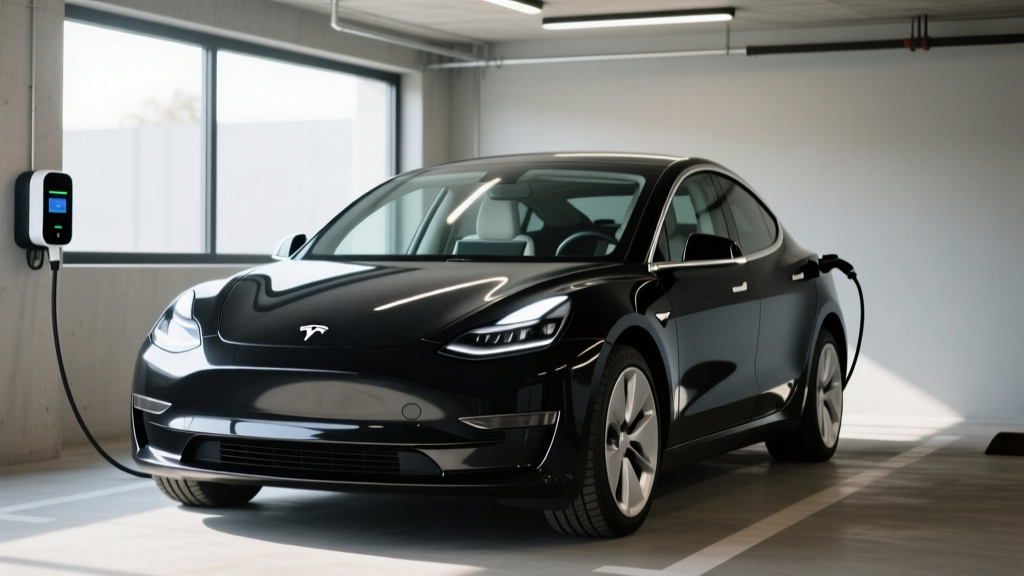
For home Level 2 charging, the Tesla Wall Connector at $420 is hard to beat — it delivers up to 11.5 kW on a 60-amp circuit (48 amps continuous). Expect a full overnight charge from 20% to 100% in roughly 6–7 hours for the Long Range models. Installation costs vary: budget $800–$2,000 for a straightforward install near the panel, or $2,500–$4,500 if a panel upgrade or long conduit run is required.
Pricing, Lease Terms, and the Federal Tax Credit
Tesla's standard lease program offers 24- and 36-month terms with 10,000, 12,000, or 15,000 annual mileage options. Unlike traditional leases, there is no negotiation — the monthly payment, money factor (interest rate equivalent), and residual value are fixed and visible on Tesla's website at the time of order.
| Trim | Base MSRP | Est. Monthly Lease | §30D Credit Eligible? | Effective Lease Reduction |
|---|---|---|---|---|
| Model 3 RWD | $38,990 | ~$399–$449/mo | Yes — up to $7,500 | ~$125–$208/mo savings |
| Model 3 Long Range AWD | $45,990 | ~$499–$559/mo | Yes — up to $7,500 | ~$125–$208/mo savings |
| Model Y RWD | $44,990 | ~$469–$519/mo | Yes — up to $7,500 | ~$125–$208/mo savings |
| Model Y Long Range AWD | $48,990 | ~$539–$599/mo | Yes — up to $7,500 | ~$125–$208/mo savings |
Critical tax credit note for leasing: Under IRS §30D rules, when you buy an EV, the $7,500 federal tax credit is subject to buyer income caps ($150,000 single / $300,000 joint), vehicle MSRP caps ($55,000 for sedans, $80,000 for SUVs/trucks), and stringent battery-sourcing and critical-mineral requirements. However, when you lease, the credit goes to the lessor (Tesla's financing arm), not to you directly. Tesla has historically passed this savings through as a capitalized-cost reduction (effectively lowering your monthly payment), but this is at the lessor's discretion — it is not guaranteed by law. Confirm the lease terms explicitly include the credit pass-through before signing. See IRS guidance on clean vehicle credits for current rules.
- Buyer AGI ≤ $150,000 (single) or $300,000 (married filing jointly)
- Vehicle MSRP ≤ $55,000 (sedans like Model 3) or $80,000 (SUVs like Model Y)
- Battery components manufactured or assembled in North America (percentage thresholds increase annually)
- Critical minerals sourced from the U.S. or FTA partners (percentage thresholds increase annually)
- Vehicle assembled in North America
- Point-of-sale transfer available at time of purchase — reduces out-of-pocket cost directly
Performance, Tech, and Daily Livability
Even the base Model 3 RWD delivers 271 horsepower and a 5.8-second 0–60 mph time — quicker than most gas-powered compact sedans. The Long Range AWD drops that to 4.2 seconds with 346 hp and the traction advantage of dual motors. The Model Y, being heavier and taller, is slightly slower but still brisk at 4.8 seconds for the Long Range AWD.
Interior and cargo: The refreshed Model 3 (codenamed "Highland") features a quieter cabin, ventilated front seats, ambient lighting, and a rear passenger touchscreen. Cargo space is 23 cubic feet (trunk plus frunk) — adequate for weekly groceries but tight for airport runs with four passengers. The Model Y dominates here with up to 76 cubic feet of cargo volume with the rear seats folded, making it a legitimate family hauler. Rear legroom in the Model Y measures 41.6 inches versus 35.2 inches in the Model 3 — a meaningful gap for families with rear-facing car seats.
Tech and driver assist: Both vehicles run Tesla's latest software on a 15.4-inch center touchscreen (Model 3) or 15-inch (Model Y). Autopilot — Tesla's Level 2 driver-assistance system — is standard and includes adaptive cruise control and lane-keeping. Full Self-Driving (Supervised) remains a $8,000 add-on (or $99/month subscription) and, despite the name, is still a Level 2 SAE system requiring active driver supervision at all times. It does not make the vehicle autonomous.
Tesla Autopilot and FSD (Supervised) are SAE Level 2 driver-assistance systems. The driver must remain fully engaged — hands on or near the wheel, eyes on the road — at all times. These systems do NOT drive the car independently. Only Level 4 services like Waymo operate without a human driver, and those are limited to geofenced areas.
Warranty and Long-Term Battery Outlook
Tesla's warranty coverage for 2026:
- Basic vehicle: 4 years / 50,000 miles
- Battery & drive unit (RWD/LFP): 8 years / 100,000 miles, minimum 70% capacity retention
- Battery & drive unit (Long Range/NMC): 8 years / 120,000 miles, minimum 70% capacity retention
Tesla's battery warranty guarantees at least 70% state of health (SoH) over the warranty period. Independent fleet data and owner surveys suggest NMC packs in Long Range models typically degrade 8–12% over the first 100,000 miles, while LFP packs in RWD models show slightly higher initial degradation (10–15%) but stabilize with a flatter curve long-term. For lease holders, battery degradation is largely a non-issue — you return the vehicle before the warranty expires.
Pros, Cons, and the Verdict
- Access to the Supercharger network — the most reliable DC fast-charging ecosystem in the U.S.
- Class-leading efficiency (kWh/100mi) maximizes range per dollar of electricity
- Over-the-air updates continuously add features
- Strong resale values reduce lease residual risk
- LFP battery in RWD trims can be charged to 100% daily without degradation concerns
- Standardized lease eliminates dealer negotiation
- No Apple CarPlay or Android Auto — Tesla's proprietary infotainment only
- Model 3 cargo space is tight for an "executive sedan" at 23 cu ft
- FSD (Supervised) remains expensive at $8,000 and is still Level 2
- Ride quality on 19-inch wheels can be firm on rough pavement
- Lease terms are non-negotiable — no room to haggle money factor or residual
- Insurance premiums remain 15–25% higher than comparable gas vehicles
- Service center availability varies by region — some areas face multi-week wait times
Who Should Lease a Tesla in 2026?
- Choose the Model 3 RWD lease if: You commute under 40 miles round-trip, have reliable home Level 2 charging, live in a mild climate, and want the lowest monthly payment on a premium EV.
- Choose the Model 3 Long Range lease if: You take regular road trips exceeding 200 miles, need AWD for snow, and value the extra 69 miles of EPA range without stepping up to a crossover.
- Choose the Model Y RWD lease if: You need crossover cargo space and rear-seat headroom but don't regularly drive more than 200 miles between charges.
- Choose the Model Y Long Range lease if: You're a family of 3–4 who road-trips regularly, needs AWD, and wants the maximum combination of range and cargo volume without moving to a larger, more expensive EV.
- Buy instead of leasing if: You qualify for the full $7,500 §30D credit, plan to keep the car 5+ years, drive under 15,000 miles/year, and want to build equity in a vehicle with strong resale value.
Frequently Asked Questions
What is the real-world range of the Tesla Model 3 and Model Y?
Real-world highway range at 70+ mph typically falls 12–18% below the EPA estimate. Expect 220–240 miles from the Model 3 RWD, 280–300 from the Model 3 Long Range, 210–230 from the Model Y RWD, and 255–275 from the Model Y Long Range. In freezing weather, subtract another 15–30% depending on cabin heat usage and whether you precondition the battery.
How fast do the Model 3 and Model Y charge?
Long Range models peak at 250 kW on a V3/V4 Supercharger, achieving 10–80% in approximately 25 minutes. RWD models with LFP batteries peak at 170 kW, taking about 30 minutes for the same session. At home on a Level 2 Wall Connector (11.5 kW), a full charge takes 6–7 hours for Long Range and 5–6 hours for RWD.
Does the Tesla Model 3 or Model Y qualify for the federal EV tax credit?
Both vehicles are eligible for up to $7,500 under §30D when purchased, subject to buyer income caps, MSRP limits, and battery-sourcing requirements that tighten annually. When leased, the credit goes to the lessor (Tesla), who may pass savings through as a cap-cost reduction — confirm this explicitly in your lease agreement. Consult IRS §30D guidance and a tax professional for your specific situation.
Is it worth leasing a Tesla vs. buying in 2026?
Leasing makes sense if you want lower monthly payments, plan to upgrade every 3 years, and don't want to worry about battery degradation or resale value. Buying is better if you qualify for the $7,500 point-of-sale credit, drive fewer than 15,000 miles annually, and plan to keep the car 5+ years. Over a 36-month period, leasing typically costs $3,000–$6,000 less out of pocket, but you walk away with no equity.
How does the Tesla lease compare to competitors like the Hyundai Ioniq 5 or BMW i4?
The Model 3 RWD undercuts the Ioniq 5 and i4 on price and efficiency. The Ioniq 5 offers faster 800V charging (10–80% in ~18 minutes at 350 kW) and a more conventional interior layout. The BMW i4 offers premium build quality and CarPlay but starts $10,000+ higher. Tesla's Supercharger network remains the decisive advantage for road-trip-heavy buyers.
Can I purchase the Model 3 or Model Y at the end of the lease?
Tesla's lease terms have historically included a purchase option at the predetermined residual value. Confirm the specific terms in your lease contract, as Tesla has adjusted end-of-lease policies in prior years. The residual is typically set at 55–60% of MSRP for a 36-month lease.