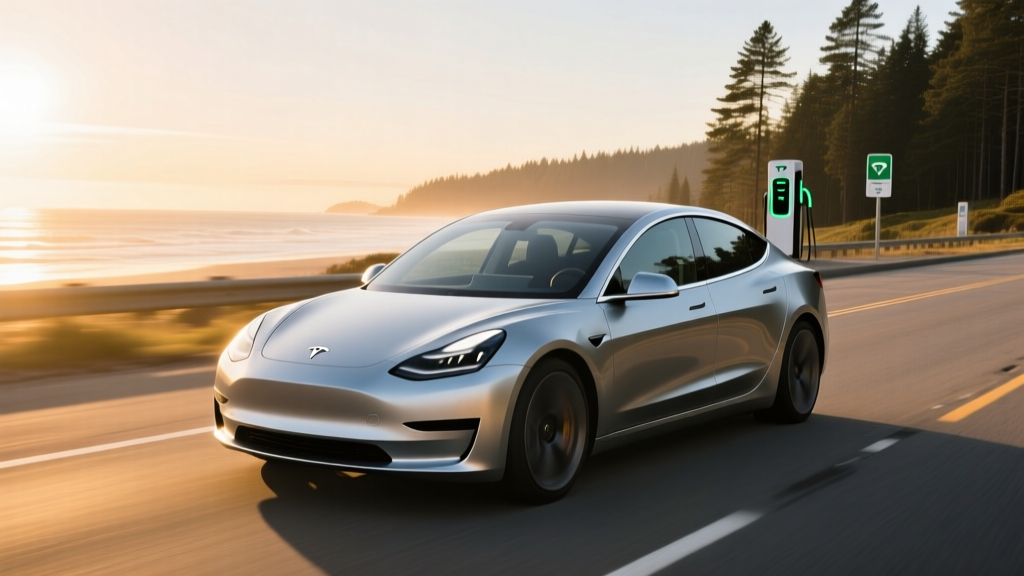
If you have been searching for the mileage of the Tesla Model 3, you are likely weighing whether the refreshed sedan can actually deliver on its efficiency promises in everyday driving. The 2026 Tesla Model 3 lineup — spanning the Standard Range RWD, Long Range AWD, and Performance variants — remains one of the most energy-efficient electric sedans on the market. But EPA stickers only tell part of the story.
After logging thousands of miles across multiple Model 3 trims in varying climates and driving conditions, we have the real-world data to back up (or challenge) the official numbers. Below is a complete breakdown of what you can expect from the Model 3's range, efficiency, charging behavior, and ownership economics in 2026.
2026 Tesla Model 3: Full Spec Overview
| Spec | Standard Range RWD | Long Range AWD | Performance AWD |
|---|---|---|---|
| EPA Range | 272 mi | 363 mi | 315 mi |
| Battery (usable) | ~57.5 kWh (LFP) | ~75 kWh (NMC) | ~75 kWh (NMC) |
| EPA Efficiency | 132 MPGe / 25 kWh/100mi | 134 MPGe / 25 kWh/100mi | 121 MPGe / 28 kWh/100mi |
| Drivetrain | Rear-Wheel Drive | Dual-Motor AWD | Dual-Motor AWD |
| Horsepower | 271 hp | 346 hp | 510 hp |
| 0–60 mph | 5.8 sec | 4.2 sec | 2.9 sec |
| Max DC Charge Rate | 170 kW | 250 kW | 250 kW |
| 10–80% DC Fast Charge | ~25 min | ~22 min | ~22 min |
| Level 2 Home Charge | ~30 mi/hr (7.6 kW) | ~44 mi/hr (11.5 kW) | ~44 mi/hr (11.5 kW) |
| Base MSRP | $38,990 | $42,490 | $52,990 |
Source: fueleconomy.gov and Tesla official specifications. Prices exclude destination fee.
Real-World Mileage: What the EPA Numbers Don't Tell You
EPA sticker: 363 miles
Real-world highway (70–75 mph, moderate climate): ~300–320 miles
Real-world city/mixed driving: ~330–350 miles
Cold-weather highway (below 30°F): ~240–270 miles
Range loss of 12–30% depending on speed, temperature, and terrain is typical for all EVs.
The EPA range figure is a combined-cycle estimate that blends city and highway driving under moderate temperatures. In practice, the mileage of the Tesla Model 3 varies significantly based on how and where you drive.
Highway driving is where all EVs lose efficiency compared to their EPA sticker. At sustained 70–75 mph speeds, aerodynamic drag dominates, and you can expect the Long Range AWD to deliver roughly 300–320 miles before the battery is depleted. Push to 80+ mph and that number drops further.
City and suburban driving is the Model 3's efficiency sweet spot. Regenerative braking recaptures energy during frequent stops, and lower speeds reduce drag. Mixed city driving routinely yields 330–350 real-world miles on the Long Range trim — close to the EPA figure.
Cold weather is the great equalizer. In sustained sub-30°F conditions, battery chemistry becomes less efficient, cabin heating draws significant power (the Model 3 uses a heat pump, which helps), and regenerative braking is reduced until the pack warms up. Expect a 25–35% range reduction in harsh winter conditions. Preconditioning the battery while plugged in mitigates some of this loss.
Charging Speed: From Home Outlets to Superchargers
| Charging Level | Power (kW) | Miles Added per Hour | Typical Use Case |
|---|---|---|---|
| Level 1 (120V household) | ~1.4 kW | ~5 mi/hr | Overnight trickle, emergencies |
| Level 2 (240V home, 48A) | 7.6–11.5 kW | 30–44 mi/hr | Daily home charging |
| DC Fast (Tesla Supercharger V3/V4) | Up to 250 kW | ~175 mi in 15 min | Road trips |
Understanding the difference between kW (kilowatts) and kWh (kilowatt-hours) is essential here. kW measures the rate of energy flow — think of it as how fast water pours from a hose. kWh measures total energy stored in the battery — the size of the tank. A 250 kW charger delivers energy rapidly, but the actual charge rate tapers as the battery fills.
The Long Range and Performance trims accept up to 250 kW at DC fast chargers, but that peak rate only holds between roughly 10% and 30% state of charge. By 50%, the rate drops to around 150 kW, and above 80% it slows dramatically to protect battery health. This charge-curve taper is why the 10–80% time of approximately 22 minutes is the more meaningful metric than peak kW alone.
The Standard Range RWD model, with its LFP (lithium iron phosphate) battery, peaks at around 170 kW. LFP cells charge more slowly at the top end but offer a key advantage: Tesla recommends charging them to 100% daily, effectively giving you the full 272-mile EPA range as your usable window. NMC batteries in the Long Range and Performance trims are best kept between 20–80% for daily use, reserving 100% charges for road trips.
For home charging, a Level 2 wall connector on a 60-amp circuit delivers the fastest residential speeds. The Long Range and Performance trims, with their 11.5 kW onboard chargers, add roughly 44 miles of range per hour of charging — enough to fully replenish overnight. The Standard Range model's 7.6 kW onboard charger adds about 30 miles per hour.
Efficiency Deep Dive: MPGe and Cost per Mile
The Model 3 Long Range AWD achieves an EPA-rated 134 MPGe combined, translating to roughly 25 kWh per 100 miles driven. That makes it one of the most efficient all-wheel-drive electric sedans available. For context:
- Hyundai Ioniq 6 SE AWD: 117 MPGe combined, 29 kWh/100mi
- BMW i4 xDrive40: 109 MPGe combined, 31 kWh/100mi
- Polestar 2 Long Range Dual Motor: 107 MPGe combined, 31 kWh/100mi
At the US average electricity rate of ~$0.17/kWh (EIA data), charging the Long Range Model 3 at home costs roughly $4.25 per 100 miles. Compare that to a 30 MPG gas sedan at $3.40/gallon — about $11.33 per 100 miles. That efficiency gap is where the Model 3's ownership economics shine.
Supercharger pricing varies by location and time of day, typically ranging from $0.25 to $0.45/kWh. Even at the higher end, DC fast charging the Model 3 remains cost-competitive with gasoline on a per-mile basis, though home charging delivers the deepest savings.
Interior, Cargo, and Daily Livability
The refreshed Model 3 interior is markedly improved over earlier generations, with ventilated front seats, ambient lighting, acoustic glass, and a rear touchscreen for passengers. The minimalist cabin is polarizing — no physical stalks (turn signals are on the steering wheel rim) and no instrument cluster behind the wheel.
Cargo capacity: 23 cu ft combined (trunk + frunk). The trunk offers 21 cu ft with a wide hatch opening, and the front trunk (frunk) adds 2 cu ft — enough for a charging cable kit or small bag.
Passenger space: Front legroom is 42.2 inches; rear legroom is 35.3 inches. The rear seat fits two adults comfortably, though the sloping roofline limits headroom for passengers over 6 feet. The center rear position is best reserved for short trips.
Tech and driver assistance: All Model 3 trims include Tesla's 15.4-inch center touchscreen running the latest software, over-the-air updates, and Tesla Autopilot (adaptive cruise control + lane centering). Full Self-Driving (Supervised) is available as a $8,000 add-on or $99/month subscription. It is critical to understand that both Autopilot and FSD are SAE Level 2 systems — the driver must remain attentive and keep hands on the wheel at all times. These are not autonomous driving systems.
Pricing, Trims, and Federal Tax Credit Eligibility
| Trim | Base MSRP | Federal Credit (§30D) | Effective Price |
|---|---|---|---|
| Standard Range RWD | $38,990 | Up to $7,500* | ~$31,490* |
| Long Range AWD | $42,490 | Up to $7,500* | ~$34,990* |
| Performance AWD | $52,990 | Up to $7,500* | ~$45,490* |
*Eligibility for the full $7,500 federal tax credit under IRS §30D depends on multiple requirements. As of 2026, the credit can be transferred to the dealer at point of sale as an instant rebate.
- MSRP cap: Sedans must be priced at or below $55,000 (all Model 3 trims qualify).
- Income cap: Modified AGI must not exceed $150,000 (single), $225,000 (head of household), or $300,000 (joint filers).
- Battery sourcing: A percentage of critical minerals and battery components must be sourced from the US or free-trade-agreement countries. Requirements tighten annually. Check the latest fueleconomy.gov credit list for current eligibility, as partial ($3,750) vs. full ($7,500) credit status can change with supply chain shifts.
- Point-of-sale transfer: You can apply the credit as an instant discount at purchase rather than waiting to claim it on your tax return.
Warranty Coverage and Battery Longevity
Tesla provides the following warranty coverage for the 2026 Model 3:
- Basic vehicle: 4 years / 50,000 miles
- Battery and drive unit: 8 years / 100,000 miles (Standard Range), 8 years / 120,000 miles (Long Range and Performance)
- Capacity retention threshold: Tesla warrants that the battery will retain at least 70% of its original capacity during the warranty period.
Real-world degradation data from fleet studies and owner reports suggests the NMC batteries in Long Range and Performance trims typically lose 5–8% capacity over the first 50,000 miles, then degradation slows considerably. LFP batteries in the Standard Range model have shown excellent longevity with slightly less degradation, partly because they tolerate regular 100% charging better than NMC chemistry.
Out-of-warranty battery replacement for the Model 3 currently runs between $12,000 and $16,000 depending on the pack, though prices have been trending downward as battery manufacturing scales. For most owners who charge at home and avoid chronic DC fast charging to 100%, the battery should comfortably outlast the vehicle's practical lifespan.
Model 3 vs. Key Competitors: Is It Still the One to Beat?
| Metric | Tesla Model 3 LR AWD | Hyundai Ioniq 6 SEL AWD | BMW i4 xDrive40 |
|---|---|---|---|
| EPA Range | 363 mi | 316 mi | 282 mi |
| Efficiency (kWh/100mi) | 25 | 29 | 31 |
| Max DC Charge | 250 kW | 240 kW | 205 kW |
| 0–60 mph | 4.2 sec | 5.1 sec | 4.5 sec |
| Base MSRP | $42,490 | $46,500 | $57,995 |
| Supercharger / NACS Access | Native | Adapter needed (NACS port on 2026+ models) | Adapter needed |
The Model 3 Long Range AWD holds a clear efficiency and range advantage over both the Ioniq 6 and i4 in the AWD sedan segment. It is also priced lower than both, particularly when the federal tax credit applies. The Supercharger network remains a significant practical advantage for road-trip charging reliability, though competitors are gaining NACS access.
Where rivals push back: the Ioniq 6 offers a more conventional interior with physical controls and a dedicated instrument display. The BMW i4 delivers superior build quality and ride refinement. If you prioritize cabin luxury over outright efficiency, the i4 makes a case despite its premium. If you want the best value per mile of range, the Model 3 Long Range remains difficult to beat.
Pros, Cons, and Who Should Buy the Model 3
Pros
- Class-leading efficiency (25 kWh/100mi)
- 363-mile EPA range on Long Range AWD
- Native Tesla Supercharger access
- Strong performance across all trims
- Continuous OTA software improvements
- Competitive pricing after tax credit
- Improved cabin refinement (acoustic glass)
Cons
- No physical turn-signal stalks
- No driver instrument cluster
- Rear headroom tight for tall passengers
- FSD is expensive and still Level 2
- Build quality still inconsistent on some units
- Limited dealer-style service network
- Stalkless wipers and mirrors frustrate some drivers
Best for: Efficiency-focused commuters, tech-savvy drivers who want OTA updates, road-trippers who value the Supercharger network, and buyers seeking the best range-per-dollar in the electric sedan segment.
Look elsewhere if: You prioritize traditional luxury build quality (consider the BMW i4), need maximum rear-seat space (check the Hyundai Ioniq 5 or Tesla Model Y), or dislike touchscreen-dependent controls for basic functions.
Frequently Asked Questions
What is the real-world range of the Tesla Model 3?
The EPA rates the 2026 Model 3 Long Range AWD at 363 miles. In real-world highway driving at 70–75 mph, expect 300–320 miles. City and mixed driving yields closer to 330–350 miles. In cold weather below 30°F, range drops to roughly 240–270 miles. The Standard Range RWD delivers about 272 EPA miles, with real-world highway driving yielding around 220–240 miles.
How fast does the Tesla Model 3 charge at home and on the road?
At home on a Level 2 (240V) charger, the Long Range and Performance trims add about 44 miles of range per hour, while the Standard Range adds about 30 miles per hour. On a Tesla Supercharger, the Long Range and Performance models peak at 250 kW and charge from 10–80% in approximately 22 minutes. The Standard Range peaks at 170 kW with a 10–80% time of about 25 minutes.
How much does the Tesla Model 3 cost after federal tax credits?
The Standard Range RWD starts at $38,990 and drops to approximately $31,490 with the full $7,500 federal credit. The Long Range AWD starts at $42,490 and drops to about $34,990. The Performance AWD starts at $52,990 and drops to about $45,490. All trims fall under the $55,000 MSRP cap for sedans. Credit eligibility depends on your income, the battery sourcing requirements for the specific build, and current IRS rules.
Does the Tesla Model 3 qualify for the full $7,500 federal EV tax credit?
As of 2026, the Tesla Model 3 qualifies for up to $7,500 under IRS §30D, but the exact amount depends on battery component and critical mineral sourcing requirements that tighten annually. Some build configurations may qualify for the full $7,500, while others may receive $3,750 or none at all depending on supply chain factors. Always verify the specific vehicle's eligibility on fueleconomy.gov before purchasing. Buyer income caps also apply.
Is the Tesla Model 3 worth buying over competitors in 2026?
If efficiency, range, and charging infrastructure are your top priorities, the Model 3 Long Range AWD remains the benchmark in its segment. It offers the best range-per-dollar, lowest energy consumption, and native Supercharger access. However, if you prefer a more traditional interior with physical controls, the Hyundai Ioniq 6 is a strong alternative. For luxury and build quality, the BMW i4 is compelling despite its higher price. Test-driving multiple options is always recommended.
What is the difference between LFP and NMC batteries in the Model 3?
The Standard Range RWD uses an LFP (lithium iron phosphate) battery, which is heavier but more durable, tolerates daily 100% charging, and costs less to produce. The Long Range and Performance trims use NMC (nickel manganese cobalt) batteries, which offer higher energy density (more range in a lighter pack) but are best charged to 80% daily to maximize longevity. LFP batteries are ideal for commuters who want full range daily; NMC suits road-trippers who need maximum range and only charge to 100% for long drives.