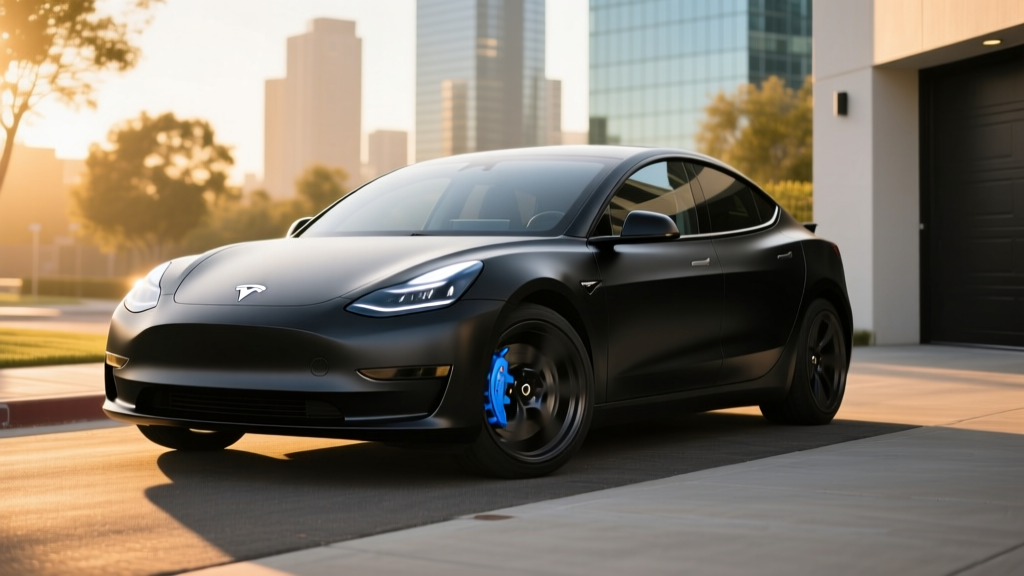
The phrase "Tesla 3 Ludicrous" isn't an official trim badge—it's what enthusiasts call the Tesla Model 3 Performance when you floor it in its most aggressive acceleration mode. For 2026, the Model 3 Performance (internally the "Highland" refresh that debuted for MY2024 and carries forward) remains the quickest sedan under $60,000, pairing dual-motor all-wheel drive with a track-tuned chassis that finally addresses the old Model 3's ride-quality complaints. But beyond the 2.9-second 0-60 party trick, how does it function as a daily-driver EV? We break down the real-world range, charging behavior, pricing after federal incentives, and where it stacks against the Hyundai Ioniq 6, BMW i4 M50, and Polestar 2.
Tesla Model 3 Performance: Key Specs at a Glance
| Spec | Value |
|---|---|
| EPA Range | 315 miles |
| Battery (usable) | ~79 kWh, NMC (nickel manganese cobalt) |
| Drivetrain | Dual-motor AWD (permanent magnet rear + induction front) |
| Horsepower | 510 hp (combined) |
| 0-60 mph | 2.9 seconds (with rollout subtracted) |
| Top Speed | 163 mph |
| Peak DC Fast Charge | 250 kW (CCS via NACS adapter or native NACS) |
| 10-80% DC Charge Time | ~25 minutes |
| Level 2 Home Charge Rate | 11.5 kW (~44 mi/hr on 48A circuit) |
| EPA Efficiency | 121 MPGe combined / 28 kWh/100 mi |
| Cargo Volume | 23 cu ft (rear trunk) + 3.1 cu ft (frunk) |
| Base MSRP | $52,990 (before incentives) |
| Battery/Drive Unit Warranty | 8 years / 120,000 miles (70% minimum retention) |
Source: EPA / fueleconomy.gov, Tesla.com order page (2026 model year).
Real-World Range: What the 315-Mile EPA Sticker Actually Means
Real-World Highway (70 mph, 72°F): ~265-280 miles
Real-World Highway (32°F, winter): ~220-240 miles
City / Commuter (moderate speeds, regen-heavy): ~290-310 miles
The Model 3 Performance's 315-mile EPA rating is solid for a dual-motor performance sedan, but as with every EV, your mileage will vary—sometimes dramatically. The 20-inch Performance wheels and stickier summer-compound tires carry a rolling-resistance penalty versus the Long Range AWD's 363-mile rating (which uses 18- or 19-inch wheels). In our mixed-driving experience, expect roughly 270 miles on a warm-weather highway trip at 70-75 mph. Push it to 80+ mph or drive into a headwind and you'll see the consumption gauge climb past 30 kWh/100 mi, compressing range toward 240-250 miles.
Cold weather remains the great EV equalizer. Below freezing, expect a 25-35% range reduction depending on whether you precondition the cabin and battery. The Model 3's heat pump (standard since the 2021 refresh) is among the best in the industry at scavenging waste heat from the drive units, which helps—but physics is physics. If your winter commute is under 100 miles round-trip, you'll barely notice. For a 300-mile January road trip, plan a charge stop.
Preconditioning matters. Always use Scheduled Departure or navigate to a Supercharger before you arrive. A cold battery will charge at a fraction of its 250 kW peak—sometimes as low as 40-50 kW until it warms up. Tesla's navigation system automatically begins battery preconditioning 15-30 minutes before you reach a Supercharger, which is essential for hitting published charge speeds.
Charging Speed: 250 kW Peak, but the Curve Tells the Real Story
The Model 3 Performance supports up to 250 kW on a V3 (or newer V4) Tesla Supercharger, or on any CCS-compliant DC fast charger using the included NACS-to-CCS adapter (or native NACS at Tesla stalls). Here's what that means in practice:
| Charging Method | Power (kW) | Miles Added per Hour | Notes |
|---|---|---|---|
| Level 1 (120V, 12A) | ~1.4 kW | ~4-5 mi/hr | Emergency/trickle only |
| Level 2 (240V, 48A) | 11.5 kW | ~44 mi/hr | Requires 60A breaker; full overnight charge in ~7 hours |
| DC Fast (Tesla V3 Supercharger) | Up to 250 kW | ~1,000 mi/hr (peak) | 10-80% in ~25 min |
| DC Fast (CCS public station) | Up to 250 kW | ~1,000 mi/hr (peak) | Adapter required at non-NACS stalls |
The charge curve reality: Peak 250 kW is only sustained roughly between 10-30% State of Charge (SoC). From 30-50%, you'll see ~170-200 kW. From 50-80%, it tapers to 100-60 kW. This is normal lithium-ion NMC behavior—the Battery Management System (BMS) restricts current to protect the cells from lithium plating and excess heat. The published 10-80% time of ~25 minutes assumes a preconditioned battery at a V3 Supercharger delivering its rated output.
At home on a Level 2 Wall Connector (hardwired, 60A breaker, 48A continuous), the Model 3 Performance's 11.5 kW onboard charger adds roughly 44 miles of range per hour. A full 10-100% charge takes about 7 hours—perfectly suited to overnight charging. Important: A 48A continuous draw requires a 60A dedicated circuit per NEC derating rules. Many older homes with 100A or 150A electrical panels will need a panel upgrade ($1,500-$3,000) before installing a high-amperage Level 2 charger. Budget $500-$1,500 for the electrical run if your panel is close to the garage, and factor in potential panel-upgrade costs. Always hire a licensed electrician and pull a permit.
Performance: Why "Ludicrous" Isn't Just Marketing
The 2026 Model 3 Performance produces 510 combined horsepower from its dual-motor setup: a permanent-magnet synchronous reluctance motor on the rear axle and an induction motor up front. The front motor freewheels (disconnects) during light-load cruising to reduce drag, which contributes to the car's strong efficiency. Engage the Performance acceleration mode—what the community still calls "Ludicrous" (a carryover from the Model S naming convention)—and the 0-60 time drops to a claimed 2.9 seconds with the 1-foot rollout subtracted, per Tesla's testing methodology.
In practice, the launch is violent. All-wheel drive with instant torque delivery and Tesla's traction-control calibration means zero wheelspin on dry pavement. The car simply squats and goes. For context, a base Porsche 911 Carrera does 0-60 in roughly 3.5 seconds. The Model 3 Performance is quicker to 60 than most six-figure sports cars, and it does it silently.
But the bigger story with the Highland Performance refresh is the chassis. The adaptive dampers (new for this generation), stiffer anti-roll bars, revised steering rack, and track-tuned bushings transform the car from a straight-line drag racer into something you'd actually enjoy on a canyon road. Body roll is well-controlled, turn-in is sharper, and the ride quality in Comfort damper mode is genuinely compliant over rough pavement—a massive improvement over the pre-2024 Model 3 Performance, which was harsh and jittery on anything less than freshly paved highways.
Track Mode remains available for closed-course use, allowing you to adjust torque distribution (front/rear bias), stability control intervention, and regen strength. It also routes cooling more aggressively to the battery and drive units during sustained lapping, though you'll still see thermal derating after 3-4 hot laps at a demanding circuit.
Pricing, Trims, and the Federal Tax Credit Situation
| Item | Cost |
|---|---|
| Base MSRP (Performance AWD) | $52,990 |
| Destination fee | $1,390 |
| Ultra Red paint | $2,500 |
| Full Self-Driving (Supervised) | $8,000 (or $99/mo subscription) |
| As-tested (with FSD + paint) | ~$64,880 |
Federal tax credit (§30D) eligibility: The Tesla Model 3 Performance is eligible for up to $7,500 in federal tax credits for qualifying buyers, but the rules are specific and subject to change. Per current IRS guidance (irs.gov):
- MSRP cap: The vehicle must have an MSRP at or below $55,000 for sedans. The Model 3 Performance at $52,990 clears this cap—but adding options that push the vehicle price above $55,000 can affect eligibility depending on how the dealer reports it. Verify before purchase.
- Buyer income limits: Modified Adjusted Gross Income (MAGI) must not exceed $150,000 (single), $225,000 (head of household), or $300,000 (joint filers) in either the delivery year or the prior year.
- Battery sourcing: The $7,500 credit is split into two $3,750 halves—one for critical-minerals sourcing and one for battery-component manufacturing. Sourcing requirements tighten annually. Tesla has historically met both halves for US-built Model 3 vehicles, but always confirm the specific VIN's eligibility on the IRS qualified-vehicles list at the time of purchase.
- Point-of-sale transfer: As of 2024, buyers can transfer the credit to the dealer at purchase, receiving the $7,500 as an immediate price reduction rather than waiting to claim it on their tax return. This is available regardless of tax liability.
If you qualify for the full $7,500 point-of-sale credit, the effective starting price drops to roughly $45,490—a remarkable figure for a 510-hp, 315-mile AWD sedan. Consult a tax professional to confirm your personal eligibility; incentive rules change and vary by individual circumstance.
Interior, Cargo, and Technology
The Highland refresh brought meaningful interior upgrades to the Model 3. Ventilated front seats (finally), ambient lighting, a rear 8-inch touchscreen for climate and media control, improved sound deadening (laminated glass all around), and higher-quality soft-touch materials replace the spartan pre-2024 cabin. The 15.4-inch center touchscreen remains the command center for everything—climate, media, navigation, vehicle settings, and the optional Full Self-Driving (Supervised) visualization.
Cargo space: The rear trunk offers 23 cubic feet (including the under-floor sub-trunk), and the front trunk (frunk) adds 3.1 cubic feet—enough for a charging cable bag and a small duffel. Total: ~26 cu ft. That's competitive with a compact luxury sedan but less than a hatchback like the Model Y or Ioniq 5. The rear seats fold 60/40 for longer items, but the sedan trunk opening limits what you can slide in.
Passenger space: Front legroom is 42.0 inches; rear legroom is 35.3 inches. The rear seat is genuinely comfortable for two adults on longer trips, though the sloping roofline cuts headroom for anyone over 6 feet. Three-across in the rear is tight.
Driver assistance: Basic Autopilot (lane-centering + adaptive cruise) is standard. Full Self-Driving (Supervised) is a $8,000 option or $99/month subscription. FSD (Supervised) is an SAE Level 2 system—it requires continuous driver supervision, hands on the wheel (or torque-based monitoring), and eyes on the road. It is not autonomous driving. It handles highway lane changes, navigation-based on-ramp-to-off-ramp driving, and some city-street scenarios, but it makes errors and requires you to be ready to take over at any moment.
Efficiency and Running Costs
At 121 MPGe combined (28 kWh/100 mi), the Model 3 Performance is remarkably efficient for its output. For comparison, the BMW i4 M50 rates at 97 MPGe combined, and the Polestar 2 Long Range Dual Motor at 100 MPGe. Tesla's powertrain efficiency, aerodynamic drag coefficient (~0.219 Cd), and aggressive thermal management give it an edge.
Charging cost estimate: At the US average residential electricity rate of ~$0.16/kWh (EIA, 2025 data), fully charging the ~79 kWh battery at home costs roughly $12.64, yielding a per-mile cost of about $0.04. At a Tesla Supercharger (average ~$0.35/kWh nationally), a full charge runs ~$27.65, or ~$0.088/mile. A comparable gas sedan at 28 MPG and $3.40/gallon costs ~$0.12/mile. Home charging is where the economics overwhelmingly favor EVs.
Ownership: Warranty, Depreciation, and Who This Car Suits
Tesla covers the Model 3 Performance with a 4-year/50,000-mile limited vehicle warranty and an 8-year/120,000-mile battery and drive-unit warranty, guaranteeing a minimum of 70% capacity retention over that period. NMC chemistry in Tesla's pack design has shown strong longevity—most high-mileage Model 3 data points suggest 8-12% degradation over 100,000 miles, well within the warranty threshold.
Who should buy the Model 3 Performance?
- Daily commuters with home charging: Ideal. Plug in overnight, wake up to 300+ miles, and never visit a gas station. The efficiency and low running costs shine here.
- Road-trip enthusiasts: The Supercharger network remains the gold standard for long-distance EV travel—reliable, fast, and well-distributed along major corridors. 25-minute charge stops every 200-250 miles are manageable.
- Driving enthusiasts on a budget: 2.9-second 0-60 and a genuinely capable chassis for under $46k (after credit) is unmatched.
- Families needing maximum space: Consider the Model Y or a three-row SUV instead. The Model 3 sedan trunk and rear-seat room are adequate but not generous.
- Apartment dwellers without home charging: Proceed cautiously. Public charging is viable but adds time and cost. Confirm you have reliable Level 2 or DC fast-charging access near your home before committing.
- 2.9-second 0-60 mph—supercar acceleration at sedan pricing
- 315-mile EPA range covers most daily and road-trip needs
- 250 kW DC fast charging with Supercharger network access
- Adaptive dampers deliver compliant ride + sharp handling
- Class-leading efficiency (121 MPGe / 28 kWh/100 mi)
- Eligible for up to $7,500 federal tax credit (with caveats)
- OTA updates continuously add features
- 20-inch Performance wheels reduce range vs Long Range trim
- Turn-signal buttons on steering wheel (no stalk) are polarizing
- Rear visibility is limited by sloping roofline
- No Apple CarPlay or Android Auto
- FSD (Supervised) is expensive and still requires full attention
- Insurance premiums run 15-30% higher than comparable sedans
- Cargo space trails hatchback competitors
Competitor Check: Model 3 Performance vs the Field
The Model 3 Performance doesn't compete in a vacuum. Here's how it stacks against three key rivals:
- Hyundai Ioniq 6 SE AWD (~$48,000): Longer EPA range (361 mi), 800V architecture charges 10-80% in ~18 min, but 0-60 is 5.1 seconds. Not in the same performance league, but a better efficiency play.
- BMW i4 M50 (~$67,000): More luxurious interior, 536 hp, 0-60 in 3.7s, but EPA range is only 227 miles and it costs $14,000+ more. A premium-badge alternative.
- Polestar 2 Long Range Dual Motor (~$54,000): 476 hp, 0-60 in 4.1s, 276-mile range. Solid build quality but trails on range, charging speed, and acceleration.
The Model 3 Performance wins on acceleration, efficiency, charging-network access, and value-after-credit. It loses on interior material luxury (BMW), maximum range (Ioniq 6), and Apple CarPlay availability (all three rivals offer it).
Frequently Asked Questions
What is the real-world range of the Tesla Model 3 Performance?
Expect roughly 265-280 miles on a warm-weather highway trip at 70 mph, and 290-310 miles in city/commuter driving. In freezing temperatures, plan for 220-240 miles on the highway. The EPA sticker is 315 miles, but real-world driving—especially at highway speeds or in cold weather—reduces that figure by 10-30%.
How fast does the Model 3 Performance charge?
On a Tesla V3 Supercharger or equivalent 250 kW DC fast charger (with a preconditioned battery), 10-80% takes approximately 25 minutes. Peak rate is 250 kW, but it tapers significantly above 50% SoC. At home on a Level 2 Wall Connector (11.5 kW / 48A), a full charge takes about 7 hours, adding ~44 miles of range per hour.
How much does the Model 3 Performance cost after tax credits?
Base MSRP is $52,990 plus $1,390 destination. If you qualify for the full $7,500 federal §30D credit (income under the cap, vehicle MSRP within limits, battery sourcing requirements met), the effective price drops to roughly $45,490. State incentives (California, Colorado, New York, and others) can reduce it further. Always verify eligibility on irs.gov and with a tax professional before purchasing.
Is the Model 3 Performance worth buying over competitors?
If acceleration, efficiency, and charging-network convenience are your priorities, yes—it's the best value in the performance-EV segment after the tax credit. If you prioritize interior luxury, the BMW i4 M50 is more refined. If maximum range matters more than speed, the Ioniq 6 SE AWD delivers 361 EPA miles for less money. Test-drive all three before deciding.
Does the Model 3 Performance qualify for the $7,500 federal EV tax credit?
As of the current model year, the Model 3 Performance at $52,990 MSRP falls under the $55,000 sedan cap, and Tesla's US-built Model 3 vehicles have historically met the critical-minerals and battery-component sourcing requirements. However, buyer income caps apply ($150K single / $300K joint), and sourcing rules tighten over time. Check the IRS qualified-vehicle list for the specific VIN and model year at the time of purchase.
Is "Ludicrous Mode" an official Tesla feature on the Model 3?
Not by name. The Model S and X historically had a drive mode called "Ludicrous" (and later "Plaid"). On the Model 3 Performance, the equivalent is the Performance acceleration setting, which delivers the car's quickest 0-60 time of 2.9 seconds. The community still refers to it colloquially as "Ludicrous mode," but Tesla's in-car menus simply label it as the Performance acceleration profile.