Tesla Model 3 Life Expectancy: What the Data Actually Shows
The Tesla Model 3 remains one of the most popular electric sedans on the road — and one of the most scrutinized when it comes to long-term durability. If you're researching the Tesla Model 3 life expectancy, you're likely weighing two core questions: how far can it drive on a single charge today, and how much of that range will remain in five, eight, or ten years?
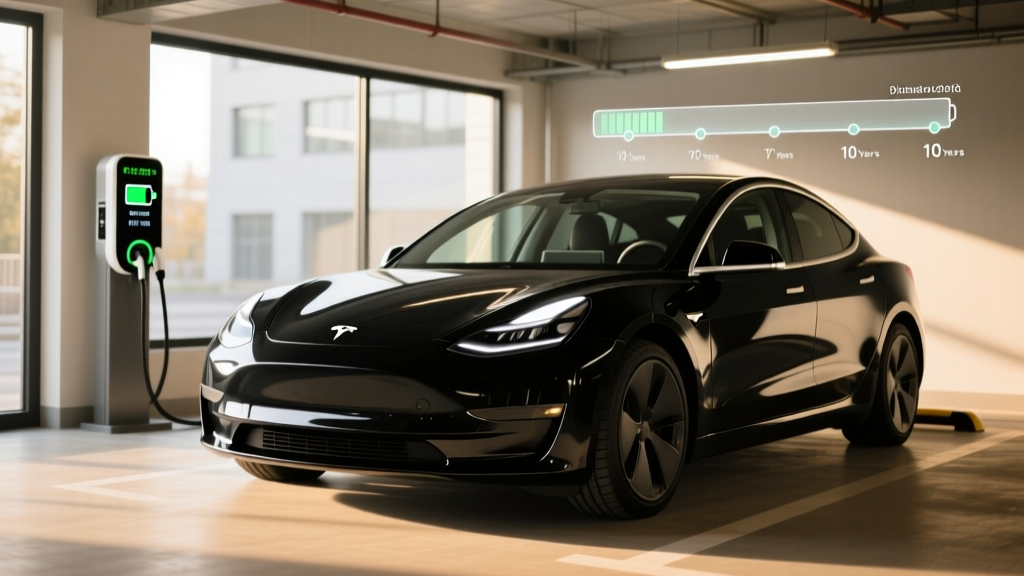
The short answer: Tesla's own fleet data shows Model 3 batteries retaining approximately 85% of original capacity after 150,000 miles. With the current-generation (Highland refresh and subsequent updates) battery chemistries, many owners can reasonably expect the vehicle to remain practical well past 200,000 miles before battery replacement becomes economically necessary. But the details — chemistry, charging habits, climate, and trim choice — matter enormously.
Below, we break down everything a 2026 buyer needs to know: range reality, battery degradation science, charging infrastructure, pricing with federal tax credits, and how the Model 3 stacks up against competitors like the Hyundai Ioniq 6 and BMW i4.
2026 Tesla Model 3 Specifications at a Glance
| Spec | Model 3 RWD | Model 3 Long Range AWD | Model 3 Performance AWD |
|---|---|---|---|
| EPA Range | 272 mi | 341 mi | 315 mi |
| Battery (usable) | ~57.5 kWh (LFP) | ~75 kWh (NMC) | ~75 kWh (NMC) |
| Drivetrain | RWD, single motor | AWD, dual motor | AWD, dual motor |
| Horsepower | 271 hp | 346 hp | 510 hp |
| 0–60 mph | 5.8 sec | 4.2 sec | 2.9 sec |
| MPGe (combined) | 132 MPGe | 131 MPGe | 121 MPGe |
| Efficiency | 26 kWh/100 mi | 26 kWh/100 mi | 28 kWh/100 mi |
| Max DC Fast Charge | 170 kW | 250 kW | 250 kW |
| 10–80% DC Time | ~25 min | ~22 min | ~22 min |
| Level 2 Home Charge | 11.5 kW (~44 mi/hr) | 11.5 kW (~44 mi/hr) | 11.5 kW (~44 mi/hr) |
| Base MSRP | $38,990 | $45,990 | $53,990 |
| Battery Warranty | 8 yr / 100,000 mi | 8 yr / 120,000 mi | 8 yr / 120,000 mi |
Source: EPA fueleconomy.gov, Tesla.com (2026 model year). Pricing excludes destination fee.
Real-World Range vs. EPA Estimates
EPA Sticker: 272 mi (RWD) / 341 mi (Long Range)
Real-World Highway (70 mph, 72°F): ~240 mi (RWD) / ~300 mi (Long Range)
Cold Weather (30°F, mixed driving): ~195 mi (RWD) / ~250 mi (Long Range)
Expect 10–15% range loss at sustained highway speeds and 20–30% loss in freezing temperatures, consistent across most BEVs.
The Model 3's efficiency is genuinely class-leading. At roughly 26 kWh per 100 miles, it extracts more miles per kilowatt-hour than nearly any competing sedan. This efficiency is what makes the relatively modest 57.5 kWh LFP battery in the RWD trim viable for daily commuting — and it's why the Long Range achieves over 340 miles EPA with a 75 kWh pack.
However, EPA range tests include significant low-speed city driving and regenerative braking recovery. On a 300-mile road trip at interstate speeds, plan conservatively. In our experience, the Long Range AWD comfortably covers 280–300 highway miles in mild weather before requiring a charge stop. The RWD trim is better suited to commuters who can charge at home nightly and rarely exceed 200 miles between charges.
Battery Chemistry, Degradation, and Life Expectancy
The Tesla Model 3 life expectancy is fundamentally a battery story. Tesla uses two distinct chemistries across the lineup, and the difference matters for longevity:
| Factor | LFP (RWD trim) | NMC (Long Range / Performance) |
|---|---|---|
| Cycle Life | 3,000–5,000+ cycles | 1,500–2,500 cycles |
| Energy Density | Lower (heavier pack for same kWh) | Higher (more range per lb) |
| Recommended Daily SoC | 100% (charge to full regularly) | 80% for daily, 100% for trips |
| Cold-Weather Performance | Moderately reduced charge acceptance | Better cold tolerance with preconditioning |
| Typical Degradation at 150k mi | ~8–12% loss | ~10–15% loss |
| Best For | Daily commuters, high-mileage drivers | Road-trippers, range-maximizers |
Tesla's 2025 Impact Report showed that Model 3 rear-wheel-drive vehicles with LFP batteries retained roughly 90% of original capacity after 100,000 miles, and Long Range (NMC) vehicles retained approximately 85% after 150,000 miles. Degradation curves are steepest in the first 20,000 miles (typically 2–5% loss), then flatten significantly.
What this means practically: If you buy a Model 3 Long Range with 341 miles EPA today, expect roughly 300–310 miles of usable range at 100,000 miles, and around 280–290 miles at 200,000 miles. For the RWD, plan on roughly 245 miles at 100,000 miles. These figures remain practical for most daily use cases — the car doesn't become unusable; it just requires slightly more charge planning on long trips.
The LFP battery in the RWD trim is arguably the longevity champion. LFP chemistry tolerates 100% daily charging without the accelerated degradation that NMC batteries experience at high states of charge. If your goal is to drive a Model 3 to 250,000+ miles with minimal battery concern, the RWD trim — despite its lower range — may paradoxically be the best long-term bet.
Battery Replacement Cost
Should a battery replacement become necessary outside of warranty, current estimates place a Model 3 battery pack replacement between $12,000 and $16,000 including labor (source: Tesla service center estimates and third-party EV repair data). This is a significant expense, but it's worth noting that complete battery failures are rare — most degradation is gradual capacity loss, not sudden failure.
Charging Speed and Infrastructure
Charging speed is one of the Model 3's strongest competitive advantages, particularly when paired with Tesla's Supercharger network. Here's how each charging level breaks down:
| Charging Level | Power | Speed (approx.) | Use Case |
|---|---|---|---|
| Level 1 (120V household) | 1.4 kW | ~5 mi/hr | Overnight trickle, emergencies |
| Level 2 (240V home) | 11.5 kW | ~44 mi/hr | Daily home charging (full in ~7 hr) |
| DC Fast (Supercharger V3/V4) | Up to 250 kW (LR/Perf) | 10–80% in ~22 min | Road trips, quick top-ups |
| DC Fast (RWD trim) | Up to 170 kW | 10–80% in ~25 min | Road trips (slightly slower) |
Key nuance — the charge curve: The 250 kW peak rate on Long Range and Performance trims is only sustained between roughly 10% and 35% state of charge. Above 50%, the rate tapers progressively — you'll see roughly 120 kW at 60% SoC and under 50 kW above 80%. This is normal lithium-ion behavior, not a defect. The 10–80% time of ~22 minutes accounts for this taper. Plan road-trip stops around the 10–80% window for maximum efficiency; charging past 80% adds significant time for diminishing range gains.
The Model 3 now ships with the NACS (North American Charging Standard) connector natively, meaning access to Tesla's Supercharger network (over 20,000 stalls in North America) without adapters. Non-Tesla DC networks like Electrify America and EVgo also support NACS as of 2025–2026, dramatically expanding public charging options compared to earlier CCS-only Teslas.
Home charging setup: A Level 2 home installation (Wall Connector or equivalent) on a 60-amp circuit delivers the full 11.5 kW (48-amp continuous). Expect installation costs between $500 and $2,000 depending on your electrical panel's capacity and proximity to the charging location. Most Model 3 owners charge 80%+ of their miles at home, which is both the cheapest and most battery-friendly charging method.
Pricing, Tax Credits, and Total Cost of Ownership
| Trim | Base MSRP | Federal §30D Credit | Effective Price |
|---|---|---|---|
| RWD | $38,990 | Up to $7,500* | ~$31,490 |
| Long Range AWD | $45,990 | Up to $7,500* | ~$38,490 |
| Performance AWD | $53,990 | Up to $7,500* | ~$46,490 |
*Federal EV tax credit eligibility under IRS §30D depends on multiple factors. The credit can now be transferred to the dealer at point of sale as an upfront discount.
- MSRP Cap: Sedans must be under $55,000 (all Model 3 trims qualify)
- Buyer Income Cap: AGI ≤ $150,000 (single) / $225,000 (head of household) / $300,000 (joint)
- Battery Sourcing: Critical minerals and battery component requirements phase in annually — confirm current-year compliance at fueleconomy.gov
- Assembly: Vehicle must undergo final assembly in North America (Model 3: Fremont, CA — qualifies)
- Point-of-Sale Transfer: You can apply the credit as an immediate price reduction at purchase rather than waiting for tax filing
Consult a tax professional for your specific eligibility. Rules are subject to legislative change.
5-Year Total Cost of Ownership
Beyond the purchase price, the Model 3's ownership economics remain compelling. Using national averages (electricity at $0.16/kWh, gas at $3.50/gallon, 12,000 miles/year):
- Fuel cost (5 years): ~$3,100 (electricity, home charging dominant) vs. ~$8,400 for a comparable 30 MPG gas sedan
- Maintenance: Minimal — no oil changes, minimal brake wear (regen braking), cabin air filter and wiper fluid are the primary consumables. Budget ~$1,200 over 5 years
- Insurance: Higher than average — expect $2,000–$2,800/year depending on state and driving record (Teslas carry higher collision repair costs)
- Depreciation: Model 3 retains approximately 50–55% of value after 5 years, improved from 2023–2024 lows due to price stabilization
Tech, Interior, and Daily Livability
The current-generation Model 3 (post-Highland refresh) is a meaningfully improved vehicle in cabin quality, ride comfort, and noise isolation compared to pre-2024 models. Key specifications:
- Cargo: 23 cu ft trunk + 3.1 cu ft frunk (26.1 cu ft total)
- Rear legroom: 35.3 inches
- Front headroom: 40.3 inches
- Display: 15.4-inch center touchscreen (all vehicle controls routed through display — no physical instrument cluster)
- Rear display: 8-inch screen for rear passengers (climate, media)
- Audio: 17-speaker premium system (Long Range/Performance)
Driver Assistance
Tesla Autopilot and Full Self-Driving (Supervised) are SAE Level 2 driver-assistance systems. The driver must remain fully engaged, hands on or near the wheel, and prepared to take over at any moment. These systems do not make the vehicle autonomous. Only Level 4 services like Waymo operate without a driver.
Standard Autopilot includes adaptive cruise control and lane centering. The optional FSD (Supervised) package ($8,000 or $99/month) adds automatic lane changes, traffic-light recognition, and city-street navigation assistance. In practice, FSD has improved substantially but still requires active supervision — it handles most highway scenarios well but can struggle with complex construction zones, unmapped intersections, and adverse weather. Treat it as a fatigue-reducer on long drives, not a replacement for attention.
Notable Drawbacks
- No physical controls: Turn signals are on a steering-wheel stalk (restored post-Highland), but climate, mirrors, and glovebox are all touchscreen-controlled
- Firm rear seat: Rear cushion is relatively flat and firm on longer trips
- Visibility: Thick rear pillars and small rear window limit over-the-shoulder sightlines
- No Apple CarPlay / Android Auto: Tesla's proprietary infotainment only — no phone projection
- Service center wait times: Tesla service centers in high-volume markets can have multi-week appointment delays for non-urgent work
How It Compares: Model 3 vs. Key Competitors
| Spec | Tesla Model 3 LR | Hyundai Ioniq 6 SEL | BMW i4 eDrive40 |
|---|---|---|---|
| EPA Range | 341 mi | 305 mi | 301 mi |
| Base MSRP | $45,990 | $42,600 | $57,900 |
| Max DC Charge | 250 kW | 240 kW | 205 kW |
| 10–80% Time | ~22 min | ~18 min | ~31 min |
| Efficiency | 26 kWh/100 mi | 27 kWh/100 mi | 32 kWh/100 mi |
| Charging Network | NACS (Supercharger + open networks) | NACS (adapter or native by 2026) | NACS (adapter or native by 2026) |
| Battery Warranty | 8 yr / 120,000 mi | 10 yr / 100,000 mi | 8 yr / 80,000 mi |
The Model 3 Long Range wins on range, efficiency, and Supercharger access. The Ioniq 6 charges slightly faster (thanks to its 800V architecture) and offers a longer battery warranty. The BMW i4 delivers premium build quality and driving dynamics but at a significant price premium and lower efficiency. For pure value-per-mile-of-range, the Model 3 remains difficult to beat.
Pros and Cons
- Class-leading efficiency (26 kWh/100 mi)
- Supercharger network access (most reliable DC network in North America)
- LFP battery option with exceptional cycle life
- Over-the-air updates continuously add features
- Strong resale value relative to EV segment average
- Excellent safety ratings (NHTSA 5-star, IIHS Top Safety Pick+)
- No physical controls for core functions
- FSD remains Level 2 — requires full driver attention
- Above-average insurance premiums
- Service availability uneven in rural markets
- Rear seat comfort lags behind competitors
- No phone integration (CarPlay/Android Auto)
Who Should Buy the Tesla Model 3?
Choose the Model 3 RWD if: You commute under 60 miles daily, have reliable home charging, want the lowest purchase price, and prioritize battery longevity over maximum range. The LFP battery is the strongest long-term play.
Choose the Model 3 Long Range if: You take regular road trips (200+ miles), live in a cold-weather state where range drops matter, or need AWD traction. The 341-mile EPA range provides a meaningful buffer.
Choose the Model 3 Performance if: You want sports-sedan acceleration (2.9-sec 0–60) and track capability, and you're willing to accept slightly lower efficiency and a higher price.
Look elsewhere if: You need a large rear seat for adults on long trips (consider the Model Y or Ioniq 5), you insist on physical dashboard controls, or you want Apple CarPlay.
Frequently Asked Questions
How long will a Tesla Model 3 battery last before needing replacement?
Based on Tesla's fleet data and independent tracking (including sources like IIHS and owner surveys), most Model 3 batteries will retain 80–85% of original capacity at 150,000 miles. Many will exceed 200,000 miles before degradation makes replacement economically worthwhile. The battery warranty guarantees 70% retention for 8 years / 100,000–120,000 miles depending on trim.
Does the Tesla Model 3 qualify for the $7,500 federal tax credit?
All Model 3 trims are assembled in Fremont, CA (qualifying North American assembly) and are priced under the $55,000 sedan MSRP cap. However, your personal eligibility depends on income limits (AGI ≤ $150K single / $300K joint) and current-year battery-sourcing requirements. The credit can be applied at point of sale. Check current eligibility at fueleconomy.gov and consult a tax professional.
Is the Tesla Model 3 expensive to insure?
Yes, relative to non-luxury sedans. National average premiums range from $2,000 to $2,800 per year, driven by higher collision repair costs (aluminum body panels, sensor recalibration, Tesla's integrated repair network). Tesla offers its own insurance product in many states that uses real-time driving data and can be 10–20% cheaper than traditional carriers for safe drivers.
How does cold weather affect Model 3 range?
Expect 20–30% range reduction in sustained freezing temperatures (20–32°F), consistent with most BEVs. The Model 3's heat pump (standard on all trims since 2021) significantly reduces cabin-heating energy draw compared to older resistive heaters. Preconditioning the battery while plugged in — using the Tesla app to warm the car before departure — recovers substantial range and improves regenerative braking performance.
Can I charge a Tesla Model 3 on non-Tesla chargers?
Yes. The current Model 3 uses the NACS connector natively. As of 2025–2026, most major DC fast-charging networks (Electrify America, EVgo, ChargePoint) have added NACS cables or support NACS vehicles. For older CCS-only stations, a NACS-to-CCS adapter is available from Tesla. Level 2 public chargers (J1772) work with the included J1772 adapter.
What's the real-world 0–60 time for the Model 3 Long Range?
Tesla rates the Long Range AWD at 4.2 seconds to 60 mph. Independent testing consistently validates this figure within ±0.2 seconds on prepped surfaces. The RWD trim clocks in at 5.8 seconds — brisk for daily driving but not performance-oriented. The Performance trim's 2.9-second time places it in supercar territory.