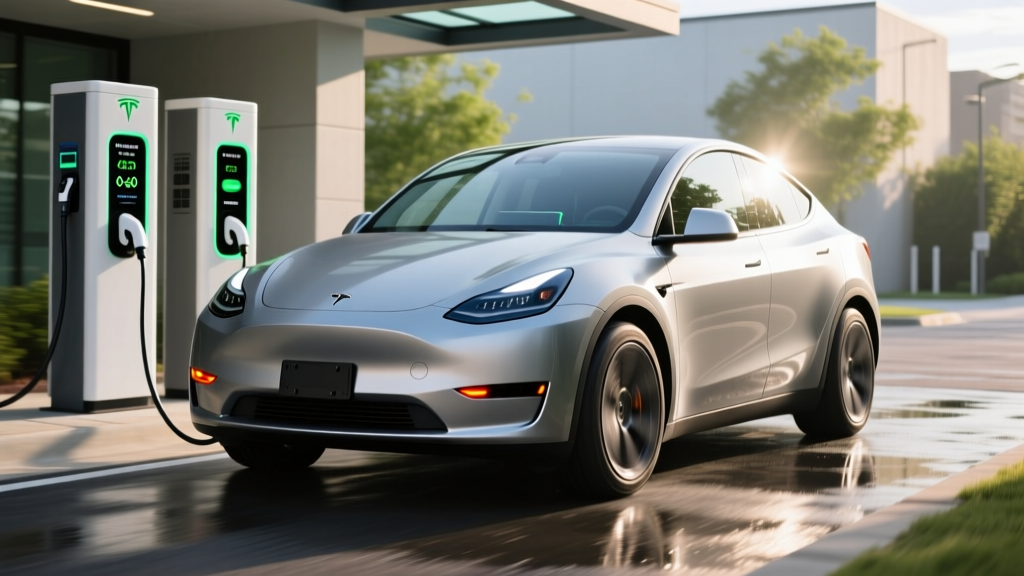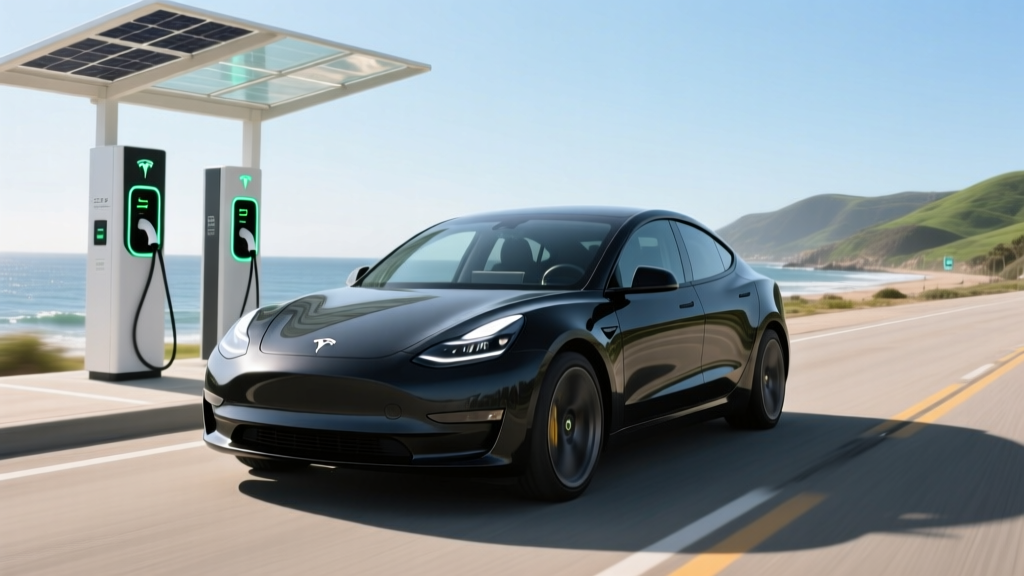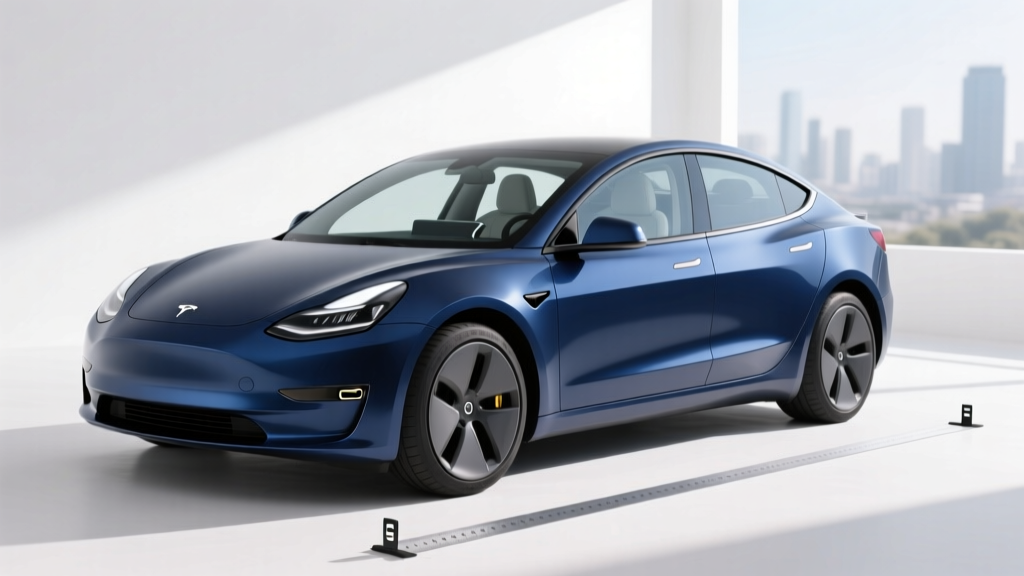
If you are measuring your garage, comparing parking footprint, or cross-shopping sedans, the Tesla Model 3 length is usually the first spec buyers check. But dimensions alone don't tell you whether this sedan fits your life. This review covers every number that matters for the 2026 Tesla Model 3 — exterior and interior measurements, real-world range, charging speed, battery chemistry, pricing, and how it stacks up against the Hyundai Ioniq 6 and BMW i4.
Exterior Dimensions: Tesla Model 3 Length, Width, and Curb Weight
The current-generation Tesla Model 3 (refreshed for the 2024 model year and carried into 2026) rides on the same wheelbase as the pre-refresh car, but the body panels and bumper designs changed slightly. Here are the exact exterior measurements:
| Dimension | Measurement |
|---|---|
| Overall Length | 184.8 inches (4,694 mm) |
| Overall Width (mirrors folded) | 72.8 inches (1,849 mm) |
| Overall Width (mirrors extended) | 82.2 inches (2,089 mm) |
| Height | 56.8 inches (1,443 mm) |
| Wheelbase | 113.2 inches (2,875 mm) |
| Ground Clearance | 5.5 inches (140 mm) |
| Curb Weight (RWD) | 3,862 lbs |
| Curb Weight (Long Range AWD) | 4,034 lbs |
| Curb Weight (Performance AWD) | 4,065 lbs |
| Drag Coefficient (Cd) | 0.219 |
At 184.8 inches long, the Model 3 is a compact executive sedan — roughly 5 inches shorter than the Tesla Model S (196.0 in) and about 11 inches shorter than the Model Y (195.8 in). Compared to rivals, the Hyundai Ioniq 6 measures 191.1 inches, while the BMW i4 comes in at 188.3 inches. The Model 3's shorter length makes it easier to park in tight urban garages, while the 113.2-inch wheelbase preserves interior legroom.
Interior Space: Cargo Volume, Legroom, and Practicality
The Model 3's exterior footprint doesn't tell the full story. Tesla's skateboard platform and lack of a transmission tunnel free up meaningful interior volume. Here is what you get:
| Measurement | Front | Rear |
|---|---|---|
| Headroom | 40.3 in | 37.6 in |
| Legroom | 42.7 in | 35.2 in |
| Shoulder Room | 56.5 in | 54.5 in |
| Hip Room | 53.4 in | 51.7 in |
Cargo volume: 23.1 cubic feet total — 21.0 cu ft in the rear trunk and 2.1 cu ft in the front trunk (frunk). The rear seats fold in a 60/40 split, opening up enough space for skis, long boxes, or a full Costco run. The frunk is small but useful for a charging cable bag or a backpack.
For comparison, the Ioniq 6 offers 12.3 cu ft of trunk space (no frunk on most trims), and the BMW i4 provides 16.6 cu ft. The Model 3's cargo advantage is significant in this segment.
Battery, Range, and Real-World Efficiency
The 2026 Model 3 is offered in three trims, each with a different battery pack and drivetrain. Tesla does not publish official kWh figures, but independent teardowns and EPA test data confirm the following usable capacities:
| Trim | Battery Chemistry | Usable Capacity | EPA Range | Drivetrain |
|---|---|---|---|---|
| RWD (Standard Range) | LFP (CATL) | ~57.5 kWh | 272 mi | Rear-Wheel Drive |
| Long Range AWD | NMC (LG/Panasonic) | ~75 kWh | 363 mi | Dual-Motor AWD |
| Performance AWD | NMC (LG/Panasonic) | ~75 kWh | 315 mi | Dual-Motor AWD |
Efficiency (MPGe):
- RWD: 132 MPGe combined (25 kWh/100 mi)
- Long Range AWD: 132 MPGe combined (25 kWh/100 mi)
- Performance AWD: 113 MPGe combined (30 kWh/100 mi)
These are among the most efficient numbers in the EV sedan segment. The Model 3's 0.219 drag coefficient and heat pump (standard on all trims) contribute heavily to this efficiency.
Charging Speed: DC Fast Charging and Home Level 2
Charging speed is where the refreshed Model 3 made meaningful gains. All trims now use a NACS (North American Charging Standard) port natively — no adapter needed for Tesla Superchargers.
| Charging Level | RWD (LFP) | Long Range / Performance (NMC) |
|---|---|---|
| Max DC Fast Charge | 170 kW | 250 kW |
| 10–80% DC Time | ~25 min | ~18 min (Long Range) / ~20 min (Performance) |
| Level 2 (240V, 48A) | 11.5 kW (~40 mi/hr) | 11.5 kW (~40 mi/hr) |
| Level 1 (120V, 12A) | ~1.4 kW (~5 mi/hr) | ~1.4 kW (~5 mi/hr) |
Charging curve reality: The Long Range and Performance trims peak at 250 kW only between roughly 10–30% state of charge. Above 50%, the rate tapers to ~120 kW, and above 80% it drops to ~40 kW. This is normal lithium-ion behavior, but it means the advertised 18-minute 10–80% time requires arriving at the charger at a low SoC and preconditioning the battery via the car's navigation system.
The RWD trim's LFP battery charges more slowly in absolute kW terms, but LFP chemistry tolerates regular 100% charging without degradation concerns — a meaningful ownership advantage for daily commuters who charge at home every night.
Home charging setup: Tesla's Wall Connector ($420) delivers up to 44 miles of range per hour at 48 amps on a 60-amp circuit. Most owners install a NEMA 14-50 outlet ($300–$800 for a typical electrician run) or hardwire the Wall Connector (requires a dedicated 60A breaker). Total home install cost ranges from $500 to $2,000 depending on panel proximity and local permitting.
Performance: 0–60, Horsepower, and Drivetrain
| Trim | Horsepower | 0–60 mph | Top Speed | Drivetrain |
|---|---|---|---|---|
| RWD | 283 hp | 5.8 sec | 125 mph | Single Motor RWD |
| Long Range AWD | 346 hp | 4.2 sec | 125 mph | Dual Motor AWD |
| Performance AWD | 510 hp | 2.9 sec | 163 mph | Dual Motor AWD |
Even the base RWD Model 3 is quicker than most gas-powered compact sedans. The Performance trim's 2.9-second 0–60 time puts it in supercar territory, with instant torque delivery that no internal-combustion competitor can match off the line. All trims feature regenerative braking with adjustable strength, though Tesla removed the full one-pedal driving option in recent software updates — you can reduce regen but not eliminate the creep at low speeds.
Pricing, Trims, and Federal Tax Credit Eligibility
| Trim | Base MSRP | Federal Tax Credit (§30D) | Effective Price |
|---|---|---|---|
| RWD | $38,990 | Up to $7,500* | ~$31,490* |
| Long Range AWD | $45,740 | Up to $7,500* | ~$38,240* |
| Performance AWD | $52,990 | Up to $7,500* | ~$45,490* |
*Federal tax credit eligibility is not automatic. Under current IRS §30D rules, buyers must meet all of the following criteria:
- Income caps: Modified AGI ≤ $150,000 (single), $225,000 (head of household), $300,000 (joint filers)
- MSRP cap: Vehicle MSRP must not exceed $55,000 for sedans (all Model 3 trims qualify)
- Battery sourcing: Critical minerals and battery components must meet phased-in percentage thresholds from U.S. or FTA-partner countries — eligibility can change mid-year as supply chains shift
- Point-of-sale transfer: As of 2024, the credit can be applied at purchase, reducing your out-of-pocket cost immediately rather than waiting for tax filing
The Long Range AWD at $45,740 sits comfortably under the $55,000 sedan cap, but the Performance trim at $52,990 is close to the limit — adding destination fees or premium paint could push it over depending on how the IRS treats options packaging. Always verify current eligibility at IRS.gov or through Tesla's point-of-sale credit tool before purchasing.
Tech, Driver Assistance, and Warranty
Infotainment: A 15.4-inch center touchscreen controls everything — climate, media, navigation, and vehicle settings. There is no instrument cluster; speed and range display on the upper-left corner of the main screen. The refresh added a rear 8-inch touchscreen for back-seat passengers (climate and media controls) and ventilated front seats. A 17-speaker audio system, wireless phone charging, and USB-C ports (front and rear) are standard.
Driver Assistance (SAE Level 2):
Tesla Autopilot (standard) and Full Self-Driving Supervised ($8,000 option or $99/month) are SAE Level 2 systems. They provide adaptive cruise control, lane-centering, and automated lane changes, but the driver must remain fully engaged — hands on or near the wheel, eyes on the road. These are not autonomous or self-driving systems. Only Level 4 robotaxi services (e.g., Waymo) operate without a human driver.
Warranty:
- Basic Vehicle: 4 years / 50,000 miles
- Battery & Drive Unit: 8 years / 100,000 miles (RWD) or 8 years / 120,000 miles (Long Range & Performance)
- Battery retention threshold: Tesla warrants a minimum of 70% capacity retention during the warranty period
For context, Hyundai covers the Ioniq 6 battery for 10 years / 100,000 miles. Tesla's battery warranty is competitive but not class-leading.
Pros, Cons, and Who Should Buy the Model 3
Pros
- Best-in-class efficiency (132 MPGe combined)
- Extensive Supercharger network with native NACS
- 250 kW DC fast charging on Long Range/Performance
- Strong cargo volume (23.1 cu ft) with frunk
- Over-the-air updates continuously improve the car
- Competitive pricing, especially after §30D credit
Cons
- No physical buttons — all controls via touchscreen
- Rear headroom is tight for passengers over 6'2"
- RWD LFP battery loses more range in cold weather
- FSD Supervised is expensive and remains Level 2
- No Apple CarPlay or Android Auto
- Turn signals on steering wheel (no stalk) take adjustment
Best for: Urban and suburban commuters who charge at home, tech-forward buyers who value OTA updates and the Supercharger network, and couples or small families who don't need SUV cargo height. The Long Range AWD is the sweet spot for road-trippers who want 300+ real-world miles and dual-motor traction.
Look elsewhere if: You regularly carry tall rear-seat passengers, need more than 23 cu ft of cargo, or prefer physical buttons and CarPlay. The Ioniq 6 offers a more conventional cockpit, and the BMW i4 provides a more traditional luxury sedan experience.
Frequently Asked Questions
What is the exact length of the 2026 Tesla Model 3?
The 2026 Tesla Model 3 measures 184.8 inches (4,694 mm) in overall length. This is approximately 15.4 feet, making it one of the more compact executive sedans on the market — shorter than the Hyundai Ioniq 6 (191.1 in) and BMW i4 (188.3 in).
What is the real-world range of the Tesla Model 3?
The EPA rates the Long Range AWD at 363 miles, but real-world highway driving at 75 mph typically yields 290–320 miles. In cold weather (below freezing), expect 250–270 miles. The RWD trim's EPA rating is 272 miles, with real-world results closer to 220–250 miles depending on conditions.
How fast does the Model 3 charge at home and on the road?
On a Level 2 home charger at 48 amps (11.5 kW), all trims add roughly 40 miles of range per hour — a full overnight charge. At a DC fast charger, the Long Range and Performance trims peak at 250 kW and charge from 10–80% in about 18–20 minutes. The RWD trim peaks at 170 kW with a 10–80% time of roughly 25 minutes.
Does the 2026 Tesla Model 3 qualify for the $7,500 federal tax credit?
All three trims fall under the $55,000 MSRP cap for sedans, making them potentially eligible. However, the buyer must also meet income caps ($150K single / $300K joint) and the vehicle's battery must satisfy current-year critical mineral and component sourcing requirements under IRS §30D. Verify eligibility at purchase, as sourcing rules can shift.
Is the Tesla Model 3 worth buying over the Hyundai Ioniq 6 or BMW i4?
The Model 3 wins on efficiency, charging network access (Supercharger + NACS), and cargo practicality. The Ioniq 6 offers a more conventional interior with physical controls and a longer battery warranty. The BMW i4 delivers a more premium ride and traditional luxury branding but at a higher price point with slower DC charging. For most buyers prioritizing range-per-dollar and road-trip charging ease, the Model 3 Long Range remains the segment benchmark.
How much interior and cargo space does the Model 3 have?
Front legroom is 42.7 inches; rear legroom is 35.2 inches. Total cargo volume is 23.1 cubic feet (21.0 cu ft trunk + 2.1 cu ft frunk). Rear seats fold 60/40 for longer items. It comfortably seats four adults, though rear headroom (37.6 in) is snug for taller passengers.