Tesla Model 3 Dimensions: Length, Width, and Interior Space
If you've been searching for the Tesla Model 3 length to see whether it fits your garage, parking spot, or carport, the answer is 184.8 inches (15.4 feet) for the current-generation "Highland" refresh (2024–2025 model years). That makes it roughly 4 inches shorter than the Tesla Model Y and about 8 inches shorter than a Toyota Camry — a meaningful difference when you're threading into a tight urban parking space or navigating a compact garage.
But dimensions go beyond length. Here's the full exterior and interior measurement breakdown that matters for real-world ownership:
| Measurement | Specification |
|---|---|
| Overall Length | 184.8 in (4,694 mm) |
| Width (mirrors folded) | 72.8 in (1,849 mm) |
| Width (mirrors out) | 82.2 in (2,089 mm) |
| Height | 56.8 in (1,443 mm) |
| Wheelbase | 113.2 in (2,875 mm) |
| Curb Weight (RWD) | 3,862 lbs |
| Curb Weight (Long Range AWD) | 4,034 lbs |
| Front Legroom | 42.7 in |
| Rear Legroom | 35.2 in |
| Cargo Volume (Trunk) | 21.0 cu ft |
| Front Trunk (Frunk) | 3.1 cu ft |
| Total Cargo | 24.1 cu ft |
| Turning Circle | 38.1 ft |
The 184.8-inch length puts the Model 3 firmly in the compact executive sedan category — shorter than a Honda Accord (195.7 in) but slightly longer than a Hyundai Ioniq 6 (191.1 in). The 113.2-inch wheelbase is generous for the footprint, which is why rear-seat legroom remains usable for adults on shorter trips, though taller passengers will notice the sloping roofline cutting into headroom.
Cargo capacity is where the sedan body style shows its limits compared to a hatchback or crossover. The 21 cu ft trunk is deep but has a narrow opening that makes loading bulky items like a large dog crate or a full-size bicycle (even with the front wheel removed) more difficult than in the Model Y's 30.2 cu ft hatchback area. The 3.1 cu ft frunk is best suited for a charging cable bag and a small soft cooler — don't plan on serious grocery overflow up front.
Range, Battery, and Efficiency: What the Numbers Actually Mean
The current Model 3 lineup offers three trims, each with a different battery chemistry and range profile. Understanding the difference between kWh (kilowatt-hours, the energy capacity of the battery — think of it as the "fuel tank size") and kW (kilowatts, the rate of power delivery or charging speed) is essential here.
| Trim | Battery (Usable kWh) | Chemistry | EPA Range | Drivetrain | MPGe (Combined) | kWh/100 mi |
|---|---|---|---|---|---|---|
| RWD (Base) | ~57.5 kWh | LFP (CATL) | 272 mi | Rear-Wheel Drive | 132 MPGe | 25 |
| Long Range RWD | ~75 kWh | NMC | 363 mi | Rear-Wheel Drive | 134 MPGe | 25 |
| Long Range AWD | ~75 kWh | NMC | 341 mi | Dual-Motor AWD | 125 MPGe | 27 |
The EPA sticker tells one story; the highway tells another. For the Long Range AWD (EPA 341 mi), expect ~280–300 miles at sustained 75 mph highway speeds in mild weather. In cold conditions (below 30°F), range can drop 20–30%, bringing real-world highway range to roughly 220–250 miles. The RWD base model (EPA 272 mi) typically delivers 210–230 miles on the highway in fair weather, and as little as 170–190 miles in winter. The LFP battery in the RWD model tolerates regular 100% charging better than NMC, so you can use the full capacity daily without accelerated degradation concerns.
The LFP (lithium iron phosphate) battery in the base RWD model trades energy density for longevity and cost. LFP cells are heavier and hold less energy per kilogram than NMC (nickel manganese cobalt), which is why the RWD range tops out at 272 miles despite a physically substantial pack. The upside: Tesla and CATL recommend charging LFP batteries to 100% at least once per week for accurate state-of-charge calibration, and LFP chemistry degrades more slowly over thousands of cycles. If you plan to keep the car 8+ years or put on high mileage, the LFP pack is arguably the more durable choice.
The NMC packs in the Long Range trims offer higher energy density and better cold-weather performance but carry a recommendation to charge to 80% for daily use and reserve 100% for road trips. This effectively reduces your daily usable range on Long Range trims to roughly 275–290 miles (AWD) if you follow best practices — a number that still beats the RWD's full-charge range but narrows the gap considerably.
Efficiency figures from fueleconomy.gov confirm the Model 3 remains one of the most efficient EVs on the market at 25–27 kWh/100 mi, meaning it extracts more miles from each unit of electricity than nearly any competitor. The Hyundai Ioniq 6 SE RWD Long Range achieves 24 kWh/100 mi, so Tesla's advantage is real but slim — roughly 1–2 extra miles per 10 kWh of charge.
Charging Speed: DC Fast Charging and Home Level 2
Charging speed is where Highland-generation Model 3 owners see a meaningful upgrade over the pre-2024 model. The refreshed Model 3 supports faster DC charging peaks and improved thermal preconditioning, which matters for road-trip practicality.
| Charging Method | Peak Power | Speed / Time | Connector |
|---|---|---|---|
| DC Fast Charge (Long Range) | 250 kW peak | 10–80% in ~25 min | NACS (native Tesla) |
| DC Fast Charge (RWD / LFP) | 170 kW peak | 10–80% in ~30 min | NACS (native Tesla) |
| Level 2 Home (240V, 48A) | 11.5 kW | ~37 mi/hr of range added | NACS / J1772 adapter |
| Level 2 Home (240V, 32A) | 7.7 kW | ~25 mi/hr of range added | NACS / J1772 adapter |
| Level 1 (120V household) | ~1.4 kW | ~3–5 mi/hr of range added | NACS / J1772 adapter |
A few important nuances about these numbers:
Peak vs. sustained charge rate: The Long Range's 250 kW peak occurs only between roughly 10–30% state of charge. Above 50%, the charge curve tapers significantly — by 80%, you're pulling closer to 60–80 kW. This is why the 10–80% time of ~25 minutes is the meaningful metric, not the peak number. The 80–100% top-off can add another 25–35 minutes, which is why road-trip strategy should target multiple shorter stops (10–80%) rather than fewer full charges.
LFP charging characteristics: The RWD model's 170 kW peak is lower, but LFP batteries tolerate high charge rates well and have a flatter charge curve, meaning the taper is less aggressive. You'll still reach 80% in about 30 minutes — acceptable for road trips, though noticeably slower than the Long Range.
Home charging reality: At 48 amps on a hardwired Tesla Wall Connector or equivalent Level 2 unit, you'll add roughly 37 miles of range per hour. An overnight session (8–10 hours) fully replenishes any daily commute. If your electrical panel only supports a 40-amp circuit (32A continuous), you'll add about 25 mi/hr — still sufficient for most daily needs but worth noting if you drive 80+ miles per day. Installation costs for a 240V/48A circuit typically run $800–$2,500 depending on panel proximity and whether an upgrade to 200-amp service is needed. Always get a quote from a licensed electrician for your specific home.
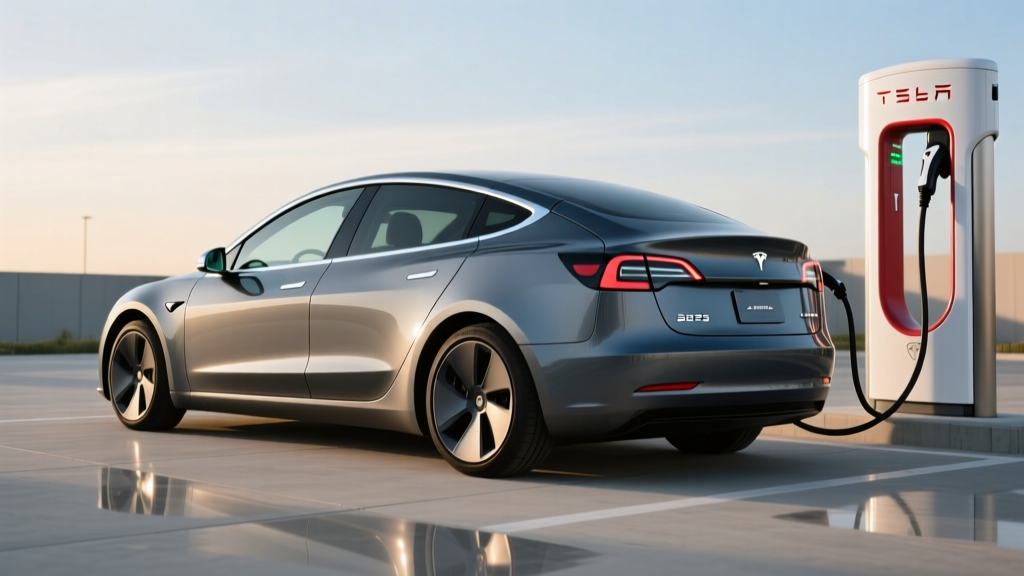
The Model 3 uses the NACS (North American Charging Standard) connector natively. This is the same connector used across the Tesla Supercharger network, which currently offers the most reliable and extensive DC fast-charging infrastructure in the US. Non-Tesla chargers with CCS connectors require a Tesla CCS adapter (~$250), though more networks are adding native NACS cables through 2025–2026.
Performance: Acceleration, Handling, and Drivetrain
| Trim | Horsepower | 0–60 mph | Top Speed | Drivetrain |
|---|---|---|---|---|
| RWD (Base) | 271 hp | 5.8 sec | 125 mph | Rear-Wheel Drive |
| Long Range RWD | 346 hp | 4.9 sec | 125 mph | Rear-Wheel Drive |
| Long Range AWD | 346 hp (combined) | 4.2 sec | 125 mph | Dual-Motor AWD |
Even the base RWD Model 3's 5.8-second 0–60 mph time is quicker than most gas-powered compact sedans in its price range. The instant torque delivery of an electric motor makes the car feel even faster in stoplight-to-stoplight city driving than the stopwatch suggests — there's no transmission lag or turbo spool-up.
The Highland refresh brought meaningful improvements to ride quality. Tesla retuned the suspension, added frequency-selective dampers, and improved sound insulation. The result is a noticeably quieter, more compliant ride over rough pavement compared to the 2018–2023 Model 3, which drew consistent criticism for firmness and road noise. The 2025 Model 3 is still sportier and firmer than a Toyota Camry or Hyundai Ioniq 6, but it no longer feels punishing on broken urban roads.
The dual-motor AWD Long Range adds front-axle traction that pays dividends in rain and snow. Tesla's traction control system is among the best in the industry, modulating power to each axle in milliseconds. If you live in a region with real winters, the AWD model is worth the premium over the Long Range RWD — not just for the extra traction but for the slight range bump that comes from regenerative braking on the front axle.
Pricing, Tax Credits, and Total Cost of Ownership
| Trim | Base MSRP | Federal Credit (§30D) | Effective Price* |
|---|---|---|---|
| RWD | $38,990 | Up to $7,500 | ~$31,490 |
| Long Range RWD | $42,490 | Up to $7,500 | ~$34,990 |
| Long Range AWD | $47,490 | Up to $7,500 | ~$39,990 |
*Effective price assumes full $7,500 federal tax credit eligibility. Actual credit depends on individual circumstances.
The Model 3 is priced before destination fees ($1,390 as of 2025) and before any state or utility incentives. All trims fall well under the IRS §30D MSRP cap of $55,000 for sedans, which means price alone doesn't disqualify any Model 3 variant.
However, federal tax credit eligibility is not automatic. Under current IRS §30D rules, you must meet several criteria:
- Income caps: Modified adjusted gross income (MAGI) must not exceed $150,000 (single), $225,000 (head of household), or $300,000 (married filing jointly).
- Battery sourcing: The $7,500 credit is split into two halves — $3,750 for critical minerals sourcing and $3,750 for battery component manufacturing. Sourcing requirements tighten annually. Tesla's US-built battery packs have generally qualified for the full credit, but always verify current eligibility at the point of sale or via the IRS VIN lookup tool.
- Point-of-sale transfer: As of 2024, you can transfer the credit to the dealer at purchase, reducing your out-of-pocket cost immediately rather than waiting for a tax refund. Tesla supports this at checkout.
- Tax liability: If you transfer the credit at point of sale, tax liability is no longer a constraint (the transfer functions as a rebate). If you claim it on your return, you need sufficient federal tax liability to absorb the credit.
Always consult a tax professional or check the IRS Clean Vehicle Credit page for the latest rules, as battery sourcing requirements and eligible vehicle lists can change mid-year.
On total cost of ownership, the Model 3 remains competitive. Electricity costs vary by region, but at the US average of ~$0.16/kWh, charging a Long Range AWD from 10–80% at home costs roughly $8.40 — the equivalent of about 2.5 gallons of gas for 230+ miles of range. Over five years and 75,000 miles, fuel savings versus a comparable gas sedan (30 MPG combined at $3.50/gal) typically run $4,000–$6,000, depending on local electricity and fuel prices. Insurance tends to run 10–20% higher than equivalent gas sedans, and tire replacement costs are elevated due to the vehicle's weight and instant torque.
Technology, Driver Assistance, and Interior
The Highland refresh simplified the interior further — some would say too far. The 15.4-inch center touchscreen handles virtually all vehicle controls, including climate, mirrors, and glovebox release. The controversial removal of the turn signal stalk (now capacitive buttons on the steering wheel) and ultrasonic parking sensors (replaced by Tesla Vision camera-based estimation) continues to divide owners.
Key technology features include:
- Infotainment: 15.4-inch touchscreen, Netflix/YouTube/theater mode (parked only), Bluetooth gaming, integrated navigation with real-time Supercharger routing
- Audio: 17-speaker premium system (Long Range), 9-speaker system (RWD) — both are impressively clear for the price class
- Connectivity: Standard connectivity included; Premium Connectivity ($9.99/mo) adds satellite maps, live traffic visualization, and streaming media on the go
- Over-the-air updates: Regular software improvements delivered wirelessly — a genuine differentiator over legacy automakers
- Ventilated front seats: Added in the Highland refresh, a welcome improvement for warm climates
- Rear 8-inch touchscreen: Climate and media controls for rear passengers
Tesla's Autopilot (included) and Full Self-Driving Supervised ($8,000 option or $99/mo subscription) are both SAE Level 2 driver-assistance systems. This means the driver must remain fully engaged, hands on or near the wheel, and eyes on the road at all times. FSD Supervised can navigate highway interchanges, handle some city streets, and manage stop signs and traffic lights — but it makes errors, misses obstacles, and requires constant supervision. It is not autonomous driving. Only Level 4 robotaxi services like Waymo operate without a human driver in defined geographic areas.
The NHTSA continues to scrutinize Tesla's Autopilot and FSD systems. Before purchasing FSD, understand that it does not eliminate your responsibility as the driver, and its capabilities vary significantly by road type, weather, and geography.
Warranty Coverage
| Coverage | Term |
|---|---|
| Basic Vehicle (bumper-to-bumper) | 4 years / 50,000 miles |
| Battery & Drive Unit (RWD) | 8 years / 100,000 miles |
| Battery & Drive Unit (Long Range) | 8 years / 120,000 miles |
| Battery Capacity Retention Threshold | 70% of original capacity during warranty period |
Tesla's battery warranty guarantees that the pack will retain at least 70% of its original capacity for the stated term. If degradation exceeds 30% within the warranty window, Tesla will repair or replace the battery. In practice, Model 3 battery degradation data from owner fleets suggests typical loss of 8–12% over 100,000 miles, with LFP packs showing slightly better retention than NMC in high-cycle-use scenarios. Full battery replacement outside warranty currently runs $12,000–$16,000 depending on the pack — a figure worth factoring into long-term ownership plans if you intend to keep the car past 150,000 miles.
Pros and Cons
Pros
- Class-leading efficiency (25–27 kWh/100 mi)
- Access to the Tesla Supercharger network — the most reliable US DC fast-charging system
- Strong performance even in base RWD trim (5.8s 0–60)
- Significantly improved ride comfort and noise isolation (Highland refresh)
- Over-the-air software updates add features over time
- LFP battery option (RWD) offers excellent longevity for daily commuting
- Competitive pricing after $7,500 federal credit
- Low center of gravity yields confident handling
Cons
- Sedan trunk opening limits cargo versatility vs. hatchbacks/crossovers
- Rear seat headroom tight for passengers over 6'0"
- Turn signal buttons on steering wheel are a steep learning curve
- No ultrasonic sensors — Tesla Vision parking distance estimation is less precise
- Panel gaps and paint quality still inconsistent on some deliveries
- Service center wait times can be lengthy in some metro areas
- FSD Supervised is expensive ($8,000) and still requires full driver attention
- Insurance premiums 10–20% above class average
Who Should Buy the Tesla Model 3?
Best for: Solo commuters and couples who prioritize efficiency, technology, and access to a mature fast-charging network. The RWD trim at ~$31,500 (after credit) is one of the best value-per-mile EVs available. If your daily commute is under 60 miles round-trip and you have home Level 2 charging, the base RWD will cover your needs with range to spare and an LFP battery built to last.
Also consider if: You take regular road trips of 200–400 miles. The Long Range AWD's 341-mile EPA range and Supercharger network access make it one of the most practical EVs for interstate travel. Plan stops every 200–250 miles (real-world) for 20–25 minute charge breaks.
Look elsewhere if: You regularly carry four adults (the rear seat is tight), need serious cargo space (consider the Model Y or Ioniq 5), tow anything (the Model 3 is not rated for towing in the US), or live in an area with limited Tesla Service Center coverage.
Frequently Asked Questions
What is the real-world range of the Tesla Model 3?
For the Long Range AWD (EPA 341 mi), expect 280–300 miles at highway speeds in mild weather and 220–250 miles in cold conditions. The base RWD (EPA 272 mi) delivers approximately 210–230 miles highway in fair weather and 170–190 miles in winter. City driving with regenerative braking can exceed EPA estimates in mild weather.
How fast does the Model 3 charge at home and on the road?
On a Level 2 home charger at 48A/11.5 kW, the Model 3 adds about 37 miles of range per hour — a full overnight session covers most daily needs. On DC fast charging, the Long Range peaks at 250 kW (10–80% in ~25 minutes), while the RWD peaks at 170 kW (10–80% in ~30 minutes).
How much does the Tesla Model 3 cost after tax credits?
The base RWD starts at $38,990 and can drop to approximately $31,490 with the full $7,500 federal tax credit (if eligible). The Long Range AWD starts at $47,490 and drops to roughly $39,990. Eligibility depends on income caps, battery sourcing requirements, and tax liability. Verify current eligibility via the IRS or at point of sale.
Is the Tesla Model 3 worth buying vs. competitors?
The Model 3 remains the efficiency and charging-network benchmark in its class. The Hyundai Ioniq 6 offers comparable range and a more traditional interior layout. The BMW i4 provides a more premium cabin but at a higher price. If Supercharger access and software integration matter to you, the Model 3 is still the strongest all-around package. If interior materials, physical controls, or cargo versatility rank higher, cross-shop the Ioniq 6 and Polestar 2.
What are the biggest pros and cons of the Model 3?
Top pros: class-leading efficiency, Supercharger network, strong performance, improved ride quality, competitive post-credit pricing. Top cons: limited cargo versatility, tight rear headroom, controversial steering-wheel turn signals, no ultrasonic parking sensors, and elevated insurance costs.
Does the Tesla Model 3 qualify for the federal EV tax credit?
All 2025 Model 3 trims fall under the $55,000 MSRP cap for sedans and are assembled in the US (Fremont, CA). The full $7,500 credit is available if you meet IRS §30D income limits (up to $150K single / $300K joint) and the vehicle meets current battery sourcing requirements, which Tesla has generally satisfied. Always verify via the IRS Clean Vehicle Credit page before purchasing.
How long is the Tesla Model 3 compared to other sedans?
The Tesla Model 3 length is 184.8 inches. For comparison: the Hyundai Ioniq 6 measures 191.1 inches, the Toyota Camry is 195.7 inches, and the BMW 3 Series is 185.7 inches. The Model 3 is one of the more compact sedans in its class, which benefits urban parking and garage fitment.