If you've searched "tesla on lease" and landed here, you're likely weighing whether a Model 3 makes financial sense as a lease versus a purchase in 2026. The Tesla Model 3 remains one of the most efficient electric sedans on the market, with class-leading range, access to the Supercharger network, and software that improves over the air. But a lease introduces unique variables: residual values set by Tesla, mileage caps, and whether the federal §30D tax credit can be applied at point of sale. This review covers everything you need to decide — EPA range versus real-world expectations, charging speeds, pricing, tax-credit math, and how the Model 3 stacks up against key rivals.
2026 Tesla Model 3 at a Glance: Core Specs
| Spec | Long Range RWD | Long Range AWD | Performance |
|---|---|---|---|
| EPA Range | 363 mi | 341 mi | 315 mi |
| Battery (usable) | ~75 kWh (NMC) | ~75 kWh (NMC) | ~75 kWh (NMC) |
| Max DC Fast Charge | 250 kW | 250 kW | 250 kW |
| 10–80% DC Time | ~25 min | ~25 min | ~25 min |
| Level 2 Home Charge | 11.5 kW (~44 mi/hr) | 11.5 kW (~44 mi/hr) | 11.5 kW (~44 mi/hr) |
| 0–60 mph | 5.8 sec | 4.2 sec | 2.9 sec |
| Horsepower | ~283 hp | ~384 hp | ~510 hp |
| Drivetrain | RWD | Dual-Motor AWD | Dual-Motor AWD |
| MPGe (combined) | 132 MPGe | 121 MPGe | 113 MPGe |
| Efficiency | 25 kWh/100 mi | 28 kWh/100 mi | 30 kWh/100 mi |
| Base MSRP | $44,130 | $49,130 | $56,130 |
Source: fueleconomy.gov and Tesla.com. Prices include destination; specs reflect 2026 model year.
Real-World Range: What the EPA Sticker Doesn't Tell You
Real-World Expectation: ~290–320 miles highway at 70 mph; ~220–260 miles in sub-freezing weather with cabin heat
The Model 3 Long Range RWD's 363-mile EPA rating is among the highest of any non-luxury EV sedan. But EPA tests use a blended city/highway cycle with generous assumptions about regenerative braking recovery. On a sustained 70-mph highway run in moderate temperatures (50–75°F), expect roughly 290–320 miles before the battery hits 0%. The Model 3's efficiency — about 25 kWh per 100 miles on the Long Range RWD — is genuinely best-in-class, thanks to its low drag coefficient (0.219 Cd) and Tesla's heat pump, which scavenges waste heat from the drivetrain to warm the cabin.
In cold weather (below 32°F), range drops 20–30% due to battery chemistry limitations and cabin heating demands, even with the heat pump. If you live in the upper Midwest or Northeast and commute 60+ miles daily in winter, plan for an effective range closer to 230–270 miles. Preconditioning the battery while plugged in — a feature Tesla enables through the app and scheduled departure settings — mitigates some of this loss and is critical for maximizing DC fast-charge speeds in cold weather.
Charging Speed: Supercharger Network Advantage
| Charging Level | Power (kW) | Miles Added per Hour | Typical Use Case |
|---|---|---|---|
| Level 1 (120V household) | ~1.4 kW | ~5 mi/hr | Emergency / overnight trickle |
| Level 2 (240V home) | 11.5 kW (48A) | ~44 mi/hr | Daily home charging |
| DC Fast (Supercharger V3) | Peak 250 kW | ~170 mi in 15 min | Road trips |
| DC Fast (Supercharger V4) | Peak 250 kW* | ~170 mi in 15 min | Road trips (newer stations) |
*Model 3 architecture peaks at ~250 kW; V4 posts are capable of higher output for future vehicles.
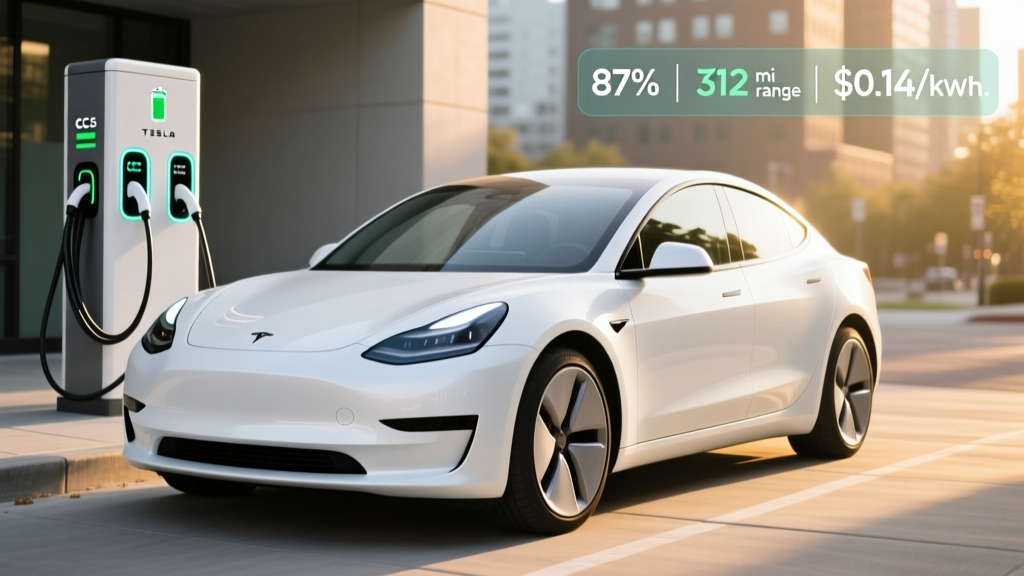
At a V3 or V4 Supercharger, the Model 3 peaks at 250 kW when the battery is preconditioned and at a low state of charge (around 5–10%). A 10–80% session takes approximately 25 minutes. However, the charge curve tapers significantly above 80% — charging from 80–100% can take nearly as long as 10–80%. For road trips, the practical strategy is to charge to 80% and move on; Tesla's navigation system automatically routes through Superchargers and preconditions the battery for optimal charge speed on arrival.
At home on a Level 2 Wall Connector (up to 48 amps on a 60-amp circuit), the Model 3 accepts 11.5 kW, adding roughly 44 miles of range per hour. An overnight charge from 20% to 80% takes about 4 hours — more than sufficient for daily driving. Installation of a Tesla Wall Connector typically costs $800–$2,000 depending on your electrical panel's proximity to the garage and whether a panel upgrade (from 100A to 200A service) is needed. Consult a licensed electrician for a site-specific quote.
Lease Pricing, Tax Credits, and Monthly Cost
Tesla offers leases directly through its website on the Model 3, typically structured as 36-month terms with 10,000 or 15,000 annual miles. Lease terms and money factors (the lease equivalent of an interest rate) update frequently, so check Tesla's configurator for current figures. As of early 2026, representative lease pricing for the Long Range AWD hovers around $499–$579/month with $4,500–$5,500 due at signing (including first month, acquisition fee, and down payment), depending on credit tier and mileage allowance.
Critical tax-credit note for leasing: Under IRS §30D rules, the $7,500 federal EV tax credit applies to purchases, not leases directly. However, there is a well-established "lease loophole" — when a vehicle is leased, the lessor (Tesla Finance) is technically the buyer and may claim the commercial clean vehicle credit under §45W. Many automakers, including Tesla, have historically passed this savings through as a capitalized-cost reduction (lowering your monthly payment). As of 2026, Tesla's lease listings on its configurator reflect whether this credit has been factored in. Verify with Tesla directly or your tax professional, as IRS guidance and Tesla's pass-through policy can change. Full §30D purchase eligibility requires meeting IRS income caps ($150K single / $300K joint), MSRP caps ($55K for sedans), and battery critical-minerals sourcing requirements.
| Trim | MSRP | Est. Lease (36 mo, 10K mi/yr) | §30D Credit Pass-Through | Effective Monthly |
|---|---|---|---|---|
| Long Range RWD | $44,130 | ~$449/mo | ~$7,500 cap reduction | ~$449/mo (credit included) |
| Long Range AWD | $49,130 | ~$539/mo | ~$7,500 cap reduction | ~$539/mo (credit included) |
| Performance | $56,130 | ~$639/mo | ~$7,500 cap reduction | ~$639/mo (credit included) |
Estimates based on publicly listed Tesla lease offers; actual terms vary by credit score, region, and current incentives. Performance trim exceeds the $55K MSRP cap for §30D purchase credit, but the §45W lease commercial credit has no MSRP cap — a key leasing advantage.
Interior, Cargo, and Daily Usability
The refreshed Model 3 (codenamed "Highland" and carried forward into 2026) features a noticeably quieter cabin, ventilated front seats, ambient lighting, and a rear touchscreen for passengers. The minimalist interior centers on a 15.4-inch front display handling all controls — there are no physical instrument clusters or stalks; turn signals are on the steering wheel, and gear selection is via the touchscreen (with a backup console button). This design polarizes: some owners adapt within a week, others find it distracting.
Cargo space totals 23 cubic feet combined (trunk plus front trunk/frunk), adequate for a week's groceries or two large suitcases but less than a crossover. Rear legroom measures 35.3 inches — sufficient for adults on shorter trips but tight for six-footers on long rides. The panoramic glass roof creates an airy feel but offers no shade; many owners apply aftermarket tint film to reduce solar heat gain in summer.
Driver-Assist Tech: Autopilot and FSD (Supervised)
Every Model 3 includes basic Autopilot (traffic-aware cruise control and lane centering) at no extra cost. The optional Full Self-Driving (Supervised) package — currently priced at $8,000 upfront or $99/month — adds automatic lane changes, navigate-on-autopilot for highway interchanges, traffic-light and stop-sign recognition, and autosteer on city streets. FSD has improved substantially but remains a driver-assist system that can make errors: missed turns, phantom braking, and inconsistent behavior in construction zones. It is not a substitute for an attentive driver.
For lessees: FSD's $99/month subscription is transferable to your Tesla account and does not need to be tied to the lease. However, if you pay $8,000 upfront for FSD on a leased vehicle, that investment stays with the car — you do not get it back at lease-end. The monthly subscription is the financially rational choice for most lessees.
Warranty and Battery Longevity
Tesla covers the Model 3 with a 4-year/50,000-mile basic vehicle warranty and an 8-year/120,000-mile battery and drive-unit warranty for Long Range and Performance trims (the base RWD battery warranty is 8 years/100,000 miles). The battery warranty guarantees at least 70% capacity retention over the coverage period. In practice, Tesla's NMC batteries in the Model 3 have shown approximately 8–12% degradation over 100,000 miles based on fleet data, meaning most owners will not approach the warranty threshold.
For a 36-month lease at 10,000–15,000 miles per year (36,000–54,000 total miles), battery degradation is a non-issue. You'll return the car well within the warranty period with minimal measurable capacity loss.
Model 3 vs. the Competition: Is It Worth Leasing?
Pros
- Best-in-class efficiency (25 kWh/100 mi) and real-world range
- Access to Tesla Supercharger network — most reliable DC fast-charging in the US
- Over-the-air updates continuously add features
- Strong resale/residual values benefit lease economics
- Heat pump standard — superior cold-weather efficiency
Cons
- No physical controls (turn signals on wheel, gear select on screen)
- Rear seat comfort and legroom trail rivals like Hyundai Ioniq 6
- FSD requires subscription discipline — don't buy outright on a lease
- Build quality has improved but panel gaps still occasionally draw complaints
- Insurance premiums run 15–30% higher than comparable gas sedans
Against the Hyundai Ioniq 6 (EPA 361 mi, starting ~$42,000), the Model 3 trades a small range edge for a significantly better charging network and stronger software. The Ioniq 6 charges faster in peak rate terms (up to 350 kW on 800V architecture, 10–80% in ~18 minutes) but relies on Electrify America and third-party networks, which have lower uptime than Superchargers. Against the BMW i4 eDrive40 (EPA 307 mi, ~$57,000), the Model 3 wins on price and efficiency but loses on interior material quality and traditional control layouts. For lessees prioritizing low monthly cost, range, and road-trip practicality, the Model 3 Long Range remains the segment benchmark.
Who Should Lease the Tesla Model 3?
- You commute 30–80 miles daily and have home Level 2 charging access
- You take 2–4 road trips per year and value reliable DC fast-charging infrastructure
- You want to test EV ownership for 3 years before committing to a purchase
- You qualify for the §45W lease credit pass-through, reducing effective monthly cost
- You need more than 23 cu ft of cargo space (consider Model Y or Ioniq 5)
- You prefer physical buttons, stalks, and a traditional instrument cluster
- You cannot install Level 2 charging at home and lack nearby public charging
- You drive more than 15,000 miles/year — lease overage penalties ($0.20–$0.25/mi) add up fast
Frequently Asked Questions
What is the real-world range of the 2026 Tesla Model 3?
The EPA rates the Long Range RWD at 363 miles. In real-world highway driving at 70 mph in moderate temperatures, expect 290–320 miles. In sub-freezing weather, plan for 220–260 miles due to battery and cabin-heating losses.
How fast does the Model 3 charge at home and on the road?
On a Level 2 home charger (11.5 kW), the Model 3 adds about 44 miles per hour, fully replenishing overnight. On a Tesla Supercharger (V3/V4), it peaks at 250 kW, charging from 10–80% in approximately 25 minutes when the battery is preconditioned.
How much does a Tesla Model 3 lease cost after tax credits?
As of 2026, a Model 3 Long Range AWD leases for approximately $539/month with $4,500–$5,500 due at signing on a 36-month term. Tesla has historically passed the $7,500 federal credit through as a capitalized-cost reduction on leases under §45W, which is reflected in the advertised monthly payment.
Does the Tesla Model 3 qualify for the federal EV tax credit?
For purchases, the Long Range RWD ($44,130) and Long Range AWD ($49,130) fall under the $55,000 MSRP sedan cap for §30D eligibility, subject to buyer income limits ($150K single / $300K joint) and battery-sourcing requirements. The Performance trim ($56,130) exceeds the sedan MSRP cap for purchase credit but can qualify under the §45W commercial credit when leased, as the lease credit has no MSRP cap. Always verify current rules at IRS.gov.
Is leasing a Tesla better than buying in 2026?
Leasing makes sense if you want lower monthly payments, access to the §45W credit pass-through on trims above the MSRP cap, and the flexibility to switch vehicles in 3 years as EV technology evolves. Buying is better if you drive more than 15,000 miles/year, want to build equity, or plan to keep the vehicle 5+ years. Depreciation risk is real but mitigated by Tesla's historically strong residuals.
What happens at the end of a Tesla Model 3 lease?
Tesla leases typically do not include a purchase option at lease-end (unlike many traditional automaker leases). You return the vehicle, pay any excess mileage or wear charges, and can lease or purchase a new Tesla. Confirm the purchase-option policy at signing, as Tesla has changed this term in prior years.