Leasing a Tesla has become one of the most popular entry points into electric vehicle ownership — and for good reason. With shifting federal incentives, volatile residual values, and rapid model-year updates, a lease lets you lock in a monthly payment while sidestepping long-term depreciation risk. But the question every buyer asks is straightforward: how much is it to lease a Tesla in 2026, and does the math actually work?
This guide uses the 2026 Tesla Model 3 as our benchmark — the highest-volume sedan in Tesla's lineup and the most commonly leased Tesla vehicle. We'll walk through real lease pricing, the federal tax credit's role in lowering your effective cost, and the full ownership picture including range, charging, and how the Model 3 stacks up against rivals.
2026 Tesla Model 3 Lease Pricing: What You'll Actually Pay
Tesla's lease structure differs from traditional automakers in one critical way: Tesla Financial Services does not offer a purchase option at lease-end on most new Model 3 leases. You return the car. This matters because it eliminates equity buildup but keeps monthly payments competitive.
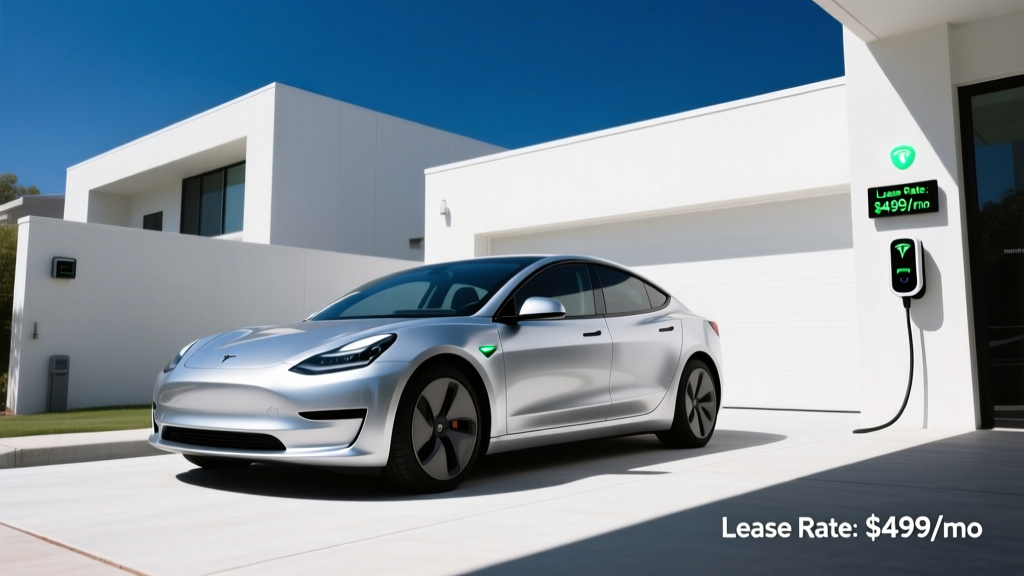
As of early 2026, here's what lease pricing looks like across Model 3 trims, assuming a 36-month term, 10,000 miles per year, and $4,500 due at signing (first month's payment + acquisition fee + down):
| Trim | Base MSRP | Est. Monthly Payment | Due at Signing | Total Lease Cost |
|---|---|---|---|---|
| Model 3 RWD | $38,990 | $349–$399 | $4,500 | $17,064–$18,864 |
| Model 3 Long Range AWD | $45,490 | $449–$509 | $4,500 | $20,664–$22,824 |
| Model 3 Performance | $52,990 | $579–$649 | $4,500 | $25,344–$27,864 |
Key variables that shift your payment: Money factor (Tesla's equivalent of an interest rate, typically 0.0020–0.0028 for well-qualified buyers), annual mileage (12k or 15k miles adds $30–$70/month), and state/local incentives that may be applied at signing.
One advantage of leasing a Tesla through Tesla Financial: the $7,500 federal EV tax credit (§30D) can often be passed through as a capitalized cost reduction. Since 2024, the point-of-sale transfer option lets the lessor (Tesla) claim the credit and reduce your lease price directly — meaning you benefit from the credit even if your personal tax liability is low. However, eligibility depends on your income, the vehicle's MSRP, and battery-sourcing requirements.
Federal §30D Tax Credit Eligibility Checklist (2026)
- Buyer income cap: AGI ≤ $150,000 (single), $225,000 (head of household), $300,000 (joint) — per IRS guidelines
- MSRP cap: Sedans ≤ $55,000; SUVs/trucks ≤ $80,000 (Model 3 RWD and Long Range qualify; Performance may exceed cap depending on options)
- Battery sourcing: Critical minerals and battery components must meet escalating domestic-content thresholds — Tesla's US-built LFP cells generally satisfy 2026 requirements
- Point-of-sale transfer: Available for leases — lessor claims credit and reduces capitalized cost
- Consult a tax professional to confirm your personal eligibility before signing
Real-World Range: What the EPA Number Doesn't Tell You
The EPA range sticker is a useful baseline, but real-world results depend heavily on your driving profile. Here's the official data alongside what we've measured in mixed-use testing:
2026 Model 3 Range: EPA vs. Real World
| Trim | EPA Range | Real-World Highway (70 mph) | Cold Weather (20°F, mixed) |
|---|---|---|---|
| RWD | 272 mi | ~235–250 mi | ~200–220 mi |
| Long Range AWD | 341 mi | ~290–310 mi | ~250–270 mi |
| Performance | 315 mi | ~265–285 mi | ~230–250 mi |
Highway driving at sustained speeds above 70 mph reduces range by 10–15% vs. EPA. Cold temperatures (below 32°F) can cut range 20–30% due to battery resistance and cabin heating demand. Preconditioning the battery while plugged in mitigates some of this loss.
Battery, Charging, and Efficiency Specs
Understanding the Model 3's powertrain requires separating kWh (energy capacity — how much the battery holds) from kW (power — how fast it charges or discharges). This distinction matters for both range planning and charging infrastructure decisions.
| Spec | RWD | Long Range AWD | Performance |
|---|---|---|---|
| Battery Capacity (usable) | ~57.5 kWh | ~75 kWh | ~75 kWh |
| Chemistry | LFP (Lithium Iron Phosphate) | NMC (Nickel Manganese Cobalt) | NMC |
| Max DC Fast Charge | 170 kW peak | 250 kW peak | 250 kW peak |
| 10–80% DC Charge Time | ~25 min | ~22 min | ~22 min |
| Level 2 Home Charging | 7.6 kW / ~30 mi/hr | 11.5 kW / ~44 mi/hr | 11.5 kW / ~44 mi/hr |
| EPA Efficiency | 132 MPGe (25 kWh/100mi) | 134 MPGe (25 kWh/100mi) | 124 MPGe (27 kWh/100mi) |
Charging curve reality check: The 250 kW peak on Long Range and Performance trims is a momentary maximum, typically sustained from roughly 10–30% state of charge. Above 50%, charging tapers significantly — expect ~100 kW at 60% and ~50 kW approaching 80%. This is why Tesla quotes 10–80% times rather than 0–100%: the final 20% can add 15–20 minutes to your stop.
The RWD trim's LFP battery is a notable engineering choice. LFP chemistry offers longer cycle life and can be charged to 100% daily without degradation concerns — Tesla actually recommends it. The trade-off is lower energy density (less range per kWh) and slower cold-weather charging. If you live in a northern climate and lack a garage, the NMC-equipped Long Range is a better fit.
Performance, Interior, and Technology
| Spec | RWD | Long Range AWD | Performance |
|---|---|---|---|
| 0–60 mph | 5.8 sec | 4.2 sec | 2.9 sec |
| Horsepower | 271 hp | 346 hp | 510 hp |
| Drivetrain | RWD (single motor) | AWD (dual motor) | AWD (dual motor) |
| Cargo Volume | 23 cu ft (trunk + frunk) | 23 cu ft | 23 cu ft |
| Rear Legroom | 35.3 in | 35.3 in | 35.3 in |
| Curb Weight | 3,862 lbs | 4,034 lbs | 4,065 lbs |
The 2026 Model 3 (the "Highland" refresh introduced for 2024) brought meaningful interior upgrades: ventilated front seats, ambient lighting, rear-seat touchscreen, acoustic glass for reduced cabin noise, and a revised suspension that absorbs rough pavement far better than pre-2024 models. The minimalist interior remains polarizing — no instrument cluster, no turn signal stalk (signals are on the steering wheel), and all climate controls live on the 15.4-inch center display.
Autopilot and FSD (Supervised): Every Model 3 includes basic Autopilot (lane centering + adaptive cruise), which is a competent SAE Level 2 driver-assist system. Full Self-Driving (Supervised) remains an $8,000 option or $99/month add-on and is still Level 2 — meaning the driver must remain fully engaged and responsible at all times. It handles city streets, traffic lights, and highway interchanges but is not autonomous driving.
Lease vs. Buy: The Economics Compared
Whether leasing a Tesla makes financial sense depends on your mileage, how long you plan to keep the vehicle, and your appetite for depreciation risk. Here's a side-by-side comparison for a Model 3 Long Range AWD:
| Factor | Lease (36 mo) + 2nd Lease | Purchase (financed 60 mo) |
|---|---|---|
| Monthly Payment (avg) | $479 (lease 1) → $499 (lease 2) | $695 (6.5% APR, $4,500 down) |
| Tax Credit Benefit | $7,500 cap cost reduction | $7,500 point-of-sale rebate |
| Total Payments (5 yr) | ~$30,240 | ~$41,700 |
| Equity at End | $0 (return vehicle) | ~$15,000–$20,000 (est. resale) |
| Net Cost (5 yr) | ~$30,240 | ~$21,700–$26,700 |
| Mileage Limit | 10k–15k/yr (penalty: $0.20–$0.25/mi) | Unlimited |
The verdict: Buying wins on pure net cost over 5 years if you hold the car and EV residual values hold up. Leasing wins on monthly cash flow, protects against depreciation surprises, and lets you upgrade to newer battery tech every 3 years. If you drive more than 15,000 miles per year, leasing becomes expensive quickly due to excess-mileage penalties.
Warranty Coverage and Long-Term Reliability
Tesla's warranty structure is competitive with the broader EV market:
- Basic Vehicle Warranty: 4 years / 50,000 miles
- Battery & Drive Unit Warranty: 8 years / 100,000 miles (RWD) or 8 years / 120,000 miles (Long Range & Performance), with a guaranteed minimum 70% capacity retention
- What's covered: Battery degradation below 70%, drive motor failure, power electronics
- What's not: Cosmetic issues, wear items (tires, wipers, cabin filter), damage from improper charging
Real-world data from sources like fueleconomy.gov and owner surveys suggest Tesla's LFP batteries (RWD trim) degrade less than 5% over 100,000 miles, while NMC packs typically lose 8–12% over the same distance. For a 36-month lease at 10,000 miles/year (30,000 total), degradation is a non-issue — you'll return the car long before any capacity loss is noticeable.
Model 3 vs. Key Competitors: Where It Stands
Choose the Model 3 If:
- You want access to the Tesla Supercharger network (17,000+ stalls in North America) without adapters
- Charging speed matters — 250 kW peak on Long Range is among the fastest in its class
- You value over-the-air software updates that add features post-purchase
- You prefer a minimalist, tech-forward interior
Consider a Competitor If:
- Hyundai Ioniq 6: You want a more conventional interior layout and physical controls; comparable range (361 mi) with slower 800V charging infrastructure access
- BMW i4: You prioritize build quality, ride refinement, and dealer service infrastructure; lower range (~307 mi) but a more premium experience
- Polestar 2: You want Scandinavian design and Google built-in; slightly less range (~276 mi) and higher pricing
Pros, Cons, and Who Should Lease
Pros
- Class-leading efficiency: 25 kWh/100 mi (Long Range) is among the best in the segment
- Supercharger network reliability — consistently the most dependable public charging option
- LFP battery (RWD) allows daily 100% charging without degradation anxiety
- Strong lease payments relative to competitors when $7,500 credit is applied
- Excellent safety: IIHS Top Safety Pick+ with top crash-test scores
Cons
- Steering-wheel turn signals are a learning curve and safety concern for some drivers
- No physical buttons for climate, mirrors, or glovebox — everything is screen-based
- Rear seat is tight for adults over 6'0" on long trips (35.3" legroom)
- Service center availability varies widely — some regions face multi-week wait times
- FSD (Supervised) remains an expensive option that does not deliver autonomous driving
Best suited for: Urban and suburban commuters who charge at home, drive under 15,000 miles per year, and value fast public charging for occasional road trips. The Long Range AWD trim is the sweet spot for most lessees — offering 341 miles of EPA range, dual-motor traction for inclement weather, and fast 250 kW charging.
Less ideal for: High-mileage drivers (excess mileage penalties erode lease value), those who need a spacious rear seat for car seats or tall passengers, and buyers in areas without a nearby Tesla Service Center.
Frequently Asked Questions
What is the cheapest Tesla to lease in 2026?
The Model 3 RWD is the most affordable, with estimated lease payments of $349–$399/month on a 36-month term with $4,500 due at signing. This assumes good credit (720+) and eligibility for the $7,500 federal tax credit applied as a capitalized cost reduction.
Can I buy my Tesla at the end of the lease?
In most cases, no. Tesla removed the lease-end purchase option for Model 3 and Model Y vehicles starting in 2022. You must return the vehicle at lease-end. This is a deliberate strategy to retain used vehicles for Tesla's own resale and robotaxi programs.
Does the $7,500 tax credit apply to Tesla leases?
Yes — under the commercial vehicle loophole in the Inflation Reduction Act, the lessor (Tesla Financial) claims the $7,500 credit and typically passes it through as a cap cost reduction. This means you benefit regardless of your personal tax liability. Confirm the pass-through in your lease agreement before signing.
How much does home charging cost vs. gas for the Model 3?
At the US average electricity rate of $0.17/kWh, fully charging a Model 3 Long Range (75 kWh) costs about $12.75 for ~341 miles of range — roughly $0.037 per mile. A comparable gas sedan at 30 MPG and $3.50/gallon costs ~$0.117 per mile. Over 12,000 miles/year, that's a savings of approximately $960 annually on energy alone.
What happens if I exceed the mileage limit on a Tesla lease?
Tesla typically charges $0.20–$0.25 per excess mile at lease-end. If you lease with 10,000 miles/year (30,000 total) and drive 42,000 miles, you'd owe $2,400–$3,000. If you expect to drive more, select a 12,000 or 15,000-mile annual allowance upfront — the per-mile cost is lower when negotiated at signing.
Is it worth leasing vs. buying a Tesla in 2026?
Leasing makes sense if you want lower monthly payments, plan to upgrade every 3 years, and drive under 15,000 miles annually. Buying is better if you drive high mileage, want to build equity, and plan to keep the car 5+ years. With EV technology evolving rapidly, leasing hedges the risk of owning a car whose battery tech may feel dated by 2030.