Quick Verdict: Still the Benchmark Compact EV
The Tesla Model 3 entered 2026 with a refreshed interior, slightly revised battery chemistry, and an unbeatable Supercharger network advantage. But for the growing number of EV buyers asking about the Tesla Las Vegas tunnel — the Boring Company's underground loop that ferries passengers between Las Vegas Convention Center stations in Tesla Model 3 and Model Y vehicles — the sedan has taken on a second identity: it's both a consumer purchase and a purpose-built urban transit pod.
For private buyers, the 2026 Model 3 Long Range AWD remains one of the most efficient, best-charging, and best-supported electric sedans on the market. It isn't the most comfortable in its class, and the minimalist cabin won't suit everyone, but on pure numbers — range, charge speed, software, and total cost of ownership — it's hard to beat.
| Attribute | Value |
|---|---|
| EPA Range | 341 miles |
| Battery (usable) | ~79 kWh, NMC (2170 cells) |
| Peak DC Fast Charge | 250 kW (Supercharger V3/V4) |
| 10–80% DC Time | ~27 minutes |
| Level 2 Home Charging | 11.5 kW / ~44 mi/hr |
| 0–60 mph | 4.2 seconds |
| Horsepower | 384 hp (dual motor) |
| Drivetrain | Dual-motor AWD |
| Efficiency | 132 MPGe combined / 25 kWh/100 mi |
| Cargo (trunk + frunk) | 23 cu ft trunk + 3.1 cu ft frunk |
| Rear Legroom | 35.2 inches |
| Battery Warranty | 8 years / 120,000 miles (70% retention) |
| Base MSRP (Long Range AWD) | $42,490 |
Range and Efficiency: EPA Meets Reality
The EPA rates the 2026 Model 3 Long Range AWD at 341 miles. The base Rear-Wheel-Drive trim (LFP battery, ~60 kWh usable) is EPA-rated at 272 miles. On paper, those are class-leading numbers for the segment.
EPA sticker: 341 mi (Long Range AWD). Expect ~285–305 mi at sustained 75 mph highway speeds in mild weather. In sub-30°F winter conditions without preconditioning, plan for ~240–260 mi of usable range. City/regenerative driving in temperate climates can push past 330 mi. The Model 3's heat pump helps limit cold-weather losses compared to older EVs without one, but physics still wins at highway speeds in deep cold.
Efficiency is where Tesla's engineering still shows its edge. At roughly 25 kWh per 100 miles (combined), the Model 3 sips electrons compared to the Hyundai Ioniq 6 (~27 kWh/100 mi) and the BMW i4 eDrive40 (~30 kWh/100 mi). Over 15,000 annual miles at a national average electricity rate of $0.17/kWh, that translates to roughly $638/year in home charging — versus $1,800+ for a comparable gas sedan at 30 MPG.
Charging: Supercharger Network Is the Real Feature
Charging is the Model 3's strongest practical advantage, and it's the main reason Tesla vehicles were selected for the Tesla Las Vegas tunnel (officially the Vegas Loop). The Boring Company's underground system relies on Tesla vehicles because the Supercharger ecosystem, combined with the Model 3's compact footprint, makes for predictable, quick turnarounds in tight urban loops.
| Level | Power | Miles Added per Hour | Notes |
|---|---|---|---|
| Level 1 (120V) | ~1.4 kW | ~5 mi/hr | Emergency/trickle only |
| Level 2 (240V, 48A) | 11.5 kW | ~44 mi/hr | Home Wall Connector; full charge in ~7.5 hrs |
| DC Fast (Supercharger V3) | Peak 250 kW | ~1,000 mi/hr (peak) | 10–80% in ~27 min; tapers sharply above 80% |
| DC Fast (CCS adapter, EA/others) | Peak ~150–200 kW | ~600–800 mi/hr (peak) | Non-Tesla networks via NACS-to-CCS adapter |
A note on the charging curve: the 250 kW peak is only sustained between roughly 10% and 35% state of charge. From 50% onward, expect rates closer to 100–120 kW, and above 80%, the car drops below 50 kW to protect the battery. Plan road-trip stops around 10–80% cycles rather than trying to fill to 100%.
Tesla's NACS connector is now the de facto North American standard, with Ford, GM, Rivian, Hyundai, and most others adopting it for 2025+ models. That means the Supercharger network — already the most reliable DC fast-charging network in the U.S., with over 6,500 V3/V4 stalls nationally — will get busier over time, but Tesla owners retain native plug-and-charge compatibility that CCS adapters still can't fully match.
Performance and Drivetrain
The dual-motor Long Range AWD puts down 384 horsepower and hits 60 mph in 4.2 seconds. The Performance trim (450 hp, adaptive dampers, track mode) drops that to 2.9 seconds. The base RWD model (283 hp, LFP battery) runs 0–60 in 5.8 seconds — still quick by any sedan standard.
Ride quality improved noticeably with the "Highland" refresh that began in late 2023 and carries into 2026. Acoustic glass, revised suspension bushings, and retuned dampers have moved the Model 3 from "firm and buzzy" to "composed and quiet" at highway speeds. It still isn't as plush as a BMW i4 or Mercedes EQB, but the gap has narrowed considerably.
The Vegas Loop: Why the Model 3 Is the Default Transit Pod
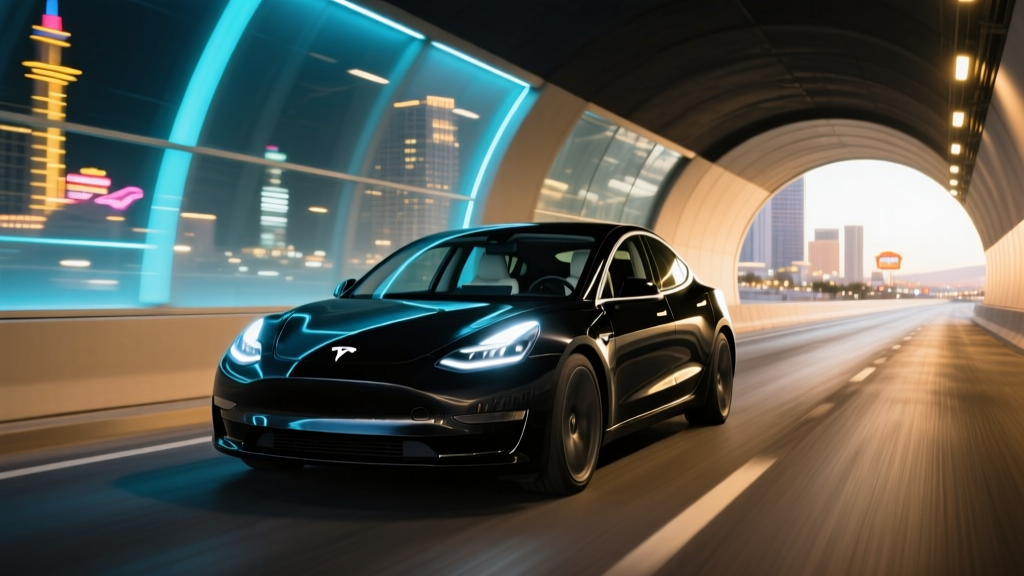
The Tesla Las Vegas tunnel system — branded the Vegas Loop — is operated by The Boring Company and uses Tesla Model 3 and Model Y vehicles driven by human drivers through a network of underground tunnels connecting the Las Vegas Convention Center, Resorts World, Wynn/Encore, Westgate, and the University of Nevada, Las Vegas (UNLV). The system has been expanding incrementally, with long-term plans to connect Harry Reid International Airport and the Strip's major resorts.
For the Vegas Loop, the Model 3 makes sense for several reasons:
- Compact footprint: Tunnel bore diameter limits vehicle width; the Model 3 fits with margin.
- Zero tailpipe emissions: Critical in an enclosed underground environment — ICE vehicles would require extensive ventilation.
- Low operating cost: Electricity cost per mile is roughly one-quarter of gasoline; for a high-cycle fleet vehicle running 12+ hours daily, this matters enormously.
- Native Supercharger integration: Fleet charging is streamlined with Tesla's proprietary ecosystem.
- Regenerative braking: One-pedal driving reduces brake wear in stop-start loop traffic.
For consumers, riding in a Vegas Loop Model 3 is also an extended test drive — many riders report considering a purchase after experiencing the quiet, responsive acceleration in the tunnel environment. It's arguably the most effective experiential marketing campaign Tesla never paid for.
Interior, Tech, and Drawbacks
The 2026 Model 3 interior is minimalist to a fault. A single 15.4-inch touchscreen handles infotainment, climate, navigation, and vehicle settings. There is no instrument cluster, no physical stalks (turn signals are steering-wheel buttons, gear selection is touchscreen or console), and no Apple CarPlay or Android Auto — Tesla's proprietary software is the only interface.
Standout tech features:
- Over-the-air updates that add features post-purchase
- Tesla app with remote climate, Sentry Mode cameras, and location tracking
- Sentry Mode (360° recording when parked)
- Dashcam and built-in navigation with real-time Supercharger routing
- HEPA-grade cabin air filtration
Notable drawbacks:
- No physical turn-signal stalk — the button-based system draws consistent criticism
- No CarPlay/Android Auto — a dealbreaker for some buyers
- Rear seat is snug for adults over 6' tall (35.2" legroom vs. 38"+ in the Hyundai Ioniq 6)
- Visibility rearward is compromised by the sloping roofline
- Panel-gap quality, while improved, still lags German and Korean competitors
Tesla's Autopilot (standard) and Full Self-Driving Supervised ($8,000 option or $99/mo subscription) are SAE Level 2 driver-assist systems. The driver must remain engaged, hands on the wheel (or torque-confirmed), and eyes on the road at all times. These are not autonomous systems. Only Level 4 services like Waymo operate without a driver in the loop.
Pricing, Tax Credits, and Ownership Cost
| Trim | Base MSRP | Est. After §30D Credit* |
|---|---|---|
| Rear-Wheel Drive | $38,990 | ~$31,490 |
| Long Range AWD | $42,490 | ~$34,990 |
| Performance | $47,490 | ~$39,990 |
*§30D federal tax credit up to $7,500 is available as a point-of-sale reduction at the dealer for eligible buyers. Eligibility requires: modified adjusted gross income below $150K single / $300K joint; vehicle MSRP under $55,000 (sedans); and battery critical-mineral + component sourcing thresholds that shift annually. Always verify current-year rules at IRS.gov and confirm with a tax professional before purchase.
The Model 3 Long Range AWD is the value sweet spot: 341 miles of range, dual-motor AWD, and eligibility for the full $7,500 credit (subject to income and sourcing rules) put the effective price in the low $30K range — territory that competes directly with well-equipped Camrys and Accords once fuel savings are factored in.
Insurance remains a real cost factor. The Model 3's average annual premium runs $2,200–$2,800 depending on state, age, and driving record — roughly 20–30% above comparable gas sedans. Tesla's own insurance product, available in most states, uses real-time driving data and can be cheaper for clean-record drivers.
Who Should Buy the 2026 Model 3?
- You want maximum range and charging infrastructure per dollar
- You can install a Level 2 home charger (the ownership experience is dramatically better with one)
- You value OTA software updates and a tech-forward interface
- You commute or road-trip frequently and want predictable DC fast-charging
- You live in or visit cities with Tesla-centric infrastructure (like the Las Vegas tunnel loop)
- You need CarPlay/Android Auto
- You regularly carry tall adults in the rear seat
- You prefer physical controls and a traditional instrument cluster
- You want a luxury-brand badge and dealership experience (consider BMW i4, Mercedes EQB)
Pros and Cons
- Class-leading efficiency (25 kWh/100 mi)
- 341-mile EPA range (Long Range AWD)
- 250 kW Supercharger access, best-in-class network reliability
- Strong 0–60 performance across all trims
- Over-the-air updates continuously improve the car
- Low operating cost vs. gas and most EV rivals
- 8-year/120,000-mile battery warranty
- No CarPlay/Android Auto
- Turn-signal buttons (no stalk) are divisive
- Rear seat legroom is tight for the segment
- Insurance premiums above average
- FSD is expensive and still Level 2
- Minimalist cabin not for everyone
Frequently Asked Questions
What is the real-world range of the 2026 Tesla Model 3?
The EPA rates the Long Range AWD at 341 miles. In real-world highway driving at 75 mph in mild weather, expect roughly 285–305 miles. In cold weather (below 30°F), plan for 240–260 miles without aggressive preconditioning. City driving with regenerative braking can approach or even slightly exceed the EPA figure.
How fast does the Model 3 charge at home and on the road?
On a Level 2 home charger (11.5 kW / 48A), the Model 3 adds about 44 miles of range per hour, reaching a full charge from empty in roughly 7.5 hours. On a Tesla V3 Supercharger, it peaks at 250 kW and charges from 10–80% in approximately 27 minutes. Non-Tesla DC chargers (via CCS adapter) typically deliver 150–200 kW peak.
How much does the Model 3 cost after tax credits?
The base RWD starts at $38,990 and can drop to approximately $31,490 after the $7,500 §30D federal tax credit — if you meet income caps ($150K single / $300K joint) and the vehicle meets current-year battery sourcing requirements. The Long Range AWD starts at $42,490, or roughly $34,990 after credit. Verify eligibility at IRS.gov before committing.
Is the Model 3 worth buying vs. the Hyundai Ioniq 6 or BMW i4?
On pure efficiency, charging speed, and Supercharger network access, the Model 3 wins. The Ioniq 6 offers more rear-seat room and CarPlay; the i4 offers a traditional luxury interior and dealer service network. If charging infrastructure and software are your priorities, Tesla. If cabin comfort and conventional controls matter more, test-drive the competitors.
What's the Tesla Las Vegas tunnel and can I ride it?
The Vegas Loop is a Boring Company-operated underground transit system connecting Las Vegas Convention Center campuses and nearby resorts using Tesla Model 3 and Model Y vehicles with human drivers. It's open to convention attendees and, at expanding stations, the general public. It's essentially a point-to-point rideshare through underground tunnels — and an extended, free test drive of the Model 3.
Does the Model 3 qualify for the federal EV tax credit?
Yes, the Model 3 qualifies for up to $7,500 under §30D, available as a point-of-sale reduction. However, eligibility depends on your modified adjusted gross income, the vehicle's MSRP (must be under $55,000 for sedans), and evolving battery critical-mineral and component sourcing rules. Check current-year requirements at IRS.gov and consult a tax professional.
How long will the Model 3 battery last?
Tesla warranties the Long Range battery for 8 years or 120,000 miles, whichever comes first, with a minimum 70% capacity retention. Real-world data from high-mileage Teslas suggests NMC batteries typically retain 85–90% capacity at 100,000 miles when charged primarily to 80% and DC fast-charged moderately. Full battery replacement out of warranty currently runs $12,000–$16,000 depending on pack and labor.