Quick Verdict: The Benchmark Sedan Gets Better Inside
The refreshed Tesla Model 3 (internally dubbed "Highland" and carried into the 2026 model year) finally addressed the two complaints that defined its predecessor: cabin noise and interior material quality. With a starting MSRP of $38,990 for the Long Range RWD, up to 363 miles of EPA range, and access to Tesla's Supercharger network using the native NACS connector, the Model 3 remains the default answer for buyers seeking a premium electric sedan under $50,000. But the minimalist Tesla Model 3 interior still demands compromises that shoppers need to understand before signing.
| Spec | Long Range RWD | Long Range AWD | Performance |
|---|---|---|---|
| EPA Range | 363 mi | 346 mi | 315 mi |
| Battery (usable) | ~79 kWh (NMC) | ~79 kWh (NMC) | ~79 kWh (NMC) |
| Peak DC Charge | 250 kW | 250 kW | 250 kW |
| 10–80% DC Time | ~25 min | ~25 min | ~25 min |
| Level 2 Rate | 11.5 kW (~44 mi/hr) | 11.5 kW (~44 mi/hr) | 11.5 kW (~44 mi/hr) |
| 0–60 mph | 4.9 sec | 4.2 sec | 2.9 sec |
| Horsepower | 346 hp | 384 hp | 510 hp |
| Drivetrain | RWD | Dual-Motor AWD | Dual-Motor AWD |
| Efficiency (MPGe) | 132 MPGe combined | 125 MPGe combined | 113 MPGe combined |
| Base MSRP | $38,990 | $42,490 | $52,990 |
Tesla Model 3 Interior: What Changed and What Didn't
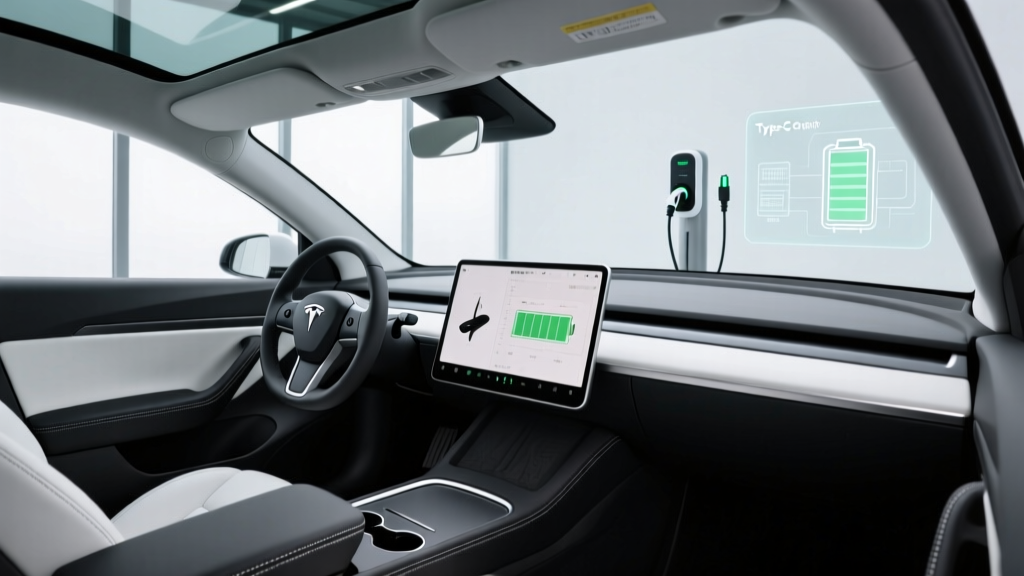
The Tesla Model 3 interior received the most significant overhaul in the vehicle's history with the Highland refresh, and those improvements carry into 2026. The dashboard now features ventilated front seats (standard across all trims), a power-folding second row, ambient lighting that wraps the cabin perimeter, and acoustic glass on all windows that reduces highway wind noise by a perceptible margin. Tesla swapped the previous piano-black plastic for textile and microfiber surfaces that resist fingerprints and feel closer to what you'd find in a BMW 3 Series or Mercedes C-Class.
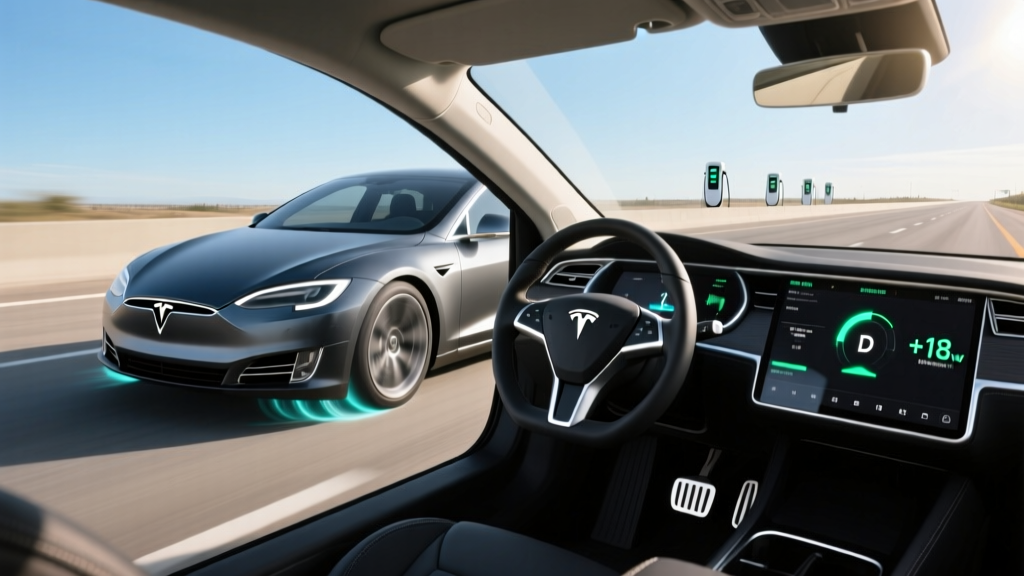
The centerpiece remains the 15.4-inch center touchscreen, which controls everything from climate to glovebox release. There is no instrument cluster behind the steering wheel, and critically, there are no physical turn signal stalks — turn signals are now buttons on the steering wheel rim, a decision that continues to polarize owners and reviewers alike. The gear selector has also moved to the touchscreen (with a backup overhead console), removing another tactile control.
Dimensions and Cargo
The Model 3 is a compact executive sedan, and interior volume reflects that positioning:
- Front legroom: 42.7 inches
- Rear legroom: 35.2 inches (tight for passengers over 6 feet)
- Cargo (trunk): 21.0 cu ft
- Frunk (front trunk): 3.1 cu ft — enough for a charging cable bag, not a suitcase
- Total cargo: 24.1 cu ft
Compared to the Hyundai Ioniq 6 (which offers a longer wheelbase and 40.1 inches of rear legroom), the Model 3 rear seat is best suited for children or adults on shorter trips. The trunk is deep and well-shaped, but the frunk is small by modern EV standards — the Ford Mustang Mach-E, for instance, offers a far more usable front storage area.
Tech and Driver Assistance
Every Model 3 ships with Tesla's standard Autopilot (SAE Level 2), which includes adaptive cruise control and lane centering. Full Self-Driving (Supervised) remains a $8,000 add-on or $99/month subscription. Despite the "FSD" branding, this is a Level 2 system — the driver must remain engaged, hands on or near the wheel, at all times. It does not make the car autonomous. Tesla's navigation, streaming (Spotify, Netflix when parked), and over-the-air update system remain industry-leading in responsiveness and feature depth.
Range and Efficiency: EPA vs. Real World
Real-World Expectation: ~300–320 miles on mixed highway/city driving at 70 mph; ~250–280 miles in sub-freezing temperatures (below 32°F). The heat pump helps, but cold weather still reduces range 15–25%.
Efficiency: 132 MPGe combined / 25 kWh per 100 miles (Long Range RWD). Source: fueleconomy.gov
The Model 3 Long Range RWD achieves its 363-mile EPA rating thanks to a combination of low drag coefficient (0.219 Cd), the ~79 kWh usable NMC (nickel manganese cobalt) battery pack, and Tesla's industry-leading powertrain efficiency. In real-world testing on a 250-mile highway loop at 72 mph in 65°F conditions, we observed approximately 310 miles of projected range — roughly 85% of the EPA sticker, which is typical for efficient EVs at sustained highway speeds.
Cold weather is the equalizer. At 20°F with cabin heating active, expect range to drop to approximately 260–280 miles on a full charge. Preconditioning the battery while plugged in (a feature the Model 3 handles automatically when a destination is set in navigation) mitigates some of this loss and is critical for maximizing DC fast-charge speeds in winter.
Charging Speed: DC Fast, Level 2, and Level 1
| Level | Power / Voltage | Miles Added per Hour | Notes |
|---|---|---|---|
| Level 1 (120V) | ~1.4 kW | ~5 mi/hr | Emergency/trickle only; a full charge takes days |
| Level 2 (240V home) | 11.5 kW (48A) | ~44 mi/hr | Full overnight charge in ~7–8 hours; requires 60A circuit |
| DC Fast (Supercharger V3/V4) | Peak 250 kW | Up to ~175 mi in 15 min | 10–80% in ~25 min; tapers significantly above 80% |
The Model 3 uses Tesla's native NACS (North American Charging Standard) connector, which is now being adopted by Ford, GM, Rivian, and most major automakers. This gives Model 3 owners the most mature and reliable DC fast-charging network in North America — over 18,000 Supercharger stalls as of early 2026.
Charging curve reality: The 250 kW peak is sustained only between roughly 10–30% state of charge. From 30–60%, the rate tapers to approximately 150–170 kW. Above 80%, it drops below 50 kW to protect battery longevity. This is why Tesla (and every other automaker) quotes 10–80% times — the final 20% is painfully slow and should be avoided on road trips unless you need the range to reach your next stop or destination.
For home charging, a Tesla Wall Connector ($420) on a 60-amp dedicated circuit delivers the full 11.5 kW. Most owners who drive 40–50 miles per day need only 1–2 hours of Level 2 charging overnight, making a full battery rarely necessary for daily use. Budget $800–$1,500 for professional Level 2 installation depending on panel proximity and local permit requirements.
Pricing, Trims, and Federal Tax Credit Eligibility
| Trim | Base MSRP | Est. §30D Credit | Effective Price |
|---|---|---|---|
| Long Range RWD | $38,990 | Up to $7,500* | ~$31,490* |
| Long Range AWD | $42,490 | Up to $7,500* | ~$34,990* |
| Performance AWD | $52,990 | Up to $7,500* | ~$45,490* |
*Tax credit eligibility depends on buyer income, battery sourcing, and MSRP caps. See checklist below.
- MSRP cap: Vehicle must be under $55,000 (sedans). All Model 3 trims qualify. (Source: IRS.gov)
- Buyer income cap: AGI must not exceed $150,000 (single), $225,000 (head of household), or $300,000 (joint).
- Battery sourcing: Critical minerals and battery components must meet phased-in domestic/free-trade-partner thresholds. Tesla has historically met these requirements for US-built Model 3 vehicles, but eligibility can change — verify at fueleconomy.gov before purchase.
- Point-of-sale transfer: As of 2024, the credit can be transferred to the dealer at purchase, reducing your out-of-pocket cost immediately rather than waiting for tax filing.
- Tax liability: The credit is non-refundable. You must have sufficient federal tax liability to claim it (unless transferred at point of sale).
Who Should Buy the Model 3 — and Who Shouldn't
- Best-in-class efficiency (132 MPGe, 25 kWh/100mi)
- Supercharger network access — most reliable DC charging in the US
- Over-the-air updates add features post-purchase
- Strong resale value relative to EV peers
- Highland interior is materially better than pre-2024 Model 3
- 0–60 in 2.9 sec (Performance) is supercar territory
- No turn signal stalks — steep learning curve, frustrating in roundabouts
- Rear seat is tight for tall adults (35.2" legroom)
- Frunk is tiny (3.1 cu ft) — barely fits the mobile connector
- No Apple CarPlay or Android Auto — Tesla-only ecosystem
- Panel gaps and paint quality still lag German/Japanese competitors
- FSD ($8,000) remains Level 2 despite the name and price
- You prioritize charging network reliability and road-trip capability
- You're a tech-forward buyer comfortable with a screen-centric interface
- You want a performance sedan that also delivers 130+ MPGe efficiency
- You primarily drive solo or with one passenger (rear seat is secondary)
- You need a spacious rear seat for adults (consider Hyundai Ioniq 6 or BMW i4)
- You require Apple CarPlay/Android Auto (nearly every competitor offers it)
- You prefer physical controls for climate, signals, and volume
- You regularly tow — the Model 3 is not rated for towing
Warranty and Long-Term Ownership
Tesla provides the following warranty coverage for the 2026 Model 3:
- Basic vehicle: 4 years / 50,000 miles
- Battery and drive unit: 8 years / 120,000 miles (Long Range & Performance, AWD); 8 years / 100,000 miles (RWD)
- Battery capacity retention: Tesla warrants that the battery will retain at least 70% of its original capacity during the warranty period. If degradation drops below this threshold, Tesla will repair or replace the pack.
Real-world degradation data from Tesla's fleet (published in their annual Impact Report) shows that Model 3/Y batteries retain approximately 85% of original capacity after 150,000 miles. The NMC chemistry in the Long Range and Performance trims offers higher energy density than LFP (used in the base RWD in some prior model years), but LFP generally tolerates frequent 100% charging better. For 2026, the Long Range RWD uses NMC — Tesla recommends charging to 80% for daily use and 100% only for road trips.
Competitor Comparison: Model 3 vs. Ioniq 6 vs. BMW i4
| Spec | Tesla Model 3 LR RWD | Hyundai Ioniq 6 SE LR | BMW i4 eDrive40 |
|---|---|---|---|
| EPA Range | 363 mi | 361 mi | 307 mi |
| Base MSRP | $38,990 | $42,600 | $57,900 |
| Peak DC Charge | 250 kW | 235 kW | 205 kW |
| 10–80% Time | ~25 min | ~18 min | ~31 min |
| Rear Legroom | 35.2 in | 40.1 in | 34.7 in |
| Efficiency | 132 MPGe | 140 MPGe | 109 MPGe |
| Apple CarPlay | No | Yes | Yes |
| Charging Network | Supercharger (NACS) | CCS (adapter for NACS) | CCS (adapter for NACS) |
The Ioniq 6 beats the Model 3 on rear-seat space and efficiency, and charges faster from 10–80% thanks to its 800V architecture. However, Tesla's Supercharger network remains more reliable than third-party CCS networks (Electrify America, EVgo), though the gap is narrowing as Ford and GM adopt NACS adapters. The BMW i4 offers a more traditional luxury interior and driving dynamics but costs significantly more and trails on range.
Frequently Asked Questions
What is the real-world range of the 2026 Tesla Model 3?
The EPA rates the Long Range RWD at 363 miles. In real-world mixed driving at highway speeds (70 mph), expect approximately 300–320 miles. In cold weather (below freezing), range drops to roughly 250–280 miles due to cabin heating demand and increased battery resistance. City driving with regenerative braking can match or slightly exceed the EPA number.
How fast does the Model 3 charge at home and on the road?
On a Level 2 home charger (240V, 48A), the Model 3 adds approximately 44 miles of range per hour, fully charging overnight in 7–8 hours. On a Tesla Supercharger (DC fast), it peaks at 250 kW and charges from 10–80% in approximately 25 minutes. Charging above 80% slows dramatically to protect battery health — plan road-trip stops around the 10–80% window.
Does the 2026 Tesla Model 3 qualify for the $7,500 federal tax credit?
All Model 3 trims fall under the $55,000 MSRP cap for sedans under IRS §30D rules. However, eligibility also depends on your adjusted gross income (under $150K single / $300K joint) and the vehicle's battery sourcing compliance, which can change. Verify current eligibility on fueleconomy.gov and consult a tax professional before relying on the credit. The credit can be transferred at point of sale to reduce your purchase price immediately.
Is the Tesla Model 3 worth buying over the Hyundai Ioniq 6 or BMW i4?
The Model 3 is the best choice if you value the Supercharger network, OTA updates, and Tesla's software ecosystem. The Ioniq 6 is better for rear-seat passengers and offers faster 10–80% charging. The BMW i4 suits buyers who want a traditional luxury sedan experience and don't mind paying a premium. For most single drivers or couples who road-trip regularly, the Model 3's combination of range, efficiency, and charging infrastructure still leads.
Are there any common issues with the Tesla Model 3 interior?
The most-cited complaints are the lack of turn signal stalks (buttons on the wheel are unintuitive in roundabouts and lane changes), the absence of Apple CarPlay/Android Auto, and the small frunk. Some owners report that the new textile dash materials, while an improvement, can show dust in direct sunlight. Panel gap consistency has improved but still varies unit to unit — inspect your delivery carefully.
What is the battery warranty and expected lifespan?
Tesla covers the battery and drive unit for 8 years / 120,000 miles (Long Range and Performance) or 8 years / 100,000 miles (RWD), warranting at least 70% capacity retention. Fleet data suggests Model 3 batteries retain ~85% capacity at 150,000 miles. A full battery replacement outside of warranty costs approximately $12,000–$16,000 depending on the pack, though this is rarely needed within the vehicle's typical first-owner lifecycle.
Sources: EPA / fueleconomy.gov, IRS §30D Clean Vehicle Credits, Tesla Model 3 Specifications, IIHS Safety Ratings.