Inside the Tesla Model 3: What the Cabin Really Looks Like
If you've been searching for interior pictures of the Tesla Model 3 to decide whether its minimalist cabin works for your daily life, this review covers every surface, screen, and storage cubby — paired with the hard numbers every EV buyer needs. The current-generation Model 3 (the "Highland" refresh that debuted for the 2024 model year and continues into 2026) reshaped nearly every interior panel, material, and sound-deadening layer. The result is a sedan that finally feels premium rather than spartan.
Before we walk through the cabin, here's the spec-sheet snapshot buyers cross-reference first:
| Attribute | RWD (Standard Range) | Long Range AWD | Performance AWD |
|---|---|---|---|
| EPA Range | 272 mi | 341 mi | 315 mi |
| Battery (usable) | ~57.5 kWh (LFP) | ~75 kWh (NMC) | ~75 kWh (NMC) |
| Drivetrain | Rear-Wheel Drive | Dual-Motor AWD | Dual-Motor AWD |
| Horsepower | 271 hp | 346 hp | 510 hp |
| 0–60 mph | 5.8 sec | 4.2 sec | 2.9 sec |
| Max DC Charge Rate | 170 kW | 250 kW | 250 kW |
| 10–80% DC Time | ~25 min | ~25 min | ~25 min |
| Level 2 (11.5 kW) | ~44 mi/hr | ~44 mi/hr | ~44 mi/hr |
| MPGe (combined) | 132 MPGe | 129 MPGe | 118 MPGe |
| Base MSRP | $38,990 | $45,990 | $52,990 |
Source: EPA fueleconomy.gov, Tesla specifications. Pricing reflects base MSRP before destination; final figures vary by model year and configuration.
A Visual Walkthrough: Interior Pictures of the Tesla Model 3 Explained
Opening the door on the current Model 3, the first thing you notice is how much quieter the cabin is. Tesla added acoustic glass at all four windows and layered additional sound-deadening into the doors and firewall — a direct response to years of criticism that the pre-refresh Model 3 felt loud at highway speed.
Dashboard and Center Screen
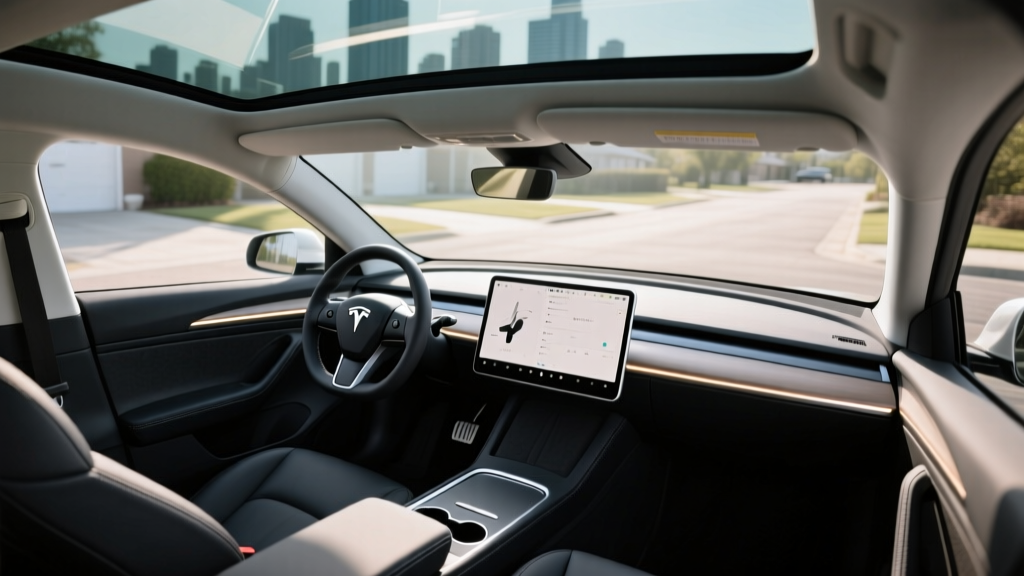
The dashboard is wrapped in a soft-touch textile or perforated faux-leather material (depending on trim), replacing the glossy piano-black plastic that showed fingerprints on older models. Ambient lighting now runs in a thin strip across the dash and into the doors, giving the interior a layered, modern feel in photos and in person. The centerpiece remains a 15.4-inch touchscreen, but it's slightly faster and more responsive than previous generations, running Tesla's latest infotainment stack with native streaming apps, navigation, and vehicle controls consolidated into one surface.
There is still no instrument cluster behind the steering wheel. Speed, range, and navigation cues live on the left third of the center display. This remains polarizing — some owners adapt within a week, others never feel comfortable without a head-up display or traditional gauge cluster.
Steering Wheel and Stalk Elimination
The refreshed Model 3 moved turn signals to buttons on the steering wheel rim and placed gear selection (Park, Reverse, Neutral, Drive) on the right side of the touchscreen. This is the single most debated interior change. In real-world driving, most owners report adapting to the touch-based shifter within a few days, but the steering-wheel turn-signal buttons are less intuitive in roundabouts or when making rapid lane changes.
Seats and Comfort
Front seats are ventilated on all trims — a welcome upgrade — and the cushion foam has been revised for longer-distance comfort. Rear seats gained a slight recline adjustment and improved cushioning over the pre-refresh car. Legroom measurements hold at approximately 42.7 inches front and 35.2 inches rear, which is competitive with the Hyundai Ioniq 6 but tighter than a BMW i4.
Rear Touchscreen
A small 8-inch rear touchscreen sits on the back of the center console, letting rear passengers control climate, seat heating, and media. It's a nice touch for families but feels like an afterthought in resolution compared to the main display.
Cargo Space
The trunk offers 23 cubic feet of cargo volume (including the rear frunk at approximately 3.1 cubic feet). The trunk opening is narrower than a hatchback like the Model Y or Ioniq 5, which limits what you can slide in, but the depth is generous for a sedan.
Real-World Range vs. EPA Estimates
- Mild-weather city/suburban: 320–350 mi (regen braking recovers energy in stop-and-go)
- Highway at 70–75 mph: ~260–290 mi (aerodynamic drag reduces efficiency by 15–20%)
- Cold weather (below 32°F), mixed driving: ~220–260 mi (battery chemistry slows, cabin heating draws power)
- Cold weather highway: ~190–230 mi (worst-case scenario)
The RWD model's LFP battery is more resistant to cold-weather degradation at low states of charge but still loses range in freezing temps. Tesla's heat pump — standard on all trims — significantly reduces the cabin-heating penalty compared to older resistive-heater EVs.
The Long Range AWD's 75 kWh NMC pack delivers the best blend of range and charging speed. The RWD's smaller LFP (lithium iron phosphate) battery trades range for longevity and a lower price — LFP chemistry tolerates regular 100% charging without the degradation concerns of NMC, making it ideal for daily commuters who charge at home every night.
Charging Speed: DC Fast Charging and Home Level 2
| Charging Level | Power / Rate | Miles Added per Hour | Notes |
|---|---|---|---|
| Level 1 (120V household) | ~1.4 kW | ~3–5 mi/hr | Emergency/trickle only |
| Level 2 (240V, 48A home charger) | 11.5 kW | ~44 mi/hr | Full charge overnight (~8–9 hrs) |
| DC Fast Charge (Supercharger V3/V4) | Up to 250 kW (LR/Perf) Up to 170 kW (RWD) | ~175 mi in 15 min (LR) | Peak rate; tapers above 50–60% SoC |
Tesla's Supercharger network remains the most reliable public charging infrastructure in the U.S., with over 25,000 connectors nationwide. The Long Range and Performance trims peak at 250 kW at a V3 or V4 Supercharger, holding that rate briefly before tapering. In practice, a 10–80% session takes roughly 25 minutes when the battery is preconditioned (the car warms the pack automatically when you navigate to a Supercharger).
The RWD model's LFP battery accepts a lower peak rate (~170 kW), but because the pack is smaller, the 10–80% time is similar at around 25 minutes. For home charging, a Tesla Wall Connector on a 60-amp circuit delivers 11.5 kW — enough to add roughly 44 miles of range per hour of charging, or a full overnight replenishment for nearly any daily commute.
Pricing, Trims, and Federal Tax Credit Eligibility
| Trim | Base MSRP | Est. After §30D Credit* | Destination |
|---|---|---|---|
| RWD (Standard Range) | $38,990 | ~$31,490 | $1,390 |
| Long Range AWD | $45,990 | ~$38,490 | $1,390 |
| Performance AWD | $52,990 | ~$45,490 | $1,390 |
*§30D credit assumes full $7,500 eligibility. Actual credit depends on buyer income, battery sourcing, and MSRP caps. Verify at IRS.gov before purchase.
The federal EV tax credit under IRS §30D offers up to $7,500, and Tesla's Model 3 has historically qualified for the full amount thanks to U.S. final assembly in Fremont, California. However, eligibility is not automatic for every buyer:
- MSRP cap: Sedans must be priced at or below $55,000. The RWD and Long Range qualify; the Performance trim may exceed the cap depending on options.
- Income cap: Modified adjusted gross income must not exceed $150,000 (single), $225,000 (head of household), or $300,000 (joint).
- Battery sourcing: Critical minerals and battery components must meet escalating domestic-content thresholds each year. Tesla's supply chain has largely met these requirements, but rules tighten annually.
- Point-of-sale transfer: As of 2024, buyers can transfer the credit to the dealer at purchase, reducing the upfront price rather than waiting for a tax refund.
Always confirm current-year eligibility with your tax professional and the IRS clean vehicle credit page before signing a purchase agreement.
Tech, Driver Assistance, and Safety
Every Model 3 ships with Tesla's basic Autopilot suite: adaptive cruise control, lane-centering, and automatic emergency braking. This is an SAE Level 2 driver-assistance system — meaning you must keep your hands on the wheel and eyes on the road at all times. It is not self-driving.
Tesla Autopilot and the optional FSD (Supervised) system require continuous driver supervision. The vehicle can steer, accelerate, and brake under certain conditions, but the driver is legally and operationally responsible. Full self-driving capability (Level 4/5) is not available on any consumer Tesla vehicle.
The optional Full Self-Driving (Supervised) package adds features like automatic lane changes, navigation-on-autopilot, and traffic-light recognition, but it remains a Level 2 system despite its name. Tesla's camera-only vision approach (no lidar or radar) continues to draw scrutiny from NHTSA regarding edge-case performance in construction zones and low-visibility conditions.
On safety, the Model 3 earns top marks: a 5-star overall rating from NHTSA and IIHS Top Safety Pick+ designation, with strong small-overlap crash-test results.
Who the Model 3 Suits — And Who Should Look Elsewhere
- You want the lowest-cost entry into a premium EV sedan with access to the Supercharger network
- Your commute is under 80 miles round-trip and you can charge at home
- You prefer a minimalist cabin with screen-centric controls
- Over-the-air updates and software-first feature improvements matter to you
- You need hatchback cargo flexibility (consider the Model Y or Hyundai Ioniq 5)
- You want a traditional instrument cluster or physical buttons for climate/audio
- You frequently tow — the Model 3 is not rated for towing
- You rely on Apple CarPlay or Android Auto (Tesla uses its own interface exclusively)
Pros and Cons at a Glance
- Best-in-class Supercharger network access
- Excellent efficiency (129–132 MPGe combined)
- Strong acceleration even on the base RWD trim
- Ventilated front seats and improved cabin quietness post-refresh
- LFP battery on RWD supports daily 100% charging with minimal degradation
- Over-the-air updates continuously add features
- Top safety ratings from NHTSA and IIHS
- No physical turn-signal stalk or gear selector — steep learning curve
- No Apple CarPlay or Android Auto
- Rear visibility is limited; relies heavily on cameras
- Sedan trunk opening restricts bulky cargo vs. hatchbacks
- FSD (Supervised) costs extra and remains Level 2 despite the name
- No HUD (head-up display) for speed/navigation
- Insurance premiums tend to run higher than comparable sedans
Warranty and Long-Term Ownership
Tesla covers the Model 3 with a 4-year/50,000-mile basic vehicle warranty and an 8-year battery and drive unit warranty. The battery warranty guarantees at least 70% capacity retention over 8 years or 100,000 miles (120,000 miles on the Long Range and Performance). Real-world data from high-mileage Tesla owners suggests NMC packs typically retain 85–90% capacity at 100,000 miles when charged primarily at home on Level 2 and kept between 20–80% SoC for daily use.
LFP packs (RWD trim) show even slower degradation curves, with many owners reporting 92–95% retention at 80,000+ miles. Tesla's mobile service and Supercharger network reduce ownership friction, but body repair costs after collisions remain above average for the segment due to aluminum-intensive construction and proprietary parts.
Frequently Asked Questions
What is the real-world range of the Tesla Model 3?
The Long Range AWD is EPA-rated at 341 miles, but expect 260–290 miles on highway road trips at 70+ mph, and roughly 220–260 miles in freezing winter conditions. The RWD's 272-mile EPA rating translates to around 210–240 miles in real-world highway driving.
How fast does the Model 3 charge?
On a 250 kW Tesla Supercharger, the Long Range and Performance add up to 175 miles in 15 minutes, with a 10–80% session taking about 25 minutes when preconditioned. At home on an 11.5 kW Level 2 Wall Connector, expect roughly 44 miles of range per hour — a full charge takes 8–9 hours.
How much does the Model 3 cost after federal tax credits?
The RWD starts at $38,990 and could drop to roughly $31,490 after a $7,500 §30D credit, assuming you meet income, MSRP, and battery-sourcing requirements. The Long Range falls to approximately $38,490 with the credit. Always verify current-year eligibility at IRS.gov.
Does the Tesla Model 3 qualify for the federal EV tax credit?
The Model 3 has qualified for up to $7,500 under §30D due to U.S. assembly and battery sourcing compliance. However, buyer income caps ($150K single / $300K joint), the $55,000 sedan MSRP cap, and annual sourcing-rule changes affect eligibility. Confirm with your tax advisor before purchasing.
Is the Model 3 worth buying vs. competitors like the Ioniq 6 or BMW i4?
The Model 3 wins on charging-network access, efficiency, and software integration. The Hyundai Ioniq 6 offers a more traditional interior with physical buttons and CarPlay, plus comparable range. The BMW i4 feels more premium and drives better, but costs significantly more and relies on third-party DC charging networks. For most buyers prioritizing value and road-trip convenience, the Model 3 remains the default recommendation.
What are the biggest drawbacks of the Model 3 interior?
The elimination of turn-signal and gear-selector stalks, the absence of a head-up display, no Apple CarPlay/Android Auto, and limited rear visibility are the most common complaints. The minimalist approach works for some but frustrates others who prefer tactile controls.
How long will the Model 3 battery last?
Tesla warranties the battery for 8 years / 100,000–120,000 miles (depending on trim) with at least 70% capacity retention. Real-world data shows most NMC packs retain 85–90% at 100K miles; LFP packs often retain 92–95%. Full battery replacement outside warranty currently costs between $12,000 and $16,000 depending on pack size.