If you've searched "Tesla smells bad" and landed here, you're not alone. A recurring thread across Tesla owner forums, Reddit communities, and service center complaint logs centers on mysterious interior odors in the Model 3 — ranging from a sweet, chemical scent to a musty, damp smell that seems to emanate from the HVAC system. Before we tear into what causes these odors and how to fix them, this is also a complete 2026 Tesla Model 3 review: range, charging, pricing, tax credits, and whether it still earns its spot as the default EV sedan benchmark.
Why Does My Tesla Smell Bad? The Odor Explained
The "Tesla smell" phenomenon typically falls into two categories, and understanding which one you're dealing with is half the battle:
1. New-Vehicle Off-Gassing (Chemical/Sweet Smell)
Like many modern vehicles, the Model 3 uses adhesives, sound-deadening materials, synthetic leather (Tesla's "vegan leather"), and plastic trim components that release volatile organic compounds (VOCs) when new. This off-gassing is most pronounced in the first 2-4 months of ownership, especially in hot weather when cabin temperatures bake these materials. Tesla's minimalist interior actually uses fewer materials than legacy luxury sedans, but the specific adhesive compounds used in the headliner and door panel assembly have drawn disproportionate complaints. The smell is generally harmless but unpleasant — think "new shoe store" mixed with "nail polish remover."
2. HVAC-Related Musty/Mildew Odor
This is the more persistent and concerning issue. The Model 3's heat pump HVAC system (standard since the 2021 refresh) uses a cabin air filter and evaporator coil that can trap moisture, particularly in humid climates or when the AC runs frequently. If the cabin filter isn't replaced on schedule — Tesla recommends every 2 years, but many owners in humid or high-pollen areas need annual swaps — mold and mildew can develop on the evaporator. This produces a damp, dirty-sock smell, especially when you first turn on the climate system. The Model 3's HEPA-filter option (available on higher trims) is more resistant to this but not immune.
- Replace the cabin air filter (Tesla part #15148-00-B or aftermarket equivalent; ~$25-40 DIY, ~$80-120 at a service center)
- Run the HVAC fan on high with fresh air (not recirculate) for 10-15 minutes with windows cracked to dry the evaporator
- Use a food-grade activated charcoal bag under the seat to absorb VOCs — avoid chemical air fresheners that mask rather than eliminate
- For off-gassing: park in shade or use a sunshade; precondition the cabin with windows cracked via the Tesla app before entering
- For persistent mildew: an HVAC evaporator foaming treatment (available at auto parts stores) applied through the intake can resolve stubborn cases
Now that we've addressed the smell, let's evaluate the car itself — because odor complaints aside, the 2026 Model 3 remains one of the most capable electric sedans on the market.
2026 Tesla Model 3: Range, Battery, and Real-World Efficiency
| Spec | RWD (Base) | Long Range AWD | Performance |
|---|---|---|---|
| EPA Range | 272 mi | 341 mi | 315 mi |
| Battery (usable) | ~57.5 kWh (LFP) | ~75 kWh (NMC) | ~75 kWh (NMC) |
| EPA Efficiency | 132 MPGe / 25 kWh/100mi | 132 MPGe / 25 kWh/100mi | 121 MPGe / 28 kWh/100mi |
| 0-60 mph | 5.8 sec | 4.2 sec | 2.9 sec |
| Horsepower | 283 hp | 366 hp | 510 hp |
| Drivetrain | RWD (single motor) | AWD (dual motor) | AWD (dual motor) |
| Max DC Fast Charge | 170 kW | 250 kW | 250 kW |
| 10-80% DC Time | ~25 min | ~22 min | ~22 min |
| Level 2 Rate | 11.5 kW (~44 mi/hr) | 11.5 kW (~44 mi/hr) | 11.5 kW (~44 mi/hr) |
| Base MSRP | $38,990 | $44,990 | $52,990 |
The EPA posts 341 miles for the Long Range AWD, but expect roughly 280-300 miles on sustained highway driving at 70-75 mph (high speeds are the enemy of EV range). In cold weather (below 32°F), plan for a 20-30% reduction, bringing real-world winter range to approximately 230-260 miles. City driving with frequent regenerative braking gets you closer to — or occasionally above — the EPA figure. The LFP-equipped RWD model is more resilient to cold-weather degradation over the battery's lifetime but offers less total range to begin with. Source: fueleconomy.gov.
The base RWD Model 3 uses a lithium iron phosphate (LFP) battery. LFP chemistry trades energy density for longevity — Tesla recommends charging LFP batteries to 100% regularly (unlike NMC batteries, which benefit from staying between 20-80% for daily use). This means the 272-mile EPA range is fully usable on a daily basis, which narrows the practical gap with the Long Range more than the spec sheet suggests. The NMC batteries in the Long Range and Performance trims offer higher energy density and faster charging but prefer partial state-of-charge for maximum cycle life.
Charging Speed: DC Fast Charge and Home Level 2
| Level | Power | Miles Added per Hour | Typical Use Case |
|---|---|---|---|
| Level 1 (120V) | ~1.4 kW | ~4-5 mi/hr | Emergency/overnight trickle |
| Level 2 (240V, 48A) | 11.5 kW | ~44 mi/hr | Home daily charging (~7 hrs empty-to-full) |
| DC Fast (NACS) | Up to 250 kW (LR/Perf) Up to 170 kW (RWD) | Up to ~1,000+ mi/hr peak | Road trips; 10-80% in ~22 min (LR) |
The Model 3 uses the NACS (North American Charging Standard) connector natively — the same connector Tesla has used for over a decade, now adopted by nearly every major automaker. At a Tesla Supercharger V3 or V4 station, the Long Range and Performance models peak at 250 kW, though this peak rate is sustained for only roughly 5-8 minutes before the charge curve tapers. Real-world average charging power from 10-80% is closer to 130-150 kW, which is why the 22-minute figure is the honest number to plan around, not the peak.
The RWD model's 170 kW peak is a meaningful step down. On a long road trip, that translates to roughly 3-5 extra minutes per charging stop versus the Long Range. For daily driving and home charging, it's irrelevant — both models charge identically on Level 2.
Preconditioning matters: If you navigate to a Supercharger using the car's built-in navigation, the Model 3 automatically preconditions (warms or cools) the battery to the optimal temperature for fast charging. Skipping this step — for instance, by driving to a charger without using nav — can add 5-10 minutes to your session in cold weather.
Pricing, Trims, and Federal Tax Credit Eligibility
| Trim | MSRP | Est. §30D Credit | Effective Price* |
|---|---|---|---|
| RWD | $38,990 | $3,750 - $7,500 | $31,490 - $35,240 |
| Long Range AWD | $44,990 | $3,750 - $7,500 | $37,490 - $41,240 |
| Performance | $52,990 | $3,750 - $7,500 | $45,490 - $49,240 |
*Effective price assumes full credit eligibility. Actual credit depends on battery sourcing, buyer income, and MSRP caps. Point-of-sale transfer available per IRS §30D rules.
The federal EV tax credit under IRS §30D is not a guaranteed $7,500 for every buyer. Here's what determines your actual credit:
- MSRP cap: Sedans must be priced at or below $55,000. The RWD and Long Range qualify; the Performance at $52,990 also qualifies but leaves little room for options.
- Income cap: Modified adjusted gross income must not exceed $150,000 (single), $225,000 (head of household), or $300,000 (joint).
- Battery sourcing: The credit is split into two $3,750 halves — one for critical minerals sourcing and one for battery component manufacturing. As of 2026, vehicles with any battery components from a "foreign entity of concern" (FEOC, primarily Chinese manufacturers) are disqualified from that half. Tesla's shifting supply chain means the exact credit amount can change quarterly. Always verify on the IRS qualified vehicles list before purchasing.
- Point-of-sale transfer: You can transfer the credit to the dealer (Tesla) at purchase, reducing your out-of-pocket cost immediately rather than waiting for a tax refund.
Interior Space, Cargo, and Daily Practicality
The Model 3 is a compact executive sedan, and its dimensions reflect that positioning:
- Cargo volume: 23 cu ft total (15.6 cu ft trunk + 7.4 cu ft front trunk/frunk)
- Front legroom: 42.7 inches
- Rear legroom: 35.2 inches — adequate for average-height adults but tight for anyone over 6'2" on longer trips
- Rear headroom: 37.8 inches — the sloping roofline cuts into space for taller passengers
Compared to the Hyundai Ioniq 6 (which offers 36.1 inches of rear legroom and 11.4 cu ft of trunk space but no frunk), the Model 3 is competitive on paper but feels tighter in the rear seat due to its lower roof and floor-mounted battery raising the floor height. The frunk is a genuine advantage for storing charging cables, groceries, or a small carry-on.
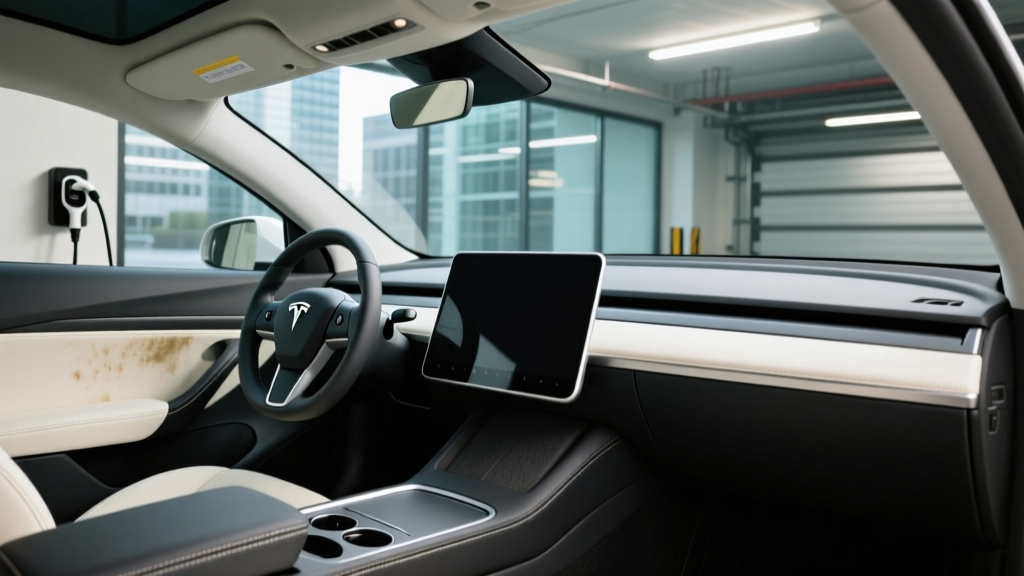
The cabin materials are where the odor complaints intersect with build quality. Tesla's vegan leather (a polyurethane-based synthetic) and recycled-material trim are durable and easy to clean, but the adhesives used in the headliner and door card assembly are the primary source of the new-car chemical smell. Owners in hot climates (Arizona, Texas, Florida) report the off-gassing is more intense and longer-lasting due to higher sustained cabin temperatures.
Tech, Driver Assistance, and Standout Features
The 2026 Model 3 Highland refresh (introduced late 2023, continuing through 2026 with minor updates) brought meaningful improvements to ride quality, cabin noise, and the infotainment system. Key features include:
- 15.4-inch central touchscreen handling all vehicle controls (no instrument cluster; a 8-inch rear screen was added for rear passengers)
- Ambient lighting and ventilated front seats (new with Highland)
- Tesla Autopilot (standard): adaptive cruise control, lane centering, automatic emergency braking — this is an SAE Level 2 driver-assistance system, not self-driving
- Full Self-Driving (Supervised) ($8,000 option or $99/month): adds automatic lane changes, traffic light/stop sign recognition, and city street navigation — still SAE Level 2, requiring constant driver supervision
- Over-the-air updates continuously adding features and refinements
- Sentry Mode and Dashcam using the vehicle's camera array
Tesla Autopilot and FSD (Supervised) are SAE Level 2 systems. The driver must remain fully attentive, with hands on or near the wheel, at all times. These systems do NOT make the vehicle self-driving. They are convenience features that assist with steering, acceleration, and braking under driver supervision. Misuse or inattention can result in serious accidents. Only Level 4 systems (e.g., Waymo's driverless service in designated areas) operate without a human driver.
Notable drawbacks: The lack of physical controls (turn signal stalks were removed in the Highland refresh, replaced by steering-wheel buttons — a polarizing change), no Apple CarPlay or Android Auto integration, and Tesla's service center network, while growing, still has longer wait times in some regions compared to legacy dealers.
Warranty Coverage
- Basic vehicle: 4 years / 50,000 miles
- Battery & drive unit (RWD, LFP): 8 years / 100,000 miles (70% minimum capacity retention)
- Battery & drive unit (Long Range/Performance, NMC): 8 years / 120,000 miles (70% minimum capacity retention)
Tesla's battery warranty guarantees that the pack will retain at least 70% of its original capacity during the warranty period. If degradation exceeds 30%, Tesla will repair or replace the battery. In practice, Tesla's NMC and LFP packs have demonstrated strong longevity — most high-mileage Model 3s show 8-12% degradation at 100,000 miles based on owner-reported data, well within the warranty threshold.
Pros and Cons: The Honest Scorecard
- Class-leading efficiency (25 kWh/100mi)
- Supercharger network access — the most reliable DC fast-charging network in North America
- LFP battery option allows daily 100% charging without degradation concern
- Strong resale value relative to most EVs
- Continuous OTA improvements
- Low running costs (~$0.04-0.06/mile on home charging)
- Interior odor complaints (VOC off-gassing, HVAC mildew)
- Rear seat is tight for tall passengers
- No physical controls — all functions through the touchscreen
- Turn signal buttons on steering wheel (no stalks) are divisive
- No Apple CarPlay / Android Auto
- FSD at $8,000 is expensive for a Level 2 system
- Service wait times in some metro areas
Who Should Buy the 2026 Tesla Model 3?
- You want the lowest cost-per-mile EV sedan with access to the best fast-charging network
- You commute 30-80 miles daily and can charge at home
- You value over-the-air updates and a tech-forward interface
- You take road trips and want reliable DC fast-charging infrastructure
- You regularly carry tall adults in the rear seat (consider the Hyundai Ioniq 5 or BMW i4)
- You want physical buttons and Apple CarPlay (consider the BMW i4 or Polestar 2)
- You need more than 23 cu ft of cargo space (consider the Model Y or Ioniq 5)
- You're sensitive to new-car chemical odors and live in a hot climate (test-drive in summer heat before committing)
Frequently Asked Questions
What is the real-world range of the 2026 Tesla Model 3?
The EPA rates the Long Range AWD at 341 miles, but sustained highway driving at 70-75 mph yields approximately 280-300 miles. In cold weather (below freezing), expect 230-260 miles. The RWD model's 272-mile EPA rating translates to roughly 220-240 highway miles in moderate weather and 180-200 in cold conditions.
How fast does the Model 3 charge at home and on the road?
On a home Level 2 charger (240V, 48A), the Model 3 charges at 11.5 kW, adding about 44 miles of range per hour — a full overnight session easily replenishes a day's driving. On DC fast charging, the Long Range and Performance peak at 250 kW (10-80% in ~22 minutes), while the RWD peaks at 170 kW (10-80% in ~25 minutes).
How much does the 2026 Model 3 cost after tax credits?
The RWD starts at $38,990 and could drop to as low as $31,490 with the full $7,500 federal credit. However, the actual credit depends on battery sourcing compliance, your income, and MSRP caps. Check the current IRS qualified vehicle list before purchasing, as eligibility shifts with supply chain changes.
Is the Tesla Model 3 worth buying versus competitors?
The Model 3's combination of efficiency, Supercharger access, and pricing is difficult to beat. The Hyundai Ioniq 6 offers similar range and a more conventional interior with physical controls. The BMW i4 provides a premium cabin and CarPlay but costs significantly more. The Polestar 2 is stylish but less efficient. If charging network reliability and cost-per-mile are your priorities, the Model 3 remains the benchmark.
Does the Tesla Model 3 qualify for the federal EV tax credit?
Yes, but with caveats. All Model 3 trims fall under the $55,000 sedan MSRP cap. Your eligibility depends on income limits ($150K single / $300K joint), and the credit amount ($3,750 or $7,500) depends on battery component and critical mineral sourcing compliance. The point-of-sale transfer option lets you apply the credit at purchase. Always verify current eligibility on IRS.gov before finalizing your order.
How do I get rid of the bad smell in my Tesla?
For chemical off-gassing: ventilate aggressively in the first few months, use activated charcoal absorbers, park in shade, and precondition with windows cracked. For musty HVAC smells: replace the cabin air filter (every 12-24 months), run the fan on high with fresh-air mode to dry the evaporator, and consider an evaporator foam treatment if the smell persists. Most odor issues resolve within 3-6 months of ownership with these steps.