The Real Cost of Insuring a Tesla Model 3 in 2026
If you're researching the Tesla Model 3, you've likely seen the sticker price and the EPA range — but one line item catches many buyers off guard: insurance. Tesla Model 3 insurance premiums consistently rank among the highest in the EV segment, and understanding why requires looking at the full ownership picture. This review covers the 2026 Tesla Model 3 lineup — its range, charging performance, tech, pricing after federal tax credits, and the insurance costs that significantly affect your five-year total cost of ownership.
Tesla vehicles carry higher premiums for documented reasons: aluminum-intensive unibody construction raises repair costs, proprietary parts limit aftermarket options, and Tesla's direct repair network has limited capacity in some regions. According to IIHS loss data, Tesla collision claim severity remains above segment average. But the Model 3's safety ratings — a 5-star NHTSA overall score and IIHS Top Safety Pick+ designation — help offset some of that premium through lower injury-liability payouts.
National average: $2,400–$3,200/year for full coverage (varies by state, age, driving record). By comparison, a Toyota Camry averages ~$1,600/year and a Hyundai Ioniq 6 averages ~$1,900/year. Tesla's own insurance product, available in select states, uses real-time driving data and can reduce premiums by 10–20% for low-risk drivers.
2026 Tesla Model 3 Specs at a Glance
| Spec | RWD (Base) | Long Range AWD | Performance |
|---|---|---|---|
| EPA Range | 363 mi | 363 mi | 315 mi |
| Battery (usable) | ~60 kWh (LFP) | ~79 kWh (NMC) | ~79 kWh (NMC) |
| 0–60 mph | 5.8 sec | 4.2 sec | 2.9 sec |
| Horsepower | ~271 hp | ~346 hp | ~510 hp |
| Drivetrain | RWD | Dual-Motor AWD | Dual-Motor AWD |
| Max DC Fast Charge | 170 kW | 250 kW | 250 kW |
| 10–80% DCFC Time | ~28 min | ~25 min | ~25 min |
| Level 2 Rate | 11.5 kW (~44 mi/hr) | 11.5 kW (~44 mi/hr) | 11.5 kW (~44 mi/hr) |
| MPGe (combined) | 132 MPGe | 130 MPGe | 113 MPGe |
| Base MSRP | $38,990 | $45,740 | $52,990 |
Source: fueleconomy.gov and Tesla.com. Specs reflect 2025/2026 model year data.
Range and Efficiency: EPA vs. Reality
EPA (Long Range AWD): 363 miles
Real-world highway (70 mph, mild weather): ~300–320 miles
Real-world winter (30°F, highway): ~250–280 miles
City/mixed with regen: ~330–350 miles
The Model 3's heat pump (standard on all trims) reduces cold-weather losses compared to older EVs using resistive heating, but expect a 20–30% range reduction in sub-freezing temperatures, especially at sustained highway speeds. LFP-equipped RWD models tolerate 100% daily charging better than NMC variants, which is useful for recovering range on cold mornings.
Efficiency remains a Model 3 strong suit. At 26 kWh/100 mi (combined) for the Long Range trim, it is one of the most efficient sedans in its class. The Hyundai Ioniq 6 achieves a similar 25–27 kWh/100 mi, while the BMW i4 eDrive40 runs closer to 30 kWh/100 mi. That efficiency translates directly to lower charging costs and more miles per charging stop on road trips.
Charging Speed: DC Fast and Home Level 2
Tesla's Supercharger network — now exceeding 6,000 stations and 60,000 stalls in North America — remains the most reliable public charging infrastructure available. The Model 3 Long Range and Performance trims peak at 250 kW on V3 Superchargers, adding roughly 175 miles in 15 minutes under ideal conditions.
However, peak kW is not sustained kW. The Model 3's charge curve tapers noticeably above 60% state of charge (SoC). Here's what a typical session looks like:
| SoC Window | Avg. Power (LR/Perf) | Time | Miles Added |
|---|---|---|---|
| 10–50% | ~210 kW | ~10 min | ~145 mi |
| 50–80% | ~100 kW | ~15 min | ~85 mi |
| 10–80% total | — | ~25 min | ~230 mi |
Preconditioning matters. The Model 3 automatically warms the battery when a Supercharger is set as your navigation destination. Skipping this step — for example, pulling into a charger without routing through the nav — can slow your initial charge rate by 30–50% in cold weather.
Home Level 2 charging at 11.5 kW (48A on a 60A circuit) delivers approximately 44 miles of range per hour, fully replenishing a Long Range battery in about 7–8 hours. A NACS (Tesla) connector is native; adapters are available for J1772 Level 2 public stations.
Pricing, Tax Credits, and Total Cost
The 2026 Tesla Model 3 starts at $38,990 for the RWD base model, placing it under the IRS §30D MSRP cap of $55,000 for sedans. The Long Range AWD at $45,740 and Performance at $52,990 also fall within the cap.
| Trim | MSRP | Est. Fed Credit | Effective Price |
|---|---|---|---|
| RWD | $38,990 | Up to $7,500* | ~$31,490 |
| Long Range AWD | $45,740 | Up to $7,500* | ~$38,240 |
| Performance | $52,990 | Up to $7,500* | ~$45,490 |
*Federal tax credit eligibility under IRS §30D depends on: (1) buyer AGI limits — $150K single / $300K joint, (2) MSRP caps — $55K for sedans, (3) battery critical-mineral and component sourcing requirements, which shift annually. The credit can be transferred to the dealer as a point-of-sale discount. Verify eligibility at purchase; rules tighten each model year.
Five-Year Ownership Snapshot (Long Range AWD)
| Cost Category | 5-Year Total |
|---|---|
| Purchase (after $7,500 credit) | ~$38,240 |
| Insurance (avg $2,800/yr) | $14,000 |
| Electricity (home, 15¢/kWh, 60K mi) | ~$2,400 |
| Maintenance (tires, cabin filter, fluid) | ~$2,200 |
| Total (before depreciation) | ~$56,840 |
Insurance is the single largest variable cost after the purchase itself. Over five years, Model 3 insurance can exceed your total electricity spend by a factor of five. This is the most important data point for budgeting buyers.
Interior, Tech, and Daily Usability
The refreshed Model 3 (introduced for 2024, carried into 2026) features a quieter cabin with acoustic glass, ventilated front seats, a rear-seat touchscreen, and ambient lighting. Cargo space measures 23 cu ft (trunk + frunk combined), competitive with the Hyundai Ioniq 6 but less than a Model Y or crossover alternative.
Dimensions: Front legroom is 42.7 inches; rear legroom is 35.2 inches — adequate for adults on shorter trips, tight for tall passengers on long hauls.
Tech highlights:
- 15.4-inch center touchscreen with Tesla's proprietary OS — no Apple CarPlay or Android Auto
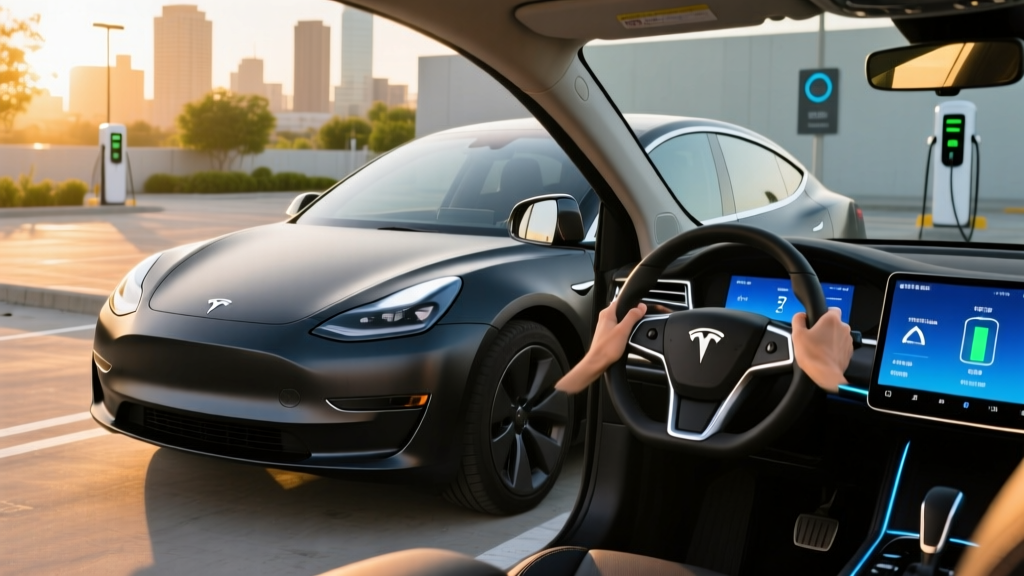
- Autopilot standard (SAE Level 2 — requires active driver supervision at all times)
- Full Self-Driving (Supervised) available as a $8,000 option or $99/month subscription — still Level 2, not autonomous
- Sentry Mode dashcam recording, over-the-air updates, and Tesla app integration
Tesla Autopilot and FSD (Supervised) are SAE Level 2 driver-assistance systems. They do NOT make the vehicle self-driving. The driver must keep hands on the wheel, eyes on the road, and remain prepared to take over instantly. Misuse of these systems has contributed to documented collisions. Treat them as advanced cruise control and lane-keeping — not autonomy.
Notable drawbacks: The absence of Apple CarPlay/Android Auto frustrates some buyers. The minimalist interior means no physical buttons for climate, mirrors, or glovebox — all controlled via touchscreen. Turn signal stalks were removed in the refresh; signals are now on the steering wheel, which some drivers find unintuitive during roundabouts.
Pros and Cons
- Best-in-class Supercharger network access
- Excellent efficiency (26 kWh/100 mi)
- Strong real-world range (300+ mi highway)
- Fast DC charging (250 kW peak, 10–80% in ~25 min)
- Continuous OTA improvements
- 5-star NHTSA safety, IIHS Top Safety Pick+
- Insurance premiums 40–60% above segment average
- No Apple CarPlay or Android Auto
- Rear seat legroom tight for tall adults
- Touchscreen-only controls (no physical buttons)
- Turn signals on steering wheel take adaptation
- Repair costs after collisions remain high
Who Should Buy the Tesla Model 3?
Choose the Model 3 if: You prioritize Supercharger reliability for road trips, want maximum efficiency per kWh, and can secure a competitive insurance quote in your state. The Long Range AWD is the sweet spot — 363 miles EPA, dual-motor traction, and ~$38K after the federal credit.
Look elsewhere if: Insurance costs in your area push your total ownership beyond budget (get a quote before ordering), you need Apple CarPlay, you regularly carry tall rear-seat passengers, or you prefer physical controls. Consider the Hyundai Ioniq 6 for similar efficiency at lower insurance cost, or the Model Y if cargo space is a priority.
Warranty Coverage
| Component | Coverage |
|---|---|
| Basic Vehicle | 4 years / 50,000 miles |
| Battery & Drive Unit (RWD) | 8 years / 100,000 miles |
| Battery & Drive Unit (LR/Perf) | 8 years / 120,000 miles |
| Battery capacity retention | Minimum 70% over warranty period |
Tesla's battery warranty guarantees at least 70% capacity retention. In practice, NMC Model 3 batteries typically show 5–8% degradation in the first 50,000 miles before stabilizing. LFP batteries (RWD trim) degrade more slowly and tolerate frequent 100% charges, making them well-suited for high-mileage commuters.
Frequently Asked Questions
Why is Tesla Model 3 insurance so expensive?
Three factors drive higher premiums: aluminum body panels and structural battery packs increase collision repair costs, Tesla's direct repair network has limited throughput, and proprietary parts carry higher prices. Even with top safety ratings, claim severity pushes premiums to $2,400–$3,200/year nationally.
Does the Tesla Model 3 qualify for the $7,500 federal tax credit?
All 2026 Model 3 trims fall under the $55,000 sedan MSRP cap. However, eligibility depends on your adjusted gross income (≤$150K single / ≤$300K joint) and the battery's critical-mineral and component sourcing compliance, which evolves annually. Check the latest IRS guidance and confirm with your tax professional before purchase. The credit can be applied as a point-of-sale reduction.
What is the real-world range of the Model 3 Long Range?
Expect approximately 300–320 miles at 70 mph in mild weather, dropping to 250–280 miles in sub-freezing winter conditions. City driving with regenerative braking can approach the 363-mile EPA figure. The standard heat pump helps but cannot fully offset cold-weather losses at highway speeds.
Is the Model 3 worth it vs. the Hyundai Ioniq 6 or BMW i4?
The Model 3 wins on Supercharger access, efficiency, and software. The Ioniq 6 offers comparable range and efficiency at lower insurance cost and with CarPlay support. The BMW i4 provides a more traditional luxury interior and physical controls but lower range and slower DC charging. If road-trip charging reliability is your top priority, the Model 3's network advantage is decisive.
How much does home charging cost vs. gas?
At the US average of $0.16/kWh, fully charging a Model 3 Long Range (~79 kWh) costs about $12.64 for 363 miles — roughly 3.5 cents per mile. A comparable gas sedan at 30 MPG and $3.50/gallon costs about 11.7 cents per mile. Home charging saves approximately $1,000–$1,200 per year at 12,000 miles driven.