The Tesla Model 3 Highland refresh brought meaningful changes to the cabin, ride quality, and efficiency of Tesla's entry-level sedan. For 2026, the Model 3 lineup carries forward with three trims — Rear-Wheel Drive, Long Range AWD, and Performance — each with distinct battery chemistry, range, and pricing. This review takes you fully inside the Tesla Model 3, covering the redesigned interior, real-world range and charging behavior, ownership economics, and how it stacks up against a rapidly closing field of competitors.
If you're cross-shopping the Model 3 against the Hyundai Ioniq 6, BMW i4, or Polestar 2, the numbers below should give you everything you need to make a data-driven decision — no marketing fluff, just specs and owner-relevant context.
2026 Tesla Model 3: Full Spec Sheet at a Glance
| Spec | RWD (Base) | Long Range AWD | Performance |
|---|---|---|---|
| Base MSRP | $38,990 | $45,490 | $52,990 |
| EPA Range | 272 mi | 363 mi | 315 mi |
| Battery (usable) | ~57.5 kWh (LFP) | ~75 kWh (NMC) | ~75 kWh (NMC) |
| Drivetrain | RWD, single motor | AWD, dual motor | AWD, dual motor |
| Horsepower | 271 hp | 346 hp | 510 hp |
| 0–60 mph | 5.8 sec | 4.2 sec | 2.9 sec |
| Efficiency (MPGe) | 132 MPGe combined | 130 MPGe combined | 118 MPGe combined |
| Efficiency (kWh/100 mi) | 25 kWh | 26 kWh | 29 kWh |
| Max DC Fast Charge | 170 kW | 250 kW | 250 kW |
| 10–80% DCFC Time | ~25 min | ~25 min | ~25 min |
| Level 2 Home Charge | 11.5 kW (~44 mi/hr) | 11.5 kW (~44 mi/hr) | 11.5 kW (~44 mi/hr) |
| Battery Warranty | 8 yr / 100,000 mi | 8 yr / 120,000 mi | 8 yr / 120,000 mi |
Inside the Tesla Model 3: Cabin, Tech & Cargo
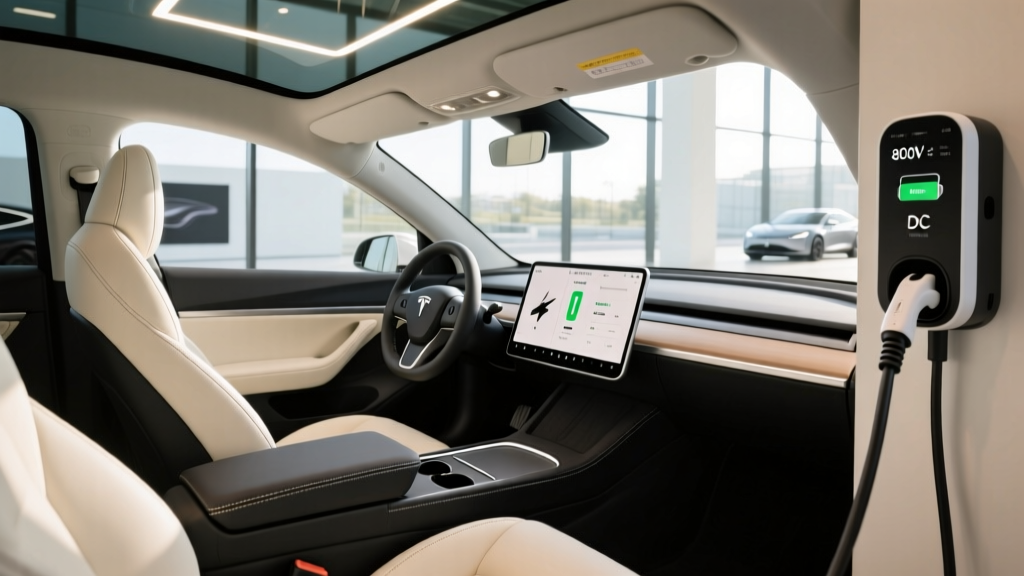
The Highland redesign overhauled the Model 3 interior, and the changes are immediately visible when you step inside. Tesla replaced the old hard plastics with softer-touch materials, added ventilated front seats (a common complaint on pre-2024 models), and installed ambient lighting that runs along the dash and door panels. The minimalist ethos remains — there are still no physical buttons for climate or mirrors — but the execution is noticeably more premium.
Dimensions & Space
- Front legroom: 42.7 inches
- Rear legroom: 35.2 inches
- Front headroom: 40.3 inches
- Rear headroom: 37.8 inches
- Cargo (trunk): 21.0 cu ft
- Frunk (front trunk): 3.1 cu ft
- Total cargo volume: 24.1 cu ft
The rear seat is adequate for adults under 6 feet, but the sloping roofline cuts into headroom for taller passengers. Cargo space trails the Hyundai Ioniq 6 (which offers slightly more trunk room despite a similar fastback profile) but beats the BMW i4's more traditional sedan trunk. The frunk is small — useful for a charging cable bag, not much else.
Infotainment & Controls
The 15.4-inch center touchscreen handles everything: navigation, climate, media, vehicle settings, and even the speedometer (there is no instrument cluster). The Highland refresh added an 8-inch rear touchscreen for back-seat passengers to control climate and media — a welcome addition, though it's small and mounted low. Audio comes from a 17-speaker system on Long Range and Performance trims that delivers genuinely impressive sound quality for the price class.
The removal of turn signal stalks (now capacitive buttons on the steering wheel) and the gear selector (swipe on the screen) remains polarizing. Most owners adapt within a week, but it's worth testing on a drive before committing.
Driver Assistance
Tesla's Autopilot and Full Self-Driving (Supervised) are Level 2 driver-assist systems, not autonomous driving. The driver must remain engaged, hands on the wheel (or torque-applied), and eyes on the road at all times. FSD (Supervised) costs $8,000 upfront or $99/month and adds city-street navigation, but it does not remove driver responsibility. Only Level 4 services like Waymo operate without a human driver in geofenced areas.
Real-World Range: What the EPA Number Doesn't Tell You
EPA estimate: 272 mi (RWD) / 363 mi (Long Range) / 315 mi (Performance)
Real-world highway (70 mph, moderate weather): Expect ~230 mi (RWD) / ~300 mi (Long Range) / ~265 mi (Performance)
Cold weather (below 32°F, highway): Subtract 20–30% — the Long Range drops to ~210–240 mi effective range
Why the gap? EPA testing includes low-speed city driving and regenerative braking. Sustained highway speeds, cold temperatures (which increase battery resistance and cabin heating load), and elevation changes all reduce range below the sticker number.
The Model 3 Long Range's 363-mile EPA rating is among the highest of any EV under $50,000, and Tesla's efficiency is genuinely class-leading. The 25 kWh/100 mi figure on the RWD model means you're squeezing more miles per kilowatt-hour than nearly any competitor. That efficiency is partly why the Model 3 can achieve strong range with a smaller, lighter battery pack — which also benefits handling and tire wear.
The LFP battery in the RWD model has a practical quirk: Tesla recommends charging it to 100% regularly (unlike NMC batteries, which degrade faster when held at full charge). This means the RWD's 272-mile EPA range is fully usable day-to-day, whereas Long Range and Performance owners typically set a daily charge limit of 80% (~290 miles effective), reserving 100% for road trips.
Charging Speed: DC Fast, Home Level 2 & the Curve
| Charging Level | Power (kW) | Speed (miles of range added) | Notes |
|---|---|---|---|
| Level 1 (120V household) | ~1.4 kW | ~3–5 mi/hr | Emergency/trickle only |
| Level 2 (240V home, 48A) | 11.5 kW | ~44 mi/hr | Full charge in ~6–7 hours |
| DC Fast Charge (RWD) | 170 kW peak | ~170 mi in 15 min | Tapers significantly above 60% |
| DC Fast Charge (LR/Perf) | 250 kW peak | ~200 mi in 15 min | Peak only below 40% SoC |
Understanding the charge curve: The 250 kW peak on Long Range and Performance trims is a headline number, not a sustained rate. In practice, the Model 3 holds peak power only up to roughly 35–40% state of charge, then tapers progressively. The 10–80% time of approximately 25 minutes is competitive but not class-leading — the Hyundai Ioniq 5 and Kia EV6, with their 800V architectures, can do 10–80% in about 18 minutes at a 350 kW charger.
At home on a Level 2 Wall Connector (48 amps, 11.5 kW), you'll add roughly 44 miles of range per hour of charging. A typical overnight session of 8 hours restores ~350 miles — more than enough for any daily driving. Home charging installation typically runs $800–$2,000 depending on panel proximity and whether your electrical panel needs an upgrade to support a 60-amp circuit.
The Model 3 uses the NACS (North American Charging Standard) connector natively, giving it seamless access to Tesla's Supercharger network — over 6,000 stalls in North America, widely regarded as the most reliable public DC fast-charging network. With the expanding NACS adoption, competitors are gaining Supercharger access via adapters, but the native experience (plug in, walk away, billing handled automatically) remains a Tesla advantage.
Pricing, Tax Credits & Ownership Cost
| Trim | Base MSRP | Federal Credit Eligibility | Effective Price (with credit) |
|---|---|---|---|
| RWD | $38,990 | Up to $7,500 (point-of-sale) | ~$31,490 |
| Long Range AWD | $45,490 | Up to $7,500 (point-of-sale) | ~$37,990 |
| Performance | $52,990 | Up to $7,500 (point-of-sale) | ~$45,490 |
Critical tax credit caveats: The IRS §30D federal EV tax credit (up to $7,500) is available as a point-of-sale transfer beginning in 2024, meaning the dealer applies the credit as a down-payment reduction at purchase rather than waiting for a tax refund. However, eligibility depends on several factors that change frequently:
- Buyer income caps: Modified AGI must not exceed $150,000 (single), $225,000 (head of household), or $300,000 (joint). See IRS §30D guidelines for current-year thresholds.
- MSRP cap: Sedans must have an MSRP of $55,000 or less. All 2026 Model 3 trims currently fall under this cap.
- Battery sourcing requirements: The credit is split into two halves ($3,750 each) based on critical-mineral sourcing and battery-component manufacturing requirements. These thresholds tighten annually. Always verify current-year eligibility on the IRS site or with your tax professional before relying on the full $7,500.
- VIN verification: Tesla's checkout page and the DOE's tax credit lookup tool confirm per-VIN eligibility at time of purchase.
5-Year Ownership Cost Estimate
Based on 15,000 miles/year, $0.14/kWh home electricity, and $3.50/gallon gas for a comparable BMW 330i:
- Fuel/energy (5 years): ~$2,625 (Model 3 LR) vs. ~$9,375 (gas sedan)
- Maintenance (5 years): ~$500 (Model 3, no oil changes) vs. ~$2,500 (gas sedan)
- Insurance (5 years): ~$9,000–$11,000 (Model 3 — Tesla insurance premiums run higher than average for the segment)
- Estimated 5-year savings vs. gas sedan: $6,000–$8,500, partially offset by higher insurance
Warranty & Battery Longevity
Tesla covers the Model 3 with:
- Basic vehicle warranty: 4 years / 50,000 miles
- Battery & drive unit warranty (RWD): 8 years / 100,000 miles, minimum 70% capacity retention
- Battery & drive unit warranty (Long Range, Performance): 8 years / 120,000 miles, minimum 70% capacity retention
The LFP chemistry in the RWD model has a longer cycle life than NMC — typically 3,000+ full cycles before significant degradation, versus ~1,500–2,000 for NMC. In practical terms, both chemistries should outlast the vehicle's useful life for most owners. Tesla's fleet data shows average degradation of roughly 12% after 200,000 miles, though individual results vary with charging habits and climate exposure.
The 70% retention threshold in the warranty is standard for the industry but worth noting: if your battery degrades to 71% capacity at 95,000 miles, it's not covered. Third-party data from Recurrent suggests most Tesla batteries retain 85–90% capacity at 100,000 miles under normal use.
Pros & Cons: The Honest Take
Pros
- Class-leading efficiency (25–29 kWh/100 mi)
- Supercharger network access (most reliable DCFC in North America)
- 363-mile EPA range on Long Range — top of segment under $50K
- LFP battery (RWD) allows daily 100% charging with less degradation concern
- Strong OTA update cadence adds features post-purchase
- High resale value relative to EV segment average
- Highland cabin is genuinely more refined than pre-2024 models
Cons
- No physical turn signal stalks or gear selector — learning curve
- Rear seat headroom is tight for passengers over 6'1"
- No Apple CarPlay or Android Auto — Tesla's ecosystem only
- Insurance premiums run 15–25% above segment average
- FSD (Supervised) costs $8,000 and remains Level 2 — not autonomous
- DC fast-charge curve tapers earlier than 800V competitors (Ioniq 5, EV6)
- Rear visibility is limited; relies heavily on cameras
Who Should Buy the 2026 Tesla Model 3?
- Choose the RWD ($38,990) if: You commute under 50 miles/day, have reliable home charging, and want the lowest entry price with the LFP battery's longevity advantage. The 272-mile EPA range is more than sufficient for daily use, and the ~$31,500 effective price after tax credit is exceptional value.
- Choose the Long Range AWD ($45,490) if: You take regular road trips (200+ miles), live in a cold-weather state where range drops 20–30%, or need dual-motor AWD for snow. The 363-mile range provides a comfortable buffer for highway driving in all conditions.
- Choose the Performance ($52,990) if: You want a 2.9-second 0–60 time and track-capable handling, and you're willing to trade 48 miles of EPA range for it. This is a sports-sedan competitor to the BMW i4 M50 at a lower price point.
- Look elsewhere if: You need Apple CarPlay, prefer physical controls, need more than 24 cu ft of cargo space, or want faster DC charging (consider the Ioniq 5/EV6 with 800V architecture).
Frequently Asked Questions
What is the real-world range of the 2026 Tesla Model 3?
The EPA rates the Long Range AWD at 363 miles, the Performance at 315 miles, and the RWD at 272 miles. In real-world highway driving at 70 mph in moderate temperatures, expect roughly 300 miles (Long Range), 265 miles (Performance), and 230 miles (RWD). In cold weather below freezing, subtract another 20–30% due to battery resistance and cabin heating load.
How fast does the Tesla Model 3 charge?
On a DC fast charger, the Long Range and Performance trims peak at 250 kW, achieving a 10–80% charge in approximately 25 minutes. The RWD peaks at 170 kW. At home on a Level 2 charger (240V, 48 amps), all trims charge at 11.5 kW, adding about 44 miles of range per hour — a full overnight charge covers any daily driving need.
How much does the Tesla Model 3 cost after tax credits?
With the full $7,500 federal tax credit applied at point of sale, the RWD drops to approximately $31,490, the Long Range to $37,990, and the Performance to $45,490. Eligibility depends on buyer income (AGI caps of $150K/$225K/$300K), MSRP (all trims qualify at under $55K), and battery sourcing requirements that change annually. Always verify on IRS.gov before purchasing.
Is the Tesla Model 3 worth buying vs. the competition?
The Model 3 Long Range remains the efficiency and range leader in its price class, and Supercharger access is a meaningful advantage for road-trippers. The Hyundai Ioniq 6 offers a comparable range (361 mi), faster 800V charging, and CarPlay — but lacks Supercharger access. The BMW i4 is more luxurious but costs significantly more and offers less range. For most buyers prioritizing range, charging infrastructure, and value, the Model 3 is still the benchmark — but the gap has narrowed considerably.
Does the 2026 Tesla Model 3 qualify for the $7,500 federal EV tax credit?
All three Model 3 trims are expected to qualify for up to $7,500 under IRS §30D, available as a point-of-sale transfer. However, the credit has two $3,750 components tied to battery-component manufacturing and critical-mineral sourcing requirements that tighten each year. Your personal eligibility also depends on income caps. Confirm current-year status on the IRS website or with a qualified tax professional before finalizing your purchase.
How does the Tesla Model 3 interior compare to pre-Highland models?
The 2024+ Highland redesign added ventilated front seats, ambient lighting, improved sound insulation, softer-touch materials, and a rear passenger touchscreen. The cabin is noticeably quieter at highway speeds, and the ride quality is substantially improved with revised suspension tuning. If you test-drove a pre-2024 Model 3 and found it too harsh or spartan, the current generation addresses most of those complaints.