Tesla Model 3 Performance: Does Insane Mode Live Up to the Name?
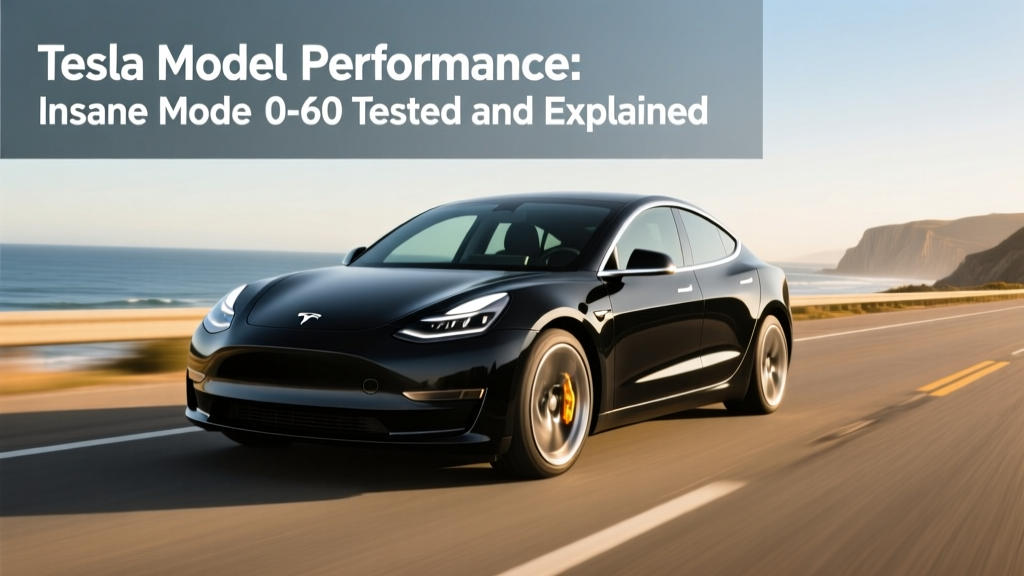
The phrase "tesla model 3 insane mode 0 60" has followed Tesla's compact sedan since the early dual-motor days, when the company offered an "Insane Mode" toggle that unlocked the car's full torque envelope. Today's 2026 Tesla Model 3 Performance no longer uses that exact badge in the software menu — it's now simply the Performance trim with Track Mode — but the physics-defying acceleration remains. With a claimed 2.9-second 0-60 mph time, 510 horsepower, and a starting price under $55,000, it occupies a rare space: supercar acceleration in a daily-drivable electric sedan.
This review puts the Model 3 Performance through the lens that matters to real buyers: not just how fast it launches, but how far it goes, how quickly it charges, what it costs after incentives, and where it falls short. We'll also clarify what "Insane Mode" means in 2026 and whether the Performance trim is worth the premium over the Long Range AWD.
Full Specs at a Glance
| Spec | Value |
|---|---|
| EPA Range | 315 miles |
| Battery (usable) | ~79 kWh, NMC (nickel manganese cobalt) |
| Drivetrain | Dual-motor AWD |
| Horsepower / Torque | 510 hp / 546 lb-ft |
| 0-60 mph | 2.9 seconds (with rollout subtracted) |
| Top Speed | 163 mph |
| Max DC Fast Charge | 250 kW peak |
| 10-80% DCFC Time | ~25 minutes |
| Level 2 Home Charge | 11.5 kW (~44 mi/hr) |
| EPA Efficiency | 121 MPGe combined / 28 kWh/100 mi |
| Cargo Volume | 23 cu ft (trunk + frunk) |
| Base MSRP | $54,990 (incl. destination) |
| Battery Warranty | 8 years / 120,000 miles (70% retention) |
Real-World Range: Beyond the 315-Mile Sticker
Real-World Highway (70-75 mph): ~260-280 miles
Real-World Cold Weather (below 32°F): ~220-250 miles
City / Moderate Climate: ~290-310 miles
The EPA's 315-mile estimate is measured on a specific drive cycle that blends low-speed urban and moderate highway driving. In practice, the Model 3 Performance's 20-inch wheels, stickier summer tires, and more aggressive motor mapping cost it roughly 20 miles of range compared to the Long Range AWD on the same battery pack.
At sustained highway speeds of 70-75 mph, expect to use between 300-330 Wh/mile, which translates to roughly 260-280 miles before the battery buffer kicks in. In winter conditions — particularly below freezing — the NMC chemistry loses some efficiency, and cabin heating draws significant power even with Tesla's standard heat pump. Plan for 220-250 miles of usable range on a cold road trip.
For daily commuting under 80 miles round-trip, you'll charge at home every other night at most. The range only becomes a planning exercise on road trips exceeding 250 miles, where Tesla's Supercharger network (now open to other brands via NACS adoption) remains the most reliable DC fast-charging ecosystem in the U.S.
Insane Mode, Acceleration Mode, and the 2.9-Second 0-60
In earlier Model 3 software, Tesla offered selectable acceleration modes: "Chill," "Sport," and — on Performance models — "Insane Mode." The latter unlocked the full current delivery from both motors, shaving tenths off the 0-60 time. With the Highland refresh and into the 2026 model year, Tesla simplified this into the Performance trim's default calibration and added Track Mode, which adjusts torque distribution, regen behavior, and thermal management for closed-course driving.
The 2.9-second 0-60 mph claim (per Tesla's official specs) uses a 1-foot rollout subtraction standard in drag racing. In independent testing, real-world 0-60 times cluster between 3.0 and 3.3 seconds depending on surface temperature, tire condition, and state of charge. Below 20% SoC, Tesla's battery management system limits peak power delivery, so full-throttle launches are best performed above 50% charge.
The dual-motor setup pairs a permanent-magnet rear motor with an induction front motor. This allows the car to disconnect the front motor under light loads for efficiency, then instantly engage it under hard acceleration. The result is not just straight-line speed but exceptional traction — the Model 3 Performance puts its power down with minimal wheelspin even on damp pavement.
Charging Speed: 250 kW Peak, But the Curve Matters
| Level | Power | Speed | Notes |
|---|---|---|---|
| Level 1 (120V) | ~1.4 kW | ~5 mi/hr | Emergency/trickle only |
| Level 2 (240V, 48A) | 11.5 kW | ~44 mi/hr | Full charge in ~7-8 hours |
| DC Fast (Supercharger V3/V4) | 250 kW peak | ~175 mi in 15 min | 10-80% in ~25 min |
The Model 3 Performance peaks at 250 kW on V3 and V4 Superchargers, but as with all EVs, that peak is not sustained. The charging curve holds above 200 kW from roughly 10-30% state of charge, then tapers progressively. By 60% SoC, you're typically seeing 120-140 kW; above 80%, the rate drops sharply to protect the battery, falling below 50 kW.
This means the commonly cited "10-80% in 25 minutes" is achievable under ideal conditions: a warm battery (Tesla's navigation-based preconditioning handles this automatically when you route to a Supercharger), a V3 or V4 stall not shared with another vehicle, and a starting SoC at or below 10%.
For home charging, the Model 3's onboard charger accepts up to 11.5 kW on a 240V/48A circuit. A Tesla Wall Connector installed on a dedicated 60A circuit delivers a full overnight charge in roughly 7-8 hours. If your home has a 200A electrical panel with spare capacity, installation typically runs $800-$1,500. Older panels may require a $2,000-$3,500 upgrade — factor this into your first-year ownership budget.
The Model 3 now ships with the NACS (North American Charging Standard) port natively, eliminating the need for adapters at Tesla Superchargers. For Electrify America and other CCS networks, a NACS-to-CCS adapter is available but limits peak charging to the adapter's rated capacity.
Pricing, Trims, and the Federal Tax Credit Picture
| Trim | MSRP | Est. After §30D Credit |
|---|---|---|
| Rear-Wheel Drive | $38,990 | $31,490 (if eligible) |
| Long Range AWD | $45,990 | $38,490 (if eligible) |
| Performance AWD | $54,990 | $47,490 (if eligible) |
The Model 3 Performance starts at $54,990 including destination. Options are minimal — paint colors ($1,000-$2,500), FSD (Supervised) capability ($8,000 one-time or $99/month), and interior color ($1,000). A fully loaded example can reach $66,000+ before incentives.
Federal tax credit eligibility under IRS §30D is the most complex part of the purchase equation. The Model 3 qualifies for up to $7,500 if you meet all of the following:
- Income cap: Modified AGI ≤ $150,000 (single), $225,000 (head of household), $300,000 (joint)
- MSRP cap: Vehicle base price ≤ $55,000 for sedans (the Model 3 Performance at $54,990 clears this by a razor-thin margin — adding options does not affect the MSRP cap calculation)
- Battery sourcing: Critical minerals and battery components must meet phased-in domestic/F TA content thresholds that tighten annually through 2029
- Point-of-sale transfer: As of 2024+, you can transfer the credit to the dealer at purchase, reducing your out-of-pocket cost immediately rather than waiting for tax filing
The battery-sourcing requirements are the wildcard. Tesla has shifted significant battery supply chain activity to North America, but specific eligibility can change quarterly. Always verify current credit status on fueleconomy.gov before purchasing.
Interior, Cargo, and Daily Livability
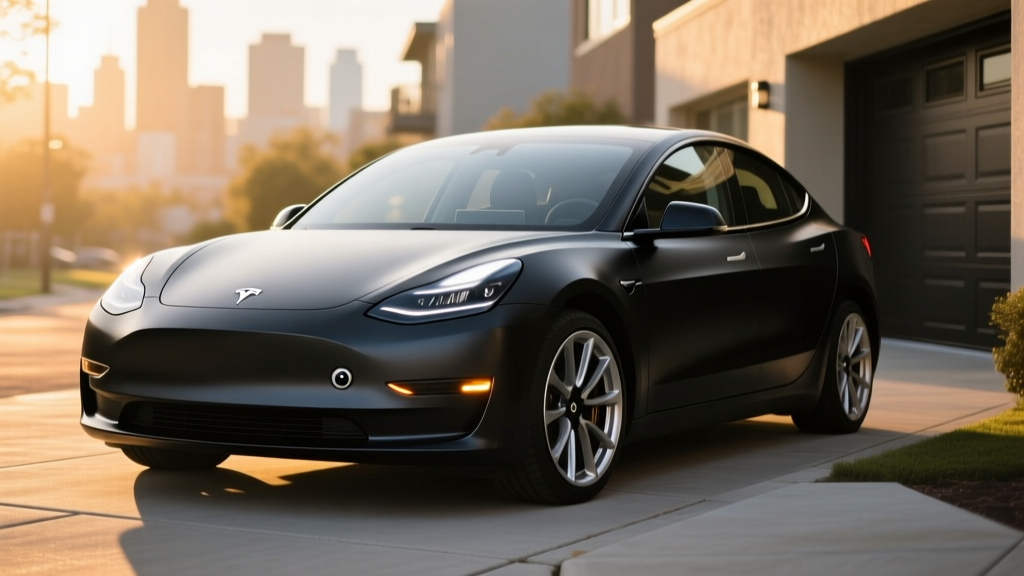
The Highland refresh brought meaningful improvements to the Model 3's cabin: ventilated front seats, ambient lighting, acoustic glass (noticeably quieter at highway speeds), rear-seat ventilation controls, and a redesigned center console. The minimalist ethos remains — no physical instrument cluster, no traditional stalks (turn signals are now steering-wheel-mounted buttons, which take roughly two weeks of muscle-memory adaptation).
Passenger space is adequate for four adults. Front legroom measures 42.7 inches; rear legroom is 35.2 inches — tighter than a Hyundai Ioniq 6 or BMW i4. The rear seat is best suited for children or shorter trips for adults over 6 feet.
Cargo capacity totals 23 cubic feet split between the rear trunk (19.4 cu ft) and front trunk/frunk (3.1 cu ft). The trunk opening is narrower than a hatchback, which limits loading bulky items. For comparison, the Model Y offers 30+ cu ft behind the second row.
The 15.4-inch center touchscreen handles infotainment, climate, navigation, and vehicle settings. Wireless phone charging, USB-C ports front and rear, and a 17-speaker audio system are standard. Apple CarPlay and Android Auto remain unsupported — Tesla's proprietary interface is the only option, which is either a pro or a con depending on your ecosystem preference.
Autopilot, FSD, and Driver Assistance
Standard Autopilot includes Traffic-Aware Cruise Control and Autosteer (lane-centering on marked highways). The optional FSD (Supervised) package adds automatic lane changes, Navigate on Autopilot (highway on/off-ramp management), Autopark, Summon, and traffic-light/stop-sign recognition. As of early 2026, FSD operates on a vision-only architecture — no radar or ultrasonic sensors — and has improved significantly in urban environments, though it still requires regular driver intervention in construction zones, unmapped areas, and complex intersections.
The Performance trim also includes Tesla's Track Mode, which allows adjustable front/rear torque bias, increased regenerative braking, and a lap timer for closed-course driving. This is a genuine differentiator against competitors like the BMW i4 M50, which lacks comparable track-oriented software.
Who Should Buy the Model 3 Performance?
The Model 3 Performance is best suited for:
- Driving enthusiasts who want sports-car acceleration without the fuel cost or maintenance of a combustion performance sedan
- Tech-forward commuters who value over-the-air updates, Supercharger access, and a minimalist cabin
- Two-person households who don't need crossover-level cargo space but want AWD capability for snow/rain
- Track-day hobbyists who appreciate Track Mode's adjustability and the low center of gravity inherent to a skateboard-platform EV
It's less ideal for families needing rear-seat space for car seats and strollers (consider the Model Y), buyers in areas without reliable home-charging access, or those who prefer physical controls and traditional instrument clusters.
Pros and Cons
- 2.9-sec 0-60 rivals Porsche Taycan at half the price
- Supercharger network remains the gold standard for road trips
- Track Mode is a genuine enthusiast feature, not a gimmick
- OTA updates continuously add features post-purchase
- Low cost per mile: ~$0.04-$0.06/mi on home electricity
- Strong resale value relative to EV segment average
- Button-style turn signals require adaptation period
- Rear seat is tight for tall adults on long trips
- No Apple CarPlay / Android Auto
- 250 kW peak DCFC trails Hyundai Ioniq 5's 350 kW capability
- FSD costs $8,000 and remains Level 2 (not autonomous)
- Insurance premiums run 20-40% above segment average
Frequently Asked Questions
What is Insane Mode on the Tesla Model 3?
Insane Mode was Tesla's name for the maximum-acceleration software setting on earlier dual-motor Model 3 vehicles. On the 2026 Model 3 Performance, this capability is baked into the default drive calibration — there's no separate toggle needed. The Performance model delivers its full 510 hp and 2.9-second 0-60 in standard driving mode. Track Mode, available on the Performance trim, further adjusts torque distribution and thermal management for closed-course use.
How fast does the Tesla Model 3 Performance charge at home?
On a 240V Level 2 circuit at 48 amps (11.5 kW), the Model 3 Performance adds approximately 44 miles of range per hour. A full charge from near-empty takes 7-8 hours, making overnight charging practical for daily use. Most owners install a Tesla Wall Connector on a dedicated 60A circuit.
Does the 2026 Model 3 Performance qualify for the $7,500 federal tax credit?
It can, but eligibility depends on your income (≤$150K single / $300K joint), the vehicle's MSRP (≤$55K for sedans — the Performance at $54,990 qualifies), and current battery-sourcing rules under IRS §30D. The credit can be transferred at point of sale. Always confirm eligibility on fueleconomy.gov and with a tax professional before purchasing.
How does the Model 3 Performance compare to the BMW i4 M50?
The BMW i4 M50 offers 536 hp and a 3.3-second 0-60, with a more traditional interior (physical gauges, iDrive with CarPlay). However, the i4 M50 starts above $67,000, has a slightly shorter EPA range (270-300 mi depending on wheels), and lacks access to the Supercharger network without an adapter. The Model 3 Performance wins on price, charging infrastructure, and acceleration; the i4 M50 wins on interior luxury and interface familiarity.
What is the real-world highway range of the Model 3 Performance?
Expect 260-280 miles at 70-75 mph in moderate temperatures. In cold weather (below freezing), plan for 220-250 miles. The EPA's 315-mile estimate reflects a mixed cycle that doesn't fully capture sustained high-speed driving. Tesla's navigation system accounts for elevation, temperature, and speed when projecting range, and it's generally accurate within 5-10 miles on a given route.
Is the Model 3 Performance worth it over the Long Range AWD?
If acceleration, Track Mode, adaptive dampers, and the Performance aesthetic matter to you, the ~$9,000 premium is justified. If you prioritize range (the Long Range AWD achieves 341 miles EPA) and don't care about 0-60 bragging rights, the Long Range is the more pragmatic choice. Both share the same battery, Supercharger access, and software features.