Search for "Tesla Model 3 images" and you'll find hundreds of glossy renders and press shots — but photos don't tell you how this sedan handles a 400-mile road trip, whether the minimalist cabin actually works day-to-day, or how the latest Highland refresh changed the ownership equation. This review goes beyond the gallery to deliver the exact numbers, real-world range data, charging speeds, and pricing you need to decide if the Model 3 still earns its spot as the benchmark electric sedan in 2026.
The current-generation Model 3 (internally called "Highland") debuted for the 2024 model year with a redesigned exterior, improved sound insulation, ventilated seats, and a rear touchscreen. For 2026, Tesla continues to offer the Long Range RWD and Long Range AWD trims alongside the performance-oriented Model 3 Performance. The base Rear-Wheel Drive variant was discontinued in late 2024, simplifying the lineup but raising the entry price.
What Tesla Model 3 Images Show — and What They Don't
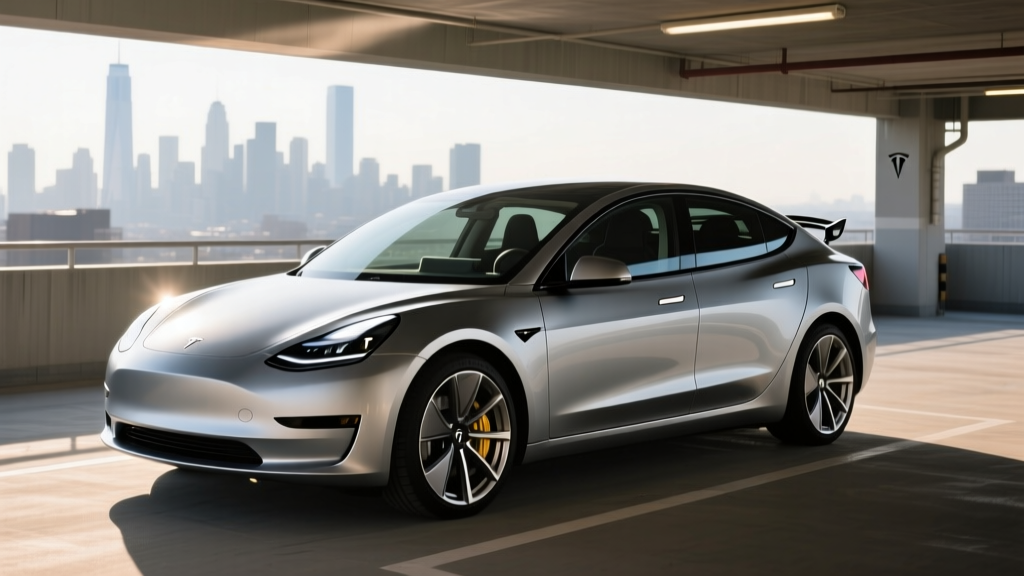
Official Tesla imagery highlights the Model 3's sleeker LED light bar, redesigned front fascia, and new wheels. What photos can't capture is the improved acoustic glass that makes the Highland cabin noticeably quieter at highway speeds, or the ventilated front seats that were a long-requested addition. The rear 8-inch touchscreen for climate and media control is visible in interior shots, but you won't see how responsive it is in practice (it's quick, with minimal lag).
Exterior color options for 2026 include Pearl White, Solid Black, Deep Blue Metallic, Ultra Red, and Stealth Grey. The Quicksilver paint previously exclusive to the Model S/X is not available. Images often show the car on 19-inch Nova wheels, but the standard 18-inch Photon wheels deliver better efficiency and range.
Spec Table: 2026 Tesla Model 3 at a Glance
| Spec | Long Range RWD | Long Range AWD | Performance |
|---|---|---|---|
| EPA Range | 363 mi | 346 mi | 315 mi |
| Battery (usable) | ~79 kWh (NMC) | ~79 kWh (NMC) | ~79 kWh (NMC) |
| Drivetrain | Rear-Wheel Drive | Dual Motor AWD | Dual Motor AWD |
| Horsepower | ~346 hp | ~384 hp | ~510 hp |
| 0–60 mph | 4.9 sec | 4.2 sec | 2.9 sec |
| Peak DC Charge | 170 kW | 170 kW | 250 kW |
| 10–80% DC Time | ~27 min | ~27 min | ~18 min |
| Level 2 Rate | 11.5 kW (~44 mi/hr) | 11.5 kW (~44 mi/hr) | 11.5 kW (~44 mi/hr) |
| EPA Efficiency | 132 MPGe (25 kWh/100mi) | 125 MPGe (27 kWh/100mi) | 113 MPGe (30 kWh/100mi) |
| Cargo (trunk + frunk) | 23 cu ft (trunk) + 3.1 cu ft (frunk) | 23 cu ft + 3.1 cu ft | 23 cu ft + 3.1 cu ft |
| Rear Legroom | 35.2 in | 35.2 in | 35.2 in |
| Base MSRP | $42,490 | $47,490 | $52,990 |
Real-World Range: Beyond the EPA Sticker
The Model 3 Long Range uses an NMC (nickel manganese cobalt) lithium-ion battery with approximately 79 kWh of usable capacity. Tesla does not publish exact chemistry details, but teardowns and supply-chain data confirm NMC for Long Range and Performance trims. Unlike the previously available RWD Standard Range (which used LFP chemistry and was discontinued), the current lineup requires you to follow NMC care guidelines: Tesla recommends charging to 80% for daily use and 100% only for long trips to minimize degradation.
Efficiency is a standout. The Long Range RWD achieves 132 MPGe combined (25 kWh per 100 miles) per fueleconomy.gov, making it one of the most efficient EVs in its class. That efficiency translates directly to lower charging costs — at the national average electricity rate of ~$0.17/kWh, a full charge costs roughly $13.40, or about $0.037 per mile.
Charging Speed: DC Fast Charging and Home Level 2
| Charging Level | Power / Rate | Miles Added per Hour | Notes |
|---|---|---|---|
| Level 1 (120V) | ~1.4 kW | ~5 mi/hr | Emergency/trickle only |
| Level 2 (240V, 48A) | 11.5 kW | ~44 mi/hr | Full charge in ~7–8 hours |
| DC Fast (Long Range) | 170 kW peak | ~650 mi/hr (peak) | 10–80% in ~27 min |
| DC Fast (Performance) | 250 kW peak | ~950 mi/hr (peak) | 10–80% in ~18 min |
The Model 3 uses the NACS (North American Charging Standard) connector natively, giving it access to Tesla's Supercharger network — over 30,000 stalls in North America — without adapters. This remains a significant practical advantage. While CCS-equipped vehicles can now access some Superchargers via a Magic Dock adapter, the native NACS experience is seamless: plug in and charging begins with no app or RFID card required.
A critical detail for road-trippers: the Long Range's 170 kW peak charge rate is lower than some competitors. The Hyundai Ioniq 6 peaks at ~240 kW, and the BMW i4 at ~205 kW. The Model 3 Long Range's charge curve tapers noticeably above 60% SoC, meaning that 10–80% session takes roughly 27 minutes. The Performance trim's 250 kW peak brings that down to approximately 18 minutes. In practice, the Model 3's exceptional efficiency partially offsets its slower peak rate — you're charging fewer kWh per mile driven — but on back-to-back DC stops, competitors with faster charge curves gain time.
For home charging, the onboard 11.5 kW charger adds roughly 44 miles of range per hour on a 48-amp Level 2 circuit. A typical overnight charge (8 hours) restores about 350 miles — more than enough for most daily commutes. Home installation of a Tesla Wall Connector on a 60-amp circuit typically costs $800–$2,000 depending on panel proximity and local permitting, based on electrician quotes across major metros.
Performance and Driving Dynamics
Even the "base" Long Range RWD is quick, hitting 0–60 mph in 4.9 seconds with 346 horsepower. The dual-motor Long Range AWD drops that to 4.2 seconds with 384 hp, adding all-weather traction. The Performance model delivers a supercar-rivaling 2.9-second 0–60 with approximately 510 hp, plus Adaptive Dampers, a lowered stance, and Track Mode.
Driving dynamics improved meaningfully with the Highland refresh. The revised suspension tuning reduces harshness over broken pavement, the new acoustic glass cuts wind and road noise, and the steering — while still on the numb side — is more consistent than pre-2024 models. Regenerative braking remains single-mode (no adjustable regen levels), meaning one-pedal driving is the default experience. If you prefer a coasting feel, the Model 3 is not the EV for you.
Pricing, Trims, and Federal Tax Credit Eligibility
| Trim | Base MSRP | Est. §30D Credit | Effective Price* |
|---|---|---|---|
| Long Range RWD | $42,490 | Up to $7,500 | ~$34,990 |
| Long Range AWD | $47,490 | Up to $7,500 | ~$39,990 |
| Performance | $52,990 | Up to $7,500 | ~$45,490 |
*Effective price assumes full §30D credit eligibility. Destination fee ($1,390) not included. Actual credit depends on battery sourcing, buyer income, and MSRP caps per current IRS rules.
Under current IRS §30D Clean Vehicle Credit rules, the Model 3 may qualify for up to $7,500 in federal tax credits, which can be transferred to the dealer at the point of sale as an instant price reduction. However, eligibility is not guaranteed and depends on several factors:
- MSRP Cap: Sedans must have an MSRP at or below $55,000. All current Model 3 trims meet this threshold.
- Buyer Income Cap: Modified adjusted gross income must not exceed $150,000 (single), $225,000 (head of household), or $300,000 (joint filers).
- Battery Sourcing: The $7,500 credit is split into two $3,750 halves — one for critical minerals sourcing and one for battery component manufacturing. Tesla has worked to shift supply chains, but the exact credit amount available can vary by production batch and model year. Always verify the current sourcing status on the manufacturer's website or with your tax professional before purchasing.
The Long Range RWD at $42,490 represents the value sweet spot — it offers the best range, qualifies for the credit, and undercuts the AWD by $5,000. If you live in a snowy climate or need the extra traction, the AWD premium is justified.
Interior, Tech, and Daily Usability
The Model 3 interior remains defined by its radical minimalism. There are no physical buttons, no instrument cluster, and no traditional stalks — turn signals are on the steering wheel, and gear selection is via the touchscreen (with a backup console button). A 15.4-inch central touchscreen handles everything: navigation, climate, media, vehicle settings, and the available Autopilot visualization.
Standout tech features:
- Ambient lighting strip across the dashboard and doors (new with Highland)
- Rear 8-inch touchscreen for passengers
- Ventilated front seats (long overdue, now standard)
- Available Full Self-Driving (Supervised) at $8,000 or $99/month — SAE Level 2 only, requiring constant driver attention
- Over-the-air updates that continue to add features years after purchase
- Sentry Mode dashcam recording and remote climate preconditioning via the Tesla app
Notable drawbacks:
- No physical controls for climate, volume, or wipers — everything goes through the screen
- Rear visibility is compromised by the sloping roofline; reliance on cameras is heavy
- Turn signals on the steering wheel take adjustment, especially during roundabouts or multi-point turns
- Build quality has improved but still occasionally trails German and Korean competitors in panel-gap consistency
- No Apple CarPlay or Android Auto — Tesla's proprietary system is the only option
Cargo, Passenger Space, and Practicality
The Model 3 offers 23 cubic feet of trunk space plus a 3.1-cubic-foot front trunk (frunk). The trunk opening is a traditional sedan shape rather than a hatchback, which limits loading bulky items compared to the Model Y or Ioniq 5. Rear legroom measures 35.2 inches — adequate for average-height adults but tight for anyone over 6'2" on longer trips. Headroom in the rear is also reduced by the glass roof's low mounting position.
For families: the Model 3 fits two rear-facing child seats, but the sloping roofline makes loading them more awkward than in a crossover. If cargo flexibility is a priority, the Model Y or a similarly sized electric SUV is a more practical choice at a similar price point.
Warranty and Battery Longevity
Tesla covers the Model 3 with:
- Basic Vehicle Warranty: 4 years / 50,000 miles
- Battery & Drive Unit Warranty: 8 years / 120,000 miles (Long Range & Performance), with a guaranteed minimum 70% capacity retention over that period
Real-world degradation data from Tesla's fleet reports and third-party tracking (such as Recurrent Auto) shows NMC batteries in the Model 3 typically lose 8–12% of capacity over the first 100,000 miles, with the degradation curve flattening significantly after the initial 20,000–30,000 miles. With proper care (avoiding frequent 100% charges, using preconditioning for DC fast charging, minimizing deep discharges), the battery should comfortably outlast the warranty period.
Out-of-warranty battery replacement costs remain a concern. A Model 3 battery pack replacement currently ranges from $12,000 to $16,000 depending on the pack configuration and labor. This figure has been trending downward as refurbished packs become more available, but it's a cost to factor into long-term ownership planning.
Pros and Cons
Pros
- Class-leading efficiency (132 MPGe / 25 kWh/100mi)
- Native NACS access to 30,000+ Supercharger stalls
- Strong real-world range (363 mi EPA on Long Range RWD)
- Excellent software, OTA updates, and Tesla app integration
- Quiet, refined cabin post-Highland refresh
- Strong resale value relative to most EVs
Cons
- 170 kW peak DC charge rate trails competitors
- No physical buttons or CarPlay/Android Auto
- Sedan trunk limits cargo flexibility vs. hatchbacks
- Steep learning curve for stalkless steering wheel controls
- FSD (Supervised) is expensive and still Level 2 only
- Rear seat space tight for taller passengers
Who Should Buy the 2026 Tesla Model 3?
The Model 3 remains the strongest pick for tech-savvy commuters and road-trippers who value efficiency, Supercharger network access, and continuous software improvement. The Long Range RWD is ideal for drivers in mild climates with a daily commute under 80 miles round-trip and access to home Level 2 charging. The AWD variant suits those in snow-belt states who need all-weather capability without sacrificing too much range.
This EV is not the best fit for buyers who need maximum cargo space (consider the Model Y or Ioniq 5), prefer physical controls and Apple CarPlay (look at the Hyundai Ioniq 6 or BMW i4), or want the fastest possible DC charging for frequent multi-state road trips (the Ioniq 6 or Lucid Air charge faster).
Frequently Asked Questions
What is the real-world range of the Tesla Model 3?
The Long Range RWD is EPA-rated at 363 miles. Expect 290–320 miles in real-world highway driving at moderate temperatures, and 240–270 miles in cold weather below freezing. City driving with regenerative braking can match or slightly exceed the EPA estimate.
How fast does the Tesla Model 3 charge?
On a DC fast charger, the Long Range peaks at 170 kW (10–80% in ~27 minutes), while the Performance peaks at 250 kW (10–80% in ~18 minutes). At home on a 48-amp Level 2 charger, it adds approximately 44 miles of range per hour.
How much does the Tesla Model 3 cost after tax credits?
The Long Range RWD starts at $42,490. If you qualify for the full $7,500 §30D federal credit (based on income, battery sourcing, and MSRP rules), the effective price drops to approximately $34,990 before destination fees and state incentives.
Is the Tesla Model 3 worth buying over competitors?
Against the Hyundai Ioniq 6, the Model 3 wins on Supercharger access, software, and resale value, but loses on DC charging speed and interior ergonomics. Against the BMW i4, it wins on price and efficiency but loses on build quality and driving refinement. The Model 3 remains the default choice for buyers prioritizing the Tesla ecosystem.
Does the Tesla Model 3 qualify for the federal EV tax credit?
It may qualify for up to $7,500 under IRS §30D rules, but eligibility depends on your income (must be under $150K/$225K/$300K depending on filing status), the vehicle's battery sourcing compliance, and the $55,000 MSRP cap for sedans. Always verify current eligibility on IRS.gov and with a tax professional before purchase.
Does the Model 3 have Apple CarPlay or Android Auto?
No. Tesla uses its proprietary infotainment system exclusively. There is no support for Apple CarPlay, Android Auto, or any third-party phone-mirroring standard. The built-in navigation, media, and voice controls are robust, but this remains a dealbreaker for some buyers.