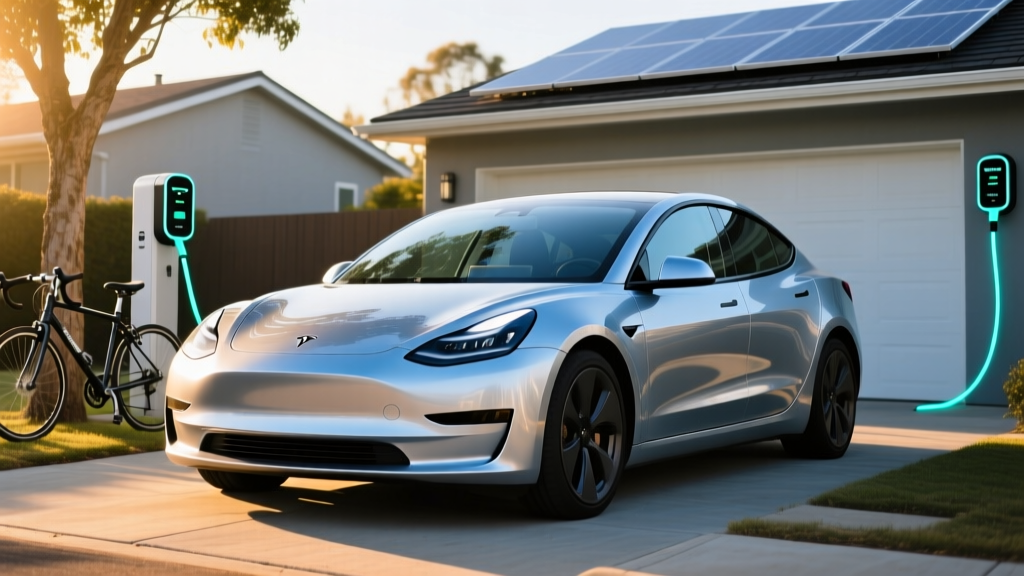
The Tesla Model 3 Highland refresh brought more than a facelift. For buyers and existing owners, the most consequential upgrade is Hardware 4 (HW4) — Tesla's latest Autopilot computer and camera suite. This review breaks down what HW4 actually changes, how the 2025-2026 Model 3 performs in range, charging, and daily driving, and whether it still earns its spot as the default EV sedan benchmark.
What Is HW4 and Why It Matters
Hardware 4 replaced HW3 starting with the 2023 Model S/X and rolled into the refreshed Model 3 (project Highland) for the 2024 model year. The key differences:
- Camera resolution: HW4 uses cameras up to 5 megapixels, compared to HW3's 1.2 MP sensors. Higher resolution means better object detection at distance and in low light.
- Camera count: HW4 Model 3 retains 8 external cameras but drops the ultrasonic parking sensors entirely, relying on Tesla Vision (camera-only) for proximity detection.
- Compute: Tesla's in-house FSD chip on HW4 delivers roughly 2x the processing throughput of HW3, enabling more complex neural net models for FSD (Supervised).
- No radar, no ultrasonics: Tesla removed both. Parking assist now uses camera-based depth estimation, which has improved through OTA updates but remains a friction point for some owners.
For 2025-2026 Model 3 buyers, HW4 is standard across all trims. There is no HW3 Model 3 in current production.
Range, Battery, and Efficiency: Model 3 Trims Compared
| Spec | RWD (Base) | Long Range AWD | Performance |
|---|---|---|---|
| EPA Range | 272 mi | 363 mi | 315 mi |
| Battery (usable) | ~60 kWh (LFP) | ~79 kWh (NMC) | ~79 kWh (NMC) |
| Drivetrain | RWD, single motor | AWD, dual motor | AWD, dual motor |
| 0-60 mph | 5.8 sec | 4.2 sec | 2.9 sec |
| Horsepower | ~271 hp | ~384 hp | ~510 hp |
| Efficiency (MPGe) | 132 MPGe combined | 131 MPGe combined | 118 MPGe combined |
| Efficiency (kWh/100 mi) | 25 kWh | 26 kWh | 29 kWh |
| Base MSRP (2025) | $38,990 | $45,240 | $52,990 |
Sources: EPA fueleconomy.gov, Tesla.com order pages. Efficiency figures per EPA. Prices before destination or incentives.
EPA range is measured under controlled conditions. In our experience and aggregated owner data:
- Highway driving (70-75 mph): Expect ~85-90% of EPA. A Long Range AWD rated at 363 mi will deliver roughly 310-325 mi on a flat interstate in mild weather.
- Cold weather (below 32°F): Range drops 15-30% depending on severity and whether you precondition. LFP batteries in the RWD trim are more susceptible to cold-induced range loss than NMC packs.
- City/commuter driving: You can meet or slightly exceed EPA numbers thanks to regenerative braking and lower average speeds.
Charging Speed: DC Fast, Level 2, and the Supercharger Advantage
| Charging Level | RWD (LFP) | Long Range / Performance (NMC) |
|---|---|---|
| DC Fast Charge (peak) | ~170 kW | ~250 kW |
| 10-80% DC time | ~30 min | ~25-28 min |
| Level 2 (240V, 48A) | ~11.5 kW / ~37 mi/hr | ~11.5 kW / ~44 mi/hr |
| Level 1 (120V) | ~1.4 kW / ~4-5 mi/hr | ~1.4 kW / ~4-5 mi/hr |
| Connector | NACS (native Tesla). CCS adapters available for non-Tesla networks. | |
Charging curve reality: The 250 kW peak on Long Range/Performance trims applies only at low state of charge (roughly 10-30% SoC). By 50% SoC, the rate tapers to ~100-120 kW, and above 80% it drops sharply. The published 10-80% time of ~25-28 minutes reflects this taper. If you're planning road-trip stops, plan around 20-25 minute Supercharger sessions for a 10-80% fill.
Preconditioning matters: Navigate to a Supercharger using the car's built-in navigation and the battery will automatically precondition (warm up) for optimal charge speed. Arriving at a Supercharger without preconditioning — especially in cold weather — can cut peak charge rates in half.
NACS and the Supercharger network: The Model 3 uses the North American Charging Standard (NACS) connector natively. Tesla's Supercharger network now serves over 6,000 U.S. stalls with 250 kW (V3) or 350 kW (V4) capability. Non-Tesla EVs with NACS ports (Ford, Rivian, GM, etc.) now share these stalls, so peak-hour congestion at popular corridors is worth factoring into trip planning.
Performance, Ride Quality, and the Highland Refinement
The pre-refresh Model 3 was fast but noisy. The Highland update addressed the most common complaints:
- NVH (noise, vibration, harshness): Acoustic glass on all windows, additional sound deadening, and redesigned suspension bushings make the 2025 Model 3 noticeably quieter at highway speed. It's still not Lexus-quiet, but it's a meaningful step up from the 2022 model.
- Ride quality: Revised damper tuning and a slightly softer spring rate reduce the crashy feel over sharp bumps that plagued earlier Model 3s. The Performance trim retains a firmer setup with adaptive dampers.
- Handling: The Model 3's low center of gravity and near 50/50 weight distribution remain class-leading. The Performance trim's track mode and new wheels/tires deliver genuine sports-sedan dynamics.
- Ventilated front seats: Finally added with the Highland refresh — a welcome fix for warm-climate owners.
- Rear touchscreen: An 8-inch rear display controls climate, media, and entertainment for back-seat passengers.
Cargo and passenger space:
- Trunk: 23 cu ft (with rear seats folded: ~64 cu ft equivalent)
- Frunk: ~3.1 cu ft (fits a small backpack or charging cables)
- Front legroom: 42.3 in
- Rear legroom: 35.2 in — adequate for adults on shorter trips, tight for tall passengers on long drives
The Model 3 is a compact executive sedan. If you regularly carry rear-seat adults or need SUV-level cargo space, the Model Y is the practical choice.
HW4, Autopilot, and FSD (Supervised): What It Actually Does
Every 2025-2026 Model 3 ships with HW4 and Tesla's latest FSD (Supervised) software. Here's the honest breakdown:
Standard Autopilot (included):
- Traffic-Aware Cruise Control (TACC)
- Autosteer (lane centering on marked highways)
- Automatic Emergency Braking, blind-spot monitoring, lane departure warning
FSD (Supervised) — $8,000 one-time or $99/month:
- All Autopilot features plus:
- Navigate on Autopilot (automatic highway interchanges and exits)
- Auto lane change with turn-signal activation
- Traffic light and stop sign recognition with automatic response
- City street driving with turn execution
- Smart Summon (car navigates parking lots to your phone location)
- It is NOT autonomous. You must remain attentive, hands on wheel, ready to intervene instantly.
- It does NOT reliably handle construction zones, unmapped roads, heavy rain/snow, or complex unprotected left turns.
- It is NOT a Level 3 or Level 4 system. You are legally and practically the driver at all times.
- Performance varies significantly by geography, road markings, and traffic complexity.
HW4 practical improvements over HW3: Owners report fewer phantom braking events, better detection of pedestrians and cyclists at distance, and smoother lane-keeping in crosswinds. The higher-resolution cameras also improve Smart Summon's parking-lot navigation. However, the absence of ultrasonic sensors means the parking proximity visualization is less precise than older Model 3s — you'll rely more on the camera feeds than the distance readout.
Pricing, Tax Credits, and Total Cost
| Trim | Base MSRP | Under §30D MSRP Cap? | Max Credit (if eligible) |
|---|---|---|---|
| RWD | $38,990 | ✅ Yes (sedan cap: $55,000) | Up to $7,500 |
| Long Range AWD | $45,240 | ✅ Yes | Up to $7,500 |
| Performance | $52,990 | ✅ Yes | Up to $7,500 |
To claim the full $7,500 credit on a new Model 3, ALL of the following must apply:
- MSRP cap: Vehicle MSRP ≤ $55,000 for sedans (all Model 3 trims qualify)
- Buyer income cap (MAGI): ≤ $150,000 single / ≤ $225,000 head of household / ≤ $300,000 joint
- Battery sourcing: Critical minerals and battery components must meet phased-in percentage thresholds that increase annually. Tesla's supply chain has largely met these requirements for Model 3, but the split between $3,750 and $7,500 can shift — verify current eligibility at fueleconomy.gov before purchasing.
- Point-of-sale transfer: You can transfer the credit to Tesla at purchase for an immediate price reduction (rather than waiting for a tax refund). Requires IRS registration at time of sale.
- Tax liability: The credit is non-refundable. You must owe at least $7,500 in federal income tax to benefit from the full amount (unless using point-of-sale transfer).
Rules are subject to change. Consult IRS.gov or a tax professional for your specific situation.
As-tested pricing reality: A Long Range AWD with FSD, premium paint ($2,000), and 19" wheels totals approximately $57,240 before incentives. With the full $7,500 credit applied at point of sale, that drops to ~$49,740 — competitive with a well-equipped BMW 330i or Audi A4, but with dramatically lower fuel and maintenance costs.
Ownership Costs: Warranty, Insurance, and Long-Term Value
Warranty coverage:
- Basic vehicle: 4 years / 50,000 miles
- Battery & drive unit: 8 years / 100,000 miles (RWD) or 8 years / 120,000 miles (Long Range & Performance)
- Battery degradation threshold: Tesla warrants that the battery will retain at least 70% of original capacity during the warranty period. Below 70%, Tesla will repair or replace at no cost.
Insurance: Model 3 insurance premiums remain above average for the compact sedan segment. Expect $1,800-$2,800/year depending on your state, age, driving record, and coverage level. Tesla Insurance (available in select states) can be competitive but varies significantly by driver profile. Get quotes before purchasing.
Maintenance: No oil changes, no spark plugs, no transmission fluid. Expect cabin air filter replacement (~$100-150 every 2 years), tire rotation, wiper fluid, and occasional brake fluid checks. Tire wear is the biggest recurring cost — EVs are heavy and torquey. Budget $800-$1,200 for a set of four tires every 25,000-35,000 miles.
Charging cost vs. gas: At the U.S. average electricity rate of ~$0.16/kWh, a Long Range Model 3 costs roughly $4.16 to "fill" 100 miles of range at home. A comparable gas sedan at 30 MPG and $3.40/gallon costs $11.33 for 100 miles. Over 15,000 miles/year, that's ~$624 vs. ~$1,700 — a savings of over $1,000 annually on fuel alone.
Model 3 vs. the Competition: Who Should Buy What
- You want access to the Supercharger network (still the most reliable DC fast-charging network in the U.S.)
- You value OTA software updates that add features post-purchase
- You want the longest EPA range in a compact EV sedan (363 mi, Long Range)
- You're interested in FSD (Supervised) as a driver-assist option, understanding its Level 2 limitations
- You prefer a minimalist interior with a single central screen
- Hyundai Ioniq 6 (361 mi SE range): You want a more conventional interior with physical buttons, 800V charging (~18 min 10-80%), and a lower starting price
- BMW i4 eDrive40 (307 mi): You want a premium-badge sedan with more traditional luxury materials and dealer service
- Polestar 2 (320 mi Long Range): You prefer Scandinavian design, Google built-in, and a more driver-focused cockpit
- You need rear-seat space: The Model Y, Ioniq 5, or any compact EV SUV offers more rear headroom and cargo flexibility
- Best-in-class EPA range (363 mi, Long Range)
- Supercharger network access (NACS native)
- HW4 cameras improve FSD and Autopilot reliability
- Highland refresh fixes NVH and ride quality complaints
- Class-leading efficiency (25-29 kWh/100 mi)
- Strong OTA update track record
- All trims under §30D MSRP cap
- No physical buttons or stalks (turn signals on steering wheel)
- Rear legroom is tight for tall adults
- Camera-only parking assist less precise than ultrasonics
- Insurance premiums above segment average
- FSD ($8,000) is expensive and still Level 2
- No Apple CarPlay / Android Auto
- LFP battery (RWD) more sensitive to cold-weather range loss
Frequently Asked Questions
What is the real-world range of the Tesla Model 3 HW4?
The EPA rates the Long Range AWD at 363 miles, the RWD at 272 miles, and the Performance at 315 miles. In real-world highway driving at 70-75 mph in mild weather, expect roughly 85-90% of EPA — about 310-325 miles for the Long Range. In cold weather (below freezing), range drops 15-30% depending on conditions and whether you precondition the battery. City driving with regenerative braking can meet or exceed EPA estimates.
How fast does the Model 3 charge at home and on the road?
On a Level 2 home charger (240V, 48A), the Model 3 charges at up to 11.5 kW, adding roughly 37-44 miles of range per hour depending on trim. A full overnight charge (8-10 hours) easily refills any trim. On DC fast charging, the Long Range and Performance peak at ~250 kW on V3 Superchargers, with a 10-80% charge taking approximately 25-28 minutes. The RWD with its smaller LFP battery peaks around 170 kW, taking about 30 minutes for 10-80%.
How much does the Model 3 cost after the federal tax credit?
With the full $7,500 §30D credit applied at point of sale, the RWD starts around $31,490, the Long Range AWD drops to ~$37,740, and the Performance comes in near $45,490. However, eligibility depends on your income (MAGI caps apply), and battery-sourcing rules determine whether you receive the full $7,500 or a partial $3,750. Always verify current eligibility on fueleconomy.gov before finalizing a purchase.
Does the Tesla Model 3 qualify for the federal EV tax credit?
Yes — all current Model 3 trims fall under the $55,000 sedan MSRP cap set by the Inflation Reduction Act. Eligibility for the full $7,500 credit depends on your modified adjusted gross income (≤$150K single, ≤$300K joint), the vehicle's battery component and critical mineral sourcing (which Tesla has largely met, but verify annually), and having sufficient federal tax liability. The credit can be transferred to Tesla at point of sale for an instant price reduction. Check IRS.gov for current rules.
Is the HW4 Model 3 worth buying over competitors like the Ioniq 6 or BMW i4?
It depends on your priorities. The Model 3 Long Range wins on EPA range (363 mi vs. Ioniq 6's 361 mi, BMW i4's 307 mi) and Supercharger network reliability. HW4 gives it the most advanced driver-assist camera suite in the segment. However, the Ioniq 6 charges faster on non-Tesla DC networks (800V architecture, ~18 min 10-80%), has physical buttons, and starts at a lower price. The BMW i4 offers a more traditional luxury experience with dealer service. If Supercharger access and Tesla's software ecosystem matter most, the Model 3 remains the default pick. If you prefer conventional controls or faster CCS charging, test-drive the Ioniq 6.
What are the biggest drawbacks of the refreshed Model 3?
The most common owner complaints: (1) turn signals are now buttons on the steering wheel instead of a stalk — a steep learning curve; (2) no physical climate or volume controls — everything goes through the touchscreen; (3) no Apple CarPlay or Android Auto; (4) rear seat legroom (35.2 in) is tight for adults on long trips; (5) camera-only parking assist is less intuitive than the ultrasonic sensors it replaced; (6) insurance costs remain elevated compared to non-Tesla sedans.
Can I charge a Model 3 on non-Tesla charging networks?
Yes. The Model 3 uses the NACS connector natively. For CCS-equipped networks (Electrify America, EVgo, some ChargePoint stations), you'll need a NACS-to-CCS adapter (~$150-200 from Tesla or third-party suppliers). Charging speeds on non-Tesla networks depend on the station's maximum output and the vehicle's acceptance rate. With the adapter, the Model 3 can accept up to its peak rate on compatible CCS chargers.