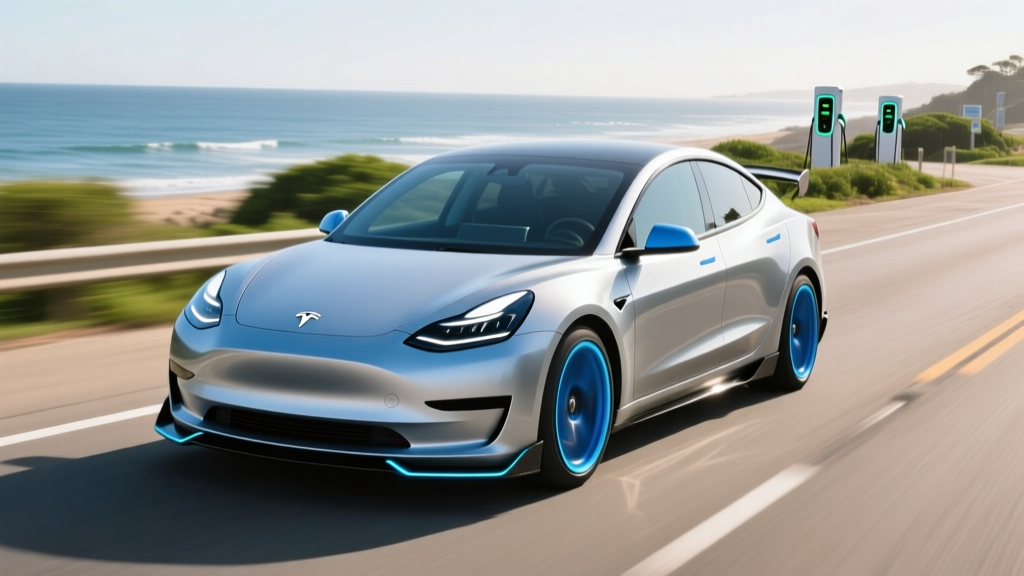
If you've ever typed "how much hp does a Tesla Model 3 have" into a search bar, you've probably noticed the answer changes depending on which trim you're looking at—and Tesla doesn't always make horsepower front and center on its spec sheets. Unlike legacy automakers that lead with engine output, Tesla historically emphasizes 0–60 mph times and range. But horsepower still matters: it shapes highway passing power, towing feel, and how the car behaves when fully loaded with passengers and cargo.
For the 2026 model year, the Tesla Model 3 lineup carries over the refreshed "Highland" architecture introduced in late 2023, with three trims spanning from an efficient single-motor commuter to a dual-motor performance sedan. Below, we map every horsepower figure, 0–60 time, battery spec, and charging curve to help you match the right Model 3 to your driving needs.
Tesla Model 3 Horsepower by Trim: RWD, Long Range, and Performance
The 2026 Tesla Model 3 is offered in three configurations in the U.S. market. Horsepower varies significantly depending on the powertrain, and because electric motors deliver torque instantly, even the base model feels punchier than its numbers might suggest.
| Specification | Model 3 RWD | Model 3 Long Range AWD | Model 3 Performance |
|---|---|---|---|
| Horsepower | 271 hp | 384 hp (combined) | 510 hp (combined) |
| Torque | 317 lb-ft | 364 lb-ft | 546 lb-ft |
| Drivetrain | Rear-Wheel Drive (RWD) | Dual-Motor All-Wheel Drive | Dual-Motor All-Wheel Drive |
| 0–60 mph | 5.8 seconds | 4.2 seconds | 2.9 seconds |
| Top Speed | 125 mph | 125 mph | 163 mph |
| EPA Range | 272 miles | 341 miles | 303 miles |
| Battery (usable) | ~57.5 kWh (LFP) | ~75 kWh (NMC) | ~75 kWh (NMC) |
| Efficiency (MPGe) | 132 MPGe combined | 134 MPGe combined | 121 MPGe combined |
| Base MSRP | $38,990 | $45,990 | $53,990 |
Sources: EPA fueleconomy.gov, Tesla.com spec sheets (2026 model year). Horsepower figures reflect combined system output for dual-motor trims. Tesla does not officially publish per-motor HP breakdowns; combined figures are industry-standard estimates based on dynamometer testing.
Real-World Range vs. EPA Estimates: What You'll Actually See
EPA Sticker vs. Real-World Expectation
The Long Range AWD carries a 341-mile EPA estimate, but on a 70-mph highway loop in moderate temperatures (65–75°F), expect roughly 290–310 miles before needing a charger. In cold weather (below 32°F), range can drop 20–30%, bringing real-world winter highway range to approximately 240–270 miles for the Long Range trim.
The RWD model's 272-mile EPA rating translates to about 230–245 miles on the highway and as low as 190–210 miles in freezing conditions.
Tesla's LFP (lithium iron phosphate) battery in the RWD trim is less energy-dense than the NMC (nickel manganese cobalt) packs in the Long Range and Performance models, which explains the range gap despite similar vehicle weight. However, LFP chemistry has a key advantage: Tesla recommends regular charging to 100% for LFP packs, so you can use the full 272 EPA miles daily. With NMC packs, daily charging to 80% is recommended for longevity, effectively giving you about 273 usable miles from the Long Range on a typical weekday.
According to EPA data, the Model 3 Long Range achieves 134 MPGe combined (25 kWh/100 mi), making it one of the most efficient all-wheel-drive electric sedans on the market. The RWD model's 132 MPGe combined is nearly identical because its lighter single-motor setup offsets the lower energy density of the LFP pack.
Charging Speed: DC Fast Charging and Home Level 2
Horsepower gets headlines, but charging speed determines daily livability. Here's what the 2026 Model 3 can handle across every charging scenario:
| Charging Level | Max Power (kW) | Miles Added per Hour | Notes |
|---|---|---|---|
| Level 1 (120V household) | ~1.4 kW | ~5 mi/hr | Emergency/trickle only; 50+ hrs for full charge |
| Level 2 (240V home, 48A) | 11.5 kW | ~44 mi/hr | Full charge in ~7–8 hrs (Long Range) |
| DC Fast Charge (Supercharger V4) | Up to 250 kW (LR/Perf) Up to 170 kW (RWD) |
~1,000+ mi/hr (peak) | 10–80% in ~25 min (LR), ~22 min (RWD) |
A critical nuance: the peak 250 kW rate on the Long Range and Performance trims only holds between roughly 10–30% state of charge (SoC). Above 50%, the charge curve tapers significantly—dropping to around 100 kW by 60% and below 50 kW past 80%. This is standard behavior for NMC lithium-ion cells to protect battery health, but it means that 10–80% time of approximately 25 minutes is far more relevant than the peak number alone.
The RWD model's LFP battery can accept a lower peak DC rate of about 170 kW, but because the battery is smaller (~57.5 kWh usable), the 10–80% session completes in roughly 22 minutes—not dramatically longer. LFP cells also tolerate higher SoC charging more gracefully, so Tesla allows you to charge to 100% at DC fast chargers without the same degradation concerns.
For home charging, all 2026 Model 3 trims accept up to 11.5 kW on a 240V/48A Level 2 circuit. A typical installation with a Tesla Wall Connector on a dedicated 60A circuit adds about 44 miles of range per hour—enough to fully replenish even the Long Range overnight. If your home has a 200A electrical panel with spare capacity, expect installation costs between $500–$1,500 for the Wall Connector unit and electrician labor. Homes requiring a panel upgrade to 200A or 400A service may see costs of $2,000–$5,000+.
Pricing, Trims, and Federal Tax Credit Eligibility
The 2026 Model 3 pricing structure is straightforward, but federal tax credit eligibility under IRS §30D requires careful attention to income caps, MSRP limits, and battery sourcing requirements that shift year to year.
| Trim | Base MSRP | Destination Fee | Est. §30D Credit | Effective Price (if eligible) |
|---|---|---|---|---|
| RWD | $38,990 | $1,390 | Up to $7,500 | ~$32,880 |
| Long Range AWD | $45,990 | $1,390 | Up to $7,500 | ~$39,880 |
| Performance | $53,990 | $1,390 | Up to $7,500 | ~$47,880 |
§30D tax credit caveats (per IRS.gov):
- MSRP cap: Sedans must be priced at or below $55,000 to qualify. The RWD and Long Range trims qualify; the Performance trim at $53,990 base MSRP qualifies, but adding options (Ultra Red paint, 19" wheels) can push the total above the cap.
- Income limits: Modified adjusted gross income (MAGI) must not exceed $150,000 (single), $225,000 (head of household), or $300,000 (joint filers).
- Battery sourcing: The full $7,500 requires meeting both critical mineral and battery component sourcing thresholds, which tighten annually. As of 2026, vehicles with battery components from a "foreign entity of concern" (FEOC) are disqualified. Tesla sources LFP cells from CATL for the RWD trim, which may affect partial or full credit eligibility depending on the current-year FEOC rules. Always verify on Tesla's checkout page and with a tax professional.
- Point-of-sale transfer: Since 2024, buyers can transfer the credit to the dealer at purchase, reducing the out-of-pocket price immediately rather than waiting for a tax refund.
Interior Space, Cargo, and Daily Practicality
The Model 3 is a compact executive sedan, and its dimensions reflect that positioning:
- Cargo volume: 23 cu ft total (15.6 cu ft trunk + 3.1 cu ft frunk + under-floor storage)
- Front legroom: 42.7 inches
- Rear legroom: 35.2 inches
- Rear headroom: 36.6 inches (slightly reduced by the glass roof)
- Ground clearance: 5.5 inches
The rear seat fits two adults comfortably on longer trips, though the center position is narrow and best for short rides or a child seat. The glass roof creates an airy cabin but does reduce rear headroom for passengers over 6 feet tall. Cargo capacity is competitive with a BMW 3 Series but trails the Hyundai Ioniq 6 (which offers a hatchback-style opening).
For 2026, Tesla continues to equip ventilated front seats, ambient lighting, and a rear-seat touchscreen for climate and entertainment control—features that were added in the Highland refresh and remain standard across all trims.
Tech, Autopilot, and Driver Assistance
Every 2026 Model 3 comes with Tesla's basic Autopilot suite, which includes adaptive cruise control and lane-keeping assist. This is a SAE Level 2 driver-assistance system: it can manage steering and speed on well-marked highways, but you must keep your hands on the wheel and eyes on the road at all times. It is not self-driving.
Autopilot & FSD (Supervised) Are Not Autonomous
Tesla's Full Self-Driving (Supervised) package, available as a $8,000 add-on or $99/month subscription, adds automatic lane changes, traffic light and stop sign recognition, and navigate-on-autopilot for highway interchanges. However, it remains a Level 2 system requiring full driver supervision. You are legally responsible for the vehicle at all times. True Level 4 driverless operation is currently only available through commercial robotaxi services like Waymo in limited metro areas.
The 15.4-inch center touchscreen runs Tesla's proprietary infotainment system—no Apple CarPlay or Android Auto. Instead, Tesla offers built-in Spotify, Netflix, YouTube, and a surprisingly capable navigation system with real-time Supercharger routing and battery preconditioning. The removal of physical turn signal stalks (replaced by steering-wheel buttons in the Highland refresh) remains divisive; some drivers adapt within a week, others find it frustrating in roundabouts and lane-change-heavy commutes.
Warranty Coverage and Battery Longevity
Tesla's warranty structure is competitive but not class-leading:
- Basic vehicle warranty: 4 years / 50,000 miles
- Battery & drive unit warranty: 8 years / 100,000 miles (RWD), 8 years / 120,000 miles (Long Range & Performance)
- Battery retention threshold: Tesla guarantees at least 70% capacity retention during the warranty period
Real-world degradation data from fleet analytics (including Tesloop and Recurrent Auto reports) suggests that NMC-equipped Model 3 vehicles typically retain 88–92% of original capacity after 100,000 miles. LFP packs in the RWD trim show even lower degradation rates in early data, likely due to the chemistry's inherent cycle-life advantage—often exceeding 3,000 full cycles before reaching 80% capacity. That translates to well over 300,000 miles for most drivers.
Out-of-warranty battery replacement costs remain a concern for high-mileage buyers. A Model 3 battery replacement currently runs $12,000–$16,000 at Tesla service centers, though refurbished packs are increasingly available at lower cost as early Model 3 vehicles age out of warranty.
Pros and Cons: The Honest Scorecard
Pros
- Class-leading efficiency (134 MPGe combined on Long Range)
- Extensive Supercharger network—still the most reliable DC fast-charging ecosystem in North America
- LFP battery on RWD allows daily 100% charging with minimal degradation
- Strong resale value relative to most EVs
- Performance trim delivers supercar-rivaling 2.9s 0–60 at sedan pricing
- Over-the-air updates continuously add features
Cons
- No Apple CarPlay or Android Auto
- Turn-signal buttons on steering wheel require adjustment period
- Rear seat headroom limited for tall passengers
- RWD LFP battery charges slower on DC (170 kW peak vs 250 kW on NMC)
- Ride quality is firm—especially on 19" Sport wheels
- Panel gaps and paint quality still inconsistent on some deliveries
Which Model 3 Trim Is Right for You?
Choose the RWD ($38,990) if: You commute under 60 miles round-trip, have reliable home Level 2 charging, live in a mild climate, and want the lowest entry price with an LFP battery built for daily 100% charges. The 271 hp is more than adequate for highway merging.
Choose the Long Range AWD ($45,990) if: You take regular road trips of 200+ miles, live in a cold-weather state where AWD traction and extra range buffer matter, or frequently drive with a full cabin of passengers. The 384 hp combined provides effortless passing power.
Choose the Performance ($53,990) if: You want 510 hp and 2.9-second sprints, value adaptive damping and track mode, and don't mind sacrificing ~38 miles of range for the privilege. Verify that your configuration stays under the $55,000 MSRP cap for the §30D tax credit.
Frequently Asked Questions
How much hp does a Tesla Model 3 have in the base RWD trim?
The 2026 Model 3 RWD produces 271 horsepower and 317 lb-ft of torque from a single rear-mounted permanent-magnet motor. That's enough for a 5.8-second 0–60 mph time, which outpaces most 4-cylinder turbocharged gas sedans in this price range.
Does the Model 3 Long Range have more horsepower than the RWD?
Yes, significantly. The Long Range AWD combines a front induction motor and rear permanent-magnet motor for a combined 384 hp and 364 lb-ft of torque. The dual-motor setup also provides all-wheel-drive traction, which improves launch grip and cold-weather handling.
What is the fastest Tesla Model 3 available in 2026?
The Model 3 Performance produces 510 hp combined and hits 0–60 mph in 2.9 seconds. It includes adaptive dampers, a track-mode software profile, and high-performance brakes that the other trims lack.
Does the 2026 Tesla Model 3 qualify for the $7,500 federal tax credit?
All three trims fall under the $55,000 MSRP cap for sedans under §30D rules, so they are potentially eligible. However, you must also meet income limits ($150K single / $300K joint) and the vehicle must satisfy battery-sourcing requirements that exclude FEOC-origin components. The RWD's CATL-sourced LFP cells may affect eligibility—check Tesla's point-of-sale credit tool and consult a tax professional before purchasing.
What is the real-world range of the Model 3 Long Range?
While the EPA rates it at 341 miles, expect approximately 290–310 miles on a 70-mph highway drive in moderate temperatures. In winter conditions below freezing, real-world range drops to roughly 240–270 miles. City driving with frequent regenerative braking can actually exceed the EPA estimate in warm weather.
Is the Tesla Model 3 worth buying over the Hyundai Ioniq 6 or BMW i4?
The Model 3 Long Range undercuts the BMW i4 xDrive40 by over $10,000 while offering similar range and more horsepower. The Hyundai Ioniq 6 SEL ($42,750) offers comparable efficiency and a more conventional interior layout with CarPlay, but its charging network (via Electrify America) is less reliable than Tesla's Superchargers. If charging infrastructure reliability is your top priority, the Model 3 remains the strongest choice.
How much does it cost to charge a Model 3 at home vs. Superchargers?
At the U.S. average residential electricity rate of ~$0.16/kWh, fully charging the Long Range's 75 kWh battery costs roughly $12 for 341 miles—about 3.5 cents per mile. Supercharger pricing averages $0.25–$0.35/kWh depending on location, bringing the cost to roughly $19–$26 for a full charge. Compare that to a 30-mpg gas sedan at $3.50/gallon: about 11.7 cents per mile.