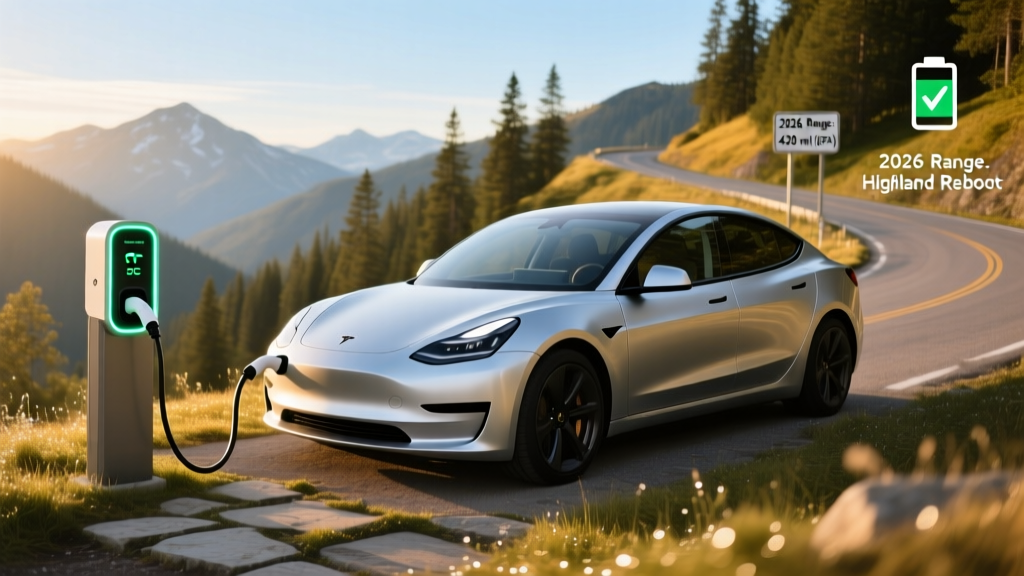
The Tesla Model 3 underwent its most significant transformation since launch with the "Highland" refresh — a mid-cycle reboot that touched nearly every panel, refined the cabin, and sharpened efficiency without ballooning the battery. For 2026, the Model 3 lineup continues with the same revised architecture, now fully settled into production with updated software and incremental pricing adjustments. If you have been searching for a "Tesla reboot" moment — the point where the company's most affordable sedan matured from minimalist experiment into a polished daily driver — the 2026 Model 3 Highland is it.
This review covers the Long Range AWD and Performance trims in detail, with notes on the base Rear-Wheel Drive variant. We will walk through EPA range versus real-world expectations, charging curves at DC fast chargers, cabin changes, tax credit eligibility under current IRS §30D rules, and how it stacks up against the Hyundai Ioniq 6, BMW i4, and Polestar 2.
2026 Tesla Model 3: Specifications at a Glance
| Spec | RWD (Base) | Long Range AWD | Performance |
|---|---|---|---|
| EPA Range | 272 mi | 341 mi | 315 mi |
| Battery (usable) | ~57.5 kWh (LFP) | ~75 kWh (NMC) | ~75 kWh (NMC) |
| Drivetrain | Rear-Wheel Drive | Dual-Motor AWD | Dual-Motor AWD |
| Horsepower | 271 hp | 346 hp | 510 hp |
| 0–60 mph | 5.8 sec | 4.2 sec | 2.9 sec |
| MPGe (combined) | 132 MPGe | 125 MPGe | 113 MPGe |
| Peak DC Charge Rate | 170 kW | 250 kW | 250 kW |
| 10–80% DCFC Time | ~25 min | ~25 min | ~25 min |
| Level 2 Home Charge | 7.6 kW (~30 mi/hr) | 11.5 kW (~44 mi/hr) | 11.5 kW (~44 mi/hr) |
| Base MSRP | $38,990 | $45,990 | $52,990 |
| Battery Warranty | 8 yr / 100,000 mi | 8 yr / 120,000 mi | 8 yr / 120,000 mi |
Sources: fueleconomy.gov, Tesla.com official specs (2026 model year). Prices exclude destination fee.
EPA Range vs. Real-World Driving: What to Actually Expect
EPA Estimate: 341 miles
Real-World Highway (70–75 mph, moderate temps): ~280–300 miles
Real-World Cold Weather (below 32°F, mixed driving): ~240–270 miles
City/Commuter (regenerative braking, mild climate): ~310–330 miles
The Model 3 Long Range AWD carries an EPA rating of 341 miles, placing it near the top of the premium electric sedan segment. However, EPA testing cycles include substantial low-speed and regenerative-braking phases that flatter EVs relative to sustained highway driving.
In real-world highway testing at 70–75 mph with climate control active, the Long Range AWD typically delivers between 280 and 300 miles before reaching 10% State of Charge (SoC). This represents roughly 12–18% below the EPA sticker — consistent with how most EVs perform at sustained interstate speeds where aerodynamic drag dominates and regenerative braking contributes nothing.
Cold weather compounds the gap. The Highland Model 3 includes a heat pump (standard across all trims), which significantly reduces cabin-heating energy draw compared to resistive heaters. Even so, expect 20–30% range reduction in sub-freezing conditions due to battery chemistry limitations, increased rolling resistance, and cabin heating demands. LFP-equipped RWD models are somewhat more susceptible to cold-weather range loss because LFP chemistry has higher internal resistance at low temperatures than NMC.
The base RWD model's 272-mile EPA rating translates to roughly 220–240 real-world highway miles. For commuters with home charging and sub-50-mile round trips, this is entirely adequate. For road trips exceeding 200 miles between charging stops, the Long Range becomes the more comfortable choice.
Charging Speed: DC Fast Charge and Home Level 2
Charging speed is where the Highland Model 3 shows its maturity. Tesla's V3 and V4 Supercharger network remains the most reliable public DC fast-charging ecosystem in the U.S., and the Model 3 is optimized to take full advantage of it.
| Charging Level | Power | Miles Added per Hour | Notes |
|---|---|---|---|
| Level 1 (120V outlet) | ~1.4 kW | ~5 mi/hr | Emergency/trickle only |
| Level 2 (240V, 32A) | 7.6 kW | ~30 mi/hr | RWD max onboard charger |
| Level 2 (240V, 48A) | 11.5 kW | ~44 mi/hr | Long Range / Performance |
| DC Fast (Supercharger V3) | Up to 250 kW | ~170 mi in 15 min | LR & Perf; RWD peaks at 170 kW |
On a V3 Supercharger (250 kW capable), the Long Range and Performance models peak near 250 kW at low SoC, but the charge curve tapers meaningfully above 50%. The 10–80% session takes approximately 25 minutes under ideal conditions (battery preconditioned via navigation routing to the charger). Without preconditioning — for instance, arriving at a charger without the car having routed you there — expect that session to stretch to 30–35 minutes as the battery management system limits power to protect cell health.
The RWD model with its LFP battery peaks at around 170 kW. LFP cells accept fast charge differently than NMC; the curve is flatter but at a lower peak. You will still see a 10–80% session in roughly 25 minutes, but the total energy added is less because the battery is smaller (57.5 kWh usable vs. 75 kWh).
For home charging, the Long Range and Performance trims support 11.5 kW on a 48-amp Level 2 circuit (requiring a 60-amp breaker). This adds roughly 44 miles of range per hour, meaning a full overnight charge from 20% to 100% takes about 7 hours. The RWD model's onboard charger maxes at 7.6 kW (32 amps), adequate for overnight replenishment given the smaller battery.
Important note: Since 2025, Tesla has opened select Supercharger stalls to non-Tesla EVs via the NACS connector standard. However, Tesla vehicles still enjoy the most seamless plug-and-charge experience on the network, with no adapter required and automatic billing. The Model 3 uses the NACS connector natively.
Performance and Driving Dynamics
The Performance trim's 2.9-second 0–60 mph time remains among the quickest in any sedan at any price. But the Highland reboot's real achievement is ride quality. Tesla revised the suspension bushings, added frequency-selective dampers, and improved sound insulation. The result is a noticeably quieter, more compliant highway cruiser than the pre-2024 Model 3.
The Long Range AWD's 4.2-second 0–60 time is brisk by any standard and more than sufficient for merging and passing. Dual-motor torque vectoring provides confident all-weather traction without the efficiency penalty of a mechanical AWD system.
Regenerative braking remains strong and predictable. The Model 3 does not offer adjustable regen levels — Tesla removed the low-regen option in recent software updates — but the one-pedal driving experience is well-calibrated. Drivers transitioning from ICE vehicles typically adapt within a few days.
Interior, Tech, and Cargo: The Highland Upgrades
The Highland refresh addressed the most common pre-2024 complaints. Ventilated front seats are now standard on Long Range and Performance trims. Ambient lighting, upgraded materials (including textile dashboard trim replacing the previous all-vinyl surface), and power-folding side mirrors elevate the cabin from spartan to contemporary-premium.
The 15.4-inch center touchscreen remains the primary interface for virtually all vehicle controls. There is still no traditional instrument cluster — speed and navigation information appear in the upper-left corner of the main display. A rear 8-inch touchscreen for passengers was added in the Highland update, controlling rear climate and entertainment.
Cargo dimensions:
- Trunk: 21.0 cu ft (with rear seats up)
- Frunk (front trunk): 3.1 cu ft
- Rear legroom: 35.3 inches
- Front headroom: 40.3 inches
The 21 cu ft trunk is competitive with the BMW i4 (though the i4's liftback is more practical for bulky items) and significantly larger than the Polestar 2's 14.4 cu ft. However, the Model 3's sedan trunk opening is narrower than the Hyundai Ioniq 6's liftback, making large-item loading less convenient.
On the tech front, Tesla's infotainment system remains the segment benchmark for responsiveness and over-the-air update frequency. The navigation system is excellent, with real-time Supercharger availability and automatic battery preconditioning when routing to a charger. However, the absence of Apple CarPlay and Android Auto continues to frustrate buyers who prefer phone-mirroring interfaces. Tesla's native apps (Spotify, Apple Music, YouTube, Netflix while parked) partially offset this.
Driver Assistance: Autopilot and FSD Supervised
Tesla Autopilot and Full Self-Driving (Supervised) are Level 2 driver-assistance systems. The driver must remain fully engaged, hands on or near the wheel, eyes on the road, and ready to take over at any moment. These systems do not make the vehicle self-driving. Level 4 driverless capability (like Waymo's robotaxi) is not available in any consumer Tesla vehicle.
Standard Autopilot includes Traffic-Aware Cruise Control and Autosteer (lane centering). The optional FSD (Supervised) package ($8,000 one-time or $99/month as of 2026) adds automatic lane changes, navigation-guided on/off-ramp handling, traffic light and stop sign recognition, and a city-streets steering mode that handles intersections and turns.
FSD Supervised has improved substantially through 2025–2026 software iterations, particularly in urban environments. However, it still requires active supervision. Disengagements — moments where the driver must intervene — occur regularly in construction zones, complex intersections, and adverse weather. We recommend evaluating it through the monthly subscription before committing to the full purchase price.
Pricing, Tax Credits, and Total Cost
| Trim | Base MSRP | Destination | Est. §30D Credit | Effective Price |
|---|---|---|---|---|
| RWD | $38,990 | $1,390 | Up to $7,500* | ~$32,880 |
| Long Range AWD | $45,990 | $1,390 | Up to $7,500* | ~$39,880 |
| Performance | $52,990 | $1,390 | Up to $7,500* | ~$46,880 |
*Federal §30D tax credit eligibility depends on multiple requirements. As of 2026, per IRS guidelines:
- MSRP cap: Sedans must be at or below $55,000. The RWD and Long Range qualify; the Performance at $52,990 + destination clears the cap, but adding options (e.g., FSD, special paint, wheels) can push the vehicle above $55,000 and disqualify it.
- Buyer income cap: Modified adjusted gross income must not exceed $150,000 (single), $225,000 (head of household), or $300,000 (joint).
- Battery sourcing: A percentage of critical minerals and battery components must be sourced from the U.S. or free-trade-agreement countries. These thresholds increase annually. Tesla has shifted significant supply chain sourcing to qualify, but final eligibility can vary by production batch and model year. Always verify with your dealer and tax professional before purchase.
- Point-of-sale transfer: Since 2024, buyers can transfer the credit to the dealer at purchase, reducing the upfront cost rather than waiting for a tax refund.
The Model 3 RWD at roughly $32,880 after the credit is one of the most affordable new EVs with over 270 miles of range. The Long Range at ~$39,880 delivers 341 EPA miles and dual-motor AWD — a price point that undercuts comparably equipped competitors by $5,000–$10,000.
How It Compares: Model 3 vs. Key Competitors
The 2026 Model 3 Highland competes primarily with the Hyundai Ioniq 6, BMW i4 eDrive40, and Polestar 2. Each has distinct trade-offs:
- Hyundai Ioniq 6 SE Long Range: 361 EPA miles (best-in-class), 800V architecture enabling 10–80% in ~18 minutes at 350 kW chargers. However, rear visibility is poor, infotainment is less polished, and the dealer network lacks Tesla's direct-sale pricing transparency. Starting around $42,000 before credit.
- BMW i4 eDrive40: 301 EPA miles, superior build quality and ride refinement, available Apple CarPlay. Priced from ~$57,000 — significantly more expensive even after the credit. A luxury choice for buyers who prioritize cabin quality over range-per-dollar.
- Polestar 2 Long Range Dual Motor: 276 EPA miles, Google-based infotainment with native Google Maps. Starting around $49,900. A compelling design-forward alternative but trails the Model 3 in range, charging speed, and price.
- Best-in-class Supercharger network access (native NACS)
- 341 mi EPA range (LR) at under $46K before credit
- Highland ride and noise improvements are substantial
- Industry-leading OTA updates and software responsiveness
- 250 kW DC fast charging with battery preconditioning
- Strong resale value relative to most EV competitors
- No Apple CarPlay or Android Auto
- Rear visibility limited by sloping roofline and no rear wiper
- All controls through touchscreen — no physical buttons or stalks (turn signals on steering wheel)
- FSD remains Level 2 despite the "Full Self-Driving" name
- Service center wait times can be long in some markets
- RWD LFP battery less optimal in extreme cold climates
Who Should Buy the 2026 Tesla Model 3?
- You want the best range-per-dollar in a premium sedan
- You take regular road trips and value Supercharger network reliability
- You live in a region with cold winters and need AWD + heat pump efficiency
- You prefer direct-purchase pricing without dealer negotiation
- Your daily commute is under 60 miles round trip
- You want the lowest entry price and rarely drive in freezing weather
- You can charge at home every night
- You require Apple CarPlay / Android Auto
- You need a hatchback/liftback for bulky cargo
- You want physical buttons, a traditional instrument cluster, or a rear wiper
- You need more than 35.3 inches of rear legroom (consider Model Y or Ioniq 5)
Frequently Asked Questions
What is the real-world range of the 2026 Tesla Model 3?
The Long Range AWD delivers approximately 280–300 miles at highway speeds (70–75 mph) in moderate temperatures, and 240–270 miles in cold weather below freezing. The RWD model achieves roughly 220–240 highway miles. City driving with regenerative braking gets closer to the EPA estimates.
How fast does the Model 3 charge at home and on the road?
On a V3 Supercharger, the Long Range and Performance peak at 250 kW, reaching 10–80% in about 25 minutes with battery preconditioning. At home on a 48-amp Level 2 charger (240V), the Long Range adds approximately 44 miles per hour (11.5 kW), fully charging overnight in about 7 hours.
Does the 2026 Model 3 qualify for the $7,500 federal tax credit?
The RWD ($38,990) and Long Range AWD ($45,990) fall under the $55,000 MSRP cap for sedans. The Performance ($52,990) also qualifies at base, but adding options can push it above the cap. Buyer income limits ($150K single / $300K joint) and battery-sourcing requirements also apply. Verify current eligibility via IRS §30D guidelines and confirm with your tax professional.
Is the Model 3 Highland worth buying over the Hyundai Ioniq 6?
If Supercharger access and software experience are priorities, yes. The Ioniq 6 offers more EPA range (361 mi) and faster 800V charging, but lacks Tesla's charging network seamlessness and OTA sophistication. The Model 3 also tends to hold resale value better. If maximum range and 350 kW charging speed matter most, the Ioniq 6 SE Long Range is the stronger pick.
How long will the Model 3 battery last?
Tesla warranties the Long Range and Performance NMC batteries for 8 years or 120,000 miles (whichever comes first) with at least 70% capacity retention. The RWD LFP battery is warrantied for 8 years or 100,000 miles at 70% retention. Real-world data from Tesla's impact reports suggest NMC packs retain approximately 85% capacity at 150,000 miles. LFP chemistry generally shows slower degradation but starts from a smaller total capacity.
Does the Model 3 have a rear wiper?
No. The 2026 Model 3 does not include a rear wiper, which is a common complaint in rainy or snowy conditions. Tesla relies on the sloping glass and aerodynamics to shed water, but real-world effectiveness varies.