Quick Verdict: Is the Acceleration Boost Worth It?
The Tesla Model 3 "Highland" refresh brought sharper styling, a quieter cabin, and a revised suspension. But for enthusiasts, the headline upgrade is the Acceleration Boost — a $2,000 over-the-air software purchase that drops the Long Range AWD's 0–60 mph time from 4.2 seconds to a claimed 3.9 seconds. That's serious sports-car territory for a sedan that starts under $48,000 before incentives.
After spending time with a 2025 Model 3 Long Range AWD equipped with the Acceleration Boost, the verdict is clear: it transforms an already quick daily driver into a genuinely thrilling machine, without compromising the 330+ mile range that makes the Long Range variant so practical. The trade-offs are real — firmer ride quality, a touchscreen-only interface, and the usual Tesla insurance premiums — but for the price-to-performance ratio, nothing else in the EV sedan segment comes close.
Spec Sheet: 2025 Tesla Model 3 Long Range AWD with Acceleration Boost
| Specification | Value |
|---|---|
| EPA Range | 330 mi (Long Range AWD w/ 19" wheels); 341 mi (w/ 18" wheels) |
| Battery Capacity | ~79 kWh usable (NMC chemistry) |
| Drivetrain | Dual-Motor All-Wheel Drive |
| Horsepower | ~440 hp (combined) |
| 0–60 mph (Acceleration Boost) | 3.9 seconds |
| 0–60 mph (without Boost) | 4.2 seconds |
| Top Speed | 125 mph |
| Max DC Fast Charge Rate | 250 kW (peak) |
| 10–80% DC Charge Time | ~25 minutes |
| Level 2 Home Charging | 11.5 kW (~44 mi/hr) |
| EPA Efficiency | 134 MPGe combined / 25 kWh/100 mi |
| Cargo Volume | 23 cu ft (trunk + frunk combined) |
| Rear Legroom | 35.3 inches |
| Battery Warranty | 8 years / 120,000 miles |
| Base MSRP (LR AWD) | $47,740 (before destination) |
| Acceleration Boost Add-On | $2,000 |
| Federal Tax Credit (§30D) | Up to $7,500 (eligibility varies) |
Real-World Range: What to Actually Expect
EPA Sticker: 330 miles (19" Gemini wheels) / 341 miles (18" Photon wheels)
Real-World Highway (70 mph, 65°F): ~275–295 miles
Real-World Highway (70 mph, 30°F): ~230–255 miles
Mixed Commute (city + suburban): ~300–320 miles
The EPA numbers on the Model 3 Long Range are among the most achievable in the industry, thanks to Tesla's industry-leading drivetrain efficiency and excellent aerodynamics (Cd of 0.219). In mixed driving around town, hitting 300+ miles before needing a charge is realistic, especially if you use the standard regenerative braking setting for one-pedal driving.
Highway driving is where all EVs lose efficiency, and the Model 3 is no exception. At sustained 70–75 mph speeds, expect to consume about 28–30 kWh/100 mi, which translates to roughly 275–295 miles of usable range on a full charge in mild weather. In freezing temperatures, battery resistance increases and cabin heating draws significant power — plan for 230–255 miles of real range. The EPA's fueleconomy.gov listing confirms the 134 MPGe combined rating, which remains class-leading.
One practical note: the Acceleration Boost doesn't measurably reduce range in normal driving. The software unlock primarily changes throttle mapping and peak torque delivery at low speeds. If you drive aggressively and use the extra performance often, you'll naturally consume more energy — but the Boost itself isn't a range penalty.
Charging Speed: Home and DC Fast Charging
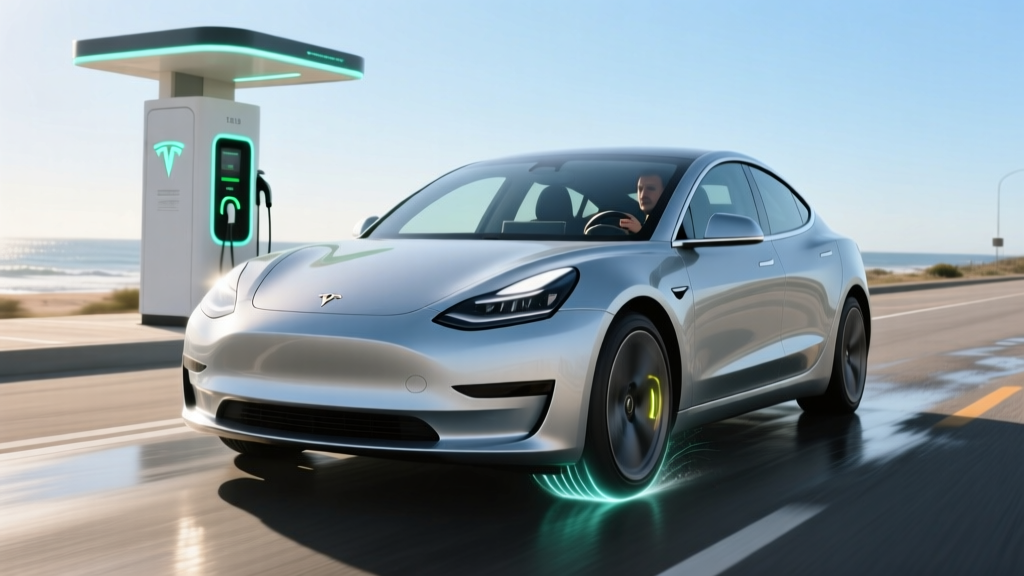
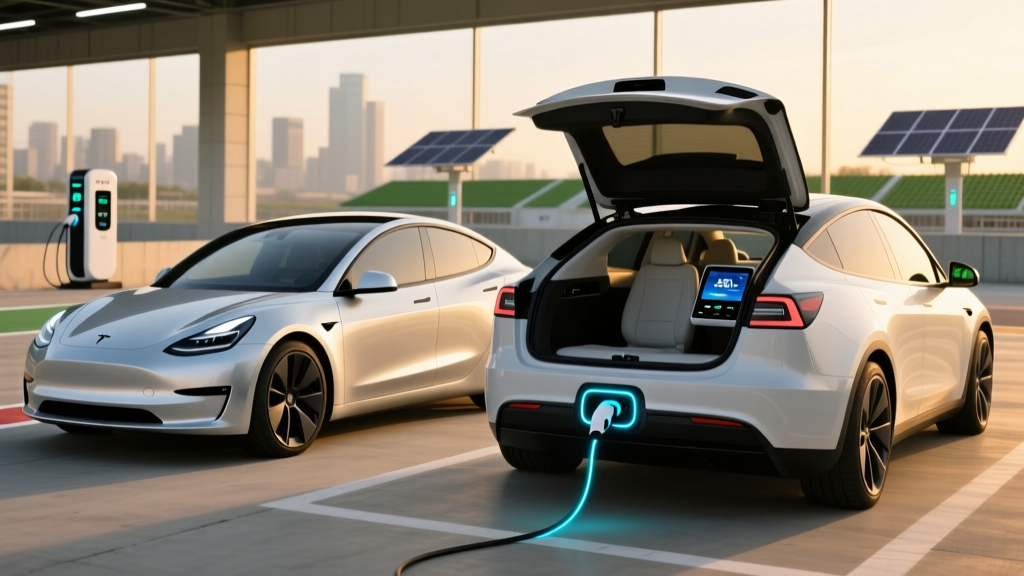
Tesla's Supercharger network remains the most reliable public DC fast-charging ecosystem in North America, and the Highland Model 3 takes full advantage of it.
| Charging Level | Power (kW) | Speed | Notes |
|---|---|---|---|
| Level 1 (120V household) | ~1.4 kW | ~5 mi/hr | Emergency/trickle only |
| Level 2 (240V, 48A Wall Connector) | 11.5 kW | ~44 mi/hr | Full charge in ~7.5 hours |
| Level 2 (240V, 32A mobile connector) | 7.7 kW | ~30 mi/hr | NEMA 14-50 outlet |
| DC Fast (V3 Supercharger) | 250 kW peak | ~175 mi in 15 min | 10–80% in ~25 min |
| DC Fast (V4 Supercharger) | Up to 250 kW | Similar to V3 | Newer stations, CCS adapter compatible |
Understanding the charge curve: The 250 kW peak rate applies only between roughly 10–30% State of Charge (SoC). From 30–60%, the rate tapers to approximately 150–170 kW. Above 80%, it drops further to protect the NMC battery, falling below 50 kW. This is why Tesla (and we) quote 10–80% times rather than 0–100%. Charging the final 20% can add another 20–30 minutes — plan accordingly on road trips and charge to 80% unless you need the full battery for your destination.
At home, the Tesla Wall Connector on a 60-amp circuit delivers the full 11.5 kW (48 amps continuous). That's enough to recover a full day's driving (40–50 miles) in about an hour, or fully recharge overnight. Installation costs vary widely — expect $500–$2,000 depending on whether your electrical panel needs an upgrade. Always have a licensed electrician assess your panel capacity before committing to a 60-amp circuit.
The Highland Model 3 retains the native NACS (North American Charging Standard) connector, meaning direct access to all Tesla Superchargers without adapters. For non-Tesla DC fast chargers using CCS1, Tesla sells a CCS adapter (~$175), though most Supercharger stations now cover the routes that matter.
Acceleration Boost: What It Actually Does
The Acceleration Boost is a $2,000 over-the-air software upgrade available for the Long Range AWD Model 3. It's not a hardware change — the motors, inverter, and battery are identical whether you purchase it or not. What Tesla does is remap the torque curve, allowing the dual motors to deliver peak torque more aggressively in the 0–50 mph range where it matters most for stoplight-to-stoplight performance and highway merging.
Measured results with the Boost enabled:
- 0–60 mph: 3.9 seconds (Tesla claim; independent tests show 3.8–4.1s depending on surface, temperature, and tire condition)
- 0–30 mph: ~1.6 seconds — this is where the Boost is most noticeable
- Quarter mile: ~12.3 seconds at ~113 mph
- 5–60 mph rolling start: ~4.4 seconds
In practice, the difference between 4.2 and 3.9 seconds sounds marginal on paper. Behind the wheel, it's not. The 0–30 mph shove is noticeably sharper, and the car feels more eager to respond to partial-throttle inputs during highway passing. The dual-motor AWD system manages torque vectoring between front and rear axles seamlessly, with no perceptible lag or wheelspin on dry pavement.
For context, a 3.9-second 0–60 time puts the Model 3 Long Range with Acceleration Boost in the company of a Porsche 718 Cayman S, a BMW M340i xDrive, or a Chevrolet Corvette C7 — but with four doors, a usable back seat, a frunk, and a $47,000 starting price. The value proposition is hard to argue with.
Pricing, Trims, and Federal Tax Credit Eligibility
| Configuration | MSRP | After Est. §30D Credit |
|---|---|---|
| Model 3 RWD (Base) | $38,990 | ~$31,490 (if eligible) |
| Model 3 Long Range AWD | $47,740 | ~$40,240 (if eligible) |
| Model 3 LR AWD + Accel. Boost | $49,740 | ~$42,240 (if eligible) |
| Model 3 Performance | $54,990 | ~$47,490 (if eligible) |
All prices include destination fee but exclude state/local fees and optional paint, wheels, or FSD.
Federal tax credit (§30D) eligibility for the Model 3 in 2026: The Model 3 qualifies for up to $7,500 under IRS §30D rules, but eligibility depends on three factors:
- MSRP cap: The vehicle must have an MSRP below $55,000 (sedans). All current Model 3 trims clear this threshold.
- Buyer income cap: Modified AGI must not exceed $150,000 (single), $225,000 (head of household), or $300,000 (married filing jointly).
- Battery sourcing requirements: The $7,500 is split into two halves — $3,750 for critical minerals and $3,750 for battery component sourcing. Tesla has progressively shifted supply chains, but the exact credit amount ($3,750 or $7,500) can change as sourcing rules tighten annually. Check the latest fueleconomy.gov tax credit listings for the current status.
Since 2024, the credit can be transferred to the dealer at point of sale, reducing your purchase price directly rather than waiting for a tax refund. Consult a tax professional to confirm your specific eligibility.
Interior, Tech, and Daily Livability
The Highland refresh addressed the most common complaints about the pre-2024 Model 3: cabin noise, ride quality, and material finish. The result is a noticeably more refined sedan that competes more credibly with the BMW i4 and Mercedes EQB on comfort, even if Tesla's minimalist approach remains polarizing.
What improved with Highland:
- Acoustic glass all around reduces wind and road noise significantly at highway speeds
- Revised rear suspension with frequency-selective dampers smooths out rough pavement
- Ventilated front seats (a long-requested feature) are now standard on Long Range and above
- Rear passengers get an 8-inch touchscreen for climate, media, and seat heater controls
- Ambient lighting, improved materials on the dash and door panels, and a power-folding rear seat
What's still divisive:
- No physical stalks — turn signals are on the steering wheel buttons, and gear selection is via the touchscreen (with backup buttons on the overhead console)
- No Apple CarPlay or Android Auto — Tesla's native infotainment is capable but closed
- Everything routes through the 15.4-inch center touchscreen, including glovebox release and mirror adjustment
Cargo and passenger space:
- Trunk: 21 cu ft (class-leading for a compact sedan)
- Frunk (front trunk): ~2 cu ft — useful for charging cables or a small bag
- Rear legroom: 35.3 inches — adequate for adults on shorter trips, tight for tall passengers on long drives
- Front headroom: 40.3 inches; rear headroom: 37.6 inches
Driver assistance: The Model 3 comes standard with Tesla's Basic Autopilot (lane centering, adaptive cruise control, automatic emergency braking). Enhanced Autopilot ($6,000) adds auto lane change, autosteer on highways, and smart summon. Full Self-Driving (Supervised) at $8,000 adds traffic light/stop sign recognition and city street autosteer. All of these are SAE Level 2 systems — you must keep your hands on the wheel and eyes on the road at all times. Tesla's FSD is not autonomous driving.
Pros and Cons
- 3.9s 0–60 for under $50K is unmatched value
- 330+ mi EPA range with top-tier efficiency (134 MPGe)
- Supercharger network access — best public charging reliability
- Highland cabin is genuinely quieter and more refined
- Over-the-air updates keep adding features post-purchase
- Strong safety ratings (IIHS Top Safety Pick+, NHTSA 5-star)
- Generous cargo space with frunk + trunk
- No physical turn signal stalks or gear selector — steep learning curve
- Touchscreen-only controls frustrate some drivers
- No Apple CarPlay / Android Auto
- Rear seat is tighter than BMW i4 or Hyundai Ioniq 6
- Insurance costs run 15–30% higher than comparable gas sedans
- Acceleration Boost is non-refundable and tied to the car, not your account
- FSD ($8,000) remains a Level 2 system despite the name
Who Should Buy the Model 3 Highland with Acceleration Boost?
Choose this configuration if:
- You want sports-car acceleration in a practical, daily-drivable sedan
- You commute 30–80 miles round trip and can charge at home
- You take road trips 3–5 times per year and value Supercharger network reliability
- You're tech-comfortable and don't mind a touchscreen-centric interface
- You want the lowest cost-per-mile of any performance sedan on the market
Look elsewhere if:
- You need a spacious rear seat for adult passengers regularly (consider the Hyundai Ioniq 6 or BMW i4)
- You refuse to give up Apple CarPlay or physical buttons
- You live in an apartment without home charging access and your area has sparse public charging
- You want a traditional luxury badge and dealership experience (BMW i4, Mercedes EQE)
The Model 3 Long Range AWD with Acceleration Boost occupies a unique niche: it's the cheapest way to get sub-4-second acceleration in a four-door EV with over 300 miles of range. For the performance-minded EV buyer who prioritizes efficiency and charging infrastructure over luxury-brand cachet, it's the one to beat.
Frequently Asked Questions
Can I add the Acceleration Boost after purchasing the car?
Yes. The Acceleration Boost is an over-the-air software purchase available through the Tesla app at any time after delivery. It costs $2,000 and activates instantly. It is tied to the vehicle's VIN, not your Tesla account, so it stays with the car if you sell it.
Does the Acceleration Boost reduce my range or battery life?
Not measurably in normal driving. The Boost changes throttle mapping and low-speed torque delivery, not the battery's maximum output or capacity. Aggressive driving will consume more energy regardless, but the software unlock itself doesn't degrade the battery faster. Tesla's battery warranty (8 years / 120,000 miles, retaining at least 70% capacity) remains unchanged.
How does the Model 3 LR with Boost compare to the Model 3 Performance?
The Model 3 Performance ($54,990) does 0–60 in 2.9 seconds and includes track mode, adaptive dampers, sport seats, and a higher top speed. It also has slightly less EPA range (315 mi) due to wider tires and more aggressive tuning. The LR with Boost is 0.9 seconds slower to 60 but saves $5,250 and gains 15+ miles of range — a smart trade for most buyers who don't plan to hit the track.
Does the 2025 Model 3 qualify for the full $7,500 federal tax credit?
It depends on your income and the current battery-sourcing determination. The Model 3's MSRP is well under the $55,000 sedan cap. If your modified AGI is below the thresholds ($150K single / $300K joint) and Tesla's current battery component and critical mineral sourcing meets the annual requirements, you can receive up to $7,500 — potentially at point of sale. Check IRS.gov and fueleconomy.gov for the latest eligibility status before purchasing.
What home charging setup do I need?
For optimal home charging, install a Tesla Wall Connector on a dedicated 60-amp circuit (requires a panel with at least 100 amps of spare capacity). This delivers 11.5 kW / 44 miles of range per hour. A standard NEMA 14-50 outlet on a 50-amp circuit provides about 30 mi/hr via the Mobile Connector. Have a licensed electrician evaluate your panel before installation — a 200-amp panel upgrade can add $1,500–$3,000 to the project.
Is the Highland Model 3 a good car for cold climates?
The Highland Model 3 uses a heat pump for cabin heating, which is significantly more efficient than resistive heating and helps preserve range in cold weather. Expect 20–30% range reduction in sustained sub-freezing temperatures (so roughly 230–260 miles from a full charge on the LR AWD). Preconditioning the battery while plugged in — which the Tesla app can schedule — restores charging speed and recovers some range. The AWD system provides confident traction in snow and ice.