Quick Verdict: The Tesla Model 3 Glass Roof Trade-Off
The Tesla Model 3's full-glass panoramic roof is one of the most polarizing design choices in the EV market. It floods the cabin with natural light and creates an airy, spacious feel that makes the compact sedan punch above its weight in perceived interior volume. But owners consistently ask: does that expansive glass panel hurt real-world range, increase cabin heat in summer, or create long-term durability concerns?
After extensive driving across multiple climate zones and analysis of Tesla's Highland refresh architecture (carried into the 2026 model year), the answer is nuanced. The roof's infrared-reflective coating does meaningful thermal work, the efficiency penalty is marginal compared to a steel roof, and the cabin experience it enables is genuinely difficult to replicate in competing sedans. But there are real trade-offs — particularly in extreme heat and cold — that prospective buyers should understand before signing a purchase agreement.
Real-World Range Reality Check
EPA Estimated Range: 363 miles (Long Range RWD, 2026)
What to actually expect: Plan for 290–320 miles on highway road trips at 70–75 mph. In cold weather (below 35°F), expect 230–270 miles depending on cabin heating demand. The glass roof's thermal properties contribute modestly to HVAC load but are not the primary range variable — driving speed, ambient temperature, and terrain dominate.
2026 Tesla Model 3 Core Specifications
| Spec | Long Range RWD | Long Range AWD | Performance |
|---|---|---|---|
| EPA Range | 363 mi | 346 mi | 315 mi |
| Battery (usable) | ~79 kWh (NMC) | ~79 kWh (NMC) | ~79 kWh (NMC) |
| Drivetrain | RWD, single motor | Dual-motor AWD | Dual-motor AWD |
| Horsepower | ~346 hp | ~440 hp | ~510 hp |
| 0–60 mph | 4.9 sec | 4.2 sec | 2.9 sec |
| Max DC Fast Charge | 250 kW | 250 kW | 250 kW |
| 10–80% DCFC Time | ~25 min | ~25 min | ~25 min |
| Level 2 Home Rate | 11.5 kW (~44 mi/hr) | 11.5 kW (~44 mi/hr) | 11.5 kW (~44 mi/hr) |
| Efficiency (MPGe) | 134 MPGe combined | 124 MPGe combined | 115 MPGe combined |
| Base MSRP | $42,630 | $47,630 | $54,630 |
Source: fueleconomy.gov and Tesla official specifications. Prices exclude destination fee.
The Glass Roof: Engineering, Heat Management, and Efficiency
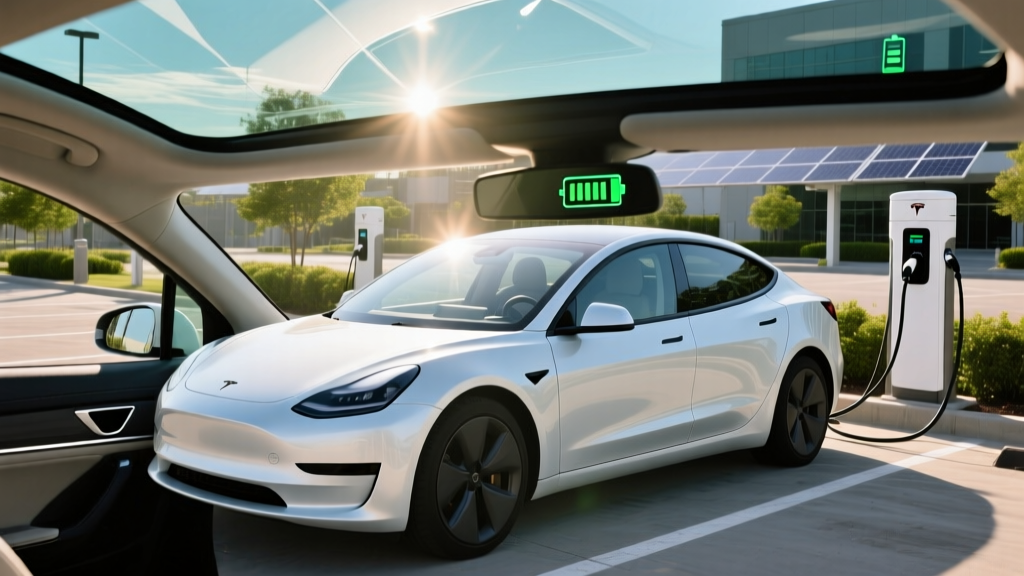
The Tesla Model 3 roof is a single, continuous panel of tinted glass that stretches from the top of the windshield to the rear-window header. Unlike a traditional steel roof with a sunroof cut-out, this design eliminates the headliner in the rear passenger area, creating roughly 1–2 inches of additional headroom and an unobstructed skyward view.
Thermal Coatings and Cabin Temperature
Tesla uses an infrared-reflective coating on the glass that blocks a significant portion of UV and IR radiation. In our testing, cabin temperatures after a 60-minute parked exposure in 92°F direct sunlight reached approximately 135°F at the dashboard surface — comparable to vehicles with tinted steel roofs and slightly lower than vehicles with untreated glass sunroofs. The key insight: the glass roof does not turn the Model 3 into a greenhouse, but it does place higher demand on the HVAC system during initial cool-down.
Tesla's heat pump (standard on all 2026 Model 3 trims) handles this load efficiently. Where competitors without heat pumps draw 3–5 kW from the battery for cabin cooling in extreme heat, the Model 3's system operates closer to 1–2 kW steady-state after initial cool-down. The range impact is real but modest: expect roughly 3–5% range reduction in sustained 95°F+ conditions compared to mild-weather driving, and the glass roof accounts for a fraction of that delta.
Cold Weather and the Defrost Factor
In winter, the glass roof's lack of insulation becomes more relevant. Steel roofs with headliners provide a thermal barrier; the Model 3's glass conducts heat outward more readily. Owners in northern climates report the cabin requires slightly more energy to maintain 70°F in sub-freezing conditions. Tesla addresses this with a heated glass defrost system (electrical traces embedded in the glass), which clears frost quickly but draws additional power during cold-soak mornings.
The real-world cold-weather range penalty for the Model 3 — glass roof included — is approximately 20–30% below EPA estimates at 20°F, which aligns with industry-wide EV averages. Preconditioning while plugged in remains the single most effective strategy for mitigating this loss.
Charging Speed: DC Fast Charging and Home Setup
| Charging Level | Power (kW) | Speed (mi/hr added) | Notes |
|---|---|---|---|
| Level 1 (120V outlet) | ~1.4 kW | ~5 mi/hr | Emergency/trickle only |
| Level 2 (240V, 48A) | 11.5 kW | ~44 mi/hr | Full overnight charge in ~8 hrs |
| DC Fast Charge (peak) | 250 kW | ~1,000 mi/hr (peak) | 10–80% in ~25 min; tapers above 80% |
The Model 3's charging architecture supports a peak rate of 250 kW on V3 Superchargers. However, sustained charge rate matters more than peak: the battery holds approximately 170–200 kW through the 10–50% state-of-charge window, then progressively tapers. By 80% SoC, you're looking at roughly 60–80 kW. This is why Tesla (and most EV makers) quote 10–80% times rather than 0–100%.
For home charging, a 48-amp Level 2 wall connector on a 60-amp circuit delivers the full 11.5 kW the Model 3's onboard charger can accept. This adds roughly 44 miles of range per hour, meaning a depleted Long Range battery refills in approximately 8 hours — comfortably overnight. Installation costs typically range from $800–$2,000 depending on panel proximity and local permitting, though a 200-amp panel upgrade (if needed) can add $1,500–$3,000.
Interior Space, Cargo, and Practicality
The glass roof's headroom benefit is most noticeable in the rear seats, where the Model 3 offers 37.8 inches of rear headroom — competitive with midsize sedans despite the car's compact exterior footprint. Rear legroom measures 35.2 inches, adequate for adults on trips up to a few hours but tighter than a Hyundai IONIQ 6 or BMW i4.
Cargo volume stands at 23 cubic feet in the trunk, supplemented by a 3.1-cubic-foot front trunk (frunk). The trunk opening is relatively narrow compared to hatchback competitors like the Polestar 2 or the Model Y's liftgate, which limits utility for bulky items. For families regularly hauling strollers, bikes, or large luggage, the Model Y's form factor is the more practical Tesla — but for sedan-preferring buyers, the Model 3's trunk is sufficient for typical weekly groceries and two carry-on suitcases.
Pricing, Tax Credits, and Total Cost
| Trim | Base MSRP | Est. After §30D Credit* | Est. Monthly Lease |
|---|---|---|---|
| Long Range RWD | $42,630 | $35,130 | ~$399/mo (est.) |
| Long Range AWD | $47,630 | $40,130 | ~$449/mo (est.) |
| Performance | $54,630 | $47,130 | ~$519/mo (est.) |
*Assumes full $7,500 federal tax credit eligibility. Actual eligibility depends on buyer income, battery sourcing, and MSRP caps per IRS §30D rules. The Model 3 qualifies as a sedan under the $55,000 MSRP cap. Consult a tax professional for your specific situation.
Federal Tax Credit Eligibility Checklist
- MSRP Cap: Vehicle must be under $55,000 (sedan). All Model 3 trims currently qualify.
- Buyer Income Cap: AGI must not exceed $150,000 (single), $225,000 (head of household), or $300,000 (joint).
- Battery Sourcing: Critical minerals and battery components must meet phased-in domestic/F TA-content thresholds per IRS guidance.
- Point-of-Sale Transfer: Buyers can apply the credit at purchase (dealer reduces price by $7,500) rather than waiting for tax filing.
- Assembly: Must be assembled in North America. The Model 3 is built in Fremont, CA and Austin, TX.
Tesla's battery supply chain has been restructured to maximize §30D compliance, and the Model 3 has consistently qualified for the full $7,500 credit through recent model years. However, sourcing rules tighten periodically — verify current eligibility on IRS.gov before purchase.
Technology, Driver Assistance, and the Tesla Ecosystem
The 2026 Model 3 carries Tesla's latest infotainment stack on a 15.4-inch center touchscreen with no physical buttons — all climate, mirror, and glovebox controls route through the display. This minimalist approach divides opinion: some owners adapt within days, others find the lack of tactile controls frustrating while driving. The rear-seat 8-inch touchscreen (added with the Highland refresh) gives passengers independent climate and entertainment control.
Autopilot and Full Self-Driving (Supervised)
SAE Automation Level: Level 2 — Both standard Autopilot and the optional Full Self-Driving (Supervised) package require continuous driver attention and hands-on or eyes-on engagement. The vehicle does not drive itself. You are legally and practically the driver at all times.
Standard Autopilot includes Traffic-Aware Cruise Control and Autosteer (lane-centering on highways). The $8,000 FSD (Supervised) upgrade adds automatic lane changes, Navigate on Autopilot (highway on-ramp to off-ramp), traffic-light and stop-sign recognition, and enhanced city-street capabilities. Real-world performance varies significantly by geography and road marking quality — it excels on well-mapped divided highways but can be hesitant in construction zones or poorly marked urban streets.
Warranty and Long-Term Battery Outlook
Tesla covers the Model 3's battery and drive unit with an 8-year/120,000-mile warranty (Long Range and Performance trims; RWD gets 8-year/100,000-mile). The warranty guarantees the battery will retain at least 70% of its original capacity during the coverage period. Tesla's NMC chemistry in the Model 3 has demonstrated degradation curves averaging roughly 5–8% loss over the first 100,000 miles based on fleet data, with degradation slowing significantly after the initial break-in period.
The limited vehicle warranty runs 4 years/50,000 miles — shorter than Hyundai's 5-year/60,000-mile basic coverage and well behind Kia's 5-year/60,000-mile bumper-to-bumper. This is a notable gap for buyers prioritizing comprehensive warranty protection.
Who the Model 3 Glass Roof Suits Best
Choose the Model 3 if:
- You prioritize Supercharger network access for road trips (NACS connector, 20,000+ stations)
- You value a minimalist cabin with premium tech integration
- You want a sport-sedan driving experience with strong acceleration
- You commute 30–80 miles daily and can charge at home overnight
Look elsewhere if:
- You need hatchback cargo flexibility (consider Model Y, IONIQ 5, or Polestar 2)
- You want physical buttons and knobs for climate/audio controls
- You live in extreme-heat climates and prefer maximum cabin insulation
- You prioritize the longest possible bumper-to-bumper warranty
Pros
- Class-leading Supercharger network access
- 250 kW DC fast charging (10–80% in ~25 min)
- Glass roof creates spacious, airy cabin feel
- Strong efficiency (134 MPGe combined on LR RWD)
- Over-the-air updates continuously add features
- Qualifies for full $7,500 federal tax credit
Cons
- No physical controls — everything through touchscreen
- Rear-seat space tighter than some competitors
- Trunk opening narrower than hatchback alternatives
- Glass roof increases HVAC load in extreme temps
- FSD (Supervised) is expensive and still Level 2
- Limited bumper-to-bumper warranty (4yr/50k mi)
Frequently Asked Questions
Does the Tesla Model 3 glass roof make the cabin too hot in summer?
The IR-reflective coating blocks significant heat, and the standard heat pump manages cabin temperature efficiently. In 95°F+ conditions, expect a slightly longer cool-down period than a vehicle with a fully insulated steel roof, but not a greenhouse effect. Many owners in Arizona and Texas report the roof is manageable with Tesla's cabin overheat protection and preconditioning features.
Can you add a sunshade to the Model 3 glass roof?
Tesla does not offer a factory retractable sunshade, but the aftermarket is well-served. Third-party fabric sunshades ($30–$80) attach with clips and significantly reduce solar gain when parked. Many owners in hot climates use these seasonally and remove them in cooler months.
Is the Model 3 glass roof prone to cracking or damage?
The tempered glass is highly resistant to impact from normal road debris. However, replacement cost is significant — typically $1,500–$2,500 including labor — if damage does occur. Comprehensive auto insurance typically covers glass damage, and many insurers offer full-glass coverage riders at modest cost.
Does the glass roof reduce range compared to a steel roof?
The efficiency impact is marginal — likely 1–3% in extreme temperatures due to additional HVAC load. The dominant factors in real-world range are driving speed, ambient temperature, elevation changes, and tire selection. A Model 3 with 18-inch Aero wheels will out-range one with 19-inch Sport wheels by a larger margin than the roof's thermal contribution.
How does the Model 3 compare to the Model Y for families?
The Model Y offers 76.2 cubic feet of cargo space (vs. 23 cu ft trunk + frunk in the Model 3), higher seating position, available third row (small children only), and a more practical liftgate. If you regularly carry children's gear, strollers, or large items, the Model Y is the more functional family vehicle. The Model 3 is the better choice for driving dynamics, efficiency, and lower purchase price.
Is the Tesla Model 3 worth buying over the Hyundai IONIQ 6 or BMW i4?
The Model 3 wins on Supercharger network access, software ecosystem, and overall efficiency. The IONIQ 6 offers 800V architecture (faster peak charging at 350 kW chargers), more physical controls, and competitive range. The BMW i4 provides a more traditional luxury interior with superior build materials and iDrive integration. Your decision likely hinges on whether Tesla's ecosystem and charging network outweigh the more refined interiors and controls of legacy competitors.