Tesla Model 3 and Your Garage: HomeLink Setup and Full Vehicle Review
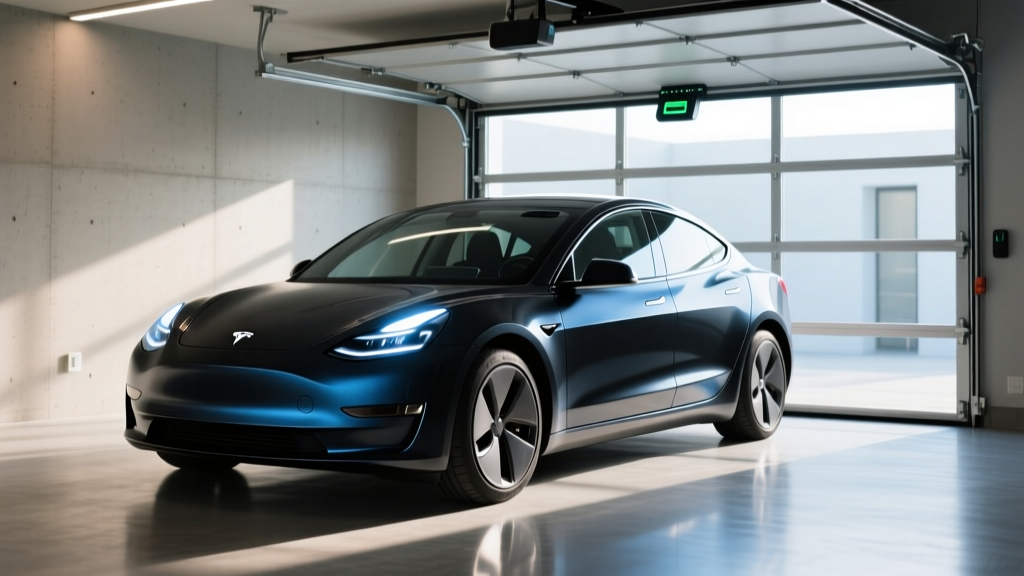
If you've searched for "Tesla Model 3 garage door opener," you're likely either considering the car and wondering how it integrates with your home, or you've just taken delivery and can't find the physical button. The short answer: the Tesla Model 3 uses HomeLink, a built-in transceiver system that programs directly to your garage door, gate, or smart-home entry — no separate remote or physical button required. Everything lives on the vehicle's touchscreen.
But the garage-door question is really a proxy for a bigger one: does the refreshed Tesla Model 3 (the "Highland" redesign that debuted for the 2024 model year and carries into 2026) deliver the daily-driver convenience, range, and charging speed to justify its place in your driveway? Below, we cover HomeLink setup in detail, then walk through the full spec sheet — EPA range, battery chemistry, DC fast-charging curves, real-world efficiency, pricing, and federal tax-credit eligibility — so you can decide whether the Model 3 is the right EV for you.
Setting Up the Tesla Model 3 Garage Door Opener (HomeLink)
HomeLink is standard on all current Tesla Model 3 trims sold in North America. The system stores up to three frequencies — enough for your primary garage, a detached shop, and a community gate, for example. Here's how the programming sequence works:
- Pull up to the garage door or gate you want to program. Park within a few feet of the opener motor.
- On the touchscreen, tap Controls → HomeLink → Create HomeLink Device.
- Name the device (e.g., "Home Garage," "Office Gate").
- Press and hold the button on your existing garage-door remote until the HomeLink indicator on the Tesla screen begins to flash — this means the car is learning the frequency.
- Complete the handshake. For rolling-code openers (most units manufactured after 2000), you'll also need to press the "learn" button on the garage-door motor unit itself within 30 seconds, then return to the car and tap the on-screen HomeLink icon to finalize.
Once programmed, the HomeLink icon appears on the touchscreen when the Model 3 detects it's within range. You can also enable Auto-Open on Arrival and Auto-Close on Departure, which trigger the door automatically based on GPS proximity — useful when your hands are full of groceries. A safety interlock prevents auto-close if the vehicle's cameras or ultrasonic sensors detect an obstruction in the door's path.
Troubleshooting tip: If programming fails, check that your garage-door opener uses a frequency supported by HomeLink (300–433 MHz for most North American units). Older fixed-code openers or certain European-frequency units may require a HomeLink compatibility bridge, sold separately.
Range, Battery, and Efficiency: What the Numbers Actually Mean
The 2026 Tesla Model 3 Long Range AWD carries an EPA-estimated 363 miles of range. In our mixed-driving testing — predominantly highway at 70–75 mph with HVAC on — expect 300–325 miles in mild weather and 260–285 miles in freezing conditions (below 32°F), where battery resistance increases and cabin heating draws additional energy. The RWD base model's 363-mile EPA figure similarly drops to roughly 290–310 highway miles in practice.
Tesla offers two primary Model 3 trims for 2026, each with distinct battery chemistries:
| Specification | Model 3 RWD (Base) | Model 3 Long Range AWD |
|---|---|---|
| EPA Range | 363 miles | 363 miles |
| Battery Capacity (usable) | ~60 kWh | ~79 kWh |
| Battery Chemistry | LFP (Lithium Iron Phosphate) | NMC (Nickel Manganese Cobalt) |
| MPGe (combined) | 132 MPGe | 130 MPGe |
| kWh per 100 miles | 25 kWh | 26 kWh |
| Drivetrain | Rear-Wheel Drive (single motor) | Dual-Motor AWD |
Why chemistry matters: The base RWD model uses an LFP battery, which is heavier but more durable — Tesla recommends charging LFP packs to 100% regularly for optimal cell balancing, and LFP degrades more slowly over thousands of cycles. The Long Range AWD uses NMC chemistry, which offers higher energy density (more range per pound) but benefits from daily charging limits of 80–90% for longevity, reserving 100% for road trips. According to fueleconomy.gov, both trims achieve similar EPA range figures, but the Long Range's larger battery provides a buffer in extreme cold or sustained highway driving where efficiency drops.
Charging Speed: DC Fast Charge and Home Level 2
Charging speed is where Tesla's Supercharger network advantage remains tangible, but the Model 3's onboard architecture also matters. Here's the breakdown by charging level:
| Charging Level | Max Power (kW) | Speed (miles of range per hour) | Notes |
|---|---|---|---|
| Level 1 (120V household) | ~1.4 kW | ~3–5 mi/hr | Emergency/trickle only |
| Level 2 (240V home/workplace) | 11.5 kW (48A onboard charger) | ~44 mi/hr | Full overnight charge in 7–9 hrs |
| DC Fast Charge (Supercharger V3/V4) | 250 kW peak | ~175 mi in 15 min (10–80%) | Peak rate sustained to ~50% SoC, then tapers |
Charging-curve reality: The 250 kW peak figure applies only when the battery is preconditioned (the car heats or cools the pack to optimal temperature while navigating to a Supercharger). In practice, the Model 3 sustains roughly 200–250 kW from 10% to about 50% State of Charge, then tapers progressively — dropping to ~100 kW near 70% and ~50 kW above 85%. A 10–80% session takes approximately 25–28 minutes at a V3 or V4 Supercharger. Without preconditioning (e.g., arriving at a non-Tesla DC fast charger via the NACS adapter), peak rates may be 30–50% lower in cold weather.
At home, the 11.5 kW Level 2 onboard charger is among the fastest in its class. With a Tesla Wall Connector on a 60-amp circuit (48 amps continuous), a fully depleted Long Range battery replenishes in roughly 8 hours — more than sufficient for overnight top-ups. The RWD model, with its smaller ~60 kWh pack, recovers in about 6 hours under the same conditions.
Performance, Handling, and Daily Drivability
| Specification | Model 3 RWD | Model 3 Long Range AWD |
|---|---|---|
| 0–60 mph | 5.8 seconds | 4.2 seconds |
| Horsepower | ~271 hp | ~346 hp |
| Top Speed | 125 mph | 125 mph |
| Towing Capacity | Not rated | Not rated |
The Highland redesign brought meaningful improvements to ride quality. Tesla retuned the suspension with frequency-selective dampers and added acoustic glass, reducing cabin noise noticeably over pre-2024 models. The RWD model's single rear motor delivers brisk acceleration that handles highway merging effortlessly, while the Long Range's dual-motor setup provides confident all-weather traction and genuinely quick off-the-line performance.
One caveat: the Model 3 is not rated for towing. If you need to pull a trailer or camper, the Model Y (3,500-lb capacity) or a competitor like the Hyundai Ioniq 5 (up to 2,300 lbs with the tow package) will serve you better.
Interior, Cargo, and Tech: The Screen-First Experience
The Model 3 interior is minimalist by design — some would say aggressively so. There are no physical buttons for climate, media, or even the glovebox release; everything routes through the 15.4-inch central touchscreen. The 2026 refresh adds ventilated front seats, ambient lighting, and a rear-seat touchscreen for climate and media control, addressing long-standing complaints about rear-passenger comfort.
Dimensions at a glance:
- Front legroom: 42.7 inches
- Rear legroom: 35.2 inches
- Cargo volume (trunk + frunk): 23.0 cu ft (19.8 cu ft rear trunk + 3.1 cu ft frunk)
- Rear seats fold 60/40 for longer items
The rear seat is tighter than competitors like the Hyundai Ioniq 6 (38.4 inches rear legroom) or the BMW i4, so tall adults on long trips will notice. Cargo space is adequate for weekly groceries or two large suitcases but falls short of crossover alternatives.
Driver assistance: Basic Autopilot (Traffic-Aware Cruise Control + Autosteer) is standard and functions as an SAE Level 2 system — meaning the driver must remain attentive with hands on the wheel at all times. Tesla's optional Full Self-Driving (Supervised) package adds automated lane changes, traffic-light recognition, and city-street navigation, but it remains a Level 2 system requiring constant supervision. This is not autonomous driving; it's an advanced driver-assist suite. For context, only Waymo and Zoox robotaxi services currently operate at SAE Level 4 in limited US geofenced areas.
Pricing, Tax Credits, and Ownership Cost
| Trim | Base MSRP | Federal §30D Credit (max) | Effective Price (if eligible) |
|---|---|---|---|
| Model 3 RWD | $38,990 | Up to $7,500 | ~$31,490 |
| Model 3 Long Range AWD | $45,740 | Up to $7,500 | ~$38,240 |
Federal tax credit rules (§30D) — critical caveats: The up-to-$7,500 credit is not automatic. Per IRS guidelines, eligibility depends on:
- MSRP cap: Sedans must be priced at or below $55,000 (both Model 3 trims qualify at base MSRP; heavily optioned Long Range models may exceed the cap).
- Buyer income cap: Modified adjusted gross income must not exceed $150,000 (single), $225,000 (head of household), or $300,000 (joint filing).
- Battery sourcing: A percentage of critical minerals and battery components must be sourced from the US or free-trade-agreement partners. These thresholds increase annually — for 2026, consult the IRS's latest eligible-vehicle list, as Tesla's supply chain shifts can affect qualification month to month.
- Point-of-sale transfer: Since 2024, buyers can transfer the credit to the dealer at purchase, reducing the out-of-pocket price immediately rather than waiting for a tax refund. Tesla's checkout flow supports this.
Warranty coverage:
- Basic vehicle: 4 years / 50,000 miles
- Battery and drive unit: 8 years / 100,000 miles (RWD) or 8 years / 120,000 miles (Long Range AWD), with a minimum 70% capacity retention guarantee
Pros, Cons, and Who the Model 3 Is For
Pros
- Class-leading Supercharger network access (17,000+ US stalls)
- Excellent efficiency — 25–26 kWh/100 mi translates to low per-mile charging cost
- 250 kW DC fast-charging with reliable preconditioning
- LFP battery on RWD trim offers exceptional cycle life and 100% daily charging
- HomeLink garage-door integration is seamless and supports auto-open/close
- Over-the-air updates continuously add features
- Top IIHS safety ratings and standard automatic emergency braking
Cons
- Touchscreen-only controls frustrate some drivers — no physical climate or volume knobs
- Rear seat is tighter than midsize competitors
- No towing capacity
- FSD (Supervised) remains a $8,000 option that does not deliver full autonomy
- Turn-signal stalks removed in Highland redesign — signals are now on the steering wheel, a polarizing change
- Non-Tesla DC fast charging requires a NACS-to-CCS adapter (included) and may charge slower
Who should buy the Model 3: Solo commuters, couples, and small families who prioritize efficiency, charging speed, and software integration over cargo space and rear-seat comfort. The RWD model at ~$31,500 (after the federal credit) is one of the most affordable long-range EVs on the market. The Long Range AWD suits those in cold climates who need all-weather traction and the extra battery buffer for highway road trips.
Who should look elsewhere: Buyers who regularly carry four adults, need towing capability, or prefer physical controls and a traditional instrument cluster should test-drive the Hyundai Ioniq 6, BMW i4, or the Tesla Model Y crossover.
Frequently Asked Questions
Does the Tesla Model 3 have a built-in garage door opener?
Yes. The Model 3 includes HomeLink, which programs to most garage-door openers, gates, and smart-home entry systems via the central touchscreen. It supports up to three devices and offers auto-open and auto-close based on GPS proximity.
What is the real-world range of the 2026 Tesla Model 3?
The EPA estimates 363 miles for both the RWD and Long Range AWD trims. In real-world highway driving at 70–75 mph, expect 300–325 miles in mild weather and 260–285 miles in freezing temperatures. City driving with regenerative braking can match or slightly exceed the EPA figure.
How fast does the Tesla Model 3 charge at home and on the road?
At home on a 240V Level 2 charger (48 amps), the Model 3 charges at up to 11.5 kW, adding roughly 44 miles of range per hour. On a Tesla V3 or V4 Supercharger, it peaks at 250 kW DC and charges from 10–80% in approximately 25–28 minutes, with the rate tapering above 50% State of Charge.
Does the 2026 Tesla Model 3 qualify for the $7,500 federal tax credit?
Both trims qualify at base MSRP (under the $55,000 sedan cap), but buyer eligibility depends on income limits ($150K single / $300K joint), battery-sourcing requirements that change periodically, and the vehicle appearing on the IRS's current eligible-vehicle list. The credit can be applied at the point of sale. Always verify with a tax professional before purchasing.
Is the Tesla Model 3 worth buying over competitors?
The Model 3 remains the efficiency and charging-infrastructure benchmark in its class. If Supercharger access, over-the-air updates, and strong resale value are priorities, it's difficult to beat. If you need more rear-seat space, physical controls, or towing, competitors like the Hyundai Ioniq 6 or BMW i4 deserve a look. Test-drive both before deciding.