The Tesla Model 3 Frunk: Dimensions and What Actually Fits
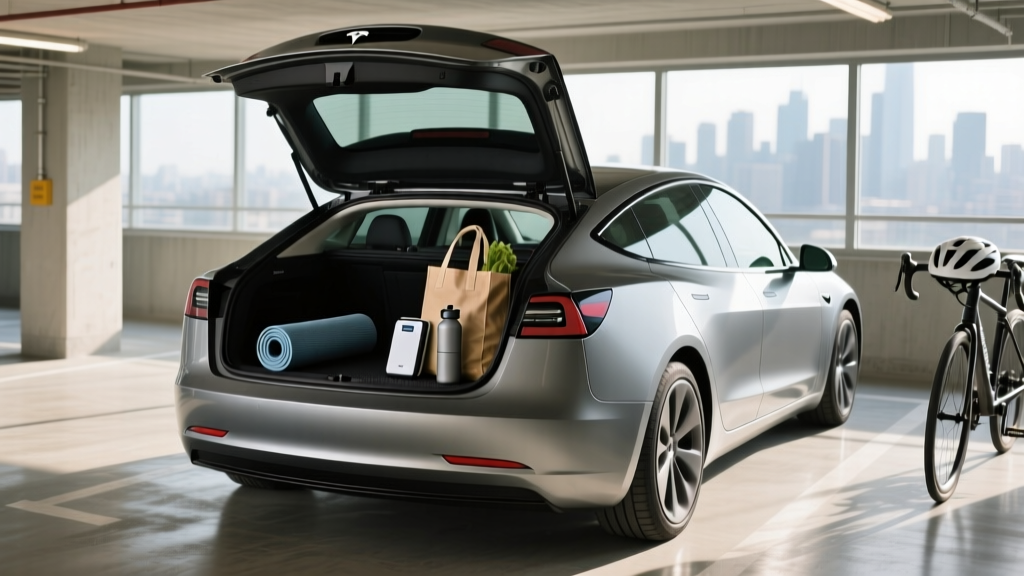
The Tesla Model 3 frunk (front trunk) is one of the most discussed storage features among EV buyers, and for good reason. Unlike sedans with traditional engine bays, the Model 3 uses its empty front compartment as a sealed, weatherproof storage area. For the current-generation Model 3 (the "Highland" refresh that debuted for the 2024 model year and carries into 2026), the frunk provides approximately 3.1 cubic feet of cargo space.
That's enough room for:
- A standard carry-on suitcase (22" × 14" × 9")
- A medium-sized backpack or laptop bag plus a jacket
- Grocery bags (roughly 2-3 standard reusable bags)
- The included Tesla mobile connector kit and a Level 1/Level 2 charging cable
The frunk is accessed via the touchscreen, the Tesla mobile app, or a physical button on the key fob. It features a soft-close motorized latch on current trims. One limitation: the opening is relatively narrow compared to the rear trunk, so bulky items like a large duffel bag need to be angled in carefully. There is no 12V accessory outlet inside the frunk on the refreshed Model 3, which limits its utility for powering a cooler or accessories during road trips.
| Compartment | Volume | Key Notes |
|---|---|---|
| Frunk (front trunk) | 3.1 cu ft | Weatherproof, motorized latch, no 12V outlet |
| Rear trunk | 21.0 cu ft | Liftback design, wide opening |
| Rear seats folded | ~56 cu ft (est.) | 60/40 split, slight load-floor step |
| Total (frunk + trunk, seats up) | 24.1 cu ft | Competitive with compact luxury sedans |
Real-World Range vs. EPA Estimates
The 2026 Tesla Model 3 is offered in three trims, each with distinct battery chemistries and EPA range ratings. Understanding these differences is critical because they affect daily usability, charging habits, and cold-weather performance.
EPA vs. Real-World Range (2026 Model 3):
- Model 3 RWD: EPA 272 mi → expect ~230-250 mi highway, ~200-220 mi in freezing weather
- Model 3 Long Range AWD: EPA 341 mi → expect ~290-310 mi highway, ~250-270 mi in freezing weather
- Model 3 Performance: EPA 315 mi → expect ~265-285 mi highway, ~230-250 mi in freezing weather
Highway driving at 75+ mph and temperatures below 32°F reduce range by 10-25%. The RWD trim's LFP battery tolerates regular 100% charging, partially offsetting its shorter range.
The RWD trim uses a lithium iron phosphate (LFP) battery pack, which Tesla recommends charging to 100% at least once per week for calibration. LFP cells are heavier and slightly less energy-dense than the nickel manganese cobalt (NMC) cells in the Long Range and Performance trims, but they offer longer cycle life and reduced fire risk. The Long Range and Performance trims use NMC chemistry and Tesla recommends daily charging to 80-90% for longevity, reserving 100% for road trips.
Battery, Charging Speed, and Efficiency
Charging speed is where the refreshed Model 3 made meaningful gains over the pre-2024 versions. The current platform supports faster DC fast charging and improved thermal preconditioning, which warms the battery before you arrive at a Supercharger.
| Charging Method | Max Rate | Speed / Time |
|---|---|---|
| Level 1 (120V household) | ~1.4 kW | ~3-4 miles per hour |
| Level 2 (240V home, 48A) | 11.5 kW | ~35-44 miles per hour |
| DC Fast Charge (RWD) | 170 kW peak | 10-80% in ~30 minutes |
| DC Fast Charge (Long Range / Performance) | 250 kW peak | 10-80% in ~22 minutes |
| Tesla Supercharger V4 | Up to 250 kW | Peak rate sustained to ~50% SoC, then tapers |
A critical note on DC fast charging: peak kW is not sustained across the entire session. The Model 3 Long Range hits 250 kW only between roughly 10-50% state of charge (SoC). From 50-80%, the rate drops to 100-130 kW, and above 80% it slows dramatically to protect battery health. This "charge curve taper" is normal for NMC chemistry. LFP-equipped RWD models have a slightly flatter curve but a lower peak, meaning the 10-80% session takes a few minutes longer.
Efficiency figures from the EPA:
- RWD: 132 MPGe combined / 25 kWh per 100 miles
- Long Range AWD: 134 MPGe combined / 25 kWh per 100 miles
- Performance: 121 MPGe combined / 28 kWh per 100 miles
These are among the most efficient figures in the EV sedan segment, thanks to the Model 3's low drag coefficient (~0.219 Cd), heat pump standard on all trims, and Tesla's powertrain efficiency.
Performance and Drivetrain
| Trim | Drivetrain | Horsepower | 0-60 mph | Battery (usable) |
|---|---|---|---|---|
| RWD | Rear-wheel drive | 271 hp | 5.8 sec | ~57.5 kWh (LFP) |
| Long Range AWD | Dual-motor AWD | 346 hp | 4.2 sec | ~75 kWh (NMC) |
| Performance | Dual-motor AWD | 510 hp | 2.9 sec | ~75 kWh (NMC) |
The Performance trim adds a new front motor and revised rear drive unit compared to pre-refresh models, along with adaptive damping, track mode, and larger brakes. Even the base RWD delivers responsive acceleration thanks to instant electric torque, though the single-motor setup can show traction limitations on wet surfaces during hard launches.
All trims feature regenerative braking with adjustable intensity via the touchscreen. One-pedal driving is effective in most scenarios but the Model 3 does not come to a complete hold without applying the brake pedal at very low speeds — a behavior that differs from some competitors like the Hyundai Ioniq 6.
Pricing, Trims, and Federal Tax Credit Eligibility
The 2026 Tesla Model 3 starts at a competitive price point within the EV sedan market, especially when factoring in potential federal incentives.
| Trim | Base MSRP | Max §30D Credit | Effective Price (if eligible) |
|---|---|---|---|
| RWD | $38,990 | Up to $7,500 | From ~$31,490 |
| Long Range AWD | $45,990 | Up to $7,500 | From ~$38,490 |
| Performance | $52,990 | Up to $7,500 | From ~$45,490 |
Federal tax credit caveats (§30D): The full $7,500 credit requires meeting both critical-mineral and battery-component sourcing thresholds set by the IRS. Additionally:
- MSRP cap: Sedans must be priced at or below $55,000 (all Model 3 trims qualify)
- Income cap: Modified AGI must not exceed $150,000 (single), $225,000 (head of household), or $300,000 (joint)
- Point-of-sale transfer: Eligible buyers can transfer the credit to the dealer at purchase, reducing the upfront cost rather than waiting for tax filing
- Battery sourcing: The RWD trim's LFP battery has historically faced tighter critical-mineral scrutiny; verify current-year eligibility on the IRS qualified vehicles list before purchasing
Tesla also offers destination fees (~$1,390) that are not included in the base MSRP above. Popular add-ons like Full Self-Driving (Supervised) capability ($8,000), premium paint colors ($1,000-$2,500), and 20" wheels ($1,500 on Performance) can push transaction prices higher.
Interior, Tech, and Driver Assistance
The Highland refresh significantly improved the Model 3 interior. Ambient lighting, ventilated front seats, a rear passenger touchscreen, and improved sound insulation bring it closer to luxury-segment expectations. However, the minimalist approach remains polarizing:
- No physical turn signal stalks: Turn signals are now integrated into the steering wheel rim buttons, a change that draws consistent criticism in owner surveys
- No instrument cluster: All driving information (speed, range, navigation) is displayed on the central 15.4" touchscreen
- Gear selection: Swipe-based on the touchscreen with backup buttons on the overhead console — no traditional shift lever
The infotainment system remains one of the fastest and most responsive in the industry, with built-in navigation, streaming apps, and a robust Tesla mobile app for remote preconditioning, charging monitoring, and vehicle location.
Driver assistance: All Model 3 trims include Tesla's Basic Autopilot (adaptive cruise control and lane centering). This is an SAE Level 2 driver-assistance system — the driver must remain attentive, keep hands on the wheel, and is fully responsible for the vehicle at all times. Enhanced Autopilot ($6,000) and Full Self-Driving (Supervised) ($8,000) add automatic lane changes, navigate-on-autopilot, and traffic light/stop sign recognition, but these remain Level 2 systems requiring constant supervision.
Important: Tesla's Autopilot and FSD (Supervised) are not self-driving systems. They are SAE Level 2 driver-assistance features. The driver must maintain visual and physical awareness at all times. Only Level 4 services like Waymo operate without a human driver, and those are limited to geofenced urban areas.
Pros, Cons, and Verdict
Pros
- Best-in-class efficiency (132-134 MPGe combined on RWD/LR)
- Tesla Supercharger network reliability — the most dependable DC fast-charging network in North America
- Excellent software, OTA updates, and app integration
- Frunk adds useful weatherproof storage for cables and small bags
- Strong resale value relative to most EV competitors
- Heat pump standard on all trims (better cold-weather range retention)
Cons
- Turn signal buttons on the steering wheel frustrate many drivers
- No physical instrument cluster or head-up display
- Rear-seat headroom is tight for passengers over 6'2"
- Build quality, while improved, still trails German and Korean competitors in panel-gap consistency
- FSD (Supervised) remains an expensive option that does not deliver true autonomy
- Limited service center network in rural areas
Who the Model 3 suits best: Tech-forward commuters and small households who prioritize efficiency, charging-network reliability, and performance. The Long Range AWD is the sweet spot for road-trippers who need 300+ miles of practical range. The RWD trim is ideal for budget-conscious buyers with reliable home charging. It's less suited for families needing easy child-seat access (rear doors are relatively narrow) or anyone who prefers traditional physical controls.
How It Compares to Key Competitors
The Model 3 competes against the Hyundai Ioniq 6, BMW i4, Polestar 2, and the upcoming next-generation Chevrolet Bolt. Against the Ioniq 6, the Model 3 offers a larger charging network advantage and slightly better efficiency, but the Hyundai provides physical controls, a more conventional instrument display, and a larger rear seat. The BMW i4 offers superior build quality and a traditional driving feel but at a significantly higher price point and with lower efficiency.
The Model 3's frunk is smaller than the Hyundai Ioniq 6's front storage area but larger than the BMW i4's, which has no functional frunk. For buyers who specifically need front-trunk utility for charging cables or a secondary cargo zone, the Model 3's 3.1 cu ft frunk is adequate but not class-leading.
Warranty and Long-Term Ownership
Tesla's warranty coverage for the 2026 Model 3:
- Basic vehicle: 4 years / 50,000 miles
- Battery & drive unit (RWD): 8 years / 100,000 miles, minimum 70% capacity retention
- Battery & drive unit (Long Range / Performance): 8 years / 120,000 miles, minimum 70% capacity retention
Real-world battery degradation data from fleet analyses suggests Tesla's NMC packs lose approximately 8-12% capacity over the first 100,000 miles, with the steepest drop occurring in the first 10,000-15,000 miles before stabilizing. LFP packs in the RWD trim show slower initial degradation but a slightly higher long-term linear decline. The 70% retention threshold at 8 years is the warranty trigger — if your battery drops below that, Tesla replaces or refurbishes it at no cost.
For long-term ownership cost data, the IIHS has awarded the refreshed Model 3 its Top Safety Pick+ rating, which helps with insurance premiums, though EV insurance costs remain 15-25% higher than comparable gas sedans on average.
Frequently Asked Questions
How big is the Tesla Model 3 frunk?
The 2026 Model 3 frunk offers 3.1 cubic feet of storage. It comfortably fits a carry-on suitcase, a few grocery bags, or your charging cables, but the opening is narrower than the rear trunk, so bulky items require careful positioning.
What is the real-world range of the Tesla Model 3?
The EPA rates the Long Range AWD at 341 miles, but real-world highway driving at 70-80 mph typically yields 290-310 miles. In freezing temperatures (below 32°F), expect 250-270 miles. The RWD trim delivers 230-250 real-world highway miles from its 272-mile EPA rating.
How fast does the Model 3 charge at home and on the road?
At home on a Level 2 (240V, 48A) charger, the Model 3 adds approximately 35-44 miles of range per hour — a full overnight charge covers most daily needs. On DC fast chargers, the Long Range and Performance trims peak at 250 kW and reach 10-80% in about 22 minutes. The RWD peaks at 170 kW with a 10-80% time of roughly 30 minutes.
Does the Tesla Model 3 qualify for the $7,500 federal tax credit?
All three trims fall under the $55,000 MSRP cap for sedans. However, eligibility depends on your income (≤$150K single / ≤$300K joint), and the battery must meet critical-mineral and component-sourcing requirements that change annually. Check the IRS qualified vehicles list before purchasing. The credit can be transferred at the point of sale to reduce your upfront cost.
Is the Model 3 worth buying over the Hyundai Ioniq 6 or BMW i4?
Choose the Model 3 if you prioritize Supercharger network access, software quality, efficiency, and the lowest cost-per-mile. Choose the Ioniq 6 if you prefer physical controls, a more spacious rear seat, and 800V charging architecture. Choose the BMW i4 if build quality and a traditional driving experience matter more than efficiency and charging speed.
Can I charge the Model 3 RWD to 100% daily?
Yes. Tesla recommends charging the LFP battery in the RWD trim to 100% at least once per week for accurate state-of-charge calibration. This is a key advantage over the NMC-equipped Long Range and Performance trims, which should be held at 80-90% for daily use.
What are the biggest drawbacks of the refreshed Model 3?
The most common complaints from owners are the steering-wheel-mounted turn signal buttons (replacing the traditional stalk), the absence of a driver instrument cluster, and limited rear headroom for tall passengers. Service center availability in rural areas also remains a concern for some buyers.