The Quick Answer: Does Tesla Have FM Radio?
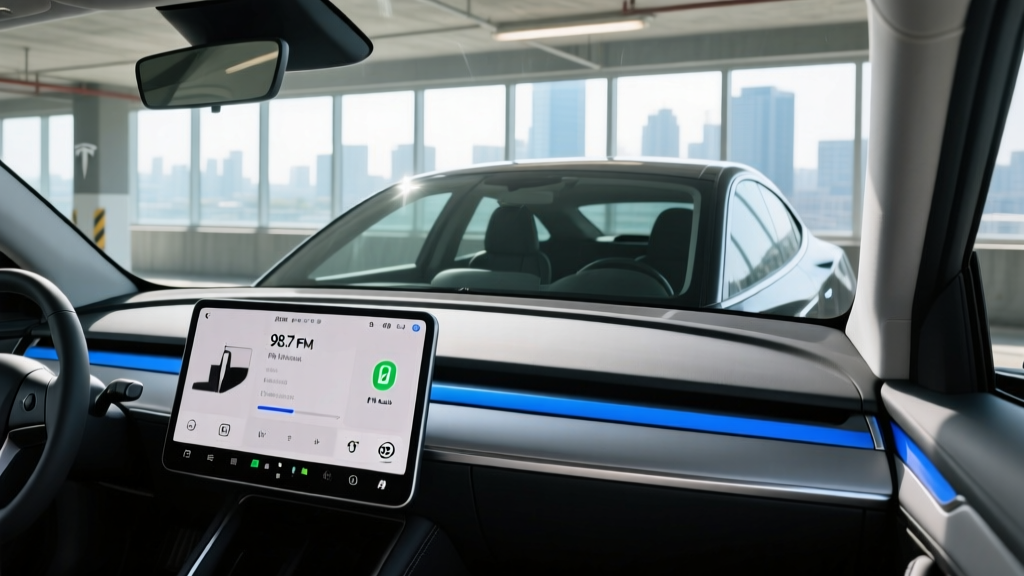
No. No Tesla vehicle — whether the Model 3, Model Y, Model S, or Model X — includes a traditional AM or FM radio tuner. Tesla removed analog radio hardware entirely from its lineup years ago, opting instead for an internet-based audio ecosystem that streams over the car's built-in LTE/5G connection or a paired phone hotspot.
Instead of FM/AM, Tesla provides:
- Streaming radio via TuneIn, which aggregates thousands of internet radio stations (including most major FM/AM stations that simulcast online)
- Native apps for Spotify, Apple Music (via Bluetooth), Tidal, and SiriusXM (streaming via app, not satellite tuner)
- Bluetooth audio for any music/podcast app on your phone
- USB playback for local media files
The trade-off is real: in areas with poor cellular coverage — rural highways, national parks, mountain passes — streaming radio can buffer or drop entirely. Traditional FM radio would continue working in those dead zones. For the vast majority of suburban and urban drivers with consistent LTE coverage, the streaming alternatives are functionally equivalent, with better metadata (album art, station info) and no static. But if you regularly drive through cellular dead zones and rely on local radio for weather or emergency broadcasts, this is a legitimate limitation worth knowing before you buy.
2026 Tesla Model 3: Range, Battery, and Real-World Efficiency
The 2026 Tesla Model 3 continues with the refreshed "Highland" body style introduced for the 2024 model year, now offered in three trims. Here's what the EPA says — and what you'll actually experience on the road.
| Spec | RWD (Base) | Long Range RWD | Long Range AWD |
|---|---|---|---|
| EPA Range | 272 mi | 363 mi | 341 mi |
| Battery (usable) | ~60 kWh (LFP) | ~79 kWh (NMC) | ~79 kWh (NMC) |
| EPA Efficiency | 132 MPGe / 25 kWh/100mi | 134 MPGe / 25 kWh/100mi | 125 MPGe / 27 kWh/100mi |
| 0–60 mph | 5.8 sec | 4.9 sec | 4.2 sec |
| Horsepower | ~271 hp | ~346 hp | ~440 hp |
| Drivetrain | RWD (single motor) | RWD (single motor) | AWD (dual motor) |
| Base MSRP | $38,990 | $44,990 | $47,990 |
LFP vs. NMC: What Chemistry Means for Your Model 3
The base RWD Model 3 uses a lithium iron phosphate (LFP) battery, while the Long Range trims use nickel manganese cobalt (NMC). This distinction matters for daily ownership:
| Factor | LFP (RWD) | NMC (Long Range) |
|---|---|---|
| Daily charging to 100% | Recommended — Tesla advises periodic 100% charges for LFP calibration | Not recommended — set daily limit to 80% to preserve longevity |
| Cycle life | Higher — 3,000+ cycles before significant degradation | Moderate — ~1,500–2,000 cycles |
| Energy density | Lower — smaller battery, less range | Higher — more range in similar package |
| Cold-weather performance | Slightly more range loss in extreme cold | Better cold performance with preconditioning |
Charging Speed: DC Fast Charging and Home Level 2
Charging speed is where the Model 3 remains competitive in 2026, though newer 800V architectures from Hyundai/Kia and some Chinese-market EVs have surpassed its peak rate. The Model 3 runs on a 400V architecture.
| Charging Method | RWD (LFP) | Long Range (NMC) |
|---|---|---|
| Max DC Fast Charge | 170 kW peak | 250 kW peak |
| 10–80% DC Time | ~25 min | ~22 min |
| Sustained DC Rate (10–80%) | ~120 kW average | ~170 kW average |
| Level 2 (240V / 48A) | 11.5 kW / ~37 mi/hr | 11.5 kW / ~44 mi/hr |
| Level 1 (120V) | ~1.4 kW / ~4 mi/hr | ~1.4 kW / ~4 mi/hr |
| Connector | NACS (native Tesla) | NACS (native Tesla) |
Charging curve reality check: The Long Range Model 3 hits its 250 kW peak only between roughly 10–25% state of charge (SoC). Above 40%, the rate tapers progressively — dropping to ~120 kW by 60% and ~50 kW by 80%. This is why the 10–80% average is approximately 170 kW, not the advertised 250 kW peak. Always precondition the battery (the car does this automatically when you navigate to a Supercharger) to hit peak rates; arriving at a Supercharger with a cold battery can cut charge speed in half.
The Model 3's NACS connector gives it native access to Tesla's Supercharger network — over 20,000 stalls in North America — without an adapter. With the CCS-to-NACS adapter (included with newer deliveries), you can also use Electrify America, EVgo, and other CCS networks, though Tesla's Supercharger reliability remains measurably higher per J.D. Power EV charging satisfaction data.
Interior, Cargo, and Technology
The refreshed Model 3 interior is a study in minimalism. A single 15.4-inch touchscreen handles everything — navigation, climate, media, vehicle settings — with no physical instrument cluster or stalks (turn signals are on the steering wheel; gear selection is via the screen or overhead console).
Passenger and Cargo Dimensions
| Dimension | Model 3 |
|---|---|
| Front legroom | 42.7 in |
| Rear legroom | 35.2 in |
| Trunk (rear) | 23 cu ft |
| Front trunk (frunk) | 3.1 cu ft |
| Total cargo (rear seats folded) | ~65 cu ft |
Rear-seat space is adequate for adults under 6 feet but noticeably tighter than a Hyundai Ioniq 6 or BMW i4. The panoramic glass roof creates an airy cabin but offers no shade — Tesla includes a removable mesh sunshade for the rear glass only.
Infotainment and Driver Assistance
Beyond the streaming-radio setup discussed above, the Model 3's infotainment system includes:
- Over-the-air (OTA) software updates that add features regularly
- Integrated navigation with real-time Supercharger routing and battery preconditioning
- Netflix, YouTube, and arcade games while parked
- Dashcam and Sentry Mode (surveillance recording while parked)
- Ventilated front seats, ambient lighting, and power-folding mirrors (added in the Highland refresh)
Autopilot and FSD (Supervised): Every Model 3 comes with Basic Autopilot (lane centering + adaptive cruise). Tesla's Full Self-Driving (Supervised) package is a $8,000 add-on (or $99/month) that adds automatic lane changes, traffic-light recognition, and city-street navigation. Per NHTSA's SAE automation framework, both Autopilot and FSD Supervised are SAE Level 2 systems — the driver must remain fully attentive with hands on the wheel and eyes on the road at all times. This is not autonomous driving.
Pricing, Tax Credits, and Total Cost
The 2026 Model 3 lineup is priced to compete directly with the Hyundai Ioniq 6, BMW i4, and Polestar 2. Here's where each trim lands before and after the federal tax credit.
| Trim | MSRP | Est. Credit | Net Price |
|---|---|---|---|
| RWD | $38,990 | Up to $7,500 | ~$31,490 |
| Long Range RWD | $44,990 | Up to $7,500 | ~$37,490 |
| Long Range AWD | $47,990 | Up to $7,500 | ~$40,490 |
Federal tax credit eligibility (IRS §30D): As of 2026, the Model 3 qualifies for up to $7,500 in federal tax credits, split between a $3,750 critical-minerals component and a $3,750 battery-components component. Eligibility depends on:
- MSRP cap: The vehicle must have an MSRP at or below $55,000 (sedans) — all Model 3 trims qualify
- Buyer income cap: Modified AGI must not exceed $150,000 (single), $225,000 (head of household), or $300,000 (joint filers)
- Battery sourcing: Critical minerals and battery components must meet phased-in domestic-content thresholds; Tesla's shifting supply chain means the exact credit amount can vary by delivery month — always verify current eligibility at IRS.gov §30D before ordering
- Point-of-sale transfer: You can transfer the credit to the dealer at purchase to reduce your out-of-pocket cost immediately, rather than waiting to claim it on your tax return
Warranty Coverage
| Coverage | Term |
|---|---|
| Basic vehicle | 4 years / 50,000 miles |
| Battery & drive unit (RWD) | 8 years / 100,000 miles |
| Battery & drive unit (Long Range) | 8 years / 120,000 miles |
| Battery capacity threshold | Minimum 70% retention during warranty period |
Pros, Cons, and Who Should Buy the Model 3
Pros
- Class-leading Supercharger network access (20,000+ stalls, highest uptime)
- Strong efficiency — 25–27 kWh/100mi beats most rivals
- Excellent OTA update cadence keeps the car current
- 363-mile EPA range (Long Range RWD) is among the best in its class
- Lowest cost of ownership in the segment when combining fuel, maintenance, and depreciation
- Strong resale value relative to non-Tesla EVs
Cons
- No AM/FM radio — streaming only, problematic in cellular dead zones
- Turn signals on steering wheel (no stalks) require re-learning
- Rear seat is tighter than Ioniq 6 or BMW i4
- No physical buttons for climate, volume, or glovebox — everything is touchscreen
- FSD (Supervised) remains Level 2 despite its name and $8,000 price tag
- Glass roof has no integrated shade; cabin heat soak in summer
- Insurance costs tend to run 15–25% higher than comparable ICE sedans
Who the Model 3 Suits Best
- Tech-forward commuters who value Supercharger convenience and OTA updates over traditional car interfaces
- Solo drivers or couples who don't regularly carry rear-seat adults
- Home-charging owners with a Level 2 setup — the Model 3 rewards daily plug-in habits
- Budget-conscious EV buyers seeking the lowest total cost of ownership in a premium sedan
The Model 3 is less ideal for families needing spacious rear seats, drivers in rural areas with poor cell coverage (no FM radio), or anyone who prefers physical controls over touchscreen-only operation.
Model 3 vs. Key Competitors: Is It Still Worth It?
| Spec | Tesla Model 3 LR AWD | Hyundai Ioniq 6 SEL AWD | BMW i4 xDrive40 |
|---|---|---|---|
| EPA Range | 341 mi | 316 mi | 282 mi |
| Peak DC Charge | 250 kW | 350 kW (800V) | 205 kW |
| 10–80% DC Time | ~22 min | ~18 min | ~31 min |
| AM/FM Radio | No | Yes (HD Radio) | Yes |
| Rear Legroom | 35.2 in | 37.0 in | 35.2 in |
| Base MSRP | $47,990 | $48,250 | $57,900 |
- Choose the Model 3 if you prioritize Supercharger network reliability, best-in-class range, and lowest total cost — and you're comfortable with a touchscreen-only interface and streaming-only audio.
- Choose the Ioniq 6 if you want faster 800V charging (18-min 10–80%), a traditional AM/FM radio, more rear-seat space, and physical climate buttons.
- Choose the BMW i4 if you prefer a conventional luxury sedan experience with premium materials, dealer service infrastructure, and don't mind paying a premium for shorter range.
Frequently Asked Questions
Can I add FM radio to my Tesla aftermarket?
There is no practical way to add a traditional FM tuner to a Tesla. The car lacks the antenna hardware, wiring, and software integration. Your best alternatives are a phone-based FM radio app streaming over Bluetooth, a portable standalone FM radio, or simply using TuneIn's internet streams (which carry most major FM stations online).
Does TuneIn work without a data connection?
No. TuneIn requires an active internet connection — either Tesla's built-in Premium Connectivity (included for the first year, then $10/month) or a phone hotspot. Without data, you're limited to Bluetooth playback from downloaded content on your phone and USB media files.
What is the real-world range of the 2026 Model 3?
For the Long Range AWD, EPA rates it at 341 miles. Real-world highway driving at 75 mph typically yields 290–310 miles. In winter conditions below freezing, expect 240–270 miles. The RWD (LFP) model delivers roughly 220–250 real-world miles in moderate weather and 200–220 in cold conditions.
How fast does the Model 3 charge at home?
On a 48-amp Level 2 home charger (the Tesla Wall Connector on a 60-amp circuit), the Model 3 gains approximately 37–44 miles of range per hour of charging. A full charge from 10% to 100% takes roughly 6–8 hours depending on trim — ideal for overnight charging.
Does the 2026 Tesla Model 3 qualify for the federal EV tax credit?
Yes, all Model 3 trims are currently eligible for up to $7,500 under IRS §30D, provided you meet the income caps ($150K single / $300K joint) and the battery-sourcing requirements are satisfied for your specific delivery batch. The credit can be transferred at point of sale to reduce your purchase price directly. Always verify current eligibility on IRS.gov before ordering, as sourcing rules can shift.
Is the Model 3 worth buying vs. the competition in 2026?
For most buyers, yes — the Model 3 Long Range offers the best combination of range, efficiency, charging infrastructure, and total cost of ownership in its segment. However, if FM radio access, physical buttons, or rear-seat space are priorities, the Hyundai Ioniq 6 is a strong alternative with faster 800V charging to boot.