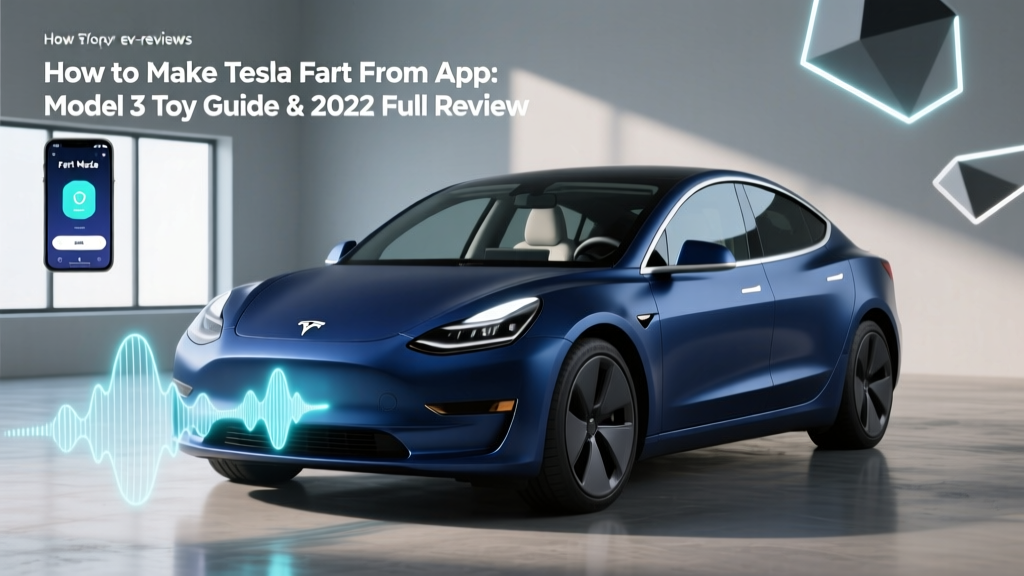
Yes, your Tesla can fart on command — and it only takes about 15 seconds to set up. But before we get to the party trick, let's talk about why the 2026 Tesla Model 3 remains one of the most data-dense, efficiency-leading sedans in the EV market, and whether its $38,990 starting price (before incentives) still makes sense against a rapidly closing field of competitors.
This guide covers the Boombox fart feature step-by-step, then delivers a full engineering-and-ownership review of the current-generation Model 3 Long Range and Performance trims — with exact EPA numbers, real-world range caveats, charging curves, and IRS §30D tax credit eligibility you won't find in Tesla's marketing materials.
How to Make Tesla Fart From App (Boombox Feature)
The "Tesla fart" trick uses the car's built-in Boombox feature, which plays custom or preset sounds through the external pedestrian warning speaker (the PWS speaker mounted near the front bumper). Here's exactly how to trigger it from your phone:
- Open the Tesla mobile app on your iOS or Android device (ensure you're logged in and your Model 3 is paired).
- Tap the "Toybox" menu at the bottom of the app's vehicle control screen.
- Select "Boombox" from the available toy options.
- Choose a preset sound — options include "Fart," "Burp," "Applause," and several others. You can also record a custom sound clip.
- Tap "Play" — the sound will blast from the external speaker on your parked Model 3. You can also enable "Drive Mode" to play sounds while the car is moving at low speeds (under ~25 mph, though Tesla has restricted this in recent software updates for safety compliance).
Pro tip: For the classic "fart as someone walks by" prank, stand near the car with the app open and time your tap. The external speaker is surprisingly loud — roughly 75-80 dB at close range — so the effect is convincing. Note that Boombox requires a car with the external speaker hardware (standard on all 2019+ Model 3 vehicles) and software version 2022.44 or later.
On the car's touchscreen, you can also access Boombox directly: Controls → Toybox → Boombox. From the driver's seat, you can assign Boombox to a steering wheel scroll button for instant playback.
2026 Tesla Model 3: Quick Spec Sheet
| Spec | Long Range AWD | Performance AWD | RWD (Base) |
|---|---|---|---|
| EPA Range | 363 miles | 315 miles | 272 miles |
| Battery (usable) | ~79 kWh (NMC) | ~79 kWh (NMC) | ~60 kWh (LFP) |
| Horsepower | 346 hp | 510 hp | 271 hp |
| 0-60 mph | 4.2 sec | 2.9 sec | 5.8 sec |
| Drivetrain | Dual-Motor AWD | Dual-Motor AWD | Rear-Wheel Drive |
| Peak DC Fast Charge | 250 kW | 250 kW | 170 kW |
| 10-80% DC Charge | ~27 min | ~27 min | ~30 min |
| Level 2 Home Charge | 11.5 kW (~44 mi/hr) | 11.5 kW (~44 mi/hr) | 7.6 kW (~30 mi/hr) |
| MPGe (combined) | 132 MPGe | 116 MPGe | 136 MPGe |
| Base MSRP | $47,740 | $54,990 | $38,990 |
| Battery Warranty | 8 yr / 120,000 mi | 8 yr / 120,000 mi | 8 yr / 100,000 mi |
Real-World Range: What the EPA Sticker Doesn't Tell You
EPA Long Range AWD: 363 miles
Real-world highway (70-80 mph, mild weather): ~290-310 miles
Real-world mixed city/highway (moderate temps): ~320-340 miles
Cold weather (below 32°F, highway): ~230-260 miles (30-35% reduction)
Hot weather with heavy A/C (above 95°F): ~300-320 miles
The Model 3 Long Range's 363-mile EPA rating is among the highest of any production sedan in 2026, but EPA testing uses a specific drive-cycle blend that favors lower-speed, stop-and-go driving. On sustained highway runs at 75-80 mph — where aerodynamic drag dominates — expect to use roughly 28-30 kWh per 100 miles, translating to about 290-310 real miles from the ~79 kWh usable battery pack.
Cold weather is the bigger equalizer. Below freezing, the Model 3's heat pump (standard on all current trims) mitigates cabin heating losses, but battery internal resistance increases and regenerative braking is limited until the pack warms up. On a 20°F winter highway drive, plan for 230-260 miles of practical range before needing to charge. Tesla's navigation system accounts for this — when you enter a destination, the trip planner factors in temperature, elevation, and wind to predict arrival State of Charge (SoC) with impressive accuracy.
The base RWD model uses an LFP (lithium iron phosphate) battery, which trades energy density for longevity and cost. LFP cells tolerate frequent 100% charging without degradation concerns, making the RWD trim ideal for daily commuters who can charge at home every night. The Long Range and Performance trims use NMC (nickel manganese cobalt) chemistry, which Tesla recommends charging to 80% for daily use and 100% only for long trips.
Charging Speed: DC Fast, Home Level 2, and the Curve Reality
Charging speed is where buyers often get misled by peak kW numbers. Here's what the Model 3 actually delivers across charging scenarios:
| Charging Level | Power / Voltage | Speed (mi/hr added) | Typical Use Case |
|---|---|---|---|
| Level 1 (120V outlet) | ~1.4 kW | ~5 mi/hr | Emergency / overnight trickle |
| Level 2 (240V, 32A Mobile Connector) | 7.6 kW | ~30 mi/hr | Standard home charging |
| Level 2 (240V, 48A Wall Connector) | 11.5 kW | ~44 mi/hr | Upgraded home / destination |
| DC Fast (Tesla Supercharger V3) | Peak 250 kW | Up to 1,000 mi/hr (peak) | Road trips, 10-80% in ~27 min |
| DC Fast (CCS adapter at EA/others) | Peak ~200-250 kW | Varies by station | Non-Tesla network charging |
The charging curve matters more than the peak number. The Model 3 Long Range hits its 250 kW peak only between roughly 10-20% SoC under ideal thermal conditions (pack preconditioned to ~50°C). From 20-50%, it sustains around 150-180 kW. From 50-80%, it tapers to 60-90 kW. Above 80%, charging slows dramatically to protect battery health — expect 30-40 kW or less. This is why Tesla's navigation system routes you to Superchargers with enough battery to arrive at a low SoC, maximizing time in the fast-charging portion of the curve.
For home charging, the Tesla Wall Connector ($420) at 48 amps delivers 11.5 kW on a 60-amp circuit, adding roughly 44 miles of range per hour — enough to fully replenish the Long Range overnight in about 7-8 hours. Most owners find a 32-amp Mobile Connector (included with the car, using a NEMA 14-50 outlet) sufficient for daily needs, adding ~30 miles per hour.
NACS vs. CCS note: The 2026 Model 3 comes with the North American Charging Standard (NACS) port natively. Tesla Superchargers are NACS-native. For Electrify America, EVgo, and other CCS networks, you'll need Tesla's CCS adapter (~$175). As of 2026, most new non-Tesla DC fast chargers are adding NACS cables, reducing adapter dependency over time.
Performance, Efficiency, and Daily Drivability
The Model 3 Performance's 2.9-second 0-60 mph time places it in supercar territory, but the more relevant metric for daily driving is the Long Range AWD's 4.2-second sprint and its 132 MPGe combined efficiency rating. That translates to roughly 25 kWh per 100 miles in mixed driving — among the most efficient vehicles in its class, aided by Tesla's industry-leading 0.219 drag coefficient and SiC (silicon carbide) inverter efficiency.
The RWD base model is the efficiency champion at 136 MPGe combined (about 24 kWh/100 mi), thanks to lower weight and the single-motor drivetrain. For urban commuters covering 30-50 miles daily with home charging, the RWD's 272-mile EPA range is more than adequate, and the LFP battery's tolerance for daily 100% charges means you always wake up to full range.
Ride quality on the refreshed Model 3 (introduced for the 2024 model year and carried into 2026) is markedly improved over earlier versions — new frequency-selective dampers, acoustic glass, and additional sound deadening have transformed what was once a harsh-riding sedan into a genuinely comfortable cruiser. The 15.4-inch center touchscreen handles all vehicle functions (no instrument cluster), and the rear 8-inch screen provides rear passengers with climate and entertainment controls.
Cargo, Passenger Space, and Practicality
The Model 3 offers 23 cu ft of total cargo space — 19.8 cu ft in the rear trunk and 3.1 cu ft in the front trunk (frunk). That's competitive with compact luxury sedans but notably less than the Model Y's 76 cu ft or the Hyundai Ioniq 6's 12.3 cu ft trunk (though the Ioniq 6 has no frunk). For two adults on a week-long road trip with soft bags, the Model 3's cargo is sufficient. For families with strollers or bulk gear, the Model Y is the more practical Tesla.
Interior dimensions:
- Front headroom: 40.3 inches
- Front legroom: 42.7 inches
- Rear headroom: 37.8 inches
- Rear legroom: 35.2 inches
Rear seat comfort is the Model 3's most common criticism. The floor-mounted battery raises the floor, forcing rear passengers into a knees-up seating position. Adults over 6 feet will find legroom tight on longer journeys. The Model Y or a competing EV like the BMW i4 (with 35.2 inches of rear legroom but a more conventional seating position) may suit taller families better.
Pricing, Tax Credits, and Total Cost
| Trim | Base MSRP | Est. Destination | §30D Credit Eligibility | Effective Price (with credit) |
|---|---|---|---|---|
| RWD | $38,990 | $1,390 | Up to $7,500 (if sourcing rules met) | ~$32,880 |
| Long Range AWD | $47,740 | $1,390 | Up to $7,500 (if sourcing rules met) | ~$41,630 |
| Performance AWD | $54,990 | $1,390 | Up to $7,500 (if sourcing rules met) | ~$48,880 |
Critical tax credit caveats: Under IRS §30D rules for 2026, the Model 3 sedan qualifies under the $55,000 MSRP cap for sedans (all three trims clear this threshold). However, the actual credit amount — up to $7,500 — depends on two components:
- $3,750 for critical minerals: Requires a percentage of battery minerals sourced from the U.S. or free-trade-agreement partners.
- $3,750 for battery components: Requires a percentage of battery components manufactured or assembled in North America.
Tesla's Fremont-built Model 3 with its Panasonic battery cells has historically qualified for the full $7,500, but battery-sourcing requirements tighten annually. Additionally, buyer income caps apply: modified adjusted gross income (MAGI) must not exceed $150,000 (single), $225,000 (head of household), or $300,000 (joint). As of 2026, buyers can transfer the credit to the dealer at point of sale for an instant price reduction. Always verify current eligibility at IRS.gov and confirm with a tax professional before purchasing.
Tech, Autopilot, and Standout Features
The Model 3's technology stack remains a benchmark, though not without controversy:
- Autopilot (included): SAE Level 2 driver assistance with adaptive cruise control and lane centering. The driver must remain engaged — hands on the wheel, eyes on the road. This is not self-driving.
- Full Self-Driving (Supervised) — $8,000 option: Adds automatic lane changes, navigation-guided on/off-ramp handling, traffic light/stop sign recognition, and Smart Summon (car navigates parking lots to you). Still SAE Level 2 — the driver bears full responsibility. FSD's real-world performance varies significantly by region and road complexity.
- 15.4" touchscreen: Handles navigation, media, climate, vehicle settings, and the Toybox (where Boombox lives). Snappy interface, excellent map rendering, but no physical buttons for climate or volume (a dealbreaker for some).
- Over-the-air updates: Tesla regularly pushes software updates that add features, improve efficiency, or adjust vehicle dynamics. Boombox itself was added via OTA.
- Sentry Mode / Dashcam: Records from all cameras when parked; clips saved to USB drive.
- Dog Mode / Camp Mode: Maintains climate for pets or keeps HVAC running for overnight camping.
Autopilot and FSD (Supervised) are SAE Level 2 systems. They require continuous driver supervision. They do NOT make the Model 3 a self-driving car. You are legally and operationally the driver at all times. Misuse of these systems has resulted in NHTSA investigations and documented collisions. Use them as assistive tools, not replacements for attention.
Pros and Cons
- Class-leading efficiency (132-136 MPGe)
- Extensive Supercharger network (20,000+ stalls in North America)
- Fast DC charging (250 kW peak, 10-80% in ~27 min)
- OTA updates continuously add features
- Strong resale value relative to EV segment
- LFP option (RWD) for worry-free daily charging
- Fun Toybox features (Boombox fart, light shows, etc.)
- Cramped rear seat for taller passengers
- No physical controls for climate/volume
- FSD ($8,000) still requires full driver attention
- Insurance costs 20-35% above segment average
- CCS adapter needed for non-Tesla DC chargers
- Minimal cargo space vs. crossover alternatives
- Service center wait times in some metro areas
Who Should Buy the 2026 Tesla Model 3?
Choose the Model 3 RWD if: You commute 30-60 miles daily, charge at home, want the lowest entry price (~$32,880 after credit), and prefer LFP battery longevity.
Choose the Model 3 Long Range if: You take regular road trips (300+ miles), live in a cold climate where range loss matters, or want dual-motor AWD for snow/ice traction.
Choose the Model 3 Performance if: You want sub-3-second 0-60 performance, track-capable handling (adaptive dampers, larger brakes), and don't mind paying $54,990 and sacrificing some range.
Look elsewhere if: You need spacious rear seating for adults (consider BMW i4 or Hyundai Ioniq 6), you want crossover cargo room (Model Y, Ioniq 5), or you refuse to rely on a touchscreen for basic climate controls.
How It Stacks Up Against Key Competitors
The Model 3 Long Range's closest rivals in 2026 include the Hyundai Ioniq 6 (361 miles EPA, $46,500), BMW i4 eDrive40 (307 miles, $57,900), and the Polestar 2 Long Range (320 miles, $49,900). The Model 3 wins on efficiency, charging speed, and Supercharger network access. The Ioniq 6 offers a more conventional interior with physical controls and more rear headroom. The BMW i4 delivers superior build quality and a driver-focused cockpit. The Polestar 2 provides a more premium interior aesthetic but trails on range and charging speed.
For buyers prioritizing total cost of ownership, the Model 3 RWD at ~$32,880 (after federal credit) with home charging at ~$0.13/kWh yields a cost-per-mile of roughly $0.035 for electricity — compared to $0.12-$0.15/mile for a 30 MPG gas sedan at $3.50/gallon. Over 5 years and 75,000 miles, that's a fuel savings of approximately $6,400-$8,600, partially offset by higher insurance premiums (typically $200-$400/year more for a Model 3 vs. a comparable gas sedan, per fueleconomy.gov comparisons).
Frequently Asked Questions
Can I make my Tesla fart while driving?
Tesla restricted Boombox playback while in Drive in a 2022 software update following NHTSA concerns about pedestrian confusion. As of 2026, Boombox sounds primarily play when the vehicle is in Park. Some owners report limited low-speed playback, but Tesla's software updates can change this behavior at any time. The fart prank works best when parked.
Does the Model 3 qualify for the full $7,500 federal EV tax credit in 2026?
It depends on battery sourcing compliance and your personal income. The Model 3 sedan is under the $55,000 MSRP cap, but the credit's two $3,750 halves (critical minerals + battery components) depend on Tesla's supply chain meeting escalating annual thresholds. Check the fueleconomy.gov tax credit tracker for real-time eligibility, and confirm with a tax professional. Point-of-sale transfer is available if you qualify.
What's the real-world range of the Model 3 Long Range on a road trip?
Plan for 290-310 miles at highway speeds (70-80 mph) in moderate temperatures. In cold weather (below 32°F), expect 230-260 miles. Tesla's trip planner in the navigation system is highly accurate — trust its SoC predictions and arrive at Superchargers with 10-15% buffer for comfort.
How long does the Model 3 battery last before replacement?
Tesla's battery warranty covers 8 years / 120,000 miles (Long Range/Performance) or 8 years / 100,000 miles (RWD) with a minimum 70% capacity retention guarantee. Real-world data from Tesla's fleet suggests NMC packs retain approximately 85-90% capacity at 100,000 miles under normal use. LFP packs in the RWD model show even slower degradation due to the chemistry's inherent stability. A full battery replacement outside warranty currently costs $12,000-$16,000 depending on the pack.
Is the Tesla Model 3 cheaper to own than a gas car?
Over 5 years, the Model 3 typically saves $6,000-$9,000 in fuel costs vs. a 30 MPG gas sedan, but insurance runs 20-35% higher, and the purchase price (before credits) is above comparable gas sedans. With the $7,500 federal credit and home charging, the Model 3 RWD's total cost of ownership can undercut a Toyota Camry or Honda Accord over 5 years — especially when factoring in near-zero maintenance (no oil changes, minimal brake wear from regen). See the IRS clean vehicle credit page for current incentive details.
Sources: EPA fuel economy data via fueleconomy.gov, Tesla official specifications, IRS §30D guidance at irs.gov.