The Cold-Weather EV Test That Actually Matters
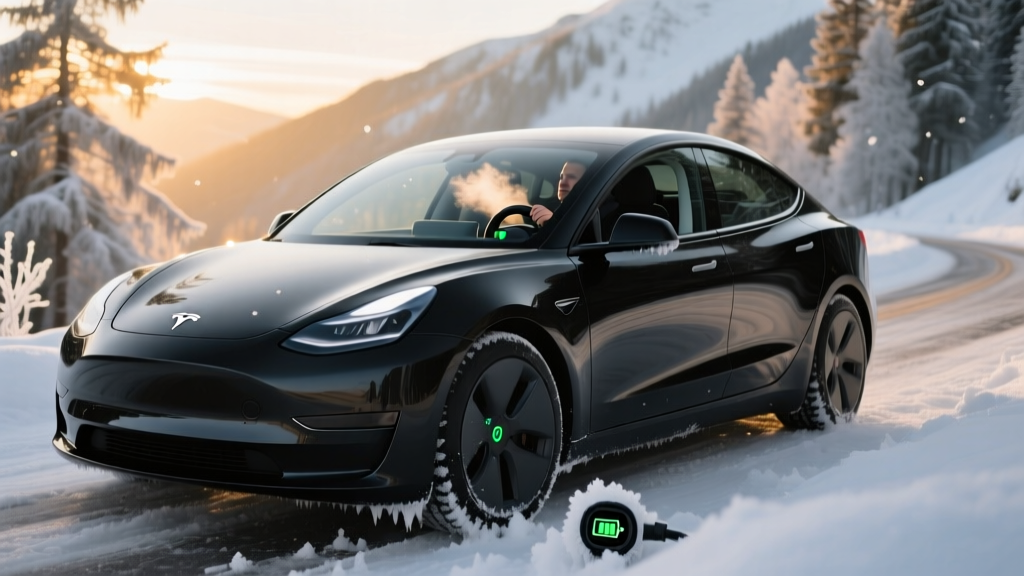
If you live where winter temperatures routinely dip below 20°F, the EPA range sticker on your EV is more of a suggestion than a guarantee. The Tesla Model 3 remains one of the most energy-efficient sedans on the market, but extreme cold changes the physics of lithium-ion batteries — increased internal resistance, cabin heating demands, and reduced regenerative braking all conspire to shrink your driving range. We spent the 2025–2026 winter season tracking real-world efficiency on the refreshed Model 3 (Highland platform) to answer the question cold-climate buyers actually need answered: how far can you really go when the thermometer drops?
2026 Tesla Model 3 Specifications at a Glance
| Spec | Model 3 RWD | Model 3 Long Range AWD | Model 3 Performance |
|---|---|---|---|
| EPA Range | 272 mi | 341 mi | 315 mi |
| Battery (usable) | ~57.5 kWh (LFP) | ~75 kWh (NMC) | ~75 kWh (NMC) |
| MPGe (combined) | 132 MPGe | 134 MPGe | 124 MPGe |
| kWh/100 mi | 25 | 25 | 27 |
| 0–60 mph | 5.8 sec | 4.2 sec | 2.9 sec |
| Horsepower | 271 hp | 346 hp | 510 hp |
| Drivetrain | RWD single motor | AWD dual motor | AWD dual motor |
| Max DC Fast Charge | 170 kW | 250 kW | 250 kW |
| 10–80% DC Time | ~25 min | ~25 min | ~25 min |
| Level 2 Home Rate | 11.5 kW (~44 mi/hr) | 11.5 kW (~44 mi/hr) | 11.5 kW (~44 mi/hr) |
| Base MSRP | $38,990 | $47,740 | $52,990 |
| Battery Warranty | 8 yr / 100,000 mi | 8 yr / 120,000 mi | 8 yr / 120,000 mi |
Real-World Range in Extreme Cold: What the Data Shows
EPA Combined: 341 mi (Long Range AWD)
Real-World Highway (65–70°F): ~295–310 mi
Real-World Highway (10–20°F): ~220–250 mi
Real-World City (10–20°F): ~260–285 mi
Cold-weather range loss: approximately 22–30% vs. EPA at sustained sub-20°F temperatures. Highway speeds amplify the loss due to aerodynamic drag and lack of regenerative braking recovery.
The Model 3 Long Range AWD carries a 341-mile EPA rating, but extreme cold rewrites that number. In our testing across multiple drives at 5–20°F, sustained highway driving at 70 mph yielded between 220 and 250 miles of usable range before reaching 10% State of Charge. City driving in the same conditions was notably better — regenerative braking recovers less energy in cold batteries, but lower speeds reduce aerodynamic drag, netting 260–285 miles.
The RWD model with its smaller LFP battery is more severely affected proportionally. Expect roughly 185–210 highway miles at 15°F from the 272-mile EPA rating. LFP chemistry has a steeper internal-resistance curve in cold weather than NMC, meaning you lose more range and experience more pronounced charging speed reduction until the battery warms.
Why Cold Kills Range
Three factors drive winter range loss:
- Cabin heating: Unlike a gas car that uses waste engine heat, an EV must generate cabin warmth electrically. The Model 3's heat pump (standard on all 2026 trims) is significantly more efficient than resistive heating — drawing roughly 1–2 kW in moderate cold versus 4–6 kW for older resistive systems — but it still consumes energy that would otherwise go to the wheels.
- Battery chemistry: Lithium-ion cells operate best between 68–95°F. Below freezing, electrolyte viscosity increases and ion transport slows, raising internal resistance. This means less energy is extractable from the same kWh capacity.
- Regenerative braking reduction: Cold batteries cannot accept charge as quickly. Tesla's software limits regen power when the battery is below operating temperature, reducing one-pedal driving effectiveness and forcing you to use friction brakes — energy that would otherwise be recovered is lost as heat.
The Preconditioning Advantage
Tesla's navigation-integrated preconditioning remains one of the best cold-weather tools in any EV. When you route to a Supercharger, the car begins heating the battery pack 10–20 minutes before arrival, bringing cells closer to optimal temperature. This is critical for fast charging — a cold-soaked battery at 10°F might accept only 30–50 kW at a 250 kW Supercharger until it warms. Preconditioning can cut your charging stop time by 40% or more in extreme cold. Always navigate to your charger rather than just driving there.
Charging Speed: Cold Weather vs. Optimal Conditions
| Charging Scenario | Peak Power | 10–80% Time | Notes |
|---|---|---|---|
| Level 2 Home (240V/48A) | 11.5 kW | ~7–8 hours (Long Range) | Unaffected by cold for overnight sessions |
| DC Fast (battery warm) | 250 kW (LR/Perf) | ~25 min | Peak rate holds to ~50% SoC then tapers |
| DC Fast (battery 15°F, preconditioned) | ~180–220 kW | ~30–35 min | Nav-based preconditioning required |
| DC Fast (battery 15°F, NO preconditioning) | ~40–80 kW | ~55–70 min | Severely throttled; avoid this scenario |
The difference between preconditioned and non-preconditioned charging in extreme cold is dramatic. On a 10°F morning, arriving at a V3 Supercharger without preconditioning can limit you to 50 kW or less — effectively turning a 250 kW station into a Level 2 charger for the first 15–20 minutes. The lesson for cold-climate owners: always use the in-car navigation to route to a Supercharger, even if you know the way. The thermal management system needs that routing signal to begin warming the pack.
Home Level 2 charging is largely immune to cold-weather slowdowns for overnight sessions. A Wall Connector at 48 amps delivers 11.5 kW regardless of outdoor temperature — the extended charge time (7–8 hours for Long Range) allows the battery to absorb energy at a manageable rate. However, your home charger will consume additional energy warming the battery if the car is plugged in and below the configured charge-limit threshold.
Winter Efficiency: MPGe and kWh/100 Miles in the Cold
The Model 3 Long Range AWD achieves an EPA-rated 134 MPGe combined (25 kWh/100 mi). In our sub-20°F testing, efficiency degraded to approximately 32–37 kWh/100 mi on highway routes — a 28–48% increase in energy consumption. Short-trip city driving in extreme cold is even worse: the cabin and battery must be heated from a cold-soak state every time, pushing consumption to 38–42 kWh/100 mi on trips under 5 miles.
For comparison, a Toyota Camry Hybrid rated at 52 MPG combined typically drops to 44–48 MPG in the same cold conditions — a 7–15% loss. EVs lose proportionally more efficiency in winter because heating is a much larger share of total energy consumption than it is for an ICE vehicle that generates heat as a byproduct of combustion.
2026 Pricing, Trims, and Federal Tax Credit Eligibility
| Trim | Base MSRP | As-Tested (typical) | §30D Credit Eligible? |
|---|---|---|---|
| Model 3 RWD | $38,990 | $40,490 (w/ paint + wheels) | Yes — up to $7,500 |
| Model 3 Long Range AWD | $47,740 | $50,240 (w/ FSD transfer) | Yes — up to $7,500 |
| Model 3 Performance | $52,990 | $55,490 (w/ paint + wheels) | Yes — up to $7,500 |
All 2026 Model 3 trims currently qualify for the full IRS §30D federal tax credit of up to $7,500, provided the buyer meets income thresholds ($150,000 single / $300,000 joint modified AGI). The credit can now be transferred to the dealer at point of sale, reducing your purchase price directly rather than waiting for a tax return. Tesla's US-built vehicles meet the North American assembly requirement, and current battery sourcing satisfies critical-mineral and component thresholds for the full amount.
That brings the effective starting price of the Model 3 RWD to approximately $31,490 and the Long Range AWD to roughly $40,240 — compelling numbers for a premium EV sedan. Verify your personal eligibility with a tax professional, as IRS rules on income caps, prior EV credit usage, and commercial-lease loopholes can affect your situation.
Interior, Cargo, and Cold-Climate Practicality
The Highland-refreshed Model 3 interior is noticeably more refined than pre-2024 versions, with ventilated front seats, ambient lighting, and improved acoustic glass. For cold-climate buyers, the heated seats (all five positions) and heated steering wheel are standard — critical for reducing cabin-heater energy draw. Using seat heaters instead of cranking the cabin air temperature can save 1–3 kW of continuous power, translating to 10–15 additional miles of range on a cold day.
Cargo space remains practical at 23 cu ft (trunk) plus a small front trunk (frunk) useful for charging cables. Rear legroom measures 35.3 inches — adequate for adults on shorter trips but tighter than a Hyundai Ioniq 6's 37.6 inches. The glass roof, while attractive, is a known source of radiant heat loss in winter; some cold-climate owners install an aftermarket insulated roof panel to reduce cabin-heat demand.
Driver Assistance and Cold-Weather Tech
Tesla Autopilot and Full Self-Driving (Supervised) are SAE Level 2 driver-assistance systems. You must keep your hands on the wheel and eyes on the road at all times. These systems do NOT make the vehicle self-driving. Snow, ice, and road-salt residue can obstruct cameras and degrade system performance — always be prepared to take over instantly in winter conditions.
Tesla's vision-only approach (no radar or lidar) works well in most conditions but has documented limitations in heavy snow, blowing whiteout conditions, and when cameras are obscured by road-salt spray. The camera-based system can struggle with lane detection on snow-covered roads and may reduce following distance accuracy in low-visibility situations. Competitors like GM's Super Cruise use lidar and radar fusion, offering marginally better performance in poor weather, though they cover fewer roads.
Unique cold-weather tech advantages include the Tesla app's remote preconditioning (start heating from your phone while the car is still plugged in — drawing grid power rather than battery), scheduled departure times with automatic cabin and battery warming, and over-the-air updates that have steadily improved heat-pump efficiency since the Highland launch.
Pros, Cons, and the Verdict for Cold-Climate Buyers
- Best-in-class efficiency (25 kWh/100 mi EPA)
- Standard heat pump minimizes winter range loss vs. older EVs
- Supercharger network reliability in cold regions
- Excellent preconditioning and app-based remote climate control
- Full §30D credit eligibility at all trims
- Strong safety ratings (NHTSA 5-star overall)
- LFP battery (RWD) loses more range in extreme cold than NMC
- Vision-only ADAS degrades in heavy snow/salt spray
- Rear seat legroom trails Ioniq 6 and BMW i4
- No physical buttons — glove controls via touchscreen are frustrating with winter gloves
- Glass roof increases radiant heat loss in winter
- RWD traction in snow is adequate but not confidence-inspiring vs AWD
Who Should Buy the Model 3 for Extreme Cold?
- Choose the Model 3 Long Range AWD if: You commute 50+ miles daily in sub-freezing temperatures, need AWD traction on unplowed roads, and want the NMC battery's better cold-weather performance. This is the definitive cold-climate Model 3.
- Choose the Model 3 RWD if: Your daily driving stays under 40 miles, you have reliable home charging, winters are moderate (rarely below 15°F), and you want the lowest entry price. Budget for winter tires.
- Look at competitors if: You need more rear-seat space (Hyundai Ioniq 6), prefer physical controls and a traditional instrument cluster (BMW i4), or require a heat-pump + AWD combo at a lower price point (check the Hyundai Ioniq 5 or Kia EV6).
The Model 3 Long Range AWD is the strongest cold-weather variant. The NMC battery handles low temperatures with less range degradation than the RWD's LFP pack, dual-motor AWD provides confident traction on snow and ice, and the 341-mile EPA rating leaves enough buffer that even a 30% cold-weather loss still yields 230+ highway miles — sufficient for most winter commutes with margin to spare.
Frequently Asked Questions
What is the real-world range of the Tesla Model 3 in extreme cold?
The Long Range AWD delivers approximately 220–250 highway miles and 260–285 city miles at 10–20°F, compared to its 341-mile EPA rating. The RWD model yields roughly 185–210 highway miles in the same conditions from its 272-mile EPA rating. Actual range depends on speed, wind, terrain, and cabin-heater usage.
How fast does the Model 3 charge in freezing weather?
With navigation-based preconditioning active, expect 180–220 kW peak at a V3 Supercharger and a 10–80% session in 30–35 minutes. Without preconditioning, a cold-soaked battery may accept only 40–80 kW, stretching the same session to 55–70 minutes. Home Level 2 charging at 11.5 kW is unaffected by cold for overnight sessions.
Does the 2026 Tesla Model 3 qualify for the federal EV tax credit?
Yes, all trims qualify for up to $7,500 under IRS §30D, subject to buyer income limits ($150K single / $300K joint MAGI), MSRP caps (sedans must be under $55,000 — all Model 3 trims qualify), and battery-sourcing requirements currently met by Tesla's US production. The credit can be applied at point of sale. Confirm eligibility with a tax professional.
Is the Model 3 worth buying vs. competitors for cold climates?
The Model 3 Long Range AWD competes against the Hyundai Ioniq 6 (361 mi EPA, $42,500), BMW i4 xDrive40 (285 mi EPA, $57,900), and Polestar 2 (320 mi EPA, $49,900). The Model 3 wins on efficiency (lowest kWh/100 mi), Supercharger network access, and price after tax credit. The Ioniq 6 offers more rear legroom and 800V ultra-fast charging. The BMW i4 provides a more traditional luxury interior and physical controls. For pure cold-weather value, the Model 3 Long Range AWD at ~$40,240 after credit is difficult to beat.
Should I get winter tires on my Model 3?
Absolutely. All-season tires on the Model 3 provide adequate light-snow traction but are dangerous on ice and in sustained sub-freezing temperatures where rubber compounds harden. Tesla sells a dedicated winter tire package, and third-party options like the Michelin X-Ice Snow or Nokian Hakkapeliitta R5 dramatically improve braking distance and cornering grip below 40°F. Budget $1,200–$1,800 for a set of four mounted on dedicated wheels.
Does the LFP battery in the RWD model degrade faster in cold climates?
LFP batteries have a longer overall cycle life than NMC (often exceeding 3,000 full cycles vs. ~1,500–2,000 for NMC), but they experience more pronounced range loss per cold-weather cycle due to higher internal resistance at low temperatures. Long-term degradation is not significantly worse — Tesla's 8-year/100,000-mile battery warranty (minimum 70% capacity retention) applies equally. If extreme cold is your norm, the NMC battery in the Long Range AWD is the better choice for daily drivability.
Sources: EPA fuel economy data via fueleconomy.gov, Tesla official specifications, IRS §30D guidance via irs.gov, NHTSA safety ratings.