There Is No Tesla Model 3 Engine — Here's What Actually Powers It
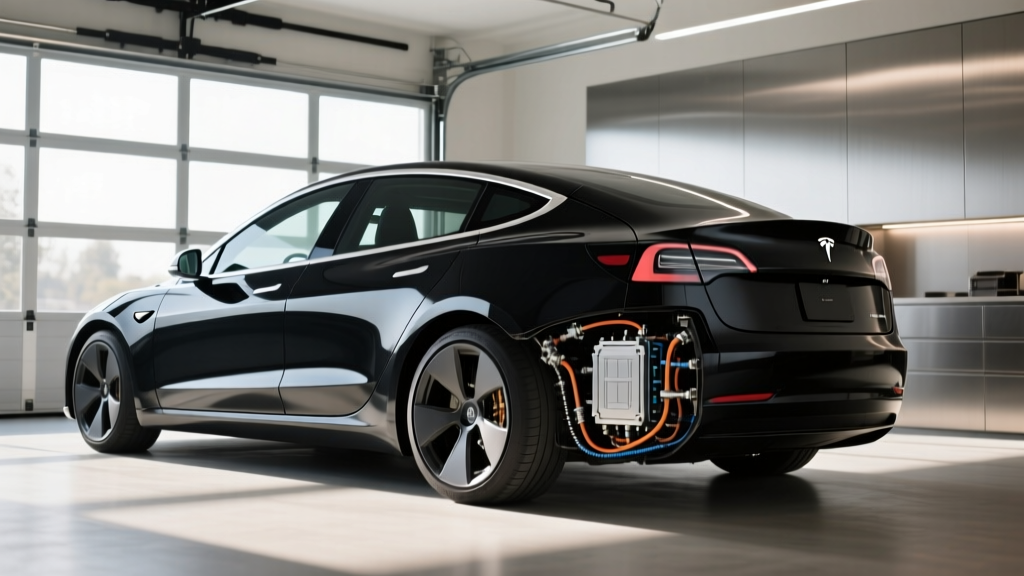
Search for "Tesla Model 3 engine" and you'll find thousands of queries from shoppers transitioning from gas cars. The short answer: the Model 3 has no engine at all. No pistons, no spark plugs, no combustion. Instead, it uses one or two electric motors powered by a high-voltage lithium-ion battery pack. Understanding what replaces the engine — and how that changes ownership — is the key to deciding if a Model 3 fits your life.
For 2026, Tesla sells the Model 3 in three trims: Rear-Wheel Drive, Long Range All-Wheel Drive, and Performance. Each pairs a different motor configuration with a different battery chemistry and capacity. Below, we translate the spec sheet into real-world ownership reality — range you can count on, charging speeds you'll actually see, and the total price after federal incentives.
| Spec | RWD | Long Range AWD | Performance |
|---|---|---|---|
| Motor Config | Single rear (permanent magnet) | Dual (induction front + PM rear) | Dual (induction front + PM rear) |
| Horsepower | 271 hp | 346 hp | 510 hp |
| 0–60 mph | 5.8 sec | 4.2 sec | 2.9 sec |
| Battery (usable) | ~57.5 kWh (LFP) | ~75 kWh (NMC) | ~75 kWh (NMC) |
| EPA Range | 272 mi | 341 mi | 315 mi |
| MPGe (combined) | 132 MPGe | 134 MPGe | 125 MPGe |
| Efficiency | 25 kWh/100mi | 25 kWh/100mi | 27 kWh/100mi |
| Max DC Charge | 170 kW | 250 kW | 250 kW |
| 10–80% DC Time | ~25 min | ~25 min | ~25 min |
| Level 2 Rate | 11.5 kW (~44 mi/hr) | 11.5 kW (~44 mi/hr) | 11.5 kW (~44 mi/hr) |
| Drivetrain | RWD | AWD | AWD |
| Base MSRP | $38,990 | $47,740 | $54,990 |
Electric Motors vs. a Gas Engine: What Changes
An internal-combustion engine converts chemical energy (gasoline) into rotational force through thousands of controlled explosions per minute. The Model 3's electric motors do the same job using electromagnetism — a rotor spinning inside a stator, driven by alternating current from the inverter. The result is instant torque from 0 RPM, no multi-speed transmission, no exhaust system, and roughly 90%+ drivetrain efficiency versus ~30% for a gas engine.
The RWD Model 3 uses a single permanent-magnet synchronous reluctance motor on the rear axle. The Long Range and Performance add a second induction motor on the front axle, enabling all-wheel drive. The front induction motor can freewheel (disconnect) when not needed, reducing drag and boosting highway efficiency — a trick gas AWD systems can't easily replicate.
For owners, the practical differences from an engine are stark: no oil changes, no timing belts, no catalytic converters, no emissions tests. Regenerative braking recaptures energy on deceleration, extending range and reducing brake-pad wear. The tradeoff is that all your energy comes from one source — the battery — so range and charging access replace MPG and gas-station proximity as your primary concerns.
Real-World Range: What the EPA Number Doesn't Tell You
- EPA sticker: 341 miles
- 70-mph highway loop: ~290–310 miles (10–15% reduction)
- Cold weather (20°F) highway: ~230–260 miles (25–30% reduction)
- Mixed city/highway, mild weather: ~320–340 miles (close to sticker)
Source: fueleconomy.gov
EPA range tests weight city and highway driving, with mild climate control. Highway-only driving at 75+ mph pushes more air and raises consumption, typically shaving 10–15% off the sticker. Cold is the bigger enemy: lithium-ion chemistry slows, cabin heating draws 2–5 kW continuously, and the battery's usable window shrinks. The Model 3's standard heat pump recovers waste heat from the motors and battery, partially offsetting this — but expect a 25–30% hit on sub-freezing highway trips regardless.
The RWD trim's LFP battery tolerates 100% daily charging (unlike NMC, which Tesla recommends keeping at 80% for daily use), effectively narrowing the usable-range gap vs. Long Range for commuters who can charge nightly.
Charging Speed: DC Fast, Level 2, and the Curve That Matters
Peak kilowatt numbers grab headlines, but sustained charging speed — the area under the charge curve — determines how long you actually sit at a Supercharger. The Model 3 Long Range and Performance peak at 250 kW on V3/V4 Superchargers, but only between roughly 10–30% state of charge. Above 50%, the rate tapers to ~120 kW; above 80%, it drops below 50 kW as the battery management system protects cell longevity.
| Source | Power (kW) | Miles Added per Hour | Notes |
|---|---|---|---|
| 120V Level 1 (std outlet) | ~1.4 kW | ~3–5 mi/hr | Emergency/top-up only |
| 240V Level 2 (home Wall Connector) | 11.5 kW | ~44 mi/hr | Full charge overnight |
| 240V Level 2 (Mobile Connector, 14-50) | 7.7 kW | ~30 mi/hr | No hardwired install needed |
| DC Fast (V3 Supercharger) | Up to 250 kW | ~1,000 mi/hr peak | 10–80% in ~25 min (LR/Perf) |
| DC Fast (RWD on V3) | Up to 170 kW | ~680 mi/hr peak | 10–80% in ~25 min |
For home charging, preconditioning isn't necessary — the car manages it. But always precondition before a DC fast stop (the nav routes through a Supercharger automatically warm the pack). Skipping preconditioning on a cold pack can cut peak charge rate by 50% or more.
Interior, Cargo, and Daily Livability
The "Highland" refresh (introduced for the 2024 model year and carried into 2026) added ventilated front seats, ambient lighting, a rear touchscreen, and significantly improved cabin insulation. At 112.8 inches of wheelbase, the Model 3 delivers 42.3 inches of front legroom and 35.3 inches rear — adequate for adults on short trips, tight for long highway hauls with tall passengers.
Cargo volume is 23 cubic feet (trunk + frunk combined). The trunk opening is narrower than a Model Y's liftgate, so bulky items like bikes require seat-folding. There's no towing rating — Tesla does not recommend towing with the Model 3, unlike the Model Y (3,500 lb capacity).
Pricing, Trims, and Federal Tax Credit Reality
The Model 3 qualifies for the IRS §30D federal tax credit — but only if you, your income, and the vehicle all clear specific thresholds. The credit is now transferable at point of sale, reducing your dealer price directly rather than waiting for a tax refund.
| Trim | Base MSRP | Max §30D Credit | Effective Price* |
|---|---|---|---|
| RWD | $38,990 | Up to $7,500 | ~$31,490 |
| Long Range AWD | $47,740 | Up to $7,500 | ~$40,240 |
| Performance | $54,990 | Up to $7,500 | ~$47,490 |
*Assumes full credit eligibility. MSRP caps: sedans must be ≤$55,000. Income caps: $150k single / $300k joint MAGI. Battery sourcing and critical-mineral rules apply. Verify on fueleconomy.gov before purchase.
For 2026, all three trims fall under the $55,000 sedan MSRP cap. The Performance at $54,990 squeaks under — but adding any paid paint, FSD, or wheels will push it over and kill eligibility. Choose accessories carefully.
Warranty, Battery Longevity, and Ownership Costs
Tesla covers the Model 3 with a 4-year/50,000-mile basic warranty and an 8-year/100,000-mile battery and drive-unit warranty (120,000 miles for Long Range and Performance). The warranty guarantees the battery retains at least 70% of original capacity during the term. Real-world degradation data from fleet aggregators shows most Model 3 packs lose 8–12% capacity over the first 100,000 miles, with the curve flattening afterward.
LFP packs (RWD) generally show slower long-term degradation and tolerate frequent 100% charges. NMC packs (Long Range, Performance) offer higher energy density and faster charging but age slightly faster if routinely charged to 100% or exposed to extreme heat. Insurance premiums run 15–25% higher than comparable gas sedans — get quotes before committing.
Autopilot, FSD, and What the Tech Actually Does
Every Model 3 ships with Basic Autopilot (lane centering + adaptive cruise) and automatic emergency braking. Enhanced Autopilot ($6,000) adds auto lane-change, Navigate on Autopilot, and Smart Summon. Full Self-Driving (Supervised) adds traffic-light/stop-sign recognition and city-street autosteer.
FSD's 2026 v13 stack is impressively smooth on highways and competent in suburban traffic, but still disengages unpredictably in construction zones and unmapped areas. Treat it as fatigue-reduction, not autonomy.
Pros, Cons, and Who Should Buy It
- Best-in-class efficiency (25 kWh/100mi)
- Access to Tesla Supercharger network (17,000+ NA stalls)
- Class-leading DC fast-charge curve on LR/Perf
- Over-the-air updates add features post-purchase
- Point-of-sale tax credit reduces out-of-pocket
- No physical stalks (turn signals on steering wheel)
- Rear visibility limited; no rear wiper
- No towing capacity
- Repair costs and insurance above segment average
- Minimalist interior polarizes — no instrument cluster
Best for: Solo commuters, couples, and tech-forward buyers who prioritize efficiency, charging-network reliability, and performance per dollar. Skip it if: you need family-scale cargo room (get a Model Y), tow regularly (F-150 Lightning, Rivian R1T), or prefer physical controls (Hyundai Ioniq 6, BMW i4).
Frequently Asked Questions
Does the Tesla Model 3 have an engine?
No. The Model 3 uses one or two electric motors — a permanent-magnet motor on the rear axle, plus an induction motor on the front axle for AWD trims. There is no combustion, no fuel tank, and no exhaust.
What's the real-world range of a 2026 Model 3?
The Long Range AWD stickers at 341 EPA miles; expect ~290–310 on a 70-mph highway trip in mild weather, and ~230–260 in 20°F cold. The RWD's 272 EPA miles translates to roughly 230 highway, less in winter.
How fast does the Model 3 charge at home?
On a 240V/48A Tesla Wall Connector, all trims accept 11.5 kW, adding about 44 miles of range per hour — enough for a full overnight charge from near-empty.
Does the 2026 Model 3 qualify for the $7,500 federal tax credit?
All three trims fall under the $55,000 sedan MSRP cap. You must also meet income limits ($150k single / $300k joint), and the vehicle must satisfy battery-sourcing requirements. Confirm current eligibility on fueleconomy.gov and consult a tax professional before relying on the credit.
Is the Model 3 worth it versus the Hyundai Ioniq 6 or BMW i4?
The Model 3 wins on charging-network access (Supercharger reliability), efficiency, and performance-per-dollar. The Ioniq 6 offers a more traditional interior and 800V architecture for fast CCS/NACS charging; the BMW i4 delivers premium materials and a quieter cabin at a higher price. Test-drive all three — controls and seating position decide most buyers.
How long will the Model 3 battery last?
Tesla warranties the pack for 8 years / 100,000–120,000 miles at 70%+ capacity retention. Fleet data suggests 8–12% degradation at 100k miles, with many packs exceeding 200,000 miles before approaching the warranty threshold. A full pack replacement currently runs $12,000–$16,000 out of warranty.