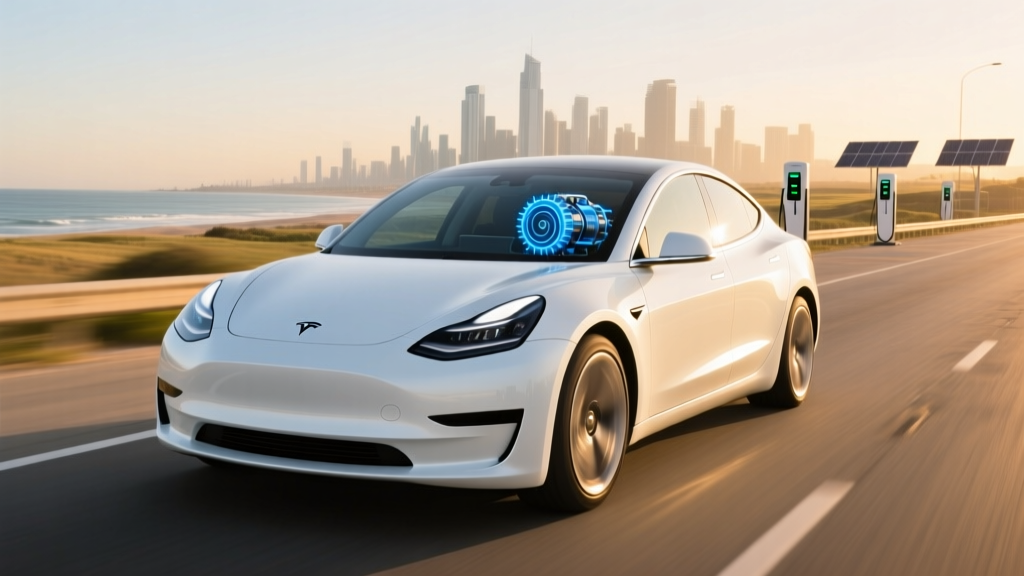
The phrase electromagnetic motor Tesla has become a top search for buyers trying to understand what actually spins the wheels of the company's most popular sedan. Unlike internal-combustion engines that rely on controlled explosions, Tesla's drive units use precisely timed electromagnetic fields to generate instant torque — no spark plugs, no multi-speed transmission, and no exhaust. In the 2026 Model 3, that technology has been refined across two distinct powertrains: a rear-wheel-drive (RWD) permanent-magnet synchronous reluctance motor and a dual-motor all-wheel-drive (AWD) setup pairing a permanent-magnet rear with an induction front unit.
This review breaks down the 2026 Tesla Model 3 lineup with exact EPA figures, charging data, real-world ownership realities, and current federal tax-credit rules — everything a research-heavy buyer needs before signing a purchase agreement.
2026 Tesla Model 3 Spec Sheet at a Glance
| Specification | Model 3 RWD (Long Range) | Model 3 Long Range AWD | Model 3 Performance AWD |
|---|---|---|---|
| EPA Range | 363 mi | 341 mi | 315 mi |
| Battery (usable) | ~75 kWh (LFP) | ~75 kWh (NMC) | ~75 kWh (NMC) |
| Motor Type | PMaSynRM (rear) | PM rear + induction front | PM rear + induction front |
| Horsepower | 271 hp | 346 hp | 510 hp |
| 0-60 mph | 5.8 sec | 4.2 sec | 2.9 sec |
| Drivetrain | RWD | AWD (dual motor) | AWD (dual motor) |
| MPGe (combined) | 132 MPGe | 125 MPGe | 116 MPGe |
| Efficiency (kWh/100 mi) | 25 kWh | 27 kWh | 29 kWh |
| Max DC Fast Charge | 170 kW | 250 kW | 250 kW |
| 10-80% DCFC Time | ~30 min | ~25 min | ~25 min |
| Level 2 Home Charge | 11.5 kW (~44 mi/hr) | 11.5 kW (~44 mi/hr) | 11.5 kW (~44 mi/hr) |
| Cargo Volume | 23 cu ft (trunk + frunk combined) | ||
| Base MSRP (incl. dest.) | $38,990 | $42,490 | $50,990 |
| Battery / Drive Unit Warranty | 8 yr / 100,000 mi | 8 yr / 120,000 mi | |
Electromagnetic Motor Technology Explained
Tesla uses two motor architectures across the Model 3 lineup, and understanding the difference matters for efficiency, range, and long-term maintenance expectations.
Permanent-Magnet Synchronous Reluctance Motor (PMaSynRM): Found in the RWD Long Range, this motor embeds rare-earth permanent magnets in the rotor while also exploiting reluctance torque — the tendency of a ferromagnetic rotor to align with the stator's rotating magnetic field. The result is a motor that operates at over 95% peak efficiency and delivers strong torque from zero RPM without needing a multi-speed gearbox. Tesla transitioned away from pure induction motors on its base trims years ago because PMaSynRM units extract more range per kWh of battery, a critical advantage for the entry-level model.
Dual-Motor AWD (PMaSynRM Rear + Induction Front): The Long Range AWD and Performance trims pair a permanent-magnet motor at the rear axle with an induction (asynchronous) motor up front. The front induction motor can be completely de-energized during steady-state cruising — producing zero drag — then instantly activated for regenerative braking, traction intervention, or hard acceleration. This dual-chemistry approach is why the AWD trims sacrifice relatively little range despite carrying an extra motor and driveshaft.
Neither motor type requires oil changes, timing-belt replacements, or emission-system service. The only wear items in the drive unit are bearings, which Tesla rates for the life of the vehicle under normal operating conditions.
Range: EPA Numbers vs. Real-World Driving
EPA Sticker: 363 mi (RWD) / 341 mi (LR AWD) / 315 mi (Performance)
Real-World Expectation: Plan for 280–320 mi on highway road trips at 70–75 mph. In sustained sub-30°F winter conditions, expect 20–30% range reduction (roughly 250–290 mi for the RWD, depending on cabin heat usage and whether you precondition). City driving with regenerative braking can match or slightly exceed the EPA number thanks to frequent energy recapture.
Tesla's thermal management system — which includes a heat pump standard on all 2026 Model 3 trims — significantly reduces cold-weather range loss compared to resistive heater systems used by some competitors. Preconditioning the battery while still plugged in (a feature enabled through the Tesla app's scheduled departure function) warms the pack and cabin using grid power, preserving the full battery for driving.
For context, EPA data on fueleconomy.gov confirms the RWD Model 3 achieves 132 MPGe combined, translating to 25 kWh per 100 miles — among the most efficient sedans in its class.
Charging Speed: DC Fast, Level 2, and Level 1
Charging speed is where the electromagnetic motor's efficiency pairs with Tesla's battery-management software to deliver class-leading replenishment times. Here's the full breakdown:
| Charging Level | Power / Voltage | Miles Added per Hour | Notes |
|---|---|---|---|
| Level 1 (120V household) | ~1.4 kW | ~4-5 mi/hr | Emergency / overnight trickle only |
| Level 2 (240V home wall connector) | 11.5 kW | ~44 mi/hr | Full charge overnight (~8 hours) |
| DC Fast (V3 Supercharger, RWD) | 170 kW peak | ~170 mi in 15 min | Tapers above 60% SoC |
| DC Fast (V3/V4 Supercharger, AWD) | 250 kW peak | ~200 mi in 15 min | 10-80% in ~25 min |
Charge-curve reality check: The 250 kW peak rate on AWD trims is not sustained for the entire session. Charging holds near peak power from roughly 10–40% state of charge (SoC), then progressively tapers. By 80%, the rate drops to approximately 50–60 kW. This is why Tesla and most EV manufacturers quote 10–80% times rather than 0–100% — the final 20% can take as long as the first 70%. For road-trip planning, budget 25–30 minutes per stop on a Supercharger for the AWD trims, and 30–35 minutes for the RWD.
Tesla's NACS (North American Charging Standard) connector is now the dominant plug in North America, with Ford, GM, Rivian, and others adopting it. Model 3 owners benefit from seamless plug-and-charge access to over 20,000 Supercharger stalls nationwide, plus growing third-party NACS networks.
Performance and Drivetrain
The electromagnetic motor's defining characteristic is instant torque — maximum rotational force from 0 RPM, with no turbo lag, transmission shift delay, or rev-building. This translates to acceleration that feels effortless even in the base RWD trim.
The Model 3 RWD (271 hp) hits 60 mph in 5.8 seconds — quicker than most turbocharged four-cylinder sport sedans. The Long Range AWD (346 hp) drops that to 4.2 seconds, while the Performance AWD (510 hp) reaches 60 in a supercar-rivaling 2.9 seconds, aided by Tesla's updated adaptive dampers, track-ready brake cooling, and a dedicated Track Mode that adjusts torque split and regen behavior.
All trims feature one-pedal driving through aggressive regenerative braking, which recaptures kinetic energy back into the battery and significantly reduces friction-brake wear. Many Tesla owners report original brake pads lasting 80,000+ miles because regen handles most deceleration duties.
Pricing, Trim Levels, and Federal Tax Credit
| Trim | Base MSRP (incl. dest.) | Est. Price After §30D Credit* | As-Tested (common config.) |
|---|---|---|---|
| RWD (Long Range) | $38,990 | $31,490 | ~$41,500 (w/ paint + FSD) |
| Long Range AWD | $42,490 | $34,990 | ~$45,800 (w/ wheels + interior) |
| Performance AWD | $50,990 | $43,490 | ~$54,200 (w/ Ultra Red + FSD) |
*Federal tax-credit estimates assume full §30D eligibility. Actual credit depends on your individual tax situation.
IRS §30D Federal EV Tax Credit Requirements (2026):
- MSRP Cap: Sedans must have an MSRP at or below $55,000. The RWD and LR AWD qualify; the Performance ($50,990) qualifies, but adding options that push total MSRP above $55,000 may disqualify it.
- Buyer Income Caps: Modified AGI must not exceed $150,000 (single), $225,000 (head of household), or $300,000 (married filing jointly).
- Battery Sourcing: A percentage of critical minerals and battery components must be sourced from the U.S. or free-trade-agreement partners. Tesla's supply chain has progressively met increasing thresholds, but eligibility can shift mid-year as requirements tighten annually. Verify current sourcing compliance on IRS.gov's qualified vehicle list.
- Point-of-Sale Transfer: You can transfer the credit to the dealer (Tesla) at purchase, reducing your out-of-pocket cost directly rather than waiting for a tax refund.
Consult a tax professional for your specific situation — credit eligibility depends on individual income, vehicle configuration, and current sourcing rules that the IRS updates periodically.
Interior, Cargo, and Technology
The 2026 Model 3 (internally called "Highland" from its 2024 refresh) carries forward a minimalist cabin dominated by a 15.4-inch center touchscreen. Physical stalks have been eliminated; turn signals live on the steering wheel, and gear selection is handled via the touchscreen or a backup capacitive strip on the overhead console.
Dimensions:
- Front legroom: 42.7 inches
- Rear legroom: 35.2 inches (adequate for adults on shorter trips, tight for tall passengers on long hauls)
- Trunk: 21 cu ft (rear cargo)
- Frunk (front trunk): 2 cu ft (useful for charging cables and small bags)
- Total cargo: 23 cu ft
Tech highlights:
- Tesla's infotainment OS with streaming, gaming, and Dashcam/Sentry Mode recording
- Standard Basic Autopilot (SAE Level 2): adaptive cruise + lane-centering on marked highways
- Optional FSD (Supervised): automated lane changes, off-ramp navigation, traffic-light recognition — still requires full driver attention and hands-on-wheel confirmation
- Ventilated front seats, ambient lighting, and power-folding mirrors (added in the Highland refresh)
- 17-speaker premium audio on AWD trims
Notable drawbacks: The stalkless steering wheel and touchscreen-only gear selector continue to polarize owners. Rear-seat visibility is compromised by the sloping roofline. There is no Apple CarPlay or Android Auto — Tesla's native system is the only option. Panel gap quality, while improved from pre-2024 production, still occasionally falls short of German luxury benchmarks.
Ownership Costs, Warranty, and Who Should Buy
Tesla covers the Model 3 with a 5-year/60,000-mile basic warranty and an 8-year battery and drive-unit warranty — 100,000 miles on the RWD, 120,000 miles on AWD trims. The battery warranty guarantees at least 70% capacity retention over the warranty period. Real-world degradation data from fleet analyses suggests most Model 3 packs retain 88–92% capacity at 100,000 miles, with the curve flattening significantly after the initial 20,000-mile break-in loss.
Who the 2026 Model 3 suits best:
- Daily commuters: The RWD at 363 miles EPA handles week-long stretches between charges for most commutes. Home Level 2 charging makes ownership nearly effortless.
- Tech-forward buyers: Tesla's software ecosystem, Supercharger network integration, and over-the-air updates remain best-in-class.
- Performance seekers: The Performance AWD offers sports-car acceleration in a four-door sedan at a fraction of the cost of a Porsche Taycan or BMW i4 M50.
Who should look elsewhere:
- Large families: The Model 3's rear seat and cargo space are tight. The Model Y crossover offers substantially more room for a modest price increase.
- Frequent road-trippers in charging deserts: While the Supercharger network is extensive, rural routes in the Mountain West and parts of the Southeast still have sparse DC fast-charging coverage compared to urban corridors.
- Buyers who prefer physical controls: If stalks, buttons, and CarPlay are non-negotiable, the Hyundai Ioniq 6 or BMW i4 may feel more intuitive.
Pros and Cons
Pros
- Class-leading efficiency: 132 MPGe combined (RWD)
- 250 kW DC fast charging on AWD trims (10-80% in ~25 min)
- Supercharger network: 20,000+ stalls with seamless plug-and-charge
- Instant electromagnetic motor torque: 2.9-sec 0-60 on Performance
- Heat pump standard — superior cold-weather range retention
- Over-the-air updates continuously add features
- Strong resale value relative to most EV competitors
Cons
- Stalkless steering wheel and touchscreen gear selector require adaptation
- No Apple CarPlay or Android Auto
- Rear seat legroom (35.2 in) trails midsize sedan competitors
- RWD trim limited to 170 kW peak DC charging
- FSD (Supervised) remains a $8,000 option and still requires full driver attention
- Insurance premiums 15–25% above comparable gas sedans in most states
Frequently Asked Questions
What is the real-world range of the 2026 Tesla Model 3?
The EPA rates the RWD at 363 miles, the Long Range AWD at 341 miles, and the Performance at 315 miles. In real-world highway driving at 70–75 mph, expect 280–320 miles depending on temperature, elevation, and driving style. In sub-freezing winter conditions, plan for 20–30% less range unless you precondition the battery while plugged in.
How fast does the Model 3 charge at home and on road trips?
On a home Level 2 Tesla Wall Connector (11.5 kW / 48A), the Model 3 gains approximately 44 miles of range per hour, fully replenishing overnight. On a V3 or V4 Supercharger, the AWD trims peak at 250 kW and charge from 10–80% in about 25 minutes. The RWD peaks at 170 kW, requiring roughly 30 minutes for the same session.
Does the 2026 Model 3 qualify for the $7,500 federal EV tax credit?
It can, but eligibility depends on your income, the vehicle's MSRP (must be ≤ $55,000 for sedans), and battery-sourcing compliance per IRS §30D rules. The RWD and LR AWD base MSRPs fall under the cap. The Performance qualifies at its $50,990 base but may exceed the cap with options. Buyer income must not exceed $150K (single) / $300K (joint). The credit can be transferred at point of sale to reduce your purchase price directly.
Is the Tesla Model 3 worth buying vs. the Hyundai Ioniq 6 or BMW i4?
The Model 3 wins on charging infrastructure (Supercharger access), efficiency (132 vs. 140 MPGe for the Ioniq 6), and software integration. The Ioniq 6 offers more rear-seat space and physical controls. The BMW i4 provides a more traditional luxury interior with CarPlay but charges slower and costs significantly more. If Supercharger reliability and range efficiency are your top priorities, the Model 3 remains the benchmark.
How long will the Tesla Model 3's electromagnetic motor last?
Electric motors have far fewer moving parts than internal-combustion engines — no pistons, valves, timing chains, or oil pumps. Tesla's drive units are designed for the life of the vehicle. The battery is warranted for 8 years / 100,000–120,000 miles (depending on trim) at ≥70% capacity retention. Real-world fleet data shows most packs retaining around 90% capacity at 100,000 miles. Full battery replacement, if ever needed outside warranty, currently costs approximately $12,000–$16,000 at a Tesla service center.
Is Tesla's Autopilot or FSD self-driving?
No. Both Basic Autopilot and FSD (Supervised) are SAE Level 2 driver-assistance systems, meaning the driver must remain fully attentive, keep hands on the wheel, and be prepared to take over instantly. They do not make the Model 3 a self-driving car. Only Level 4 services like Waymo's robotaxi operate without a human driver — and those are geofenced to specific metro areas.