Quick Verdict: Tesla's Motor Advantage in 2026
The Tesla electric motor remains one of the most efficient drivetrains in the EV industry, converting battery energy into motion with minimal waste. In the 2026 Tesla Model 3 Long Range AWD, a dual-motor setup produces 346 horsepower while achieving an EPA-estimated 341 miles of range — a combination few competitors match at the ~$42,000 price point. Whether you're evaluating the base Rear-Wheel Drive or the performance-oriented Long Range, understanding how Tesla's motor architecture affects your daily driving, charging times, and electricity bill is essential before signing a purchase agreement.
EPA Estimate: 341 miles (Long Range AWD) | 272 miles (Rear-Wheel Drive)
Expect in practice: ~280–310 miles on mixed highway driving at 70 mph; ~220–250 miles in sub-30°F winter conditions with cabin heating. The Model 3's heat pump helps mitigate cold-weather losses compared to resistive heating systems, but plan for a 15–25% range reduction in freezing temperatures.
2026 Tesla Model 3 Specifications at a Glance
| Spec | Rear-Wheel Drive | Long Range AWD |
|---|---|---|
| EPA Range | 272 miles | 341 miles |
| Battery (usable) | ~57.5 kWh (LFP) | ~75 kWh (NMC) |
| Drivetrain | Single motor RWD | Dual motor AWD |
| Horsepower | 271 HP | 346 HP |
| 0–60 mph | 5.8 sec | 4.2 sec |
| Max DC Fast Charge | 170 kW | 250 kW |
| 10–80% DC Time | ~28 min | ~22 min |
| Level 2 Home Charge | 11.5 kW (~44 mi/hr) | 11.5 kW (~44 mi/hr) |
| MPGe (combined) | 132 MPGe | 130 MPGe |
| Efficiency | 25 kWh/100 mi | 26 kWh/100 mi |
| Base MSRP | $38,990 | $42,490 |
Sources: fueleconomy.gov, Tesla.com official specifications (2026 model year).
Tesla Electric Motor Architecture: Why Efficiency Matters
Tesla's electric motor lineup uses a combination of permanent magnet synchronous reluctance motors (on the rear axle) and induction motors (on the front axle of dual-motor variants). This pairing is deliberate: the permanent magnet motor delivers high efficiency during steady-state cruising, while the front induction motor can disconnect entirely when not needed, eliminating parasitic drag.
The result is an energy consumption figure of 25–26 kWh per 100 miles — meaning the Model 3 extracts more miles from each kilowatt-hour than nearly every EV in its class. For context, that's roughly 4 miles per kWh, compared to 3.0–3.5 mi/kWh from many competing sedans. Over a year of driving 12,000 miles, that efficiency gap translates to roughly $60–$100 in electricity savings, depending on your local rate.
The single-motor RWD model uses a single permanent magnet motor producing 271 HP. The Long Range AWD adds a front induction motor, pushing combined output to 346 HP while maintaining all-weather traction. Both setups route power through a single-speed reduction gear — no multi-speed transmission, no shifting, just instant torque from zero RPM.
Charging Speed: DC Fast Charging and Home Setup
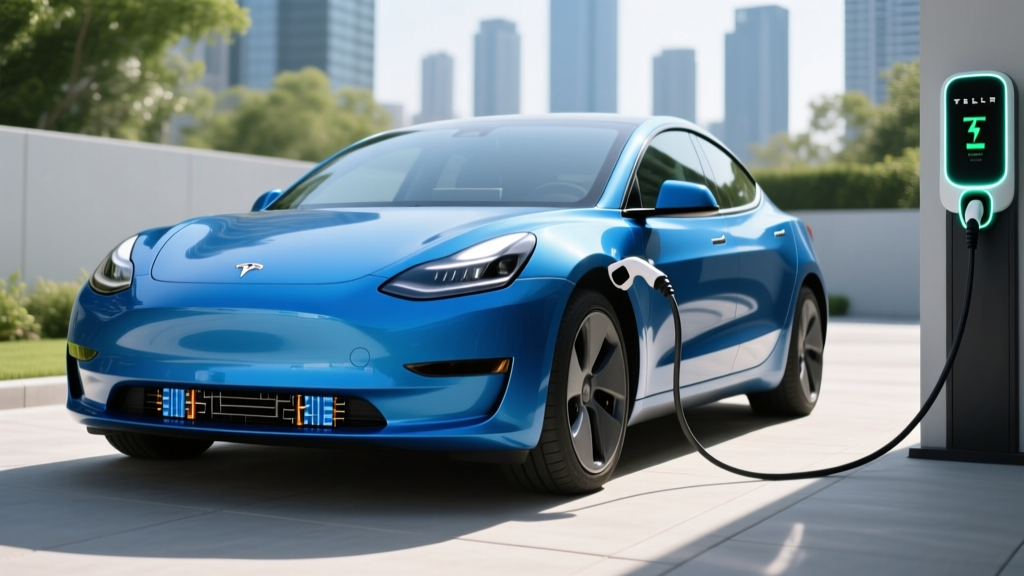
Charging speed is where the Tesla electric motor system pairs with battery thermal management to deliver class-leading results. The Long Range AWD supports up to 250 kW peak DC fast charging at V4 Superchargers, though sustained rates taper after 50% State of Charge.
| Charging Level | Power | Speed (mi/hr added) | Best Use Case |
|---|---|---|---|
| Level 1 (120V) | ~1.4 kW | ~5 mi/hr | Emergency/overnight trickle |
| Level 2 (240V home) | 11.5 kW | ~44 mi/hr | Daily overnight charging |
| DC Fast (Supercharger) | Up to 250 kW | ~1,000+ mi/hr peak | Road trips, quick top-ups |
Charging curve reality: The 250 kW peak on the Long Range holds from roughly 10% to 35% SoC, then steps down to ~150 kW through 60%, and further to ~75 kW above 80%. A 10–80% session takes approximately 22 minutes at a V3/V4 Supercharger. The RWD model with its LFP battery peaks at 170 kW and takes about 28 minutes for the same 10–80% window.
Pro tip: Enable battery preconditioning in the navigation system when routing to a Supercharger. The car will warm the battery to optimal temperature before arrival, which can shave 5–8 minutes off your charging session in cold weather.
Interior Space, Cargo, and Daily Practicality
The 2026 Model 3 "Highland" refresh improved cabin materials and noise isolation significantly over pre-2024 versions. Passenger space remains generous for a compact sedan:
- Front legroom: 42.7 inches
- Rear legroom: 35.2 inches
- Cargo (trunk): 21.0 cu ft
- Frunk (front trunk): 3.1 cu ft
- Total cargo: 24.1 cu ft
The trunk features a wide opening and deep well, easily swallowing two large suitcases plus a stroller. The frunk is best suited for charging cables and a small bag. Rear seat headroom is adequate for passengers under 6'2", though the sloping roofline cuts into space for taller occupants.
Pricing, Trim Levels, and Federal Tax Credit
The 2026 Model 3 is available in two primary trims, with the Performance variant appearing intermittently:
| Trim | Base MSRP | Est. After §30D Credit | Credit Eligibility |
|---|---|---|---|
| Rear-Wheel Drive | $38,990 | ~$31,490 | Partial — sourcing dependent |
| Long Range AWD | $42,490 | ~$34,990 | Partial — sourcing dependent |
- Income caps: AGI must not exceed $150,000 (single), $225,000 (head of household), or $300,000 (joint).
- MSRP cap: Vehicle must be under $55,000 (sedans). Both Model 3 trims qualify.
- Battery sourcing: Critical mineral and battery component requirements phase in annually. Tesla's shifting supply chains mean credit amounts can be $0, $3,750, or $7,500 depending on the build month. Always verify current eligibility on IRS.gov or via the dealer's point-of-sale transfer system before purchase.
- Point-of-sale transfer: You can apply the credit as an immediate price reduction at purchase rather than waiting for tax filing.
Tech, Driver Assistance, and Standout Features
The Model 3's 15.4-inch center touchscreen handles all vehicle controls — there are no physical buttons for climate, mirrors, or glovebox. This minimalist approach polarizes buyers, but the interface is responsive and well-organized once learned.
Standard tech includes:
- Wireless phone charging (two pads)
- Ventilated front seats (Highland refresh)
- Ambient lighting with customizable colors
- 8-camera vision system for Autopilot
- Over-the-air software updates
- Native navigation with real-time Supercharger routing
Tesla's Autopilot (standard) and Full Self-Driving Supervised ($8,000 option or $99/mo subscription) are SAE Level 2 driver-assistance systems. You must keep your hands on the wheel and eyes on the road at all times. The car does not drive itself. Only Level 4 services like Waymo operate without a human driver in defined areas.
Notable drawbacks:
- No Apple CarPlay or Android Auto — Tesla's native system only
- Turn signal stalks removed (buttons on steering wheel) — a learning curve
- Rear visibility is limited by the sloped rear glass; relies heavily on backup camera
- FSD remains a Level 2 system despite its name and price
Pros and Cons: 2026 Tesla Model 3
- Class-leading efficiency (25–26 kWh/100 mi)
- Supercharger network access — most reliable DC network in the US
- 341-mile EPA range (Long Range) covers most road trips with one stop
- Instant torque and smooth acceleration from Tesla electric motor
- Regular OTA updates add features post-purchase
- Strong resale value relative to EV segment average
- No Apple CarPlay / Android Auto
- Turn signal buttons (no stalk) frustrate many drivers
- FSD is expensive ($8,000) and still requires full driver supervision
- LFP battery (RWD) has slower DC charging and reduced cold-weather range
- Insurance premiums run 15–30% higher than comparable gas sedans
- Minimalist interior isn't for everyone
Warranty Coverage
Tesla provides competitive warranty coverage, particularly for the battery and drive units:
- Basic vehicle: 4 years / 50,000 miles
- Battery & drive unit (RWD): 8 years / 100,000 miles
- Battery & drive unit (Long Range AWD): 8 years / 120,000 miles
- Capacity retention threshold: 70% minimum over the warranty period
In practice, Tesla battery degradation data from fleet studies shows most Model 3 batteries retain 88–92% capacity at 100,000 miles. The LFP chemistry in the RWD model tends to degrade even more slowly than NMC, though it trades off energy density and cold-weather performance.
Who Should Buy the 2026 Tesla Model 3?
- Choose the RWD ($38,990) if: You commute under 40 miles daily, have reliable home Level 2 charging, live in a mild climate, and want the lowest entry price with LFP battery longevity.
- Choose the Long Range AWD ($42,490) if: You take regular road trips over 200 miles, need all-wheel drive for snow/ice, experience cold winters, or want the fastest DC charging Tesla offers.
- Look elsewhere if: You require Apple CarPlay, prefer physical buttons and stalks, need a hatchback/SUV for cargo versatility, or want a true hands-free driving system (consider GM Super Cruise on approved highways).
Frequently Asked Questions
What is the real-world range of the Tesla Model 3?
The Long Range AWD achieves an EPA-estimated 341 miles, but expect 280–310 miles in real-world highway driving at 70 mph and 220–250 miles in freezing temperatures. The RWD model's 272-mile EPA rating drops to roughly 220–240 miles on the highway and 180–200 miles in deep cold.
How fast does the Model 3 charge at home and on the road?
At home on a 240V Level 2 charger (11.5 kW), the Model 3 adds roughly 44 miles of range per hour — a full overnight session easily replenishes a day's driving. On DC fast chargers, the Long Range peaks at 250 kW (10–80% in ~22 min) and the RWD at 170 kW (10–80% in ~28 min).
Does the 2026 Tesla Model 3 qualify for the federal EV tax credit?
Both trims fall under the $55,000 MSRP cap for sedans. However, the actual credit amount ($0, $3,750, or $7,500) depends on battery component and critical mineral sourcing requirements that change periodically. Your personal AGI must also be under IRS income caps. Verify current eligibility at IRS.gov before purchasing.
Is the Tesla Model 3 worth buying vs. competitors?
Against the Hyundai Ioniq 6 (361-mile range, slower charging, no Supercharger access) and BMW i4 (premium interior, higher price, lower range), the Model 3 Long Range offers the best combination of range, charging speed, and Supercharger network reliability. If interior luxury or CarPlay matters more, the BMW i4 or Hyundai Ioniq 6 are strong alternatives.
How long will the Tesla electric motor and battery last?
Tesla's electric motors have few moving parts and rarely require replacement. The battery is warranted for 8 years / 100,000–120,000 miles (depending on trim) with a 70% capacity retention floor. Fleet data suggests most Model 3 batteries will deliver 200,000+ miles before approaching that threshold. A full battery replacement out of warranty currently runs $12,000–$16,000 at a Tesla service center.
What's the difference between LFP and NMC batteries in the Model 3?
The RWD model uses an LFP (lithium iron phosphate) battery — heavier and less energy-dense, but longer-lasting, safer in thermal runaway scenarios, and recommended for daily 100% charging. The Long Range uses NMC (nickel manganese cobalt) — lighter, more energy-dense for longer range, but Tesla recommends charging to 80% daily and only 100% before road trips.
Always confirm final specifications, pricing, and tax credit eligibility with Tesla directly and fueleconomy.gov before purchase, as details can shift between model-year production runs.